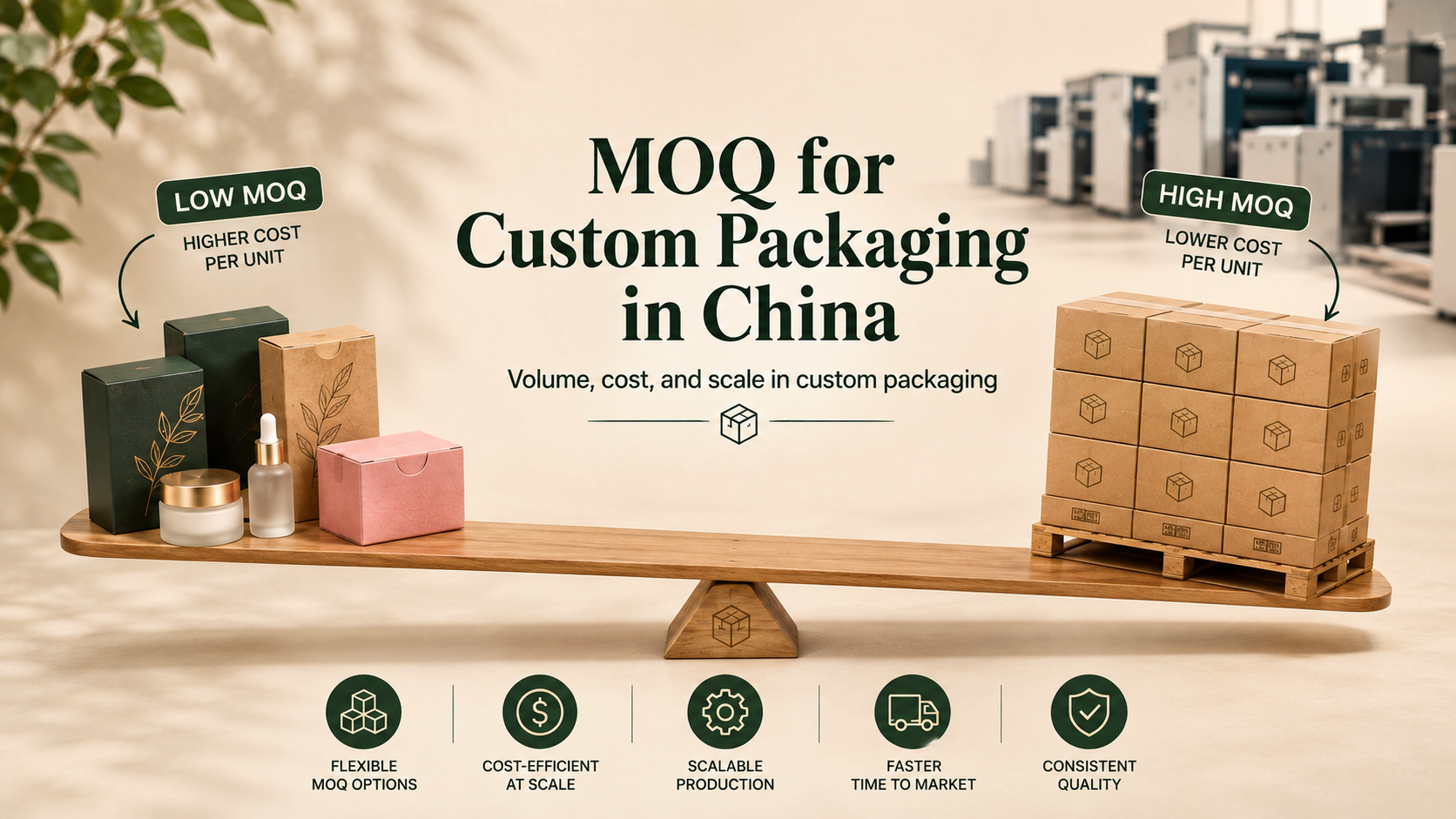
Minimum order quantity, or MOQ, is the first question most brands ask when they begin sourcing custom packaging from China — and for good reason. The MOQ determines whether a packaging project is viable for your launch volume, how much working capital you need to commit, and what your per-unit cost will be. Yet there is no single MOQ that applies across custom packaging, because the number depends heavily on the product type, the materials, and the finishing involved. This guide explains how MOQs actually work, what drives them, and how to plan an order that balances cost, quality, and the quantity your business genuinely needs — whether that is a first launch run or a multi-million-unit annual programme.
Table of contents
- Why packaging MOQs exist
- Typical MOQ by packaging type
- What moves your MOQ up or down
- Thinking in volume tiers
- How MOQ affects unit price
- Digital vs offset printing
- Samples before you commit
- High-volume production
- Annual programmes for repeat buyers
- Summary
- Frequently asked questions
Why packaging MOQs exist
An MOQ exists because every custom packaging run carries fixed setup costs that are incurred once, regardless of how many units you produce. Before the first box is printed, the factory invests in tooling and preparation: cutting a custom die for the structure, producing printing plates for each colour, setting up foil-stamping and embossing dies, and running makeready — the trial sheets used to bring colour and registration to standard before the live run begins. Specialty board, art paper, and laminating films are also purchased in mill minimums. Spread across a small order, these fixed costs make each unit expensive; spread across a larger order, they become negligible. The MOQ is the point at which a run becomes economically sensible to produce.
Typical MOQ by packaging type
There is no universal MOQ, but typical ranges by product type give a useful starting point. Custom rigid gift boxes and luxury packaging usually start from around 3,000 units, because they involve more hand-assembly and tooling. Printed paper bags often start from 1,000 units. Custom labels also start from around 1,000 units. These figures are indicative rather than fixed: the right MOQ for your specific project depends on the variables described below, and the only reliable number is a quote against your actual specification.
What moves your MOQ up or down
Several factors move your MOQ up or down. The number of finishing processes is the largest driver: each additional treatment — hot foil stamping, embossing, debossing, spot UV, soft-touch lamination — adds its own setup and minimum, so a heavily finished luxury box carries a higher MOQ than a single-colour carton. Structural complexity matters too, as an intricate die or a multi-piece construction requires more tooling. Material choice plays a role where specialty or sustainable substrates carry mill minimums. And the number of design variants affects the total: producing five label versions in one run means each version must individually meet a minimum, raising the overall quantity. If you are importing into the United States, these minimums sit alongside freight, customs and colour-proofing guidance on our United States sourcing page.
Discuss your packaging project
Thinking in volume tiers
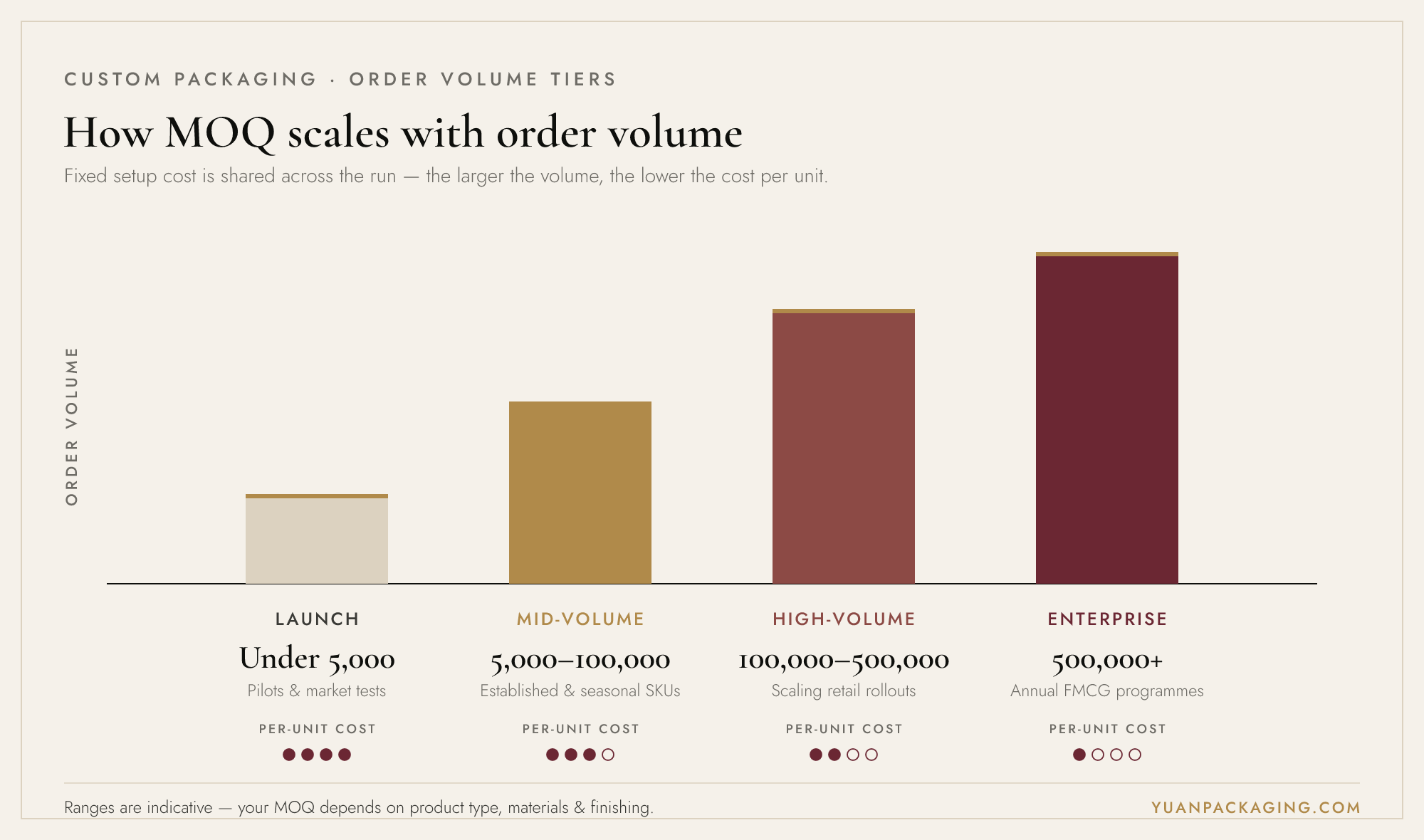
It helps to think about custom packaging in volume tiers rather than a single number. Small launch runs (under 5,000 units) suit new brands, pilot products, and market tests. Mid-volume runs (5,000–100,000 units) cover established SKUs and seasonal programmes. High-volume and enterprise runs (100,000 to 500,000+ units) apply to FMCG, beauty, and spirits brands ordering annual packaging programmes. Our production is geared towards these upper tiers: high-volume and enterprise programmes are where our four-line facility is most efficient, comfortably running hundreds of thousands to millions of units a year. Each tier unlocks different pricing, production methods, and scheduling — and understanding which tier your project sits in is the fastest way to set realistic expectations on both cost and lead time.
How MOQ affects unit price
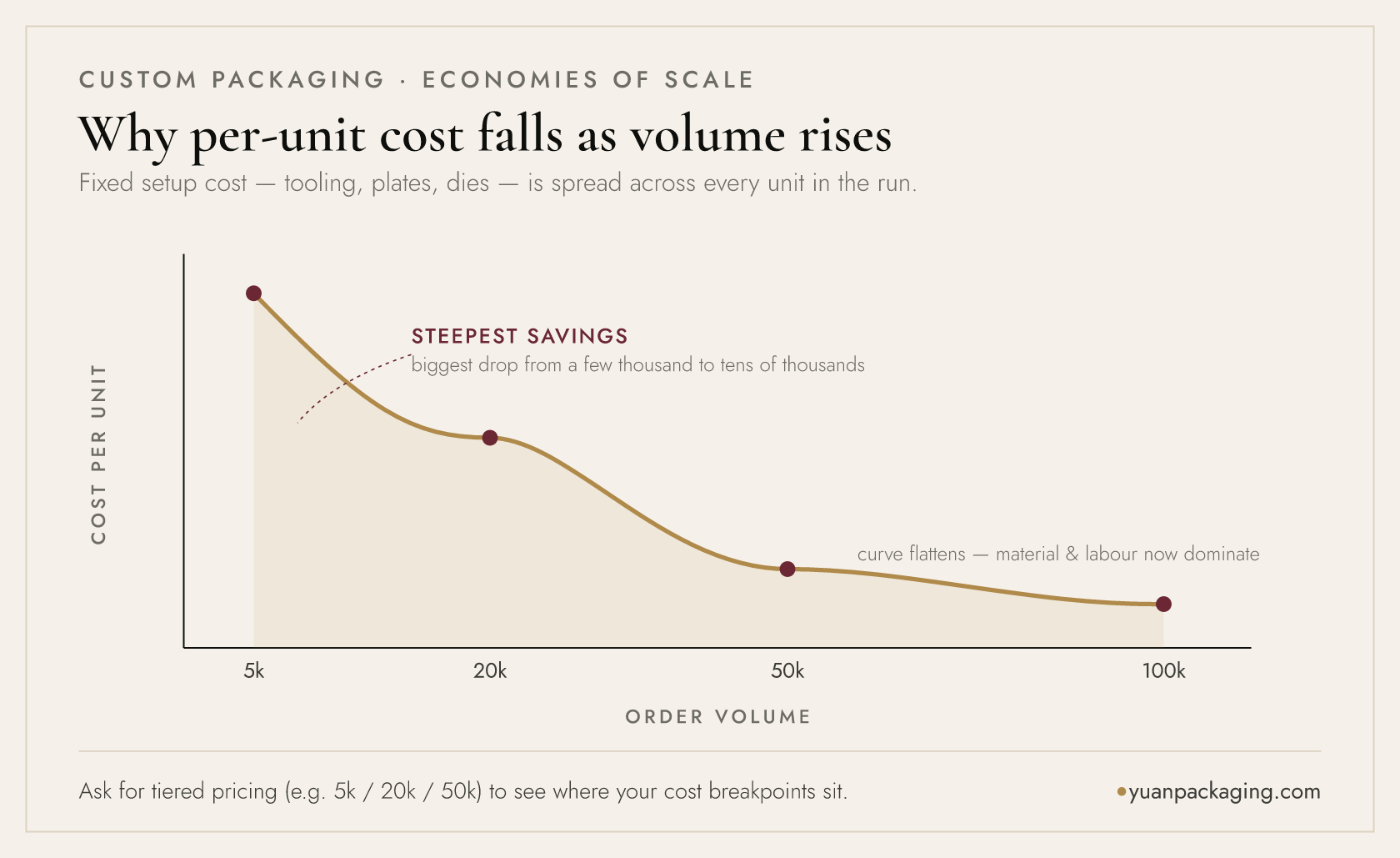
MOQ and unit price are directly linked through economies of scale. Because the fixed setup costs are shared across the run, doubling the quantity does not double the price — the per-unit cost falls as volume rises. The steepest savings typically occur in the move from a few thousand units to tens of thousands, where setup is amortised across many more pieces. Beyond a certain point the curve flattens, as material and labour become the dominant cost rather than setup. This is why requesting tiered pricing — for example quotes at 5,000, 20,000, and 50,000 units — is one of the most useful things a buyer can do: it reveals exactly where the cost breakpoints sit for your specification.
Digital vs offset printing
Production method also shapes the MOQ. Digital printing carries little to no plate setup, which makes short runs and low minimums economical, but the per-unit cost stays relatively flat as volume grows. Offset printing — the method behind most premium packaging, including our Koenig & Bauer Rapida press — has higher setup but a far lower per-unit cost at scale, making it the right choice for larger runs. For brands testing a concept, a small digital run can validate the design before committing to a high-volume offset production order.
Samples before you commit
Ordering a full MOQ is not the first step. Before committing to a production quantity, request physical samples or a pre-production sample to confirm structure, colour, and finish against your specification. A sample is produced individually and does not represent production pricing, but it removes the risk of approving a large run on screen alone. Reviewing a physical sample is the single most effective way to avoid a costly reprint, and any serious manufacturer will support a sampling stage before you place a production order.
High-volume production
Most of the value in custom packaging is unlocked at volume. Our facility is built for high-volume manufacturing — four dedicated production lines run comfortably from 100,000-unit launches to multi-million-unit annual programmes — so the larger your run, the more we can offer in unit price, dedicated scheduling and batch-to-batch consistency. Brands that consolidate their packaging into fewer, larger production runs rather than frequent small reorders see both the lowest per-unit cost and the most dependable lead times. If you are planning a national rollout, an annual programme, or a multi-SKU range, ordering at volume is where a manufacturer of our scale delivers the greatest advantage.
Annual programmes for repeat buyers
At the other end of the scale, high-volume buyers benefit from structuring orders as annual programmes rather than one-off runs. Committing to a forecast volume across a year allows a manufacturer to reserve capacity, hold material, and offer volume pricing tiers and dedicated scheduling. Our facility runs four dedicated production lines and supports programmes from prototype through to multi-million-unit annual runs, with a single point of contact from sampling to delivery. For procurement teams managing repeat packaging spend, this structure converts MOQ from a per-order hurdle into a planned, predictable supply arrangement.
Summary
The practical takeaway is that MOQ is not a fixed barrier but a variable you can plan around. Define your realistic launch volume, decide which finishes genuinely matter to your brand, and ask your manufacturer for tiered pricing so you can see the cost breakpoints clearly. If you would like an accurate MOQ and price for your specific packaging — whether you are launching a first product run or planning a high-volume annual programme — tell us about your project and our team will advise on the most cost-effective way to produce it.
Frequently Asked Questions
What is the typical MOQ for custom packaging in China?
There is no single figure. As a guide, custom luxury gift boxes typically start from around 3,000 units, paper bags from 1,000 units, and labels from 1,000 units. Your actual MOQ depends on the finishes, materials, and structure, so the only reliable number is a quote against your specification.
Can I order a small quantity or samples first?
Yes. Before committing to a production MOQ you can request physical samples or a pre-production sample to confirm structure, colour, and finish. Samples are priced individually and do not reflect production unit cost, but they remove the risk of approving a large run from a screen proof alone.
Does ordering a higher quantity lower the unit price?
Yes. Fixed setup costs — tooling, plates, dies, and makeready — are shared across the whole run, so the per-unit price falls as volume rises. The steepest savings usually occur between a few thousand and tens of thousands of units. Requesting tiered pricing reveals exactly where your cost breakpoints are.
What affects the MOQ for my project?
The main drivers are the number of finishing processes (foil, embossing, spot UV, lamination), structural complexity and tooling, material minimums for specialty substrates, and the number of design variants in the run. Reducing finishes or consolidating SKUs into one run are practical ways to meet a minimum at lower volume.