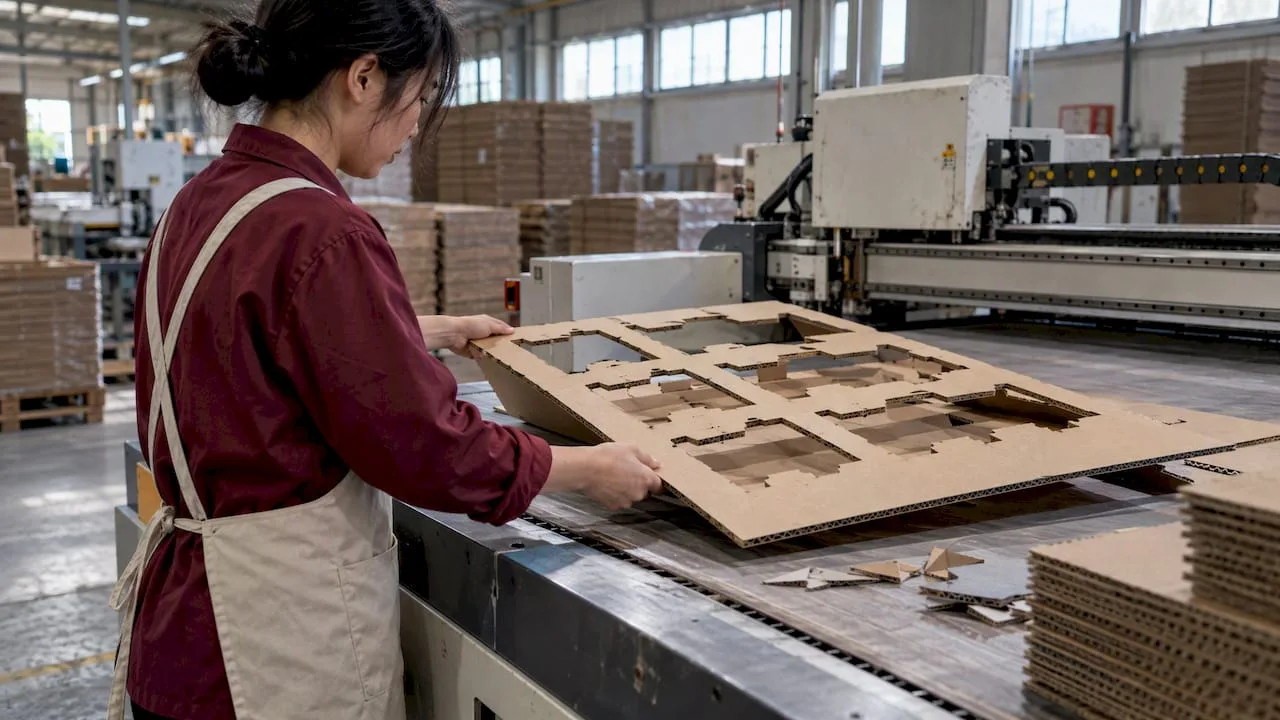
Die-cut corrugated inserts are custom-cut corrugated trays or dividers that cradle products for protection, presentation, and cost-efficient packing. They suit any shipment where a product needs a snug, repeatable fit rather than loose fill: electronics, bottles, cosmetics, or multi-item kits. Compared with foam or molded pulp, corrugated inserts are lighter, cheaper to tool, and easier to recycle, which makes them the default choice unless moisture resistance or ultra-fine cushioning rules them out.
TL;DR:
- Choosing the right flute depends on product weight and fragility, with C-flute often favored for heavy or fragile items due to its strength and cushioning.
- Accurate cavity design relies on detailed product mapping, clear fragile points, and tight tolerances, with physical sample approval preventing costly rework.
- Testing compliance, such as drop and compression tests, must follow recognized standards and be retested after changes to material Grade or weight.
- Supplier qualification should include detailed questions about board composition, tooling costs, test results, lead times, and quality controls to prevent surprises.
- Corrugated board's recyclability is superior to foam, but finishes like lamination or coatings can hinder recycling; select minimal, water-based finishes for sustainability.
Table of Contents
- Materials and flute choices that determine strength and finish
- Design and specifications: cavities, tolerances, files, and fit
- Manufacturing, lead times, MOQs, and pricing factors
- Performance testing and standards: how to verify protection
- Sourcing checklist: questions to ask suppliers and red flags
- Sustainability and end-of-life: recyclable options and certifications
- Why Yuan Packaging is a reliable partner for custom die-cut corrugated inserts
- What actually matters when you commission corrugated inserts
- Get custom die cut corrugated inserts made to your specifications
- FAQ
- Sources
- Primary standards and studies to verify design and testing
Materials and flute choices that determine strength and finish
Corrugated board is built from flat liners glued to a fluted medium, and that flute shape, not the liner alone, determines how the insert absorbs shock and holds its form. Single-wall board uses one fluted layer; double-wall stacks two flutes between three liners for heavier products or stacked cavities.
- B-flute is thin and dense, ideal for printed detail and tight cavities around cosmetics or small electronics.
- C-flute offers a middle ground of cushioning and calliper, common for general-purpose dividers.
- E-flute is fine and smooth, suited to retail-facing inserts that need crisp graphics.
- F-flute is the thinnest option, used where wall thickness must stay minimal without losing structure.
Grammage and the resulting edge crush test (ECT) and box compression test (BCT) values are what actually predict how an insert behaves under load, not the flute letter by itself. Research on flute morphology found that C-wave flutes show greater ECT sensitivity to grammage changes than E-wave flutes, meaning a small shift in liner weight can swing compression strength more in C-flute constructions. For bottles or glass, pairing B or C flute with internal bracing often matches foam-level protection at a lower cost.
Design and specifications: cavities, tolerances, files, and fit
Accurate cavities start with the inputs you hand the manufacturer, not with the die itself. A supplier can only cut what you specify, so vague dimensions or missing fragile points are the most common cause of reject samples.
- Map the product outline including handles, labels, or asymmetric shapes that affect cavity geometry.
- Flag fragile points such as caps, seams, or thin glass necks that need extra clearance or bracing.
- Set orientation so the insert holds the product in its intended shipping or display position.
- Define maximum and minimum dimensions to account for manufacturing variance across a production run.
- Specify tolerances in millimeters or fractions of an inch; tight tolerances improve fit but can raise reject rates if the board shifts slightly in humidity.
Most manufacturers accept CAD or STEP files for dielines, though some will build a dieline from a sample product if no file exists. A physical sample approval step, where you sign off on fit before full production, catches problems a flat drawing cannot show.
For stackable kits, design cavities with a slight taper so products insert and release without binding, and keep wall heights consistent across a tray so lids seat flush.
Pro Tip: Always request a signed sample approval before committing to tooling: it costs a few days of lead time but prevents expensive rework after a production run is cut.
Manufacturing, lead times, MOQs, and pricing factors
Two cutting methods dominate production. Digital flatbed cutting suits short runs and fast prototypes because it needs no hard tooling, while steel-rule die cutting suits higher volumes once a stable design is locked, since the upfront die cost pays off across thousands of units.
- Sample lead times are typically the shortest stage, often a matter of days once artwork and dielines are approved.
- Pilot runs confirm fit and print quality before committing to a full production schedule.
- Full production runs follow once the pilot is signed off, with lead time scaling by order size and board availability.
- MOQs vary by supplier and tooling method, with digital cutting generally allowing smaller minimums than steel-rule dies.
Per-unit price moves with board grade, cavity complexity, printing or laminate finishes, and total quantity. Reported price ranges for comparable custom inserts, including foam, corrugated, and molded pulp, vary broadly depending on specifics, with suppliers listing a wide range of per-unit costs.
Design for yield by nesting cavities efficiently on the sheet, share a die across similar SKUs where geometry allows, and default to standard cavity sizes when a fully custom shape is not essential.
Performance testing and standards: how to verify protection
Testing is where a design claim becomes a verified fact, and for shipped goods, that verification should follow recognized procedures rather than a supplier's word alone. ISTA Procedure 3B covers less-than-truckload motor-carrier shipments, a common scenario for multi-item e-commerce, and recommends documenting corrugated basis weights, then retesting whenever those weights change.
- Drop testing reveals how an insert and its product survive sudden shock from handling or a fall.
- Vibration testing simulates the cumulative stress of transit, which can loosen a loose-fitting cavity over time.
- Compression testing (BCT) measures how much stacking load the finished box and insert combination can bear.
ISTA's own 2020 guidelines for selecting test procedures call for retesting whenever board grade or basis weight changes, and they reference TAPPI and ISO methods for measuring those properties consistently. Flute damage from rough handling or lamination can quietly erode performance: the same flute morphology research found that crushing and geometry changes reduce bending and edge crush strength, which is one reason test reports should include specimen photos alongside the numeric results. Ask any supplier for documented test reports, not just a verbal assurance that a design "passed."
Sourcing checklist: questions to ask suppliers and red flags
A strong RFQ does most of the filtering before a sample ever ships. Use it to surface gaps in a supplier's process before you commit tooling budget.
- Board composition and flute type, stated precisely rather than as a vague "heavy duty" description.
- Tooling costs and ownership, including whether the die is reusable for future orders.
- Sample policy, covering cost, turnaround, and how many revision rounds are included.
- Test data, including ISTA or compression results tied to the specific board grade quoted.
- Lead times and MOQs for both sample and production stages, confirmed in writing.
- Quality control procedures, including how dimensional variance is checked during a run.
Red flags include basis weights given only as rough ranges, reluctance to provide a physical sample, lead times that shift without explanation, and no clear policy on returns or retesting after a specification change. Weigh protection, cost, and sustainability together rather than optimizing one in isolation: a slightly heavier board that survives one fewer complaint shipment often costs less overall than the cheapest quote.
Pro Tip: Request tolerance tables alongside the quote, not after it: a supplier that cannot state tolerance in writing is one that will struggle to explain a reject rate later.
Sustainability and end-of-life: recyclable options and certifications
Plain corrugated board recycles easily through standard paper streams, which is a real advantage over foam and most plastics. Lamination, heavy coatings, or wax treatments complicate that recyclability, so specify the lightest finish that still meets your moisture or durability needs.
- FSC certification on the board confirms traceable, responsibly sourced fiber.
- Recycled content declarations tell you how much of the board is post-consumer material versus virgin fiber.
- Minimal or water-based coatings preserve recyclability better than full plastic lamination.
- Right-sized cavities reduce material use without sacrificing fit, which lowers both cost and shipping weight.
Durability and moisture resistance often trade against recyclability, so decide which matters more for your product: a bottle insert shipped through humid climates may need a light wax treatment, while a dry-goods tray rarely does.
Why Yuan Packaging is a reliable partner for custom die-cut corrugated inserts
We bring over 25 years of experience crafting premium packaging for beauty, spirits, and lifestyle brands worldwide, and that background shapes how we approach corrugated inserts as well as rigid boxes and labels.
- We produce bespoke labels, rigid gift boxes, and carrier bags using a combination of traditional hand-finishing and modern automated production for consistent, durable results.
- We tailor structure and finish to a brand's identity to enhance shelf presence and consumer appeal.
- We source materials responsibly and offer sustainable options for brands seeking eco-friendly packaging without sacrificing protection.
- We have delivered over 100 million units to 5,000 brands globally, a track record built on repeatable quality across large production runs.
If you are ready to move forward, send your product dimensions, fragile points, and any existing CAD files, then request physical samples and test documentation before approving a full run.
What actually matters when you commission corrugated inserts
The advice that circulates most often treats flute selection as the main decision, but the research tells a different story: grammage and how it interacts with liner construction moves ECT and BCT more than the flute letter alone. Buyers who fixate on "B-flute versus C-flute" while skipping tolerance specification and sample approval are solving the wrong problem first.

What gets underrated is the sample approval step. A dieline looks correct on screen and still fails in hand, because board behaves differently once it is scored and folded under real humidity and handling. Skipping that step to save a few days of lead time is the single most common reason buyers end up reworking tooling mid-production.
Prioritize in this order: get your fragile-point mapping right, request a physical sample before tooling, and only then fine-tune flute and grammage with your supplier's test data. Everything else, including the exact per-unit price, becomes easier to negotiate once those three things are settled.
— Anthony
Get custom die cut corrugated inserts made to your specifications
We design and manufacture packaging around the product, not the other way around, so your corrugated inserts get built to the cavity, tolerance, and flute spec your product actually needs rather than a generic template.
If your brand also needs rigid gift boxes, labels, or cartons alongside your inserts, we handle those under one roof, which keeps print finishes and material sourcing consistent across a full packaging suite.
Browse our full product catalog to see the range we manufacture, or reach out through our company page to start a quote for your die-cut corrugated inserts.
FAQ
What is the difference between die-cut and standard corrugated inserts?
Die-cut inserts are custom-shaped to a specific product's dimensions and fragile points, while standard inserts use generic dividers or pads that are not tailored to any single SKU. The custom cut typically improves fit and reduces movement during transit compared with a generic layout.
How long does it take to get a corrugated insert sample?
Sample lead times are generally the shortest production stage once artwork and dielines are approved, though exact timing depends on your supplier's queue and whether digital or die-based cutting is used. Confirm the sample timeline in writing during your RFQ so it is not left vague.
What ECT or BCT rating do I need for my product?
The right rating depends on your product's weight, fragility, and the stacking or shipping conditions it will face, which is why suppliers should provide test data tied to the specific board grade they quote. ISTA's guidelines recommend retesting whenever board grade or basis weight changes rather than relying on a single historical result.
Are corrugated inserts more sustainable than foam inserts?
Plain corrugated board recycles through standard paper streams more easily than most foam, which does not break down in typical recycling systems. Heavy lamination or coating on either material can reduce recyclability, so the finish matters as much as the base material.
Does Yuan Packaging offer custom die-cut corrugated inserts?
Yes, corrugated and e-commerce packaging is one of our product lines, alongside rigid boxes, labels, and cartons, with full customization of structure and finish. Pricing is not published and is quoted per project through our product catalog.
Sources
- ISTA Procedure 3B overview
- Guidelines for Selecting and Using ISTA® Test Procedures & Projects
- The role of flute morphology in mechanical behaviour of corrugated fibreboard (Massey University thesis)
Primary standards and studies to verify design and testing
For readers who want to check specifications directly against primary sources, these are the references used throughout this guide:
- The role of flute morphology in mechanical behaviour of corrugated fibreboard
- ISTA Procedure 3B overview
- Guidelines for Selecting and Using ISTA Test Procedures & Projects
What is the difference between die-cut and standard corrugated inserts?
Die-cut inserts are custom-shaped to a specific product's dimensions and fragile points, while standard inserts use generic dividers or pads that are not tailored to any single SKU. The custom cut typically improves fit and reduces movement during transit compared with a generic layout.
How long does it take to get a corrugated insert sample?
Sample lead times are generally the shortest production stage once artwork and dielines are approved, though exact timing depends on your supplier's queue and whether digital or die-based cutting is used. Confirm the sample timeline in writing during your RFQ so it is not left vague.
What ECT or BCT rating do I need for my product?
The right rating depends on your product's weight, fragility, and the stacking or shipping conditions it will face, which is why suppliers should provide test data tied to the specific board grade they quote. ISTA's guidelines recommend retesting whenever board grade or basis weight changes rather than relying on a single historical result.
Are corrugated inserts more sustainable than foam inserts?
Plain corrugated board recycles through standard paper streams more easily than most foam, which does not break down in typical recycling systems. Heavy lamination or coating on either material can reduce recyclability, so the finish matters as much as the base material.
Does Yuan Packaging offer custom die-cut corrugated inserts?
Yes, corrugated and e-commerce packaging is one of our product lines, alongside rigid boxes, labels, and cartons, with full customization of structure and finish. Pricing is not published and is quoted per project through our product catalog.