
ISTA transit testing is the standardized set of laboratory procedures and Projects packaging teams use to confirm a package will survive its actual distribution route. It works by subjecting samples to a defined sequence of conditioning, shock, vibration, and compression that mimics real handling, hauling, and warehousing. The payoff is measurable: fewer damage claims, faster retailer approval, and packaging decisions based on results instead of guesswork.
**TL;DR:** Most shipments should undergo the ISTA 3-Series tests for reliable simulation of transport forces affecting packaged products. Choosing the correct test series depends on the shipment mode, such as 3A for parcel, 3B for less-than-truckload, or 3E for full truckload, with complex paths requiring 4AB. Accurate testing relies on proper sample preparation, detailed documentation, and running multiple replicates to account for variability and ensure results are statistically valid. Using a certified lab and applying the Transit-Tested mark only happens after meeting strict accreditation and documentation procedures, safeguarding compliance claims. Standard ASTM and ISO tests underpin ISTA procedures, but true validated certification comes from ISTA’s integrated performance testing framework recognized by retailers and carriers.
Yuanpackaging
Explore Yuan Packaging
Table of Contents
- What ISTA Transit Testing Means for Packaging Validation
- Which ISTA Test Series Fits Your Shipment
- How to Pick the Right ISTA Procedure
- The Core Test Elements Inside an ISTA Sequence
- Getting a Lab Certified and Using the Transit-Tested Program
- Preparing Samples So Your Results Actually Hold Up
- Building a Custom Plan With PackSight and Project 4AB
- From Design to Lab: A Handoff That Cuts Test Cycles
- Where ISTA Testing Falls Short
- Recent Changes Worth Tracking in ISTA Protocols
- ISTA Versus ASTM and ISO: Where Each Standard Fits
- A Practitioner’s View on Where Teams Go Wrong
- How Yuan Packaging Supports Your ISTA Testing Workflow
- Sources
- FAQ
What ISTA Transit Testing Means for Packaging Validation
The International Safe Transit Association writes and publishes the procedures that most of the packaging industry treats as the baseline for shipping validation. ISTA doesn’t sell packaging or run every test itself. It sets the methodology, accredits testing labs, and maintains the frameworks that let a designer in Ohio and a compliance manager in Rotterdam speak the same language about “3A” or “6-Amazon.com-SIOC.”
That shared vocabulary matters more than it sounds. When a retailer rejects a shipment for insufficient protective packaging, having an ISTA test report on file gives you a documented, third-party-recognized basis to push back or to revise design with confidence rather than trial and error. It also protects product launches: a new SKU that fails in transit after launch is far more expensive to fix than one caught in a lab three weeks earlier.
Beyond the procedures themselves, ISTA maintains a broader ecosystem. That includes PackSight and Project 4AB for building custom test plans, a lab accreditation system with defined certification and renewal requirements, and the Transit-Tested program that lets qualifying members put a recognized mark on packaging that has passed review. Together these pieces form a workflow, not just a stack of test documents, one that a packaging team can plug into at almost any stage of product development.
Which ISTA Test Series Fits Your Shipment
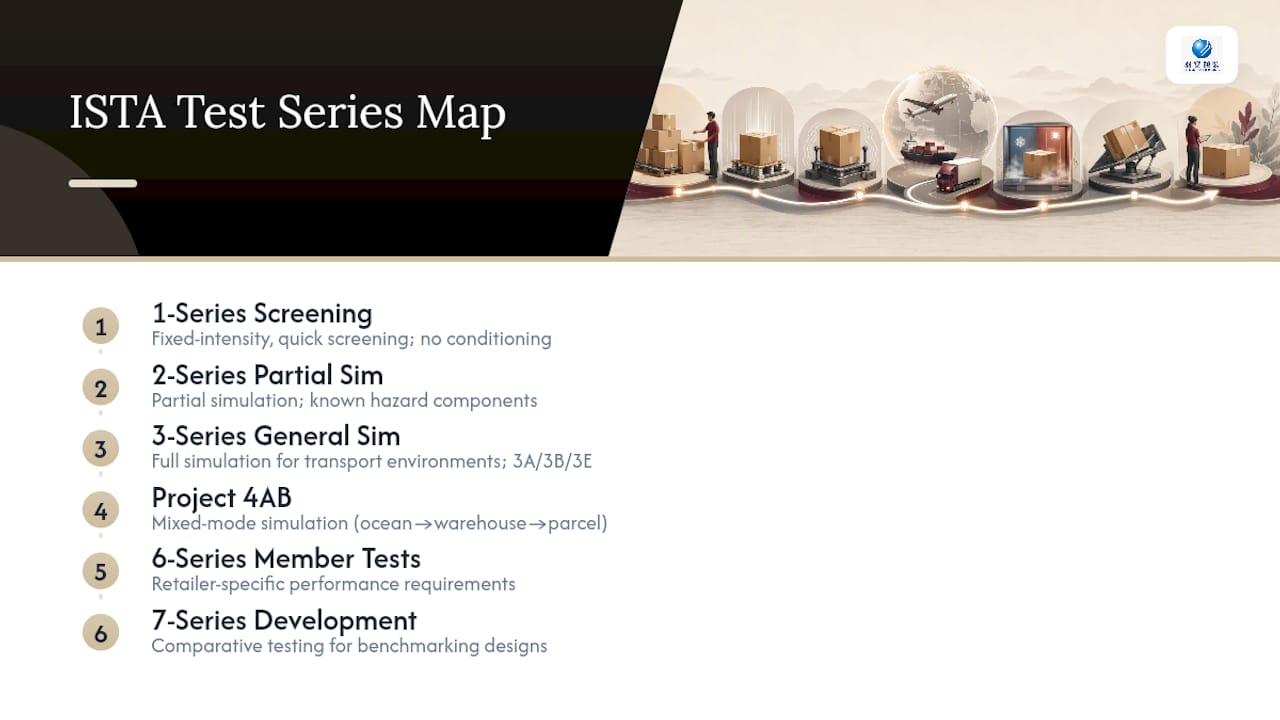
ISTA organizes its procedures into series, and each one answers a different question about your distribution chain.
The **1-Series** is your screening tool. These are fixed-intensity, quick-turn tests without atmospheric conditioning, useful early in development or when you need a fast go/no-go benchmark before committing to a more expensive simulation.
The **2-Series** offers partial simulation, blending a few defined test elements with some general sequencing. It suits situations where you know part of the distribution hazard profile (say, a known drop height) but want more than a pure screening test.
The **3-Series** is the workhorse for general simulation, and it’s where most packaging teams spend their testing budget. ISTA 3-Series procedures simulate the damage-producing motions and forces tied to specific transport environments. 3A covers packaged products shipped through a parcel delivery system, 3B addresses less-than-truckload shipments, and 3E is built for unitized, full-truckload loads. Choosing correctly here is the single biggest lever in whether your test results mean anything.
**Project 4AB**, run through the PackSight platform, handles enhanced simulation when your distribution path mixes modes: ocean freight into a regional warehouse, then parcel to the doorstep, for example. The **6-Series** covers member-specific performance tests, often mandated directly by a retailer like a big-box chain with its own damage tolerance requirements. The **7-Series** is for development and comparative testing, useful when you’re benchmarking two packaging designs against each other rather than certifying either one.
How to Pick the Right ISTA Procedure
Procedure selection comes down to three questions: How will this ship? How rough will handling actually be? And does a retailer or carrier already require a specific test?
Parcel-only shipments, especially direct-to-consumer e-commerce, point toward 3A or a 6-Series test if a major retailer specifies it. Palletized freight moving by less-than-truckload carrier suggests 3B. Full pallet loads shipped by dedicated truck point toward 3E. Anything crossing international borders or mixing air, ocean, and ground legs is a strong candidate for 4AB, because no single standard procedure was built to model that combination.
Run more than one procedure when a single shipment genuinely faces two different environments; a product that ships LTL to a distribution center and then parcel to a final address may warrant both a 3B pass and a 3A pass rather than forcing one test to stand in for both. When the distribution sequence gets too specific for any standard procedure to model accurately, that’s your signal to move to 4AB instead of stretching a general simulation past its intended scope.
The Core Test Elements Inside an ISTA Sequence
Every ISTA procedure draws from the same toolbox of test elements, combined in different orders and intensities depending on the series.
- *Atmospheric conditioning** exposes the sample to controlled temperature and humidity, following apparatus standards like ASTM D4332, before any mechanical stress begins.
- *Shock and drop testing** simulates the sudden impacts of loading, unloading, and rough handling, typically referencing ASTM D5276 for drop procedures.
- *Incline and horizontal impact** tests mimic the jolt of rail switching or a forklift bump, based on standards like ASTM D880.
- *Random vibration** reproduces the continuous low-level stress of highway or rail travel, run to ASTM D4728 or ISO 13355 depending on the lab’s equipment.
- *Compression testing** checks whether stacked loads crush the package under sustained weight, a common failure point for palletized goods held in a warehouse for weeks.
A typical 3-Series sequence runs conditioning first, then handling and vibration elements, then compression last, on the logic that a package should face structural stress after it has already absorbed the abuse of a real shipment. Equipment matters here too. A vibration table calibrated to a different spectrum than the one specified in the procedure can produce results that look clean in the lab and fall apart on the loading dock.
Getting a Lab Certified and Using the Transit-Tested Program
Not every lab that owns a vibration table can call itself ISTA-certified, and that distinction matters when you’re choosing where to send samples.
- *Join as an ISTA member** and submit equipment verification forms along with short videos demonstrating each piece of test equipment in operation.
- *Pass the initial review**, after which certification is valid for three years before the lab must resubmit for renewal.
- *Run your test and generate a report**, then submit it through the Transit Tested Portal, where review typically takes 10 to 15 business days.
- *Correct and resubmit if flagged.** The most common holdups are incomplete metadata, missing photos, or an incorrect member number on the submission form.
- *Apply the Certification Mark**, but only if your company holds ISTA Shipper membership. A passed lab report alone doesn’t grant the right to use the mark, which matters directly in retailer and carrier negotiations where the mark itself carries weight beyond the raw test data.
Preparing Samples So Your Results Actually Hold Up
A test is only as good as the sample and documentation behind it. Before shipping anything to a lab, assemble a complete package:
- Final production dielines and material specifications, not a placeholder mockup.
- Photos of the assembled package from every angle, including the filled condition.
- Pallet pattern and load configuration if the shipment ships unitized.
- Weights and dimensions for both the individual package and the full load.
- A written definition of acceptable versus unacceptable damage, agreed on before testing starts.
That last point gets skipped more often than it should. Deciding what counts as a failure after the test runs invites disputes with retailers or internal stakeholders who each have their own tolerance for a dented corner or a crushed flap. Most procedures technically require only one test run, but ISTA itself recommends five or more replicates to get performance data that holds up statistically rather than reflecting one lucky or unlucky sample.
Building a Custom Plan With PackSight and Project 4AB
Standard procedures assume a fairly typical distribution path. When your product moves through several legs, ocean freight to a port, truck to a regional hub, parcel to a final address, none of the standard series will model that accurately on its own.
PackSight lets you build a distribution “Tree” that maps each leg of that journey, then generates an enhanced simulation plan and outputs it as a PDF test plan your lab can execute directly. The platform is free for ISTA members and stores results in a cloud environment for later reference. Experienced test planners lean on 4AB specifically because choosing from hundreds of possible test blocks manually is error-prone; a defined workflow narrows that down to what your shipment actually experiences. Where you have real field data, from a data logger on an actual shipment, it’s worth validating your 4AB plan against those measurements rather than relying on assumed hazard levels alone.
From Design to Lab: A Handoff That Cuts Test Cycles
A clean handoff avoids repeat testing. Send your lab final dielines, confirmed material specs, filled-condition photos, pallet or load configuration, and a written damage tolerance definition before the first sample ships. Vague specs are the top cause of retests.
Accurate prototyping closes that gap early. Yuan Packaging has spent over 25 years producing rigid boxes, cartons, and labels for beauty, spirits, and lifestyle brands, with prototyping and production-scale capability that lets a design team validate structure and materials before committing to a full test run.
Where ISTA Testing Falls Short
ISTA procedures are widely adopted, but they aren’t a perfect stand-in for reality, and packaging engineers who treat a pass as a guarantee are setting themselves up for a surprise.
The biggest gap is that lab simulation can only approximate real-world handling. A 3B test models the general hazard profile of LTL freight, but it can’t account for a specific carrier’s forklift operators being unusually rough, or a specific route crossing poor road conditions that a standard vibration profile doesn’t fully capture. Test selection has to match the real distribution environment, and when a team picks the wrong series or skips a leg of the actual shipping path, a passing result can be misleading.
Replication is another sore spot. Because most procedures technically require only a single test run, a company under budget or schedule pressure can legally claim compliance from one sample, even though a single run tells you almost nothing about variability across a production batch. The five-plus replicate recommendation exists precisely because one unit passing doesn’t mean the next hundred will.
There’s also a documentation gap that isn’t ISTA’s fault directly but shows up constantly in practice: procedures don’t enforce how damage tolerance gets defined, so two companies running the identical 3A test can walk away with different conclusions about whether the same crushed corner constitutes a failure. And enhanced simulation tools like 4AB, while more accurate for complex distribution paths, require someone on staff who understands how to build a realistic distribution Tree. Get that input wrong and the enhanced plan is no more trustworthy than a generic one.
Recent Changes Worth Tracking in ISTA Protocols
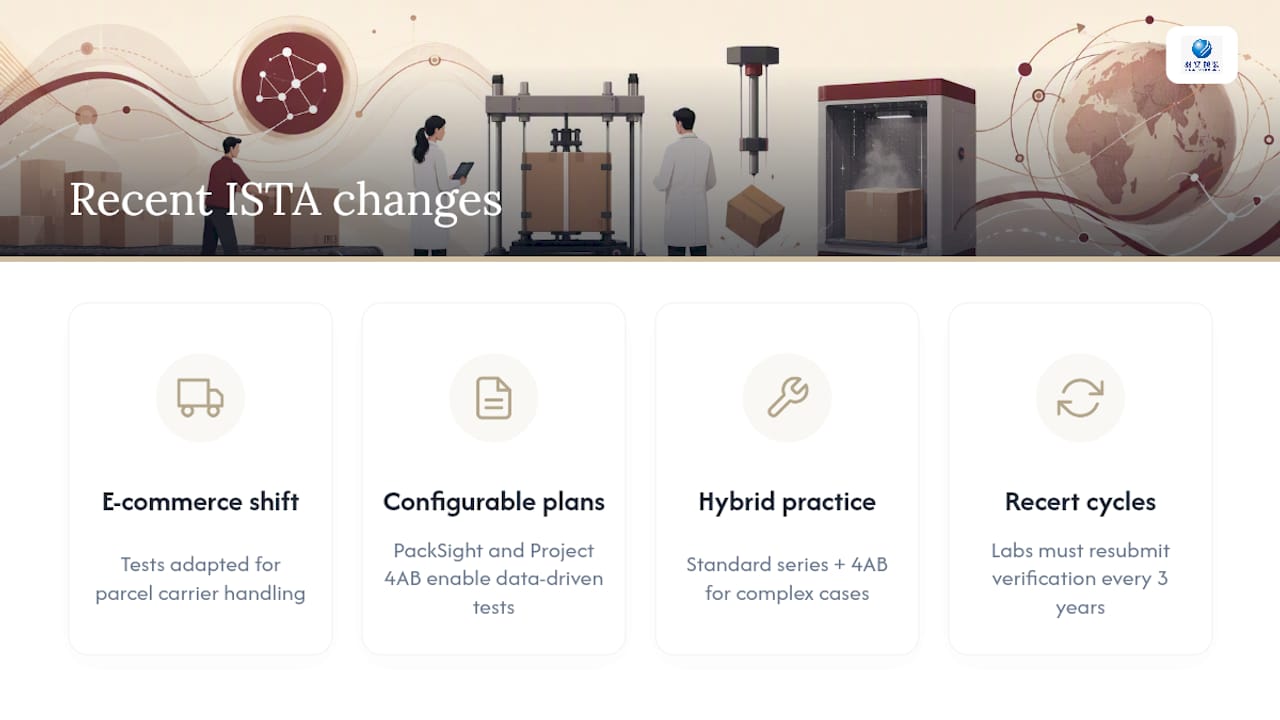
ISTA procedures carry version numbers and dates for a reason: the industry’s distribution environment keeps shifting, and the test methodology gets revised to keep up. Procedure 3E, for instance, is currently published as version 26-3.26, which reflects a numbering convention that tracks procedure updates over time.
The most consequential shift in recent years has been the growth of e-commerce-specific testing. As parcel volume shifted from retail store restocking toward direct-to-consumer shipment, procedures and 6-Series retailer-specific tests adapted to reflect the rougher, more variable handling a package experiences moving through a parcel carrier’s sorting network compared to a controlled pallet-to-store path.
PackSight and Project 4AB represent the other major direction of change: a move away from static, one-size-fits-all procedures toward configurable plans built around a company’s actual distribution data. That shift mirrors what’s happening across quality and compliance work generally, where standardized checklists are giving ground to data-driven, situation-specific validation. Packaging teams that built their testing programs around a single fixed 3A or 3B procedure a decade ago are increasingly finding that a hybrid approach, standard series for routine screening, 4AB for anything complex, produces more defensible results with less wasted lab time.
Lab certification renewal cycles also reinforce that this isn’t a “set it and forget it” standard. A lab certified three years ago has to resubmit equipment verification, which keeps testing equipment calibration and methodology current with whatever changes have been published in the interim.
ISTA Versus ASTM and ISO: Where Each Standard Fits
Packaging professionals often ask how ISTA procedures relate to ASTM and ISO standards, and the honest answer is that they’re not competitors so much as different layers of the same stack.
ASTM standards define the methodology for individual test elements: how to run a drop test, how to calibrate a vibration table, how to condition a sample at a given humidity. ISTA procedures build on top of those ASTM methods, citing them directly (drop tests reference ASTM D5276, vibration references ASTM D4728, incline impact references ASTM D880) but combining them into a full sequence tied to a real-world shipping scenario. Running an ASTM D5276 drop test alone tells you how a package handles one specific impact; running ISTA 3A tells you how it survives an entire simulated parcel journey, drop included.
ISO standards, meanwhile, often serve the vibration and conditioning side specifically, with ISO 13355 offering an alternative to ASTM D4728 for random vibration testing depending on which convention a lab’s equipment is built around. Neither ASTM nor ISO publishes a complete, retailer-recognized “does this survive shipping” certification framework the way ISTA does through Transit-Tested. That’s the practical distinction for a packaging team choosing where to invest testing budget: ASTM and ISO give you the individual instruments and their calibration, and ISTA gives you the orchestrated performance and the third-party-recognized certification that a retailer or carrier is actually likely to ask for by name.
A Practitioner’s View on Where Teams Go Wrong
The two failure modes I see most often aren’t equipment problems, they’re planning problems: picking the wrong series for the actual shipment, and skipping documentation until after a dispute starts.
Fix both early. Prescreen with a 1-Series test before committing budget, photograph your actual load configuration, plan for real replicate testing, and use PackSight when your distribution path isn’t a clean single-mode shipment.
_— Anthony_
How Yuan Packaging Supports Your ISTA Testing Workflow
Getting a packaging design to a lab in the first place is where most delays start, not the testing itself. A vague material spec or a rushed mockup means you’re testing something that doesn’t match what will actually ship, and you find that out only after a failed report.

We build production-accurate prototypes before samples ever reach a testing lab, using the same materials, finishes, and structural specs planned for the final run. That accuracy matters for ISTA testing specifically: a prototype built from placeholder board or an unconfirmed adhesive won’t tell you anything reliable about how the production version holds up to compression or vibration. Our custom rigid gift box production and cosmetic label manufacturing both include documented material specifications and quality certificates your compliance team can hand directly to a test lab alongside the sample, cutting out the back-and-forth that usually eats a week before testing even starts. We have the production scale to move from validated prototype to full run without a second design cycle. If you’re preparing a product for its first ISTA test round, get in touch about a sample run before your next test window.
Sources
FAQ
How Much Does ISTA Testing Cost?
Costs vary by lab, procedure complexity, and number of replicates run, and ISTA does not publish a fixed price list, so getting a quote directly from an accredited lab is the only reliable way to budget a project.
What Is ISTA Testing?
ISTA transit testing is a set of standardized laboratory procedures that simulate the shocks, vibration, and compression a package experiences during real distribution, used to confirm a design will survive shipping before it reaches customers.
What Are the ISTA Testing Standards?
ISTA organizes its standards into series, including 1-Series screening tests, 2-Series partial simulation, 3-Series general simulation for parcel, LTL, and full truckload shipments, Project 4AB enhanced simulation for complex distribution, 6-Series retailer-specific tests, and 7-Series development and comparative testing.
How Do You Become ISTA Certified?
A testing facility becomes ISTA certified by joining as an ISTA member and submitting equipment verification forms with videos of each machine, after which certification lasts three years before renewal is required; shippers separately need ISTA Shipper membership to use the Transit-Tested Certification Mark on packaging that has passed review.