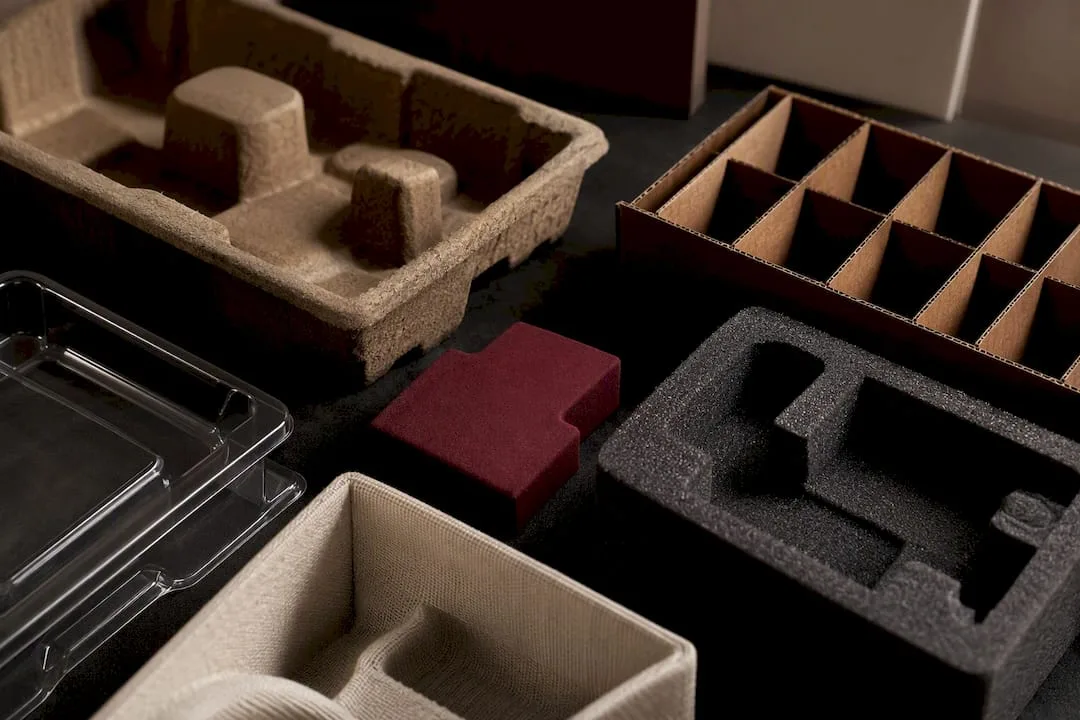
Foam, cardboard and corrugated dividers, molded pulp, PET trays, and fabric-wrapped liners cover most of what you’ll ever need inside a box. Pick foam when precision fit and impact protection matter most, molded pulp or corrugated when you need eco-friendly structural support for multipacks, fabric-wrapped inserts when the unboxing moment has to feel like a gift, and PET trays when the product needs to stay visible on a shelf. This guide walks through selection criteria, realistic costs, minimum order quantities, and how sustainability trade-offs actually play out on the production floor.
TL;DR: Foam inserts offer the tightest fit and best shock absorption but come with higher costs and potential recycling issues, especially for eco-conscious brands. Corrugated dividers are the most economical, recyclable, and fastest to deploy for light to medium-weight multipacks, ideal for high-volume packing lines. Molded pulp inserts are eco-friendly, customizable with adjustable cavity depth, and suitable for bottles, candles, and cosmetic kits, usually starting at 1,000 units. Material choices like plastics and foams can complicate recycling, making sustainability a key consideration when selecting advanced retail or health-focused packaging. Early approval of prototypes and precise dieline drawings from suppliers accelerate production timelines and prevent costly delays.
Table of Contents
- Box Insert Options and What Each One Is Built For
- Comparing Insert Materials: Density, Firmness, and Fit
- How Structural Layout Shapes Protection and Presentation
- How to Choose the Right Box Insert for Your Product
- What Box Inserts Cost and How Fast You Can Get Them
- Sustainability Trade-Offs in Insert Material Selection
- Why Production Experience Matters in Insert Design
- A Packaging Practitioner’s Take on Prioritizing Inserts
- Get a Custom Box Insert Quote From Yuanpackaging
- Sources
- FAQ
Box Insert Options and What Each One Is Built For
Every insert type solves a slightly different problem, and matching the wrong one to your product usually shows up as either damaged goods or wasted budget.
Foam inserts (EVA, EPE, PU) deliver the tightest fit of any insert category. Electronics, tools, and precision instruments rely on foam because it can be die-cut or CNC-routed into contours that cradle irregular shapes. The tradeoff is cost per unit and, depending on the foam type, recycling complications in some municipal waste streams. For glass vials and ampoules, see how flocked EVA cavities are cut in our peptide vial gift boxes.
Cardboard, paperboard, and corrugated dividers are the workhorse option. They’re inexpensive, fully recyclable when made from single-material board, and well suited to light-to-medium weight items shipped in multipacks. Corrugated dividers speed up packing lines compared to individually contoured cavities, which matters if you’re fulfilling hundreds of orders a day.
Molded pulp inserts shape recycled paper fiber into custom cavities, and they’ve become the default choice for bottles, jars, candles, and cosmetic kits that want an eco-forward look without sacrificing structure.
Plastic and PET trays, including thermoformed blister packs, offer clarity and hygiene advantages that matter for retail display and health-adjacent products, though they raise the sustainability question harder than any other category here.
Fabric-wrapped inserts, velvet, and satin liners exist purely for presentation. Jewelry, watches, and luxury gifting brands use them because nothing communicates weight and worth like a soft-touch lining against skin.
Beyond those five, you’ll also run into paper honeycomb panels for lightweight rigidity, corner protectors for edge-only impact risk, platform inserts that raise a product for a dramatic reveal, and simple sleeves or wrap inserts for slim items like cards or accessories.

Comparing Insert Materials: Density, Firmness, and Fit
Choosing a material starts with knowing what each one actually does under stress, not just what it looks like on a spec sheet.
- EVA foam is dense and closed-cell, giving it the best rebound and moisture resistance. It’s the standard for repeated-use cases like tool kits.
- EPE foam is lighter and more flexible, a good match for one-time-use protective packaging where cost matters more than long-term durability.
- PU foam offers the softest touch and highest cushioning, often chosen for cameras and optical instruments.
- Paperboard grades vary by caliper and coating; heavier board holds die-cut detail better for tight cavities.
- Corrugated flutes trade off strength against precision. E-flute gives a cleaner die-cut edge, while B-flute carries more crush resistance for heavier contents.
- Molded pulp varies by density and wall thickness, and finish can range from a natural fiber look to a smooth, printable surface.
- PET trays offer clarity and hygiene benefits but carry real recycling friction, since they’re often layered or bonded to other materials.
Foam inserts provide the tightest fit and best shock absorption, but that performance comes with a higher unit cost and, depending on the foam chemistry, added recyclability concerns that eco-minded brands need to weigh against the protection benefit.
If your inserts touch food, cosmetics, or pharmaceutical products, material compatibility isn’t optional. U.S. federal regulations governing product-packaging safety apply to contact materials, and brands in nutraceutical and health categories should confirm compliance before locking in a material choice.
How Structural Layout Shapes Protection and Presentation
The insert type gets most of the attention, but the structural layout inside that insert determines how well it actually performs.
- Cavity or contour-cut inserts hug a single product’s exact silhouette, delivering the highest level of protection available in a one-piece design.
- Tray inserts and stackable trays organize multi-item sets, subscription boxes, or gift bundles where several pieces need their own defined space.
- Partition and divider grids separate bottles or multipack units fast and cheap, sacrificing some custom-fit precision for speed on the packing line.
- Platform and riser inserts lift a product slightly above the box rim, creating the kind of dramatic reveal that makes an unboxing feel like an event rather than a delivery.
- Sleeves, wrap inserts, and corner protectors target only the vulnerable points on a slim or oddly shaped item, keeping material use and cost to a minimum.
Molded pulp adapts well to both single-cavity and multi-cavity layouts, with adjustable cavity depth, wall thickness, and finger spaces that can meaningfully improve how fast a line packs product.
How to Choose the Right Box Insert for Your Product
Start with the product itself, not the catalog of insert types. Fragility, weight, shipping distance, and how much the unboxing moment matters to your brand all point toward different answers before cost ever enters the conversation. A $40 candle and a $400 camera lens have wildly different tolerance for a two-millimeter gap in the cavity.
Once you’ve narrowed the field, the supplier conversation is where good decisions either hold up or fall apart. Ask directly about:
- Sample and prototype policy, including whether a physical sample is available before you commit to tooling.
- Tooling fees and whether those costs are recoverable against a future production run.
- Minimum order quantity and how it scales with customization level.
- Die accuracy and tolerance specs, plus whether drop or shock testing is offered.
- Finish capabilities, including embossing, printing, or lamination on the insert itself.
Pro Tip: Ask for a die-line drawing before you approve any tooling. A supplier who hesitates to share one, or who gives you vague tolerances instead of numbers, is telling you something about how the rest of the project will go.
Watch for red flags: no willingness to produce a prototype, unclear MOQ or tooling cost breakdowns, and no documentation on material safety. Before you send an RFQ, have these ready: product dimensions, internal box size, product weight, expected shipping conditions, target unit price, and the finish you’re requesting.
What Box Inserts Cost and How Fast You Can Get Them
Material, structural complexity, tooling, printing, and order quantity are the five levers that move price. Tooling versus tooling-free production is the biggest fork in the road: die-cut board and molded pulp both usually require an upfront die or mold, while some corrugated divider designs can run tooling-free on a digital cutter for smaller batches.
- Molded pulp: per supplier guides, standard small trays run roughly $0.08 to $0.15 per unit, medium trays $0.16 to $0.30, and larger custom trays $0.31 to $0.55, with custom tooling or logo embossing pushing both price and MOQ higher.
- Molded pulp MOQ: per supplier guides, typically starts around 1,000 units for standard sizes.
- Foam die-cut: pricing swings widely based on foam grade and cavity complexity, generally landing above molded pulp on a per-unit basis.
Sample production typically takes one to two weeks, tooling approval adds another week or two depending on revisions, and full production runs follow once tooling is signed off. Locking your dieline early and approving samples in a single review round, instead of several rounds of small tweaks, is the fastest way to protect your timeline.
Sustainability Trade-Offs in Insert Material Selection
Molded pulp and single-material paperboard are the two insert categories that recycle cleanly and, in many cases, compost as well. Mixed plastics, foam laminated to other materials, and coated boards with plastic film are the usual culprits that break otherwise recyclable packaging streams.
- Specify recycled-content paperboard or pulp where your supplier can confirm sourcing.
- Avoid laminates or coatings on inserts unless the finish is genuinely necessary for product protection.
- Ask whether a printed finish on molded pulp or board uses water-based ink, which keeps the material easier to process at end of life.
Packaging makes up a substantial share of municipal solid waste in the United States, according to the EPA’s data on containers and packaging, and European figures tracked by Eurostat’s packaging waste statistics show a similar pattern across EU markets. Insert material choice is a direct lever on that number, not a side detail.
Why Production Experience Matters in Insert Design
Getting an insert from concept to a working prototype takes more than a good material chart. It takes a supplier who has cut, molded, and shipped enough variations to know where a design will fail before it’s tooled.
Twenty-five years in bespoke packaging and 100 million units delivered to 5,000 brands worldwide taught us one consistent lesson: the insert fails first, long before the outer box ever does. Getting the cavity, cushioning, and material right is where protection and presentation actually get decided.
Insert projects are supported with design assistance, prototyping, sampling, and production runs that scale from small batches to high volume, backed by quality control and sustainable material sourcing.
A Packaging Practitioner’s Take on Prioritizing Inserts

A jewelry brand gets more return on a velvet-wrapped platform insert than on a thicker outer box. Electronics need the opposite: spend on precision foam cavities first, and let the outer box stay simple. Bottled goods usually land in the middle, where a molded pulp tray earns its keep on both protection and shelf story.
For a small brand with a limited budget, the rule of thumb is this: invest in the insert before the outer box, because the insert is what the customer touches, feels, and remembers.
— Anthony
Get a Custom Box Insert Quote From Yuanpackaging
Combining traditional craftsmanship with modern production technology builds inserts that hold up under shipping and look intentional at the moment of opening, whether that’s a foam cavity for a fragrance set or a molded pulp tray for a spirits multipack.
If you’re ready to move from concept to sample, gather your product dimensions, target unit price, and finish preferences before reaching out. That short prep list is usually all it takes to get an accurate quote moving. Yuanpackaging’s rigid gift box line pairs naturally with custom-fit inserts for beauty, spirits, and lifestyle brands looking to upgrade their unboxing experience, and the corrugated insert and divider options cover multipack and e-commerce needs at a lower cost point. Reach out with your specs to start a sample request and see what a properly engineered insert does for your product.
Sources
FAQ
What Are the Main Types of Box Inserts?
The core categories are foam (EVA, EPE, PU), cardboard and corrugated dividers, molded pulp, PET or plastic trays, and fabric-wrapped liners. Each fits a different priority: foam for protection, molded pulp and corrugated for eco-friendly structure, and fabric-wrapped for premium presentation.
What Are Some Creative Ideas for Packaging Inserts?
Platform or riser inserts create a dramatic reveal by lifting the product above the box rim, while custom die-cut cardboard can incorporate branded messaging directly into the insert surface. Velvet or satin liners work well for gifting lines where the tactile moment matters as much as the product itself.
What Are Some Common Examples of Package Inserts?
Molded pulp trays for bottles, jars, and candles are common examples, along with foam cavities for electronics and tools. Corrugated dividers separating multipack bottles and fabric-wrapped jewelry trays round out the most frequently used formats.
What Are the Different Box Types Used With Inserts?
Rigid gift boxes, folding cartons, and corrugated shipping boxes are the three main outer formats that pair with custom inserts. Rigid boxes typically pair with foam or fabric-wrapped inserts for premium presentation, while corrugated boxes usually pair with die-cut dividers for cost-efficient multipack shipping.
How Much Do Molded Pulp Inserts Typically Cost?
Per supplier guides, standard small molded pulp trays run about $0.08 to $0.15 per unit, with medium trays at $0.16 to $0.30 and larger custom trays at $0.31 to $0.55. Custom tooling, embossing, or added detail push both price and minimum order quantity higher.