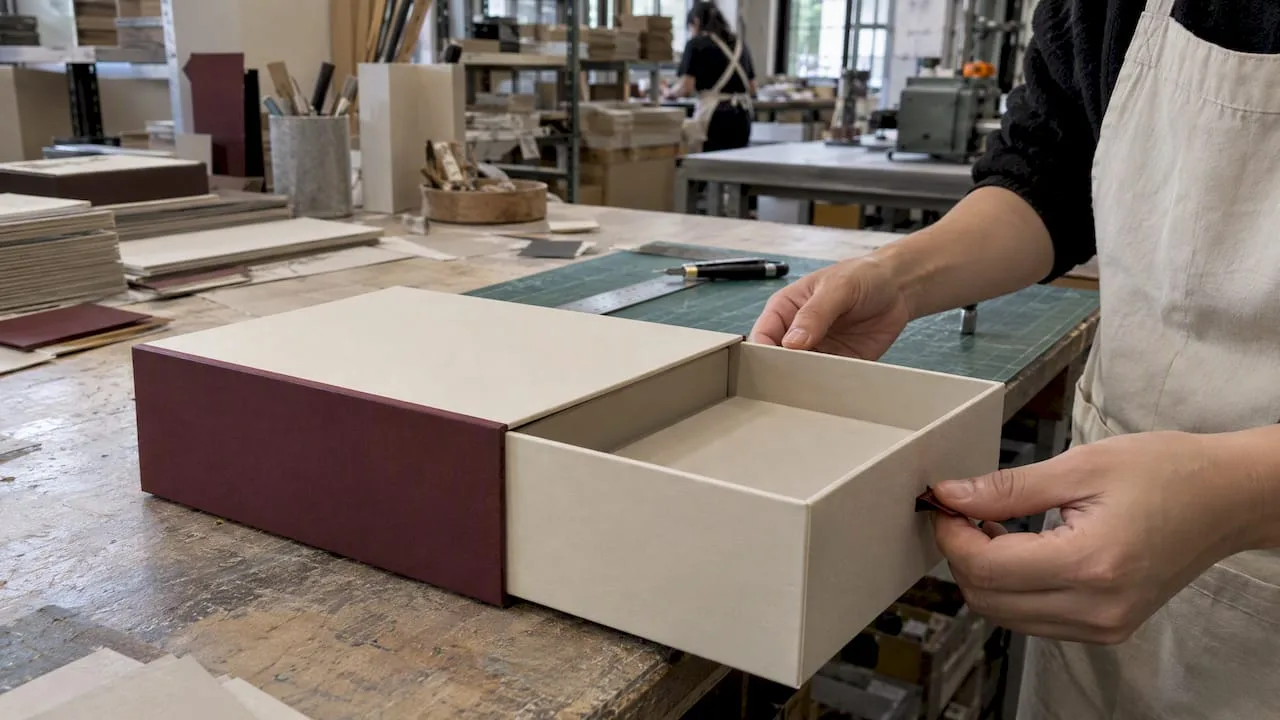
For premium retail presentation and product protection, specify a custom rigid drawer box with a tailored insert. For cost-conscious e-commerce runs, a printed cardboard slide box delivers similar structure at lower weight and cost. Before committing to either, request a sample or physical proof to catch fit issues early, and ask your manufacturer for a recyclability assessment so the finished pack meets current circularity expectations.
TL;DR: Rigid slide-with-sleeve boxes are best for premium products like spirits and cosmetics, offering a weighted feel that signals quality. Kraft board and micro-flute options provide lighter, more affordable alternatives, with finishes like soft-touch or gloss influencing perceived value. Foil stamping and embossing significantly boost shelf appeal, while environmentally friendly design favors separable coatings and minimal non-recyclable components. Minimum order quantities are higher for custom rigid boxes due to tooling needs, but printed cardboard slide boxes allow smaller batch orders. Request a physical sample and a recyclability assessment early in the process to prevent fit issues and ensure compliance with circular economy standards.
Table of Contents
- Which drawer box style fits your product and channel?
- How board choice and finishes change performance
- Customization choices that actually move perceived value
- Sizing, dielines, and artwork: a practical spec checklist
- Pricing, MOQ, and realistic turnaround expectations
- Sustainability and recyclability: standards-driven design rules
- Balancing brand impact, protection, and circularity
- How Yuan Packaging helps with samples, quoting, and next steps
- Sources
- FAQ
Which drawer box style fits your product and channel?
Drawer box packaging comes in several distinct constructions, and matching the right one to your product category prevents both overspending and underperformance on the shelf. The classic rigid slide-with-sleeve box uses a sturdy inner tray that slides into a printed outer sleeve, giving spirits and premium beauty brands a satisfying, weighted open. A matchbox or slipcase variant works the same way at a smaller scale, well suited to jewelry, small electronics, or sample kits where the ceremony of opening matters more than shelf footprint.
Printed cardboard slide boxes trade some of that heft for a lighter, more shippable format, a practical choice when unit economics depend on freight cost. Micro-flute foldable alternatives go a step further, offering similar brand presentation while folding flat for storage and transport with significantly reduced weight.
- Rigid slide-with-sleeve: best for spirits, premium cosmetics, and gifting where tactile weight signals value.
- Matchbox/slipcase: suited to small, high-value items like jewelry or sample sets.
- Printed cardboard slide: a lower-cost option for retail or subscription boxes shipped in volume.
- Micro-flute foldable: useful when shipping weight and flat-pack storage outweigh the need for rigid stiffness.
How board choice and finishes change performance
The board you specify determines how a drawer box feels, how it ships, and how it behaves at end of life. SBS (solid bleached sulfate) rigid board gives the stiffest wall and the most premium hand-feel, but it adds shipping weight and typically costs more per unit. Kraft board offers a warmer, more natural surface at a lower cost, often favored by brands leaning into an eco-conscious story. Micro-flute sits between the two, holding its shape well while cutting weight versus a fully assembled rigid box.
Surface finishes change perception as much as structure does. Soft-touch lamination adds a velvety texture that reads as premium before a customer even opens the box, while gloss finishes reflect light and suit bold, color-forward branding. Foil stamping and embossing add dimensional detail that catches attention on a shelf, though each additional finish adds a production step and, often, a separate coating or film layer.
- SBS rigid board: maximum stiffness and premium feel, higher weight and cost.
- Kraft board: lighter, cost-efficient, and visually aligned with sustainability messaging.
- Micro-flute: a middle ground on stiffness and weight, often foldable for storage.
- Finishes: soft-touch, gloss, foil, and embossing each shift perceived value and production complexity.
Coatings and laminates can complicate recycling if they are not separable from the fiber during repulping, so specifying finishes with recovery in mind matters as much as how they look.
Pro Tip: Ask your supplier which finishes are compatible with standard repulping before finalizing artwork, not after the first production run.
Customization choices that actually move perceived value
Not every customization option delivers the same return. Printing method is the first decision: offset printing gives the sharpest color and lowest per-unit cost at higher volumes, while digital printing suits shorter runs or frequent design changes without the setup cost of plates. For most launch-size orders, the breakeven point favors offset once you’re ordering several thousand units.
Among finishes, foil stamping and blind embossing consistently register as high-value cues to a customer picking up the box, more so than secondary effects like spot gloss or pattern overlays that add cost without a comparable lift in perceived quality. Windows can showcase a product directly but require a separate film or acetate component, which adds a step to end-of-life separation.
Inserts deserve equal attention. Foam inserts protect fragile or irregularly shaped items but are harder to recycle alongside the fiber box. Die-cut paper inserts are cheaper and more recyclable, appropriate for lighter products. Molded pulp inserts split the difference, offering decent protection with a fiber-based composition that pairs more cleanly with a paper box.
- Offset printing: best for larger runs needing precise color matching.
- Digital printing: better for short runs or frequent design iterations.
- Foam, die-cut paper, or molded pulp inserts: chosen by fragility, weight, and recyclability priorities.
Sizing, dielines, and artwork: a practical spec checklist
Getting dimensions and files right the first time saves a round of costly rework. Before you send specs to a manufacturer, work through these steps in order.
- Measure the product at its widest, tallest, and deepest points, then add tolerance (typically 2 to 3 millimeters per side), so the drawer slides without friction.
- Confirm orientation, especially if the product will be stacked or shipped in multiples, since drawer boxes behave differently under lateral pressure than under top-down weight.
- Request or build a dieline that clearly marks bleed, safe area, fold lines, glue tabs, and any window placement, since a dieline missing one of these details is the single most common cause of production delay.
- Prepare artwork files in vector format (AI or EPS) with a CMYK or Pantone color profile and any spot colors called out explicitly, rather than left to the printer’s interpretation.
- Request a hardproof or physical prototype before committing to a full production run, particularly if the design includes foil, embossing, or a window, since these elements rarely translate perfectly from a digital rendering.
Pro Tip: Keep a labeled master file of every dieline revision; drawer box specs often go through two or three rounds before the final proof, and version confusion is an easy, avoidable cost.
Pricing, MOQ, and realistic turnaround expectations
Unit cost on a drawer box is driven primarily by material choice, the number and type of finishes, whether custom tooling is needed for an unusual shape, and order quantity. Inserts add a separate line item, particularly foam or molded pulp, which require their own tooling.

Minimum order quantities vary meaningfully by construction. Custom rigid drawer boxes typically carry a higher MOQ because of the tooling investment, while printed cardboard slide boxes can often be ordered in smaller batches since they rely on standard die-cutting rather than custom rigid forms.
Lead times follow a similar pattern. Sample and proof turnaround is generally the shortest phase, with full production runs taking longer once tooling, printing, and finishing are all factored in. Ordering well ahead of a launch date and finalizing artwork before requesting a hardproof are the two most reliable ways to shorten the overall timeline.
- Material and finishing are the largest drivers of per-unit cost.
- Custom rigid boxes generally carry higher MOQs than printed cardboard slides.
- Confirming artwork early reduces the risk of delays during the proofing stage.
Sustainability and recyclability: standards-driven design rules
Fiber-based cartons, including coated versions with polymeric layers, are recyclable in conventional recycling mills when designed to allow fiber recovery during repulping, according to an ECMA statement on folding cartons. That position holds that coated cartons can be separated effectively in the recycling process, with most of the fiber recovered.
Design choices still matter. Minimize non-separable plastic components, choose windows that can be removed before repulping rather than permanently bonded ones, and keep adhesive and ink coverage to what’s functionally necessary. The 4evergreen Circularity by Design Guideline refines compatibility criteria for adhesives, coatings, and inks, and adds a dedicated focus on sorting disruptors, flagging small integrated components that risk diverting an otherwise recyclable pack into the wrong waste stream.
Buyers who need to validate recyclability for a retailer or regulatory requirement should request a formal assessment rather than rely on a general claim.
Ask your supplier to test against a recognized protocol such as the CEPI Laboratory Recyclability Test Method, and request the full lab report rather than a simple pass or fail summary so you can see fiber yield and contaminant risk directly. For broader packaging optimization, ISO 18602 offers a framework for minimizing material content while keeping the pack functional.
Balancing brand impact, protection, and circularity

The physical weight and texture of a box set a quality expectation before a customer sees what’s inside, a point well understood in packaging psychology. That’s the real argument for a rigid drawer box: it’s worth the added cost when unit margin and shelf position justify a premium first impression, not as a default for every SKU.
A packaging manufacturer with experience across beauty, spirits, and lifestyle categories combines hand-finishing craft with automated production to keep specialized finishes and recyclable material choices consistent across large orders.
— Anthony
How Yuan Packaging helps with samples, quoting, and next steps
Choosing between a rigid drawer box and a lighter printed alternative gets easier once you can hold a physical sample instead of guessing from a rendering. Some manufacturers produce rigid gift boxes, folding cartons, and the finishing work that goes with them, including foil, embossing, and soft-touch lamination, under one facility so material choices and recyclability questions get resolved in one place instead of across multiple vendors.
- Upload your dieline or artwork so the team can confirm dimensions and finishing feasibility.
- Request a sample before committing to a production quantity.
- Ask for a recyclability assessment if you need to validate your pack for a retailer or regulatory requirement.
Visit the Yuan Packaging product catalog to start a quote, or review the company’s full capabilities if you want background before reaching out.
Sources
- 4evergreen: Circularity by Design Guideline
- The Recyclability of Folding Cartons (ECMA statement)
- ISO 18602:2013 - Packaging and the environment — Optimization of the packaging system
FAQ
What is drawer box packaging used for?
Drawer box packaging is a rigid or semi-rigid structure where an inner tray slides out of an outer sleeve, commonly used for spirits, premium cosmetics, and gift sets where the opening experience matters. It’s chosen over a simple folding carton when a brand wants added weight, stiffness, and a slower, more deliberate unboxing moment.
Are drawer boxes recyclable?
Fiber-based drawer boxes, including coated versions, are recyclable in conventional recycling mills when designed for fiber recovery, according to an ECMA statement. Non-separable plastic windows or foam inserts can complicate that process, so design choices still affect the actual outcome.
What is the minimum order quantity for custom drawer boxes?
Minimum order quantities depend on construction type: custom rigid drawer boxes generally carry a higher MOQ because of the tooling required, while printed cardboard slide boxes can often be ordered in smaller batches. Exact figures vary by supplier and are best confirmed directly during quoting.
How do I get a sample before committing to a full production run?
Most manufacturers, including Yuan Packaging, offer a sample or hardproof stage before mass production, which lets you check fit, finish, and color accuracy on the physical box. Requesting this step early catches specification errors that are far cheaper to fix before tooling than after.