Custom Drawer & Slide Rigid Boxes
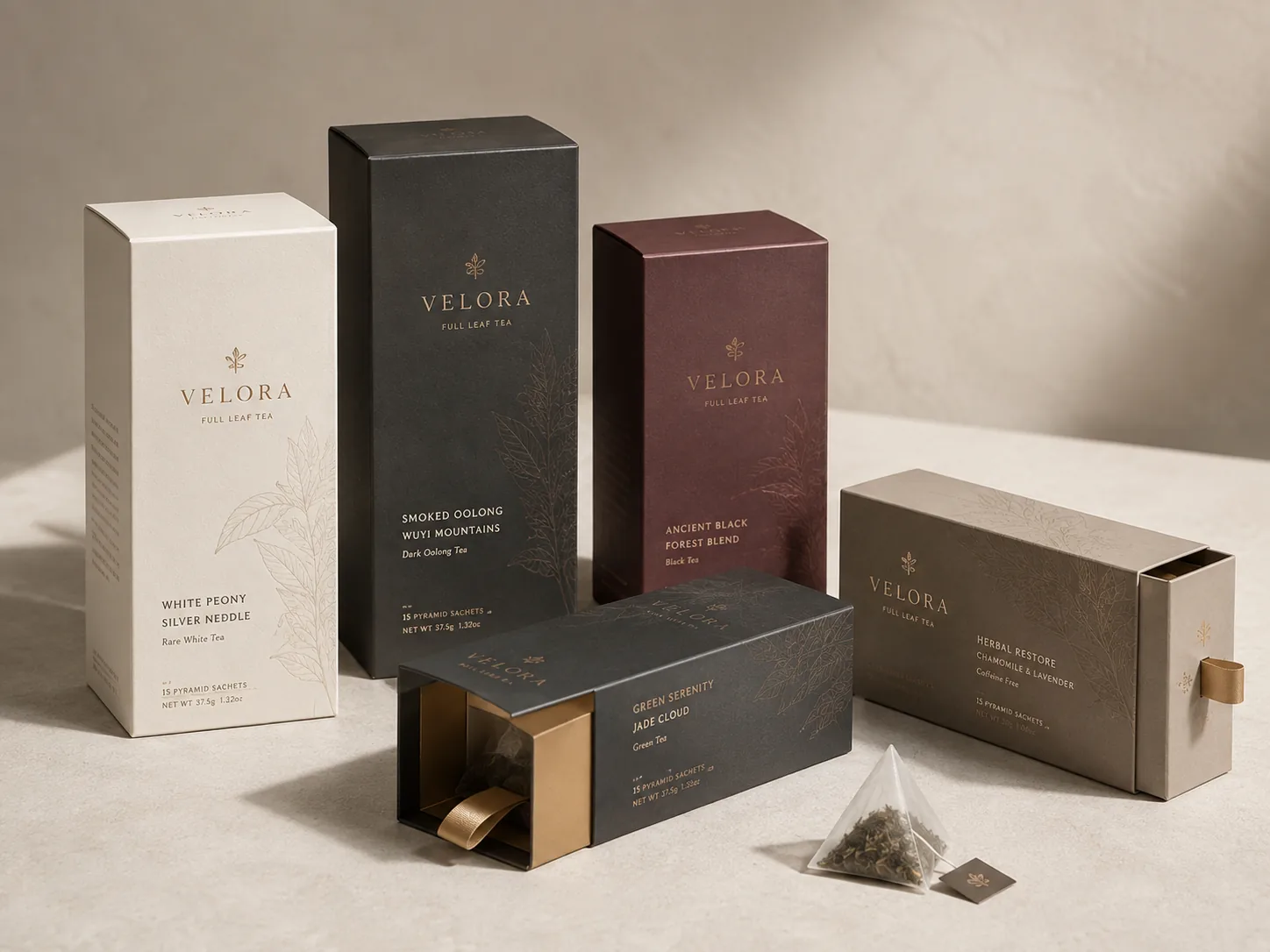
A tray that draws out of a sleeve — the structure that turns opening into a deliberate, two-handed gesture.
At a glance
- Minimum order quantity
- Typically 500–1,000 units for premium gift boxes with complex finishing
- Sampling
- Presentation-quality sample in 5–7 working days. The sample cost is credited against your first approved production order.
- Production lead time
- 15–20 working days after artwork approval; complex gift boxes 25–30 working days
- Delivery to Europe
- DDP or DAP to the EU and the UK, DDP to Switzerland; your customs broker confirms duty and VAT rates
- Production
- Made to order (OEM/ODM)
- Country of origin
- Huai'an, Jiangsu, China
- Sleeve & Tray
- Ribbon Pull
- Fitted Inserts
- Space Efficient
- Foil & Emboss
Overview
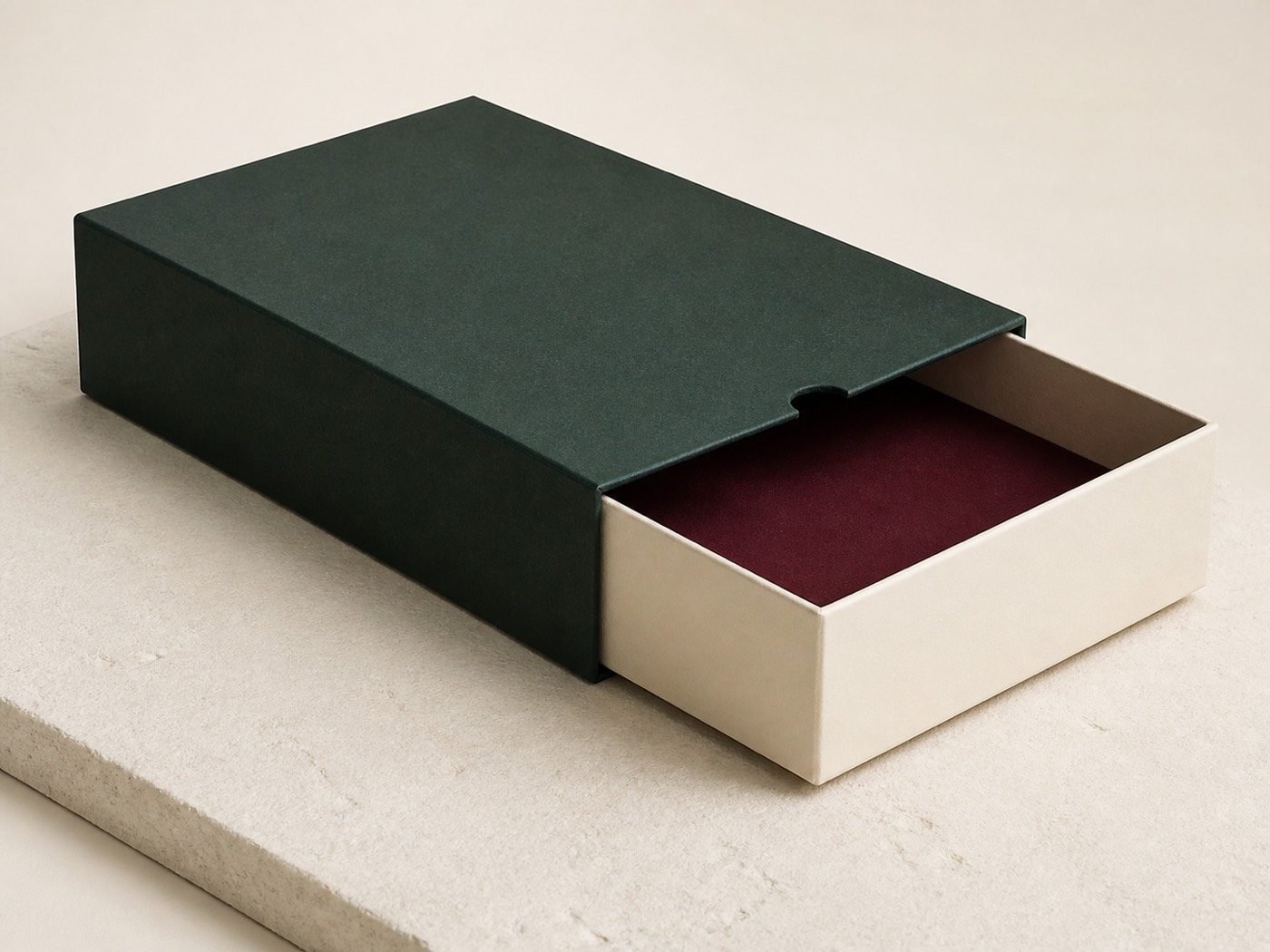
A drawer box is a wrapped sleeve with a tray inside it. Opening means holding the sleeve and drawing the tray out, which takes two hands and a second longer than lifting a lid — and that extra second is the whole point. It is the structure brands choose when the reveal matters more than speed.
The engineering sits in the friction between tray and sleeve. Too loose and the tray slides out in a bag; too tight and it needs a tug that feels wrong on a premium product. We set the clearance at sampling, and where the tray is deep or heavy we add a ribbon or die-cut pull so the force is applied where the structure can take it.
It is also efficient in a way that is easy to miss: with no lid overhanging the base, a drawer box uses close to its full external footprint internally, so it fits more product into the same shelf and carton space than a telescoping box of the same size.
Variants
Single Drawer
One tray in a sleeve — the standard, and the most economical of the drawer formats.
Double Drawer
Two trays drawing from opposite ends or stacked, for sets that should be discovered in sequence.
Ribbon-Pull Drawer
A ribbon loop set into the tray face. Necessary on deep or heavy trays, decorative on shallow ones.
Die-Cut Pull Drawer
A finger aperture cut into the sleeve or tray. No hardware, no ribbon, and nothing to snag in transit.
Drawer with Fitted Insert
EVA, card or satin-lined cavities so the contents stay in place as the tray moves.
Selected work
Across the Rigid Gift Boxes range
This page covers what is particular to this product. The full lists for the whole range are set out once, on the Rigid Gift Boxes page:
What applies to this product
- Materials
- Greyboard; Coated One Side (C1S); Textured & Felt-Marked; Leather Grain
- Printing & Finishes
- Hot Foil Stamping; Embossing; Spot UV; Soft-Touch Lamination
What you can customise
- Internal dimensions built around your product
- Board thickness against weight and opening feel
- Wrap material, print and finishing combination
- Insert material, cavity layout and lining colour
- Ribbon, closure and hardware detail
- Export carton count and pallet configuration
Specifications
| Minimum order quantity | Typically 500–1,000 units for premium gift boxes with complex finishing |
|---|---|
| Production lead time | 15–20 working days after artwork approval; complex gift boxes 25–30 working days |
| Printing | Koenig & Bauer Rapida 106 eight-colour offset — CMYK and Pantone spot colours |
| Box forming | Two Hongming 6418K automated box lines, with hand wrapping and assembly for detail work |
Terms for this specification
- Sampling
- Presentation-quality sample in 5–7 working days. The sample cost is credited against your first approved production order.
- Colour matching
- Pantone references and physical samples are used where the selected print process supports them. The approval method follows the substrate, artwork and process.
- Certifications
- ISO 9001, ISO 14001:2015, ISO 45001 and China Environmental Labelling (Ten-Ring). ISO 22000 applies to eligible food-contact work.
- Sustainable options
- FSC-certified or recycled-content paper and board, water-based inks and adhesives, and fibre-based fitments are available where the selected construction supports them.
Design & artwork
From an artwork check, through a dimensioned dieline and print-ready files, to a full concept package across a range — done by the factory that will make it.
Applications
Jewellery & Watches
Small drawer boxes with lined cavities, where the draw-out reveal suits the product value.
Beauty & Fragrance
Sample sets and discovery kits presented in sequence as the tray comes out.
Spirits & Gifting
Bottle and accessory sets where the sleeve carries the print and the tray carries the product.
Confectionery
Divided trays holding portions in place, with the sleeve doing the branding.
Why Yuan Packaging
- Two Hongming 6418K automated box lines plus hand finishing on every structure
- Presentation-quality structural sample in 5–7 working days, credited against your first order
- Printing, foil, embossing and lamination applied in-house before wrapping
- Rigid boxes produced for Chinese spirits houses including Guoyuan and Yanghe distilleries
Frequently asked questions
How tight should the drawer be?
Tight enough that the tray cannot slide out in a bag, loose enough that it draws with one steady pull. Clearance is set at sampling because it depends on board thickness and wrap tension — it is not a number that can be specified in advance.
Does a drawer box need a ribbon pull?
On a deep or heavy tray, yes — without one the customer grips the tray edge and eventually damages the wrap. On a shallow tray it is a design choice. A die-cut finger aperture does the same job with nothing added.
Is it more expensive than a lid and base box?
Usually slightly, because the sleeve and tray are two wrapped components that have to fit each other. Against that, the internal volume is better used, which sometimes lets you drop a size.
What should we send for a drawer box quote?
The product, or its dimensions and weight, since a deep or heavy tray needs a ribbon or die-cut pull; one drawer or two; any fitted insert; the artwork and finishes for the sleeve, which usually carries the print; two or three quantities; and the destination country. The clearance between tray and sleeve is then set at sampling.
From the Journal
Related products
Request a custom packaging quote
What to send for a quote
- The product it is for, and the format you have in mind
- Size as length × width × height, and whether those are inside or outside dimensions
- Quantity, or two or three quantities if you want to compare unit prices
- Material and finish preferences, or the look you are after
- Artwork status: print-ready files, a draft, or nothing yet
- The date you need the goods by
- The destination country
Missing some of these? Send what you have, and we will ask about the rest.