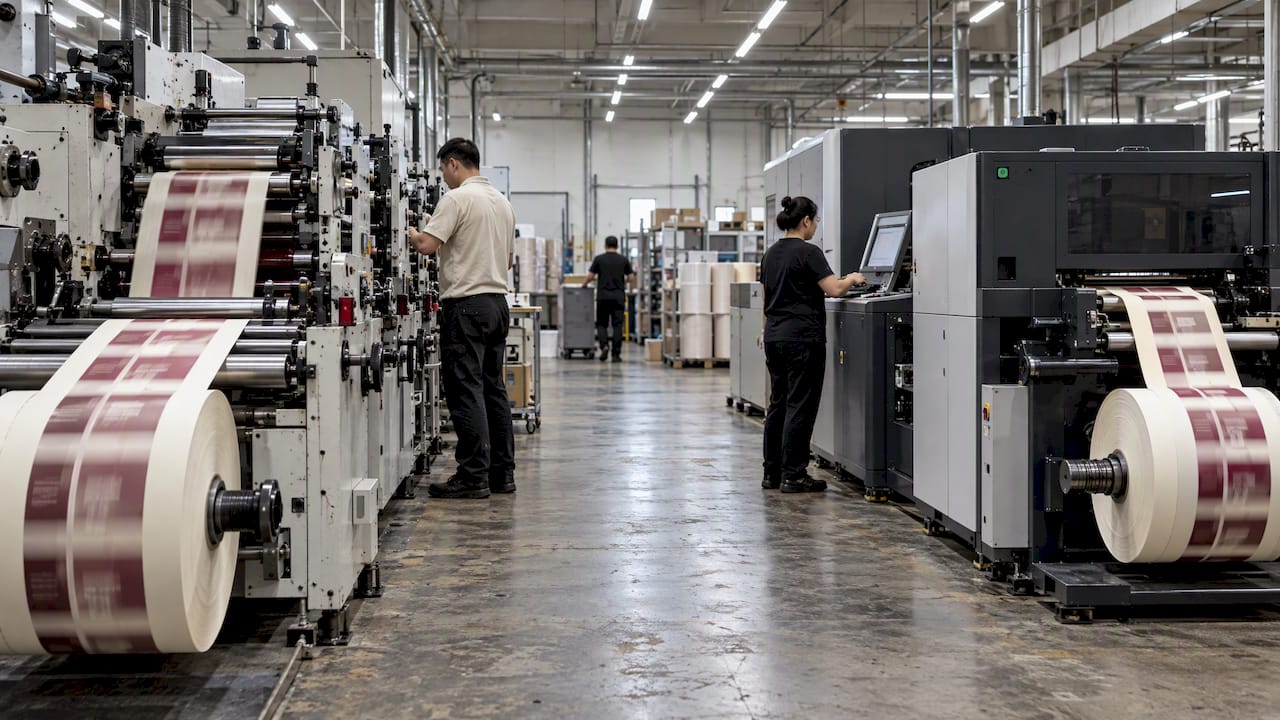
For short runs and versioned labels, digital usually wins. For medium to high stable-volume runs that need specialty inks or complex finishing, flexo usually wins. The decision comes down to three factors: cost per unit at your run length, the substrate and finish you need, and how fast you need product on shelf. We work with both processes daily, and the right answer almost always depends on your specific job rather than a blanket preference for one technology.
TL;DR:
- Flexo’s break even point shifts with plate costs, make ready waste, SKU count, artwork complexity, and finishing, so request per unit quotes at three volumes.
- Flexo reaches 1,400 feet per minute, but setup can take hours; digital runs at 184 feet per minute and reaches production sooner.
- Clear or metallized films often favor flexo for opaque white, while food and pharmaceutical packaging may require approved ink systems and migration testing.
- For runs below a few thousand units or variable data, request a digital proof; for high volumes with specialty inks, request a flexo sample.
Table of Contents
- 1. Cost and run-length economics: how to estimate the break-even
- 2. Print quality, color, and finishing: what each process reliably delivers
- 3. Speed, turnaround, and production planning
- 4. Substrate compatibility and finishing constraints
- 5. How to choose: checklist and exact questions to ask your printer
- 6. How Yuan Packaging applies these trade-offs in real projects
- 7. Limitations and constraints of each printing method relevant to packaging applications
- Industry perspective: coexistence, hybrid trends, and what buyers should expect next
- Yuan Packaging call to action: request a sample or estimate
- FAQ
- Sources
1. Cost and run-length economics: how to estimate the break-even
Flexo carries real setup costs. Plates, mounting, and press make-ready all happen before a single good label rolls off the press, and that investment only pays off once you spread it across enough units. Digital, by contrast, needs almost no setup. There are no plates to engrave or mount, so the first unit costs nearly the same as the thousandth.
Make-ready waste is the other half of the equation. Flexo presses need several hundred feet of substrate to get color, registration, and tension dialed in before production-quality output begins, and that waste gets priced into your job whether anyone mentions it or not. Digital presses produce usable output from the first impression, which matters most when you are running many SKUs in small batches.
A simple way to estimate your crossover: add your flexo plate and make-ready cost to your flexo unit cost times quantity, then compare that total to your digital unit cost times the same quantity. The volume where the two lines cross is your break-even point, and it shifts with every variable in your job.
- Plate cost and press make-ready waste raise flexo's fixed cost, but that cost gets diluted as volume grows.
- Digital's near-zero setup cost makes it cheaper per unit at low volumes, but that per-unit cost stays flat rather than dropping with scale.
That crossover point is not a fixed number. SKU proliferation, artwork complexity, and finishing steps all move it, as does how efficiently a given converter runs make-ready and plate changeovers. Readers comparing options across a wider range of run sizes may find our breakdown of offset versus digital economics useful for mapping a specific project.
Pro Tip: Ask any printer for their per-unit cost at three volumes, not one. A single quote hides where the crossover actually sits.
2. Print quality, color, and finishing: what each process reliably delivers
Flexo built its reputation on solid ink coverage and specialty capability. Anilox rollers, or the quick-change sleeves many converters now use, meter ink onto the plate with precision, and cell volume and linescreen selection give operators direct control over density and tonal range. That control is why flexo still dominates for opaque whites, metallics, and heavy solids on film and flexible packaging.

Digital's strength runs in a different direction. High-resolution imaging handles photographic detail and gradient work without the dot gain that can plague flexo on certain substrates, and there are no plates standing between an approved file and a printed label. That makes digital the natural choice for variable data, short-run versioning, or any job where design changes mid-cycle.
The gap between the two has narrowed. Recent installations of high-performance water-based inkjet presses demonstrate that digital output can approach flexo and gravure quality on many jobs, while still delivering the short-run flexibility digital is known for.
- Foil stamping, embossing, and soft-touch lamination remain largely post-press operations applied after either process, though flexo stations can sometimes add specialty coatings in-line.
- Beauty and spirits labels that demand premium finishes often benefit from a hybrid approach: digital printing for the image and variable data, flexo or in-line finishing for the tactile effects.
Our guide to finishes and print effects covers which tactile treatments pair best with each base process.
3. Speed, turnaround, and production planning
Large flexo presses can run at 1,400 feet per minute or more for high-volume production, while modern industrial digital presses reach roughly 56 meters per minute, about 184 feet per minute, according to reporting on current digital press platforms. That gap matters once you are running tens of thousands of units: flexo's raw throughput wins the race, but only after its make-ready is done.
Make-ready is where flexo loses time. Mounting plates, dialing in anilox-to-plate contact, and running waste stock to hit color can take hours before production starts. Digital presses skip most of that. A job can move from approved file to finished roll in a fraction of the time, which is why digital dominates for fast-turn or reorder situations.
That speed advantage changes how brands manage inventory. On-demand digital runs mean smaller batches ordered more often, reducing the working capital tied up in printed stock. For promotional labels, regional versions, or anything with a short shelf life, turnaround can matter more than the per-unit cost difference.
4. Substrate compatibility and finishing constraints
Your material choice narrows the field before cost ever enters the conversation.
- Uncoated and coated paper stocks run well on both flexo and digital presses, with few adhesion issues for either.
- PET and other clear or metallized films often favor flexo for opaque white ink laydown, though modern digital platforms handle many film jobs successfully.
- Food-contact and pharmaceutical packaging may require specific ink systems and migration testing regardless of process, so ink approvals need to be confirmed for your substrate rather than assumed.
- Heavily laminated or multi-layer structures sometimes call for a hybrid workflow, printing digitally for variable content and finishing on a flexo or converting line for coatings and die-cutting.
Priming and surface treatment can be the deciding factor on difficult films for either process, so it is worth asking your printer directly rather than assuming compatibility based on substrate type alone.
5. How to choose: checklist and exact questions to ask your printer
Before requesting a quote, work through six decision points: run length, SKU count or versioning needs, color and finish requirements, substrate, turnaround window, and budget ceiling. Answering these first keeps the conversation with your printer focused and fast.
- What is your expected make-ready waste on this job, and how is it priced into the quote?
- What does the plate cost run, and does that cost amortize across future reorders?
- What ink approvals or substrate testing does this material require?
- Can you provide a physical proof or sample before full production?
- Does your finishing line support the foil, emboss, or lamination this project needs?
- What is the realistic lead time from approved art to delivery?
A short decision flow helps here: if your run is under a few thousand units or includes variable data, request a digital proof first. If you need high volumes with specialty inks or heavy solids, request a flexo sample instead. When you need both digital personalization and special in-line effects on the same job, ask about a hybrid production line.
Pro Tip: Get both a flexo and digital quote on your first order, even if you think you already know the answer. The numbers sometimes surprise buyers who assumed volume alone decided the question.
6. How Yuan Packaging applies these trade-offs in real projects
Over more than 25 years and 100 million units delivered to 5,000 brands worldwide, we have matched process to project often enough to know that the right call depends on the details of each run, not a general rule. We evaluate run length, finish complexity, and substrate together before recommending a path, rather than defaulting to one process for every client.
- We assess SKU count and versioning needs early, since that often points toward digital before cost does.
- We weigh finish requirements, like foil stamping or soft-touch lamination, against substrate compatibility to avoid rework later.
- We point clients toward our label product line or artwork preparation guidance once the process decision is clear, so files are built right the first time.
7. Limitations and constraints of each printing method relevant to packaging applications
Flexo's biggest constraint is inflexibility once plates are made. A design change after plates are cut means new plates, new cost, and new make-ready waste, which makes flexo a poor fit for packaging that changes often or needs individual serialization. Flexo also struggles with very fine photographic detail compared with digital, since dot gain on certain substrates can soften gradients and fine type.
Digital's constraints sit on the other side of the ledger. Per-unit ink and consumable costs stay flat rather than dropping with volume, so a very large run can end up costing more on digital than it would on flexo once plate costs are amortized. Digital presses also have narrower substrate ranges on some platforms, and certain specialty effects, like heavy opaque whites on film or in-line coatings, still favor flexo's ink delivery system. Neither limitation is fatal. Both point to matching the process to the job rather than treating one as universally superior.

Industry perspective: coexistence, hybrid trends, and what buyers should expect next
Flexo and digital are not racing toward a winner. Industry analysis describes the two as complementary: flexo remains the backbone for high-volume runs, while digital absorbs the growing demand for personalization and SKU proliferation, with hybrid platforms expanding rapidly. Adoption data confirms flexo still carries the larger share of printed packaging output even as digital grows faster off a smaller base. If your SKU count is likely to grow, plan your vendor relationship around flexibility now rather than after the fact.
— Anthony
Yuan Packaging call to action: request a sample or estimate
Whichever process your project calls for, we produce custom labels, folding cartons, and the specialty finishes that beauty, spirits, and lifestyle brands ask for most. If you have a run length and finish in mind, we can walk through a sample or cost comparison with you.
Browse our full product range or go directly to custom label options to request a quote for your next run.
FAQ
What are the key differences between digital and print media?
In packaging, the key difference is setup: flexo requires plates and make-ready before production, while digital prints directly from a file with no plates. That makes digital better suited to short runs and frequent changes, while flexo suits stable, high-volume jobs.
What is a flexo press?
A flexo press uses raised rubber or polymer plates to transfer ink onto a substrate, with an anilox roller metering the ink volume before it reaches the plate. Anilox cell structure and volume control the ink laydown, which is why anilox selection is central to flexo print quality.
What are the key differences between rotary printing and digital printing?
Rotary printing, including flexo, runs continuous webs through plate or cylinder stations at high speed, well suited to long runs once make-ready is complete. Digital printing applies image data directly to the substrate with no physical plate, trading some top-end speed for near-zero setup time and easy version changes.
What is the difference between flexo and litho printing?
Flexo uses a flexible raised plate and is common on web presses for labels, folding cartons, and flexible packaging, while litho, or offset lithography, uses a flat plate and chemical ink-water separation, typically on sheet-fed presses for cartons and paperboard. Both are plate-based processes, so both carry setup costs, unlike digital printing.
How does Yuan Packaging decide between flexo and digital for a project?
We weigh run length, SKU count, finish requirements, and substrate together before recommending a process, rather than defaulting to one method. Projects needing specialty inks or high volumes typically point toward flexo, while versioned or shorter runs often point toward digital.
Sources
- Printing
- Specifying anilox sleeve: lightweight, quick-change, safe & stable — Flexographic Technical Association
- Apex International explores flexo vs. digital label printing — Label & Narrow Web
Recommended
- Save on Packaging Runs: Offset vs Digital Printing for 500–5,000+
- Label Printing for Premium Spirits
- Best pressure sensitive label printers in China 2026
- How to Prepare Artwork for Custom Printed Packaging
What are the key differences between digital and print media?
In packaging, the key difference is setup: flexo requires plates and make-ready before production, while digital prints directly from a file with no plates. That makes digital better suited to short runs and frequent changes, while flexo suits stable, high-volume jobs.
What is a flexo press?
A flexo press uses raised rubber or polymer plates to transfer ink onto a substrate, with an anilox roller metering the ink volume before it reaches the plate. Anilox cell structure and volume control the ink laydown, which is why anilox selection is central to flexo print quality.
What are the key differences between rotary printing and digital printing?
Rotary printing, including flexo, runs continuous webs through plate or cylinder stations at high speed, well suited to long runs once make-ready is complete. Digital printing applies image data directly to the substrate with no physical plate, trading some top-end speed for near-zero setup time and easy version changes.
What is the difference between flexo and litho printing?
Flexo uses a flexible raised plate and is common on web presses for labels, folding cartons, and flexible packaging, while litho, or offset lithography, uses a flat plate and chemical ink-water separation, typically on sheet-fed presses for cartons and paperboard. Both are plate-based processes, so both carry setup costs, unlike digital printing.
How does Yuan Packaging decide between flexo and digital for a project?
We weigh run length, SKU count, finish requirements, and substrate together before recommending a process, rather than defaulting to one method. Projects needing specialty inks or high volumes typically point toward flexo, while versioned or shorter runs often point toward digital.