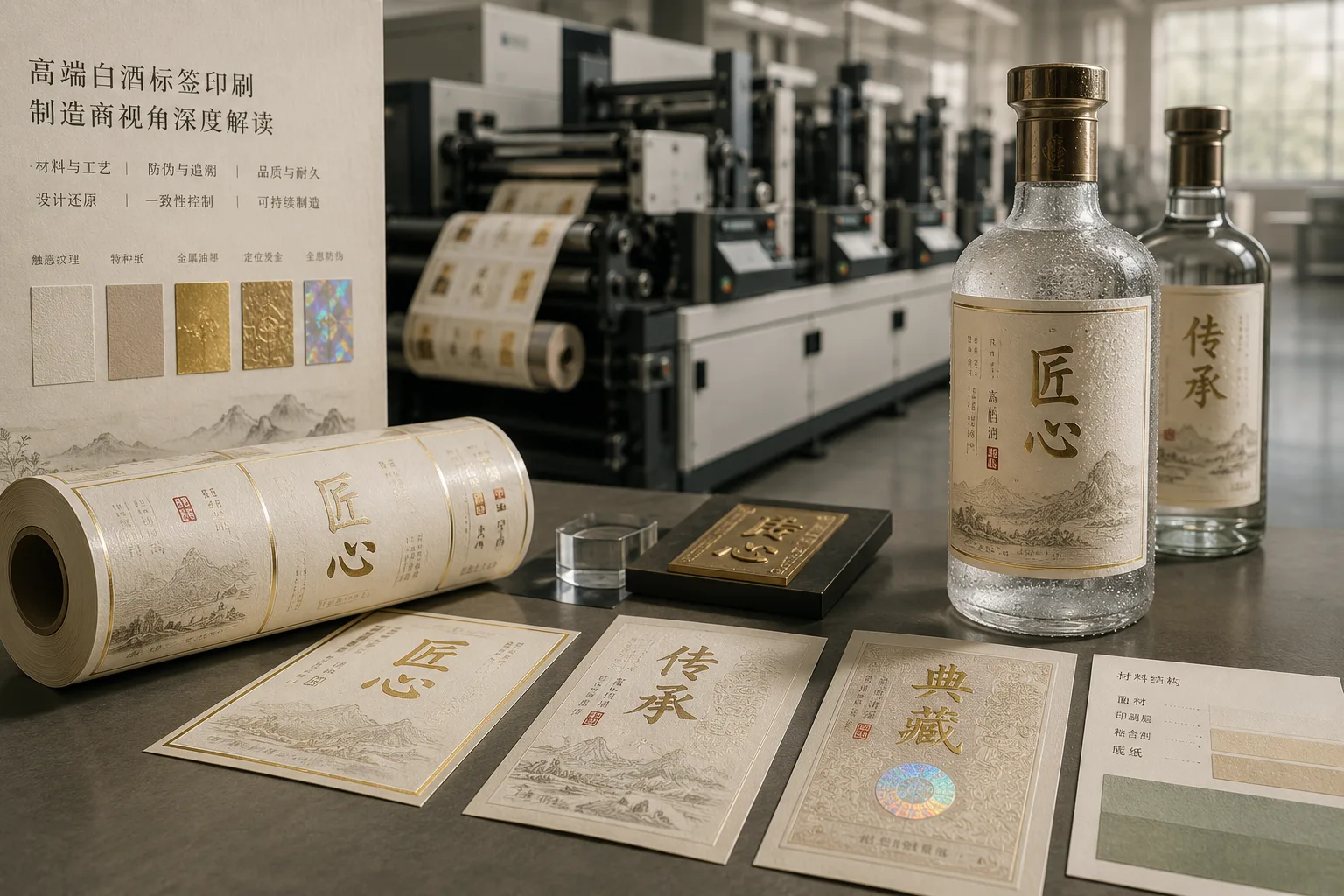
The spirits label is one of the most technically demanding applications in commercial printing. It must survive a cold, wet environment — ice buckets, condensation, refrigeration — without lifting, bubbling, or losing colour fidelity. It must read clearly at shelf in ambient retail lighting and photograph well under studio conditions. And it must carry the visual weight appropriate to a product whose price point depends partly on its perceived quality. Getting all of this right simultaneously requires both equipment capability and material knowledge.
Digital and offset label production
At Yuan Packaging, our label production line runs both digital and conventional offset and letterpress equipment, which matters because different label applications genuinely require different processes. Short-run personalised or variable-data labels, where a brand wants to produce collector editions or market-specific variants without large minimum quantities, are best produced digitally. High-volume standard labels — the core SKU of a major spirits brand — benefit from the colour consistency and special process capability of conventional printing, including our Manroland letterpress configuration.
Premium surface treatments
The surface treatments that define premium spirits labels — holographic foiling, embossing, anti-counterfeiting features — require careful sequencing in production. Embossing after foil stamping is standard; attempting the reverse risks damage to the foil. Holographic elements must be positioned with precision that conventional registration achieves reliably but that digital printing cannot always match at scale. Our production planning team designs the process sequence for complex labels before any material is committed, avoiding costly resequencing later.
Discuss your packaging project
Choosing the right substrate
Substrate selection for spirits labels deserves more attention than it typically receives. A paper label that performs beautifully in the bottling hall can fail completely after six hours in an ice bucket if the wrong adhesive or face stock has been specified. We work with a range of wet-strength papers and waterproof adhesive systems specifically tested for ice bucket immersion, and we recommend that clients developing labels for spirits applications provide us with their exact bottle geometry so we can advise on the face stock and adhesive combination that will perform under their specific conditions.
Anti-counterfeiting features
Anti-counterfeiting is an increasingly common requirement, particularly for spirits brands with significant presence in markets where counterfeiting is prevalent. Our label production capabilities include overt features — holographic elements, colour-shifting inks — and the infrastructure to integrate covert features developed in partnership with specialist security print suppliers. For brands who have not yet addressed counterfeiting at the label level, we are happy to advise on where in the market a label is most vulnerable and what the most cost-effective protective measures are.
Frequently Asked Questions
What is the difference between digital and offset label printing?
Digital printing is ideal for short runs, variable data, and collector editions with no minimum quantity. Offset and letterpress deliver superior colour consistency and special finishes for high-volume standard labels.
Can spirits labels survive ice bucket immersion?
Yes, with the right specification. We use wet-strength papers and waterproof adhesive systems specifically tested for ice bucket immersion. Provide your bottle geometry so we can recommend the optimal combination.
What anti-counterfeiting features are available for labels?
We offer holographic elements, colour-shifting inks (overt features), and can integrate covert features through specialist security print partners for comprehensive brand protection.