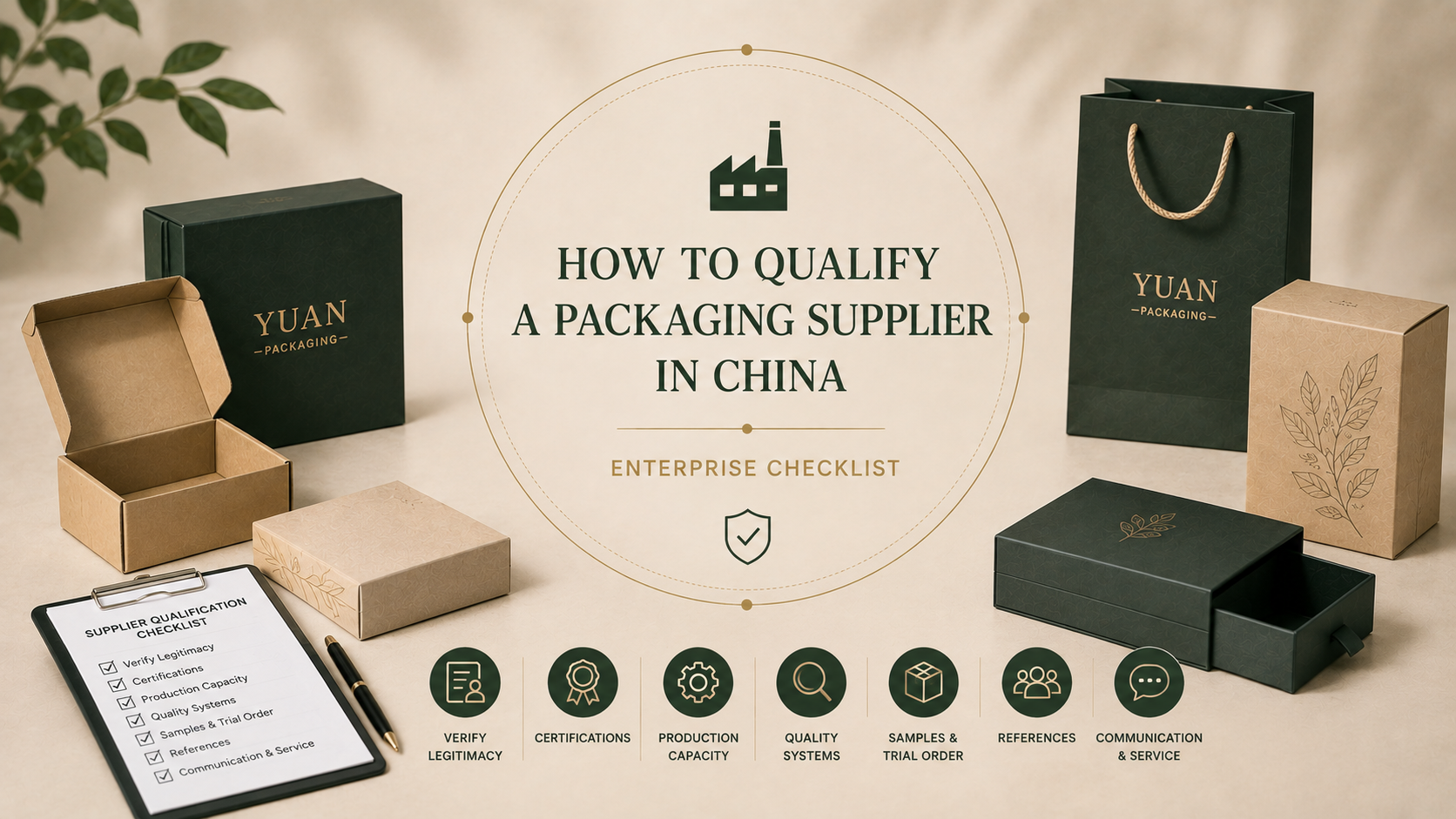
For an enterprise buyer, the choice of packaging supplier is one of the highest-risk decisions in the supply chain. A supplier that cannot hold colour, meet capacity, or pass an ethical audit can stall a launch, fail a retailer’s compliance gate, or damage a brand. Qualifying a supplier properly — before the first purchase order — is what separates a reliable annual programme from a recurring problem. This is a structured checklist procurement and packaging teams can use to qualify a manufacturer in China with confidence.
Table of contents
- Confirm it is a real factory
- Check certifications
- Assess production capacity
- Audit the quality system
- Request samples and a trial order
- Check references and track record
- Evaluate communication and account management
- Red flags to watch for
- Summary
- Frequently asked questions
Confirm it is a real factory
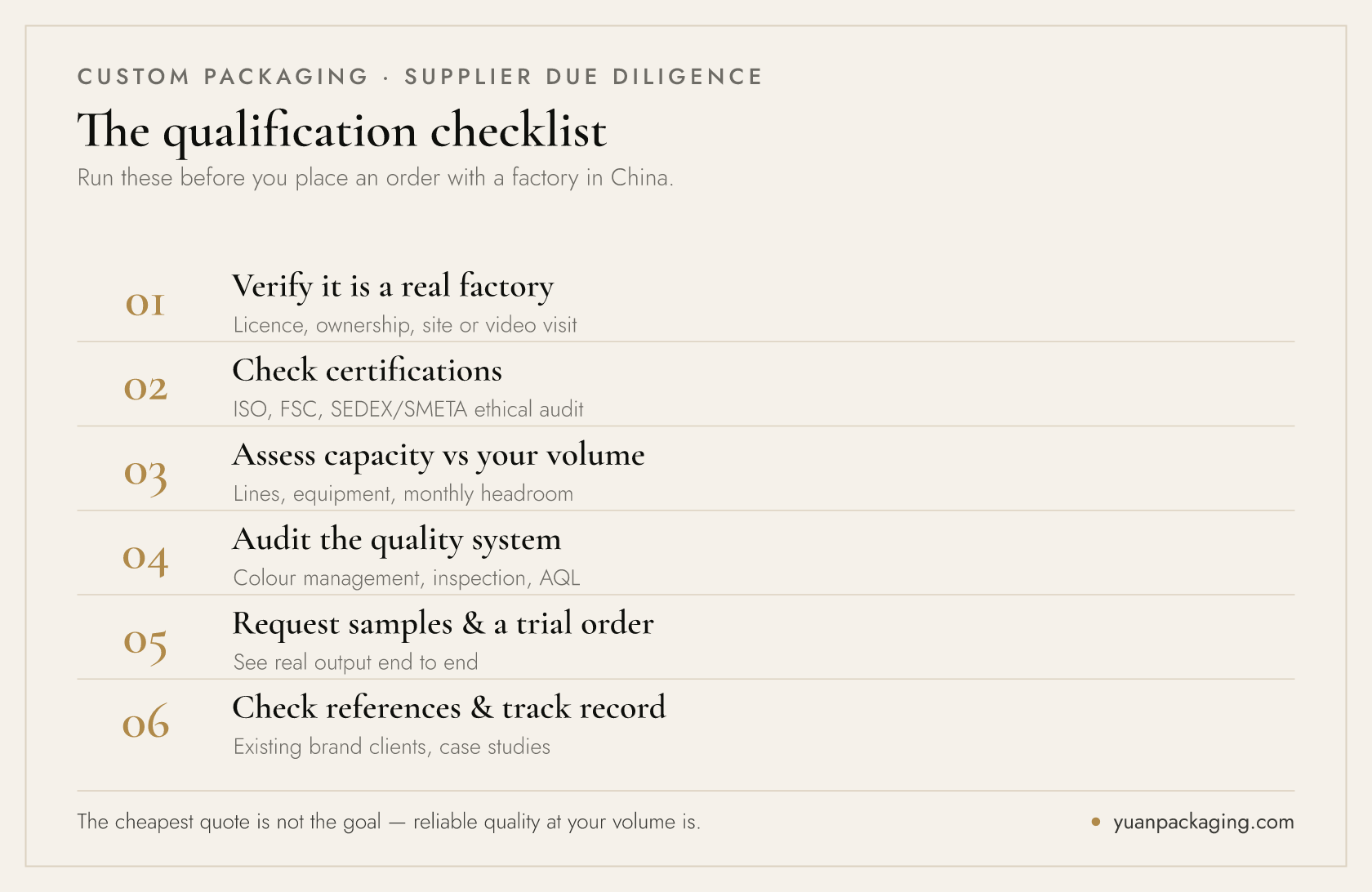
Start by confirming you are dealing with an actual factory, not a trading company. Ask for the business licence, the year the factory was established, the registered manufacturing address, and the number of employees. Request a live video walkthrough or, better, an on-site visit of the production floor. A genuine manufacturer will show you its lines openly; a trading company will deflect. Our factory and team are open to verified buyer visits and audits for exactly this reason.
Check certifications
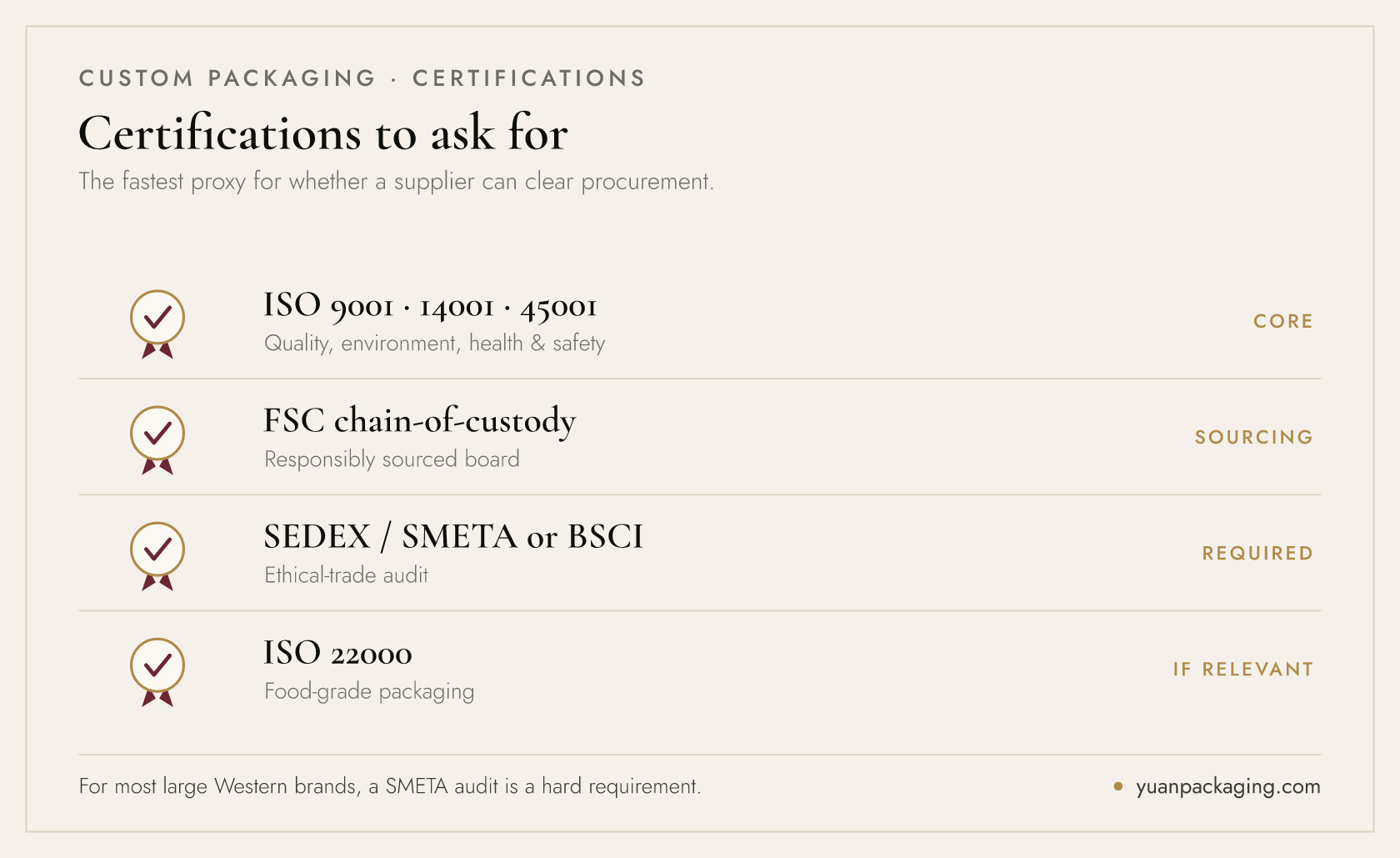
Next, check certifications — they are the fastest proxy for whether a supplier can clear procurement. Look for the core quality and environmental systems (ISO 9001, ISO 14001, ISO 45001), product-specific certifications such as ISO 22000 for food-grade packaging and FSC chain-of-custody for responsibly sourced board, and ethical-trade audits such as SEDEX/SMETA or BSCI. For most large Western brands, a SMETA audit is a hard requirement, not a preference — without it, procurement cannot approve a new supplier.
Assess production capacity
Assess production capacity honestly against your real volume. Ask how many production lines the factory runs, what equipment is on each, and the monthly capacity per product type. The key question for an enterprise programme is headroom: can the supplier comfortably run your annual volume without crowding out other clients? Our facility runs four dedicated production lines and is built for high-volume manufacturing — from 100,000-unit launches to multi-million-unit annual programmes — so scale is designed in rather than improvised.
Discuss your packaging project
Audit the quality system
Audit the quality system, not just the samples. Ask how the factory manages colour (a calibrated workflow and proofing process), at what stages it inspects (in-line versus end-of-line), how it handles defects and rework, and what AQL standard it inspects to. A supplier running a serious press operation — such as our Koenig & Bauer Rapida — should be able to explain its registration tolerance and colour consistency across a full run, not just on the first sheet.
Request samples and a trial order
Request samples and, ideally, a paid trial order before committing to volume. A physical sample confirms structure, colour, and finish against your specification, and a small trial run reveals how the supplier handles a real order end to end — communication, lead time, packing, and shipping. Our guide on shipping packaging samples covers how to get samples to you quickly for evaluation.
Check references and track record
Check references and track record. Ask which brand categories the supplier already serves, request anonymised case studies or example projects in your sector, and ask how they handle a quality issue when one arises. A supplier used to working with demanding international brands will have systems and answers ready; one that is vague about existing clients is a risk.
Evaluate communication and account management
Evaluate communication and account management — often the difference between a smooth programme and a frustrating one. Confirm you will have a responsive, English-speaking point of contact, a clear escalation path, and realistic expectations around the China time zone. For enterprise programmes, a single account owner from sampling through to delivery removes the handoffs where things usually go wrong; that is how we structure larger accounts.
Red flags to watch for
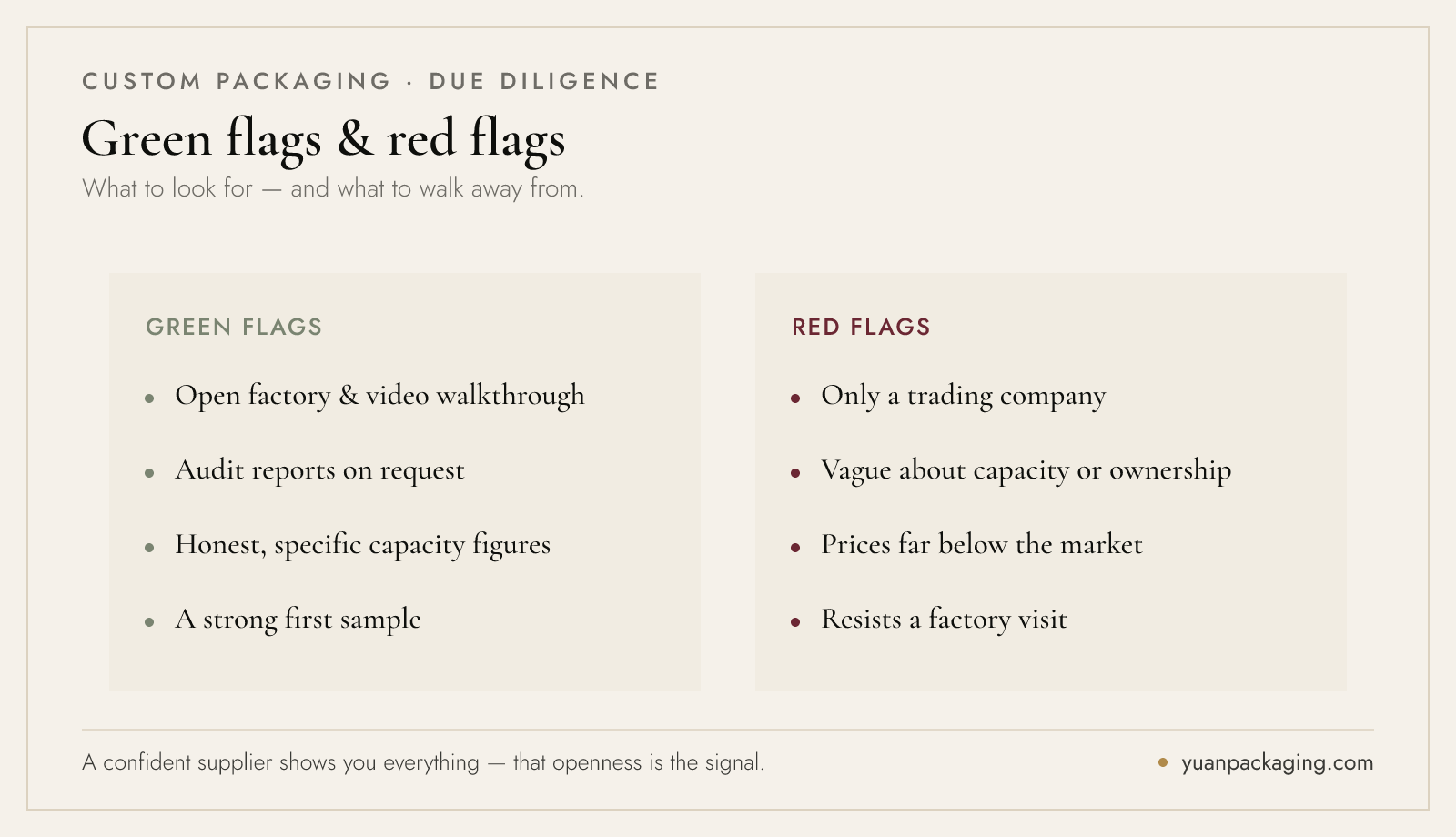
Watch for red flags throughout. Be cautious of a supplier that cannot produce audit reports, is vague about capacity or ownership, quotes prices far below the market, resists a factory visit, or sends a poor first sample. Equally, treat clear documentation, an open factory, honest capacity figures, and a strong sample as the green flags that they are. The goal is not the cheapest quote — it is a supplier who can deliver your quality at your volume, on schedule, every time.
Summary
Qualifying a supplier well is an investment that pays back across every order that follows. Run the checklist, insist on the certifications your market requires, and pressure-test capacity against your real annual volume before you commit. If you would like to evaluate us against this checklist — including an audit, a factory visit, or a capability deck for your procurement team — tell us about your programme and we will provide what your qualification process needs.
Frequently Asked Questions
How do I verify a Chinese packaging supplier is a real factory?
Ask for the business licence, year established, registered manufacturing address and employee count, then request a live video walkthrough or an on-site visit of the production floor. A genuine manufacturer shows its lines openly; a trading company deflects. Audit reports and named equipment are further proof.
What certifications should a packaging supplier have?
Look for ISO 9001 (quality), ISO 14001 (environment) and ISO 45001 (health & safety), plus product certifications such as ISO 22000 for food-grade and FSC chain-of-custody, and an ethical-trade audit such as SEDEX/SMETA or BSCI. SMETA is a hard requirement for most large Western brands.
What is a SEDEX/SMETA audit and why does it matter?
SMETA (Sedex Members Ethical Trade Audit) assesses labour, health & safety, environment and business ethics. Most large retailers and brands require a passed SMETA audit before approving a new supplier, so it is often a gating requirement for enterprise procurement rather than a nice-to-have.
Should I place a trial order before a bulk order?
Yes. Approve a physical sample first to confirm structure, colour and finish, then consider a small paid trial order to see how the supplier handles a real job end to end — communication, lead time, packing and shipping — before committing to your full annual volume.