
For a global brand, packaging is not a series of one-off purchase orders — it is an ongoing supply line that has to deliver the same quality, on time, order after order. An annual packaging programme replaces ad-hoc ordering with a structured agreement: a brand shares its forecast volume across the year, and the manufacturer reserves capacity, holds material, and schedules production around it. This is how we structure annual programmes for high-volume brands, and why procurement teams move to them.
Table of contents
- What is an annual packaging programme?
- Why brands move on from ad-hoc orders
- Step 1: Forecasting and planning
- Step 2: Capacity reservation
- Step 3: Scheduled call-offs
- A dedicated account manager
- Pricing and cost predictability
- Quality and compliance across the year
- Summary
- Frequently asked questions
What is an annual packaging programme?
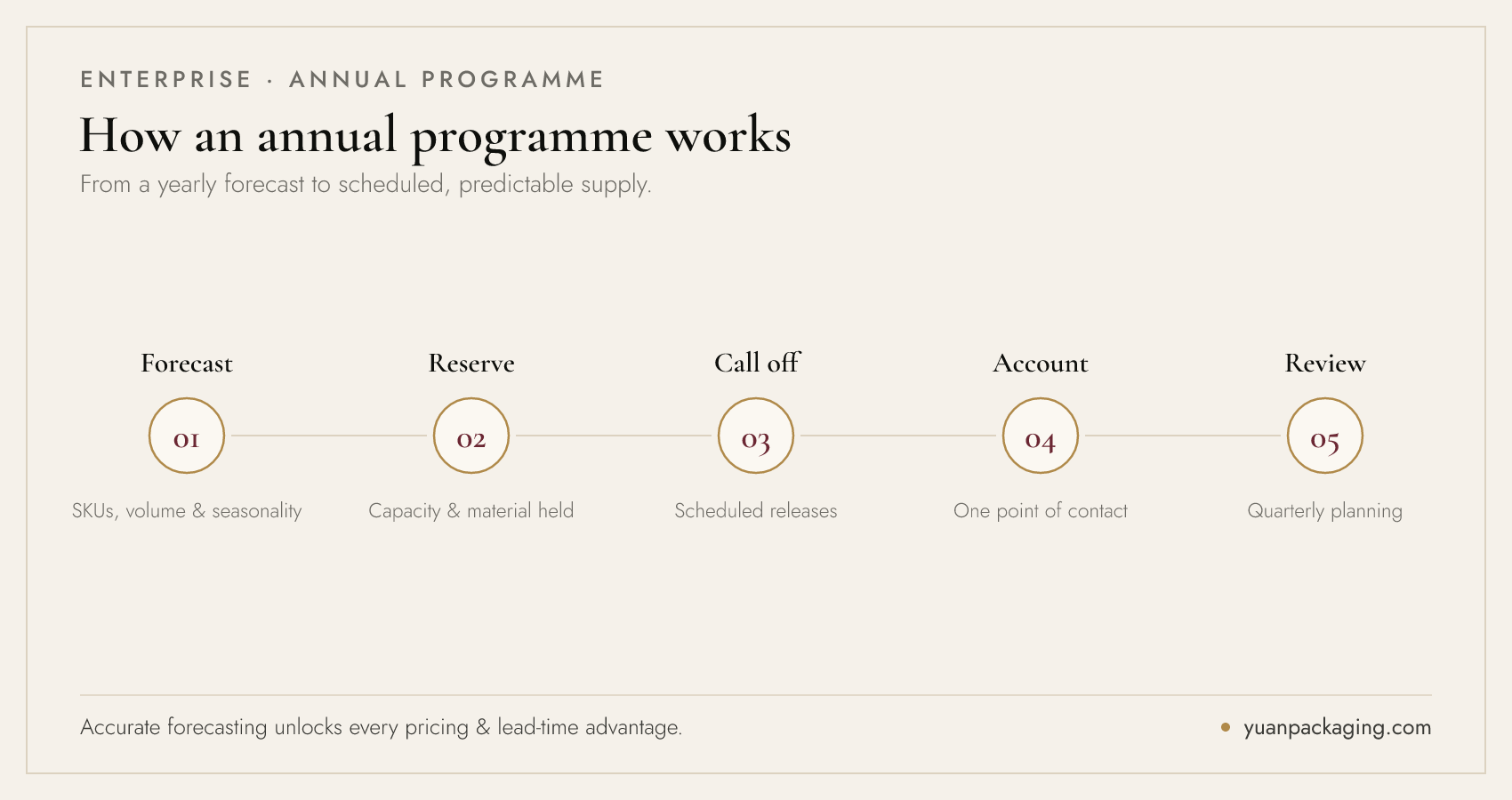
An annual programme is a commitment to a forecast volume across your packaging range over twelve months, rather than a single quantity. You share your SKUs, your expected volumes, and your seasonality; we plan dedicated capacity and material against that forecast. Individual orders are then placed as scheduled call-offs against the plan — faster and more predictable than starting each order from scratch. It is the model behind what is often called contract packaging manufacturing.
Why brands move on from ad-hoc orders
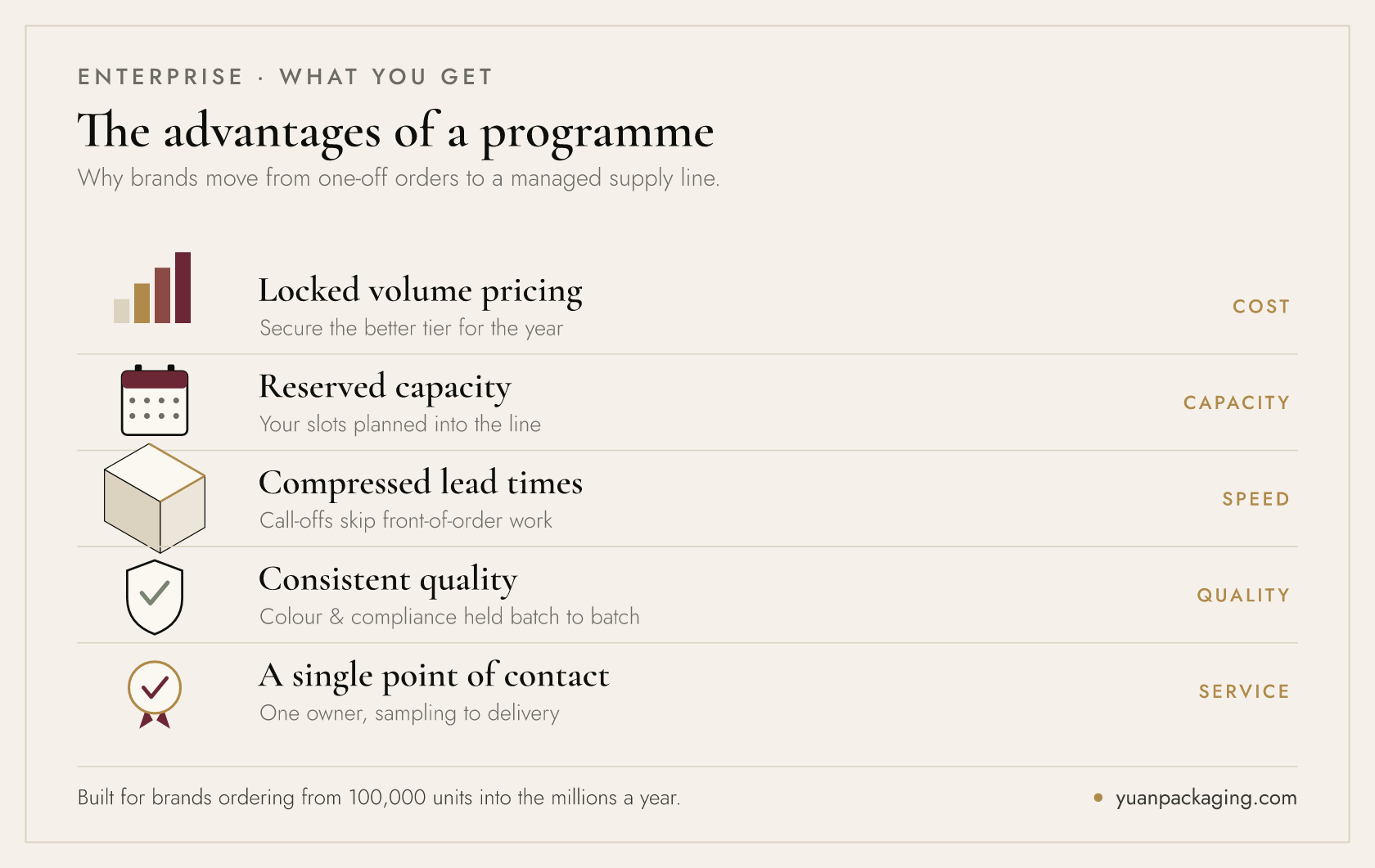
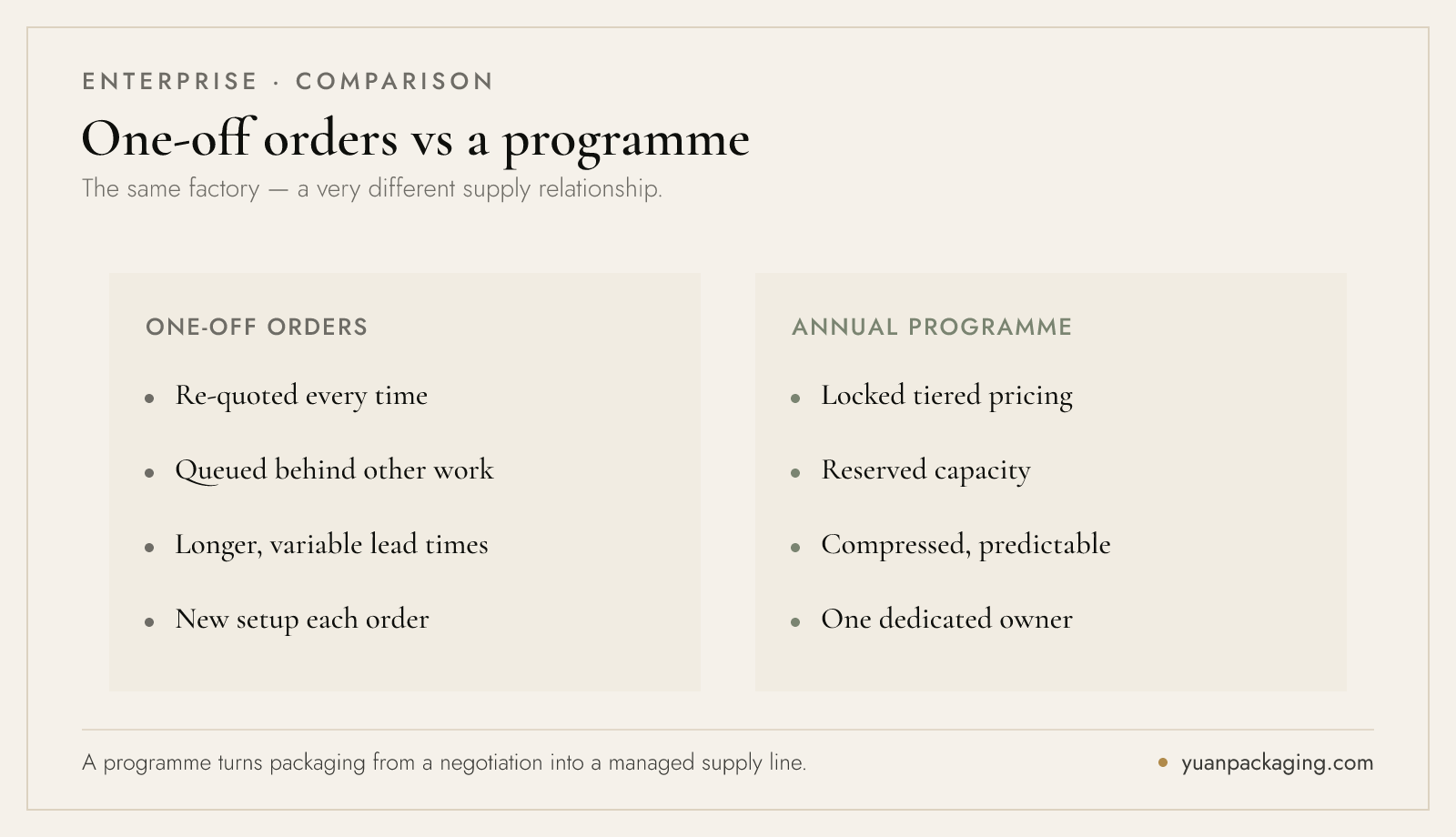
Brands move to programmes because ad-hoc ordering caps what a supplier can offer. With a forecast in hand, a manufacturer can commit to volume pricing tiers, reserve production slots, hold certified material, and guarantee lead times — none of which is possible when every order is a surprise. For FMCG, beauty, and spirits brands ordering from 100,000 units into the millions each year, a programme converts packaging from a recurring negotiation into a managed, budgeted supply line.
Step 1: Forecasting and planning
The first stage is forecasting and planning. You share your annual volume, SKU list, and seasonal peaks; we map that against capacity and propose a production and release schedule. Accurate forecasting is what unlocks every other benefit — the better the forecast, the more capacity and material we can commit in advance, and the more the pricing and lead-time advantages compound.
Discuss your packaging project
Step 2: Capacity reservation
Next is capacity reservation. Against your forecast, we reserve production slots and hold or schedule material, so your orders are planned into the line rather than queued behind whatever else arrives. Our facility runs four dedicated production lines and is built for high-volume manufacturing — from 100,000-unit launches to multi-million-unit annual programmes — so reserving meaningful capacity for a brand programme is designed in, not improvised.
Step 3: Scheduled call-offs
Orders then run as scheduled call-offs. Because the specification is locked, the material is planned, and capacity is reserved, a call-off against the programme moves far faster than a cold order — sampling is already done, plates exist, and the slot is booked. This is the single biggest way a programme compresses lead time: most of the work that usually sits at the front of an order has already happened.
A dedicated account manager
Every programme runs through a dedicated account manager — a single point of contact who owns your packaging from sampling through to delivery. That person coordinates scheduling, quality, and logistics, gives you proactive updates, and removes the handoffs between departments where delays and errors usually creep in. For an enterprise buyer managing a large packaging spend, that single owner is often the most valuable part of the arrangement.
Pricing and cost predictability
Pricing is where a programme pays back most visibly. A committed forecast lets us lock volume pricing tiers for the year, which protects your margin and gives you budget certainty rather than re-quoting every order. Our guide to volume pricing explains how the tiers work; in a programme, you secure the better tier up front by committing the volume.
Quality and compliance across the year
Quality and compliance have to hold across the whole programme, not just the first run. We manage colour consistency batch to batch, inspect in line with production, and maintain the certifications enterprise buyers require — from FSC chain-of-custody to SEDEX/SMETA ethical audit. If you are still evaluating suppliers, our checklist on qualifying a packaging supplier covers exactly what to verify before committing to a programme.
Summary
An annual packaging programme turns packaging from a recurring problem into a predictable, managed supply line — better pricing, compressed lead times, reserved capacity, and consistent quality, coordinated through one point of contact. It suits brands ordering at scale and planning ahead. If you run a repeat or high-volume packaging spend and want to structure it as a programme, tell us about your requirements and we will put together a capacity and pricing plan against your forecast.
Frequently Asked Questions
What is an annual packaging programme?
It is a structured agreement where a brand commits to a forecast volume across its packaging range over twelve months, and the manufacturer reserves capacity, holds material and schedules production against it. Orders run as scheduled call-offs rather than cold one-off purchase orders.
What volume do I need for an annual programme?
Programmes suit repeat and high-volume buyers — typically brands ordering from around 100,000 units into the millions across the year. The more accurate and committed your forecast, the more capacity, pricing and lead-time advantage we can build into the plan.
How does a programme reduce lead times?
Because the specification is locked, material is planned and capacity is reserved in advance, a call-off against the programme skips most of the work that sits at the front of a cold order — sampling is done, plates exist and the production slot is booked.
Does an annual programme lower my packaging cost?
Yes. Committing a forecast volume lets us lock volume pricing tiers for the year, which protects your margin and gives budget certainty instead of re-quoting every order. You secure the better tier up front by committing the volume.