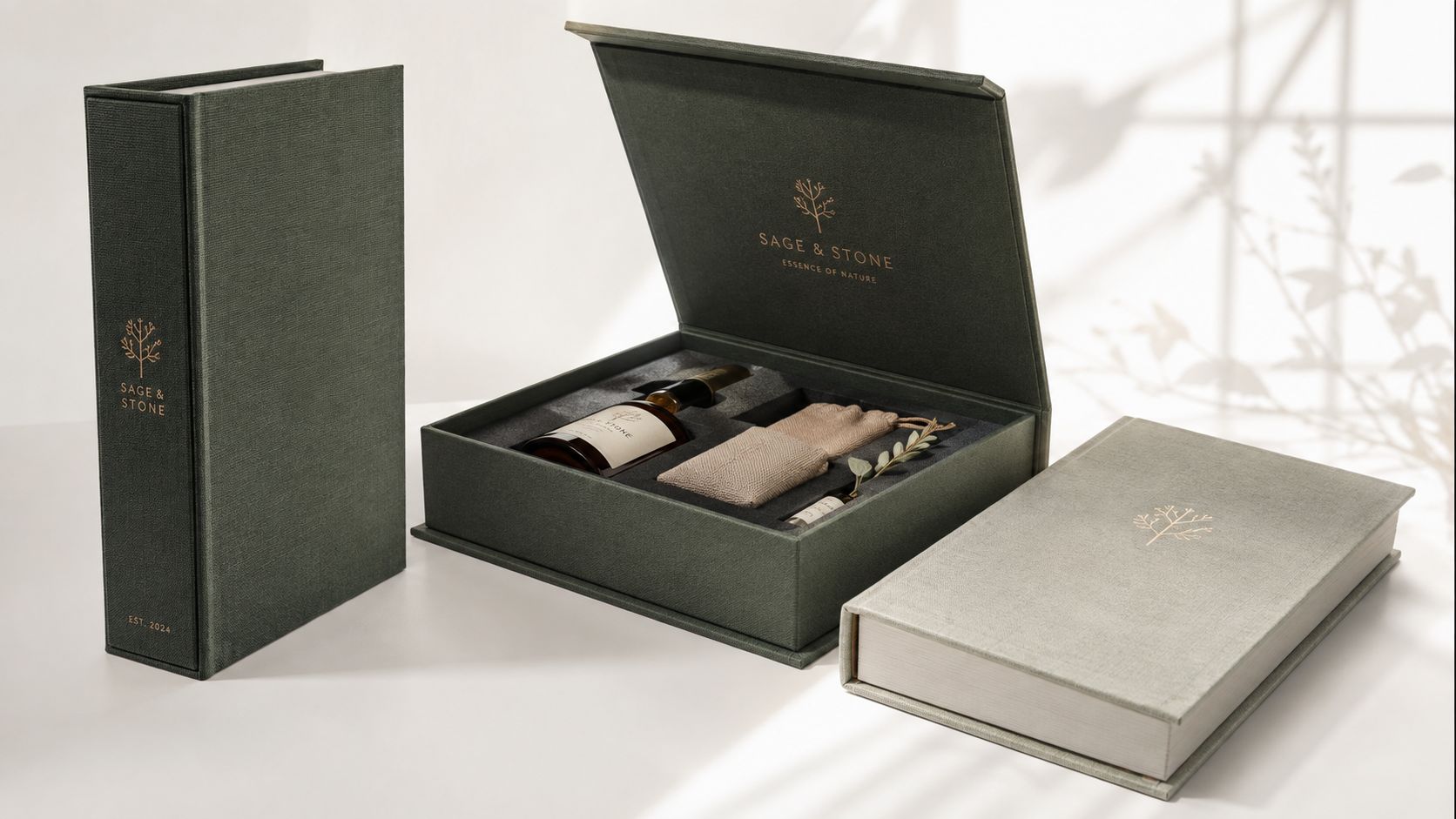
Boxes that look like books do more than imitate a familiar object. They turn a rigid container into a deliberate reveal, using the spine for recognition, a hinged opening for staged presentation, and an interior engineered around either one product or a coordinated set. That structure matters because the customer doesn't encounter a neutral carton. They encounter something that opens, displays, protects, and communicates in sequence.
The best choice isn't necessarily the most decorated example. It depends on construction, closure, inserts, finishing, use case, order scale, development support, and supply-chain control. Before requesting a quote, define what the box must hold, how it should open, which finish carries the brand story, and how the complete set will be produced and shipped. A book-style box may include the rigid shell, custom insert, label, export carton, and other components that affect the final experience.
The seven examples below compare those decisions rather than appearance alone. Yuan Packaging is a relevant benchmark for brands that need book-style rigid boxes with custom inserts, hand finishing, integrated labels, export cartons, and production-scale coordination.
Table of Contents
- 1. Custom Book-Style Hinged Rigid Boxes
- 2. Pusterla US
- 3. PakFactory
- 4. PAX Solutions
- 5. Elite Rigid Boxes
- 6. Rush Custom Boxes
- 7. OakStone Packaging
- Book-Style Boxes: Top 7 Comparison
- Turn Inspiration Into a Production Brief
1. Custom Book-Style Hinged Rigid Boxes
Yuan Packaging's custom book-style hinged rigid boxes are built around the familiar hardcover principle. The lid opens along a spine, while the printed inner cover creates another branded surface before the customer reaches the product. That sequence suits premium gift sets, spirits, cosmetics, corporate portfolios, and collectible editions where the packaging needs to feel like part of the product.
The structure can be specified with a magnetic-book closure, ribbon tie, slipcase, multi-cavity tray, or another configuration suited to the product geometry. Board type, dimensions, wrap material, inner cover printing, and finishing layers can all change the way the box feels in the hand. Soft-touch surfaces create a restrained tactile effect, while hot foil, debossing, spot UV, fabric wraps, and holographic effects can make the exterior carry a stronger visual or security function.
The manufacturer's book-style rigid box range is particularly relevant for procurement teams because the supply scope can extend beyond the shell.
Procurement lesson: A premium reveal is only as reliable as the insert, closure, labels, export carton, and quality checks supporting it.
Where the format earns its premium
The strongest distinction is the combination of hand finishing and production coordination. Yuan Packaging operates from a 30,000 m² single-site facility, with structural engineering, prepress, printing, finishing, and packaging coordination managed within one production system. Its Koenig & Bauer offset capability supports controlled color and registration, while a holographic positioning line supports registered visual and security effects.
That matters for spirits and beauty brands using several coordinated components. A box, pressure-sensitive label, tray, and export carton can be developed as one specification rather than passed between unrelated vendors. ISO-certified quality systems, export documentation, and an Australia-based office also support international communication and shipment planning.
Material selection remains a trade-off. FSC-certified papers, recycled fibres, mono-material builds, and water-based inks can support a more responsible specification, but the final recyclability of a rigid box still depends on the full construction. Magnets, mixed wraps, laminated finishes, and bonded inserts should be reviewed together rather than treated as separate decoration choices.
Custom hand finishing generally means a higher unit cost and a longer development path than a standard folding carton. For a brand selling a high-value set, however, the relevant comparison is not only unit price. It's whether the structure reduces product damage, controls the complete presentation, and gives production teams enough repeatability for a larger launch.
2. Pusterla US
Pusterla US is the North American arm of Pusterla 1880, with capabilities shaped by the integration of Taylor Box Company and Burt Rigid Box. Its book-style offer is broader than a single hardcover-like construction. The portfolio includes tray-in-four-panel folders, two-sided and three-sided hinged lids, and binder-style formats that can stage several components inside one rigid presentation.
That variety helps when the product doesn't fit a simple one-piece cavity. A beauty discovery set, spirits gift pack, or premium promotional kit may need a central tray, a side panel for information, and an interior that opens in stages. A folder structure can turn those requirements into part of the reveal rather than forcing every component into one deep compartment.
Pusterla's value proposition rests on design, engineering, finishing, quality assurance, and group-level sourcing. The company's US presence can be useful for North American teams that want local project management while retaining access to a wider luxury packaging network.
Best fit and procurement friction
The format library is useful at the specification stage. A buyer can start with a structural family, then refine the lid, tray, panel count, and finish instead of describing an entirely abstract concept. That can shorten early conversations for complex programs, although the project will still require detailed engineering around product tolerance, hinge behavior, closure strength, insert retention, and shipping protection.
The trade-off is process intensity. A luxury packaging group is generally better suited to a coordinated, high-touch program than to a small experiment that needs immediate online ordering. Custom quotation, minimum order expectations, development timing, and sourcing routes should be confirmed before artwork is finalized.
“The right structure is the one that makes the product set easy to understand before the customer removes anything.”
Pusterla US is a strong candidate when a brand needs multiple hinged constructions, premium finishes, and a global production network. It may be less convenient when the brief is a low-volume pilot, a rapid influencer kit, or a straightforward box with limited engineering needs. Buyers should ask for a physical sample that demonstrates the complete opening sequence, not just an exterior mock-up.
3. PakFactory
PakFactory's dedicated book-style rigid box offering is aimed at brands that want custom presentation packaging without managing every manufacturing handoff themselves. Its design gallery and product page show how the book format can support premium retail, cosmetics, public relations kits, and gift programs where the exterior finish and interior arrangement need to work together.
The available specification menu includes textured wraps, soft-touch coatings, foils, spot UV, and other embellishments. Those options give a brand several ways to distinguish the spine, cover, border, or interior. The useful procurement question isn't which finish looks impressive in isolation. It's whether the chosen combination survives handling, matches the product's positioning, and remains consistent across the complete production run.
PakFactory also emphasizes sampling, turnaround guidance, manufacturing management, and logistics coordination across certified facilities. That managed model can appeal to teams that need help translating a visual reference into a manufacturable rigid box.
What buyers should clarify early
The service model provides a practical starting point for teams that need design inspiration and development guidance. A sampling stage can expose issues that flat artwork won't show, including hinge alignment, corner behavior, insert fit, and how a textured wrap changes color perception.
The less transparent point is order economics. Minimum order quantities can vary by product and may not be displayed in a universal way for every rigid style. International production can also affect transit time, tariff exposure, and the handoff between approval and delivery. Those factors belong in the first quotation request, not after the design has been approved.
PakFactory makes the most sense for a brand that values a guided workflow and wants to compare finish combinations before committing. It's less attractive when the buyer needs a locally produced pilot with highly predictable small-order pricing. Request the manufacturing location, sample scope, logistics responsibility, and final component list in writing.
A book-style box can look simple in a product image while hiding a substantial coordination task. PakFactory's managed approach addresses that task, but the buyer still needs to define the product geometry, insert material, closure, destination, and expected order model before comparing quotes.
4. PAX Solutions
PAX Solutions approaches book-style packaging from an engineering perspective. Its documented Hinged Flip Top and Hinged Binder Book Box structures open like books, but the important distinction is how clearly the company explains the underlying rigid setup formats. That clarity can help procurement, packaging engineering, and brand teams discuss the same construction using the same terms.
The hinged binder format suits multi-component kits and storytelling interiors. A product can sit in a shaped insert while panels carry instructions, brand history, usage information, or secondary accessories. The hinged flip-top format is more direct, useful when the opening needs to feel premium without creating an elaborate multi-panel sequence.
PAX Solutions also supports corrugated packaging, cartons, inserts, thermoform components, and labels. That broader service range matters when the presentation box must eventually enter an export carton or ship with separately produced components.
Engineering support versus project speed
The company's resource material gives buyers a useful advantage during the early brief. A team can compare a hinged lid, binder construction, insert system, and protective outer packaging before committing to a visual direction. That reduces the risk of selecting a structure based only on a rendering.
The trade-off is that complex rigid projects may take several weeks to a few months, depending on the requirements and development path. That timing claim is presented in PAX Solutions' own project guidance, so it should be treated as a planning range rather than a guaranteed delivery schedule. Pricing and minimum order quantities are quote-based rather than published.
Engineering check: Approve the complete open, close, remove, and repack sequence before approving the artwork.
PAX Solutions is a sensible option for US-based teams that need structural explanations and project management for a multi-component kit. It may not be the fastest route for a simple small-run box, especially if the buyer needs an immediate price rather than a developed specification. The quotation should identify insert tooling, sample stages, component ownership, and the shipping configuration.
5. Elite Rigid Boxes
Elite Rigid Boxes, often presented as ERB, focuses on practical buying support alongside its book-style rigid box format. Its product page uses a form-driven quotation process and provides artwork guidance, dielines, sample support, and design assistance. That approach is useful for smaller brands, limited editions, and pilot programs that need a clear path from concept to production.
The company publishes buying information such as a minimum order quantity and typical turnaround windows on its product materials. Because those terms can change with dimensions, materials, inserts, and finishes, buyers should still confirm the details against the actual specification. The value is the starting transparency, not a promise that every configuration will carry the same commercial terms.
A lower-friction development path
The dieline and artwork resources can remove a common early obstacle. A brand team doesn't need to guess where the spine folds, how the wrap overlaps, or which areas require bleed and safe zones. Design support can also help identify whether the chosen artwork is appropriate for foil, embossing, debossing, or other finish layers.
For teams unfamiliar with rigid box construction, Yuan Packaging's guide to rigid box dielines, materials, and production rules provides a useful comparison point when preparing artwork and technical questions.
ERB's principal advantage is accessibility. A lower posted minimum order can make testing or a limited edition more achievable than a large luxury packaging program. The trade-off is footprint. Compared with a major international packaging group, the company may offer fewer sourcing and production routes for a brand distributing across several regions.
The online configurator or quote form can begin the process, but final pricing may still require a manual review. Send the actual product, cavity plan, closure preference, insert material, finish list, and destination with the first request. That turns a generic box inquiry into a quote that can be compared against other suppliers.
6. Rush Custom Boxes
Rush Custom Boxes is designed around speed, accessibility, and smaller-volume custom packaging. Its custom book-style hinged boxes include options for magnets and inserts, with the hinge positioned as an important part of the construction rather than a hidden technical detail. That makes the format suitable for influencer kits, cosmetics, gifts, and short promotional programs where timing can matter as much as long-term packaging architecture.
The supplier lists 8 to 10 business days for lead time and a minimum order as low as 50 units, alongside a published starting price. Those figures come from the company's own product information at the time of reference, and they should be reconfirmed for the selected size, finish, insert, and shipping destination. A stated starting price rarely represents a complete premium build.
Speed creates its own validation burden
A short production window can help a brand respond to a launch date or event. It can also reduce the time available for iterative sampling, especially when the box includes a magnet, wrapped board, printed interior, or fitted insert. The faster route works best when the structure is relatively defined and the product dimensions are stable.
At very low quantities, the per-unit cost may be higher because setup and handling are spread across fewer boxes. An online-first workflow can also be less suited to highly bespoke constructions that need extensive structural development. Those are not reasons to reject the supplier. They're reasons to test the exact build.
- Inspect the hinge: Open and close the approved sample repeatedly to check alignment, resistance, and surface stress.
- Check the magnet: Confirm that the closure holds securely without making the lid difficult to open.
- Review the insert: Test product retention, removal, and replacement, not just the visual fit.
- Compare the finish: Examine the sample under the lighting used for retail, photography, or event display.
Rush Custom Boxes is a strong candidate when a lower-volume program needs a fast, recognizable book opening. It becomes a weaker choice when the project requires complex security finishing, multiple companion components, or a long-term global supply program.
7. OakStone Packaging
OakStone Packaging presents book-style rigid boxes as a configurable format for technology products, cosmetics, corporate gifts, and multi-item presentations. Its guided quote form captures dimensions and add-ons at the beginning, including finishing and insert requirements. That changes the first conversation from “How much does a book box cost?” to “What construction are we pricing?”
The finishing menu includes soft-touch, gloss and matte lamination, foil, embossing, and debossing. Insert choices include foam and card dividers, which can support either protective product retention or a more editorial presentation. The company also states sustainability claims, but buyers should ask for the precise substrate, coating, adhesive, and insert specifications before making a recyclability decision.
A useful form, but still a sample-led decision
The quote form can reduce back-and-forth because dimensions and add-ons are captured up front. That's especially useful for a multi-item box where the cavity plan affects the outer footprint, board requirements, insert depth, and shipping configuration.
OakStone's packaging finishes guide offers a useful reference for comparing tactile and decorative treatments before selecting the final combination. A soft-touch wrap, foil detail, and debossed mark don't create the same brand message, and each adds a different production consideration.
No public pricing or minimum order is posted for the format, so the project remains quote-based. OakStone also has a newer online presence than some established packaging groups, which makes physical sampling particularly important. Request samples that show the hinge tolerance, corner finish, wrap alignment, insert fit, and any stated sustainable material choice.
OakStone is best suited to teams that want a guided specification process and nationwide manufacturing and shipping support. It may not be the right first call for a global program needing extensive security effects or a very established multi-country production network. The quote should identify who controls engineering, where production occurs, and how quality is checked before shipment.
Book-Style Boxes: Top 7 Comparison
| Provider | Implementation Complexity 🔄 | Resource Requirements ⚡ | Expected Quality & Impact ⭐📊 | Ideal Use Cases 📊 | Key Advantages / Tips 💡 |
|---|---|---|---|---|---|
| Custom Book-Style Hinged Rigid Boxes (Yuan Packaging) | High 🔄, artisanal hand finishing + large-scale production | High ⚡, premium board, specialty finishes, integrated supply chain | Exceptional ⭐⭐⭐⭐⭐, luxury shelf & security impact 📊 | Spirits, cosmetics, corporate portfolios, collectible editions | Turnkey end-to-end production, sustainable options; higher cost & MOQs 💡 |
| Pusterla US | High 🔄, complex, multi-component custom builds | High ⚡, US manufacturing backed by global group | Very high ⭐⭐⭐⭐, award-winning luxury results 📊 | High-touch beauty, spirits, and premium gift sets | Deep luxury expertise and scale; custom quotes, longer lead times 💡 |
| PakFactory | Medium 🔄, managed manufacturing with sampling | Medium ⚡, broad materials & finishing menu | High ⭐⭐⭐⭐, polished retail finishes 📊 | Premium retail, cosmetics, PR kits | Strong customer support and clear FAQs; MOQs vary, check tariffs 💡 |
| PAX Solutions | Medium–High 🔄, engineered rigid setups and guidance | Medium ⚡, inserts, thermoform, engineering resources | High ⭐⭐⭐⭐, functional, story-driven interiors 📊 | Multi-component kits; procurement and engineering-focused projects | Good structural resources; quote-based pricing and multi-week timelines 💡 |
| Elite Rigid Boxes (ERB) | Low–Medium 🔄, form-driven quoting and templates | Low ⚡, suited for smaller runs, US fulfillment | Good ⭐⭐⭐, practical for pilots & limited editions 📊 | Small brands, pilot runs, limited editions | Lower posted MOQ, transparent lead times, free dielines/design help 💡 |
| Rush Custom Boxes | Low 🔄, online-first configurator, fast workflows | Low ⚡, low MOQ, published entry pricing | Moderate ⭐⭐⭐, fast-to-market, verify finish quality 📊 | Influencer kits, cosmetics, quick-turn gift programs | Fast lead times and low MOQ; check samples for hinge durability 💡 |
| OakStone Packaging | Medium 🔄, guided quote form streamlines specs | Medium ⚡, finishing and insert options, nationwide support | Good ⭐⭐⭐, suitable for tech & corporate gifting 📊 | Tech, cosmetics, corporate gifts, multi-item presentations | Quote form reduces iterations; request samples to validate finishes 💡 |
Turn Inspiration Into a Production Brief
The examples point to a practical conclusion. Boxes that look like books are not one product category with one ideal construction. They range from a simple hinged rigid shell to a multi-panel binder with inserts, labels, security finishes, and export packaging. The right choice depends on the product geometry, the intended reveal, the order model, and the supplier's ability to repeat the result.
Start with the product, not the artwork. Define the product's length, width, height, weight, fragile areas, and required cavity plan. If the package holds several items, specify whether each item needs a separate cavity, divider, cradle, or removable tray. That information determines the box footprint and often changes the most suitable board, insert, closure, and shipping configuration.
Choose the opening and closure next. A magnetic book closure gives a clean, controlled reveal. A ribbon tie creates a more ceremonial interaction. A binder or multi-panel format can stage information and accessories across several surfaces. The closure must hold during transport but shouldn't make the customer fight the box.
Match the wrap and finishes to the brand message. Fabric, textured paper, foil, debossing, spot UV, soft-touch coatings, and printed inner covers all communicate differently. Decoration should support recognition, tactility, or authenticity rather than compensate for an unresolved structure. For high-value categories, ask whether registered graphics, serialized labels, QR codes, RFID, or other security features belong in the specification. A book-style box can support authentication and shelf control, but only when those elements are engineered into the complete package.
Sustainability needs the same level of detail. The EU Packaging and Packaging Waste Regulation entered into force in February 2025 and applies from August 2026, according to recent rigid packaging market coverage. That direction increases the importance of recyclable fiber-based substrates, source reduction, lightweight structures, and design for disassembly. Ask how magnets, laminated wraps, adhesives, foam, and mixed-material inserts affect the intended end-of-life route.
The recurring lesson is simple. The strongest book-style box isn't the one with the most embellishment. It's the structure that protects the product, stages the reveal, supports repeatable production, and fits the intended order model.
Your production brief should confirm:
- Product dimensions and weight: Include every item, tolerance, fragile area, and cavity requirement.
- Board and wrap materials: Specify the rigid board, paper or fabric wrap, recycled or FSC preference, coating, and adhesive approach.
- Insert requirements: Define foam, card, molded, or multi-cavity construction, along with removal and replacement expectations.
- Opening and closure: Select magnetic, ribbon-tie, hinged, binder, slipcase, or another approved structure.
- Finishes: List foil, embossing, debossing, spot UV, soft-touch, lamination, fabric, or holographic effects.
- Artwork and prepress: Confirm dielines, bleed, color targets, registration tolerances, and printed inner-cover requirements.
- Sample approval: Test the full opening sequence, hinge, closure, insert fit, finish, and repacking process.
- Quantity and timing: State the order model, launch date, repeat-order expectations, and acceptable production window.
- Destination and logistics: Provide delivery locations, export carton needs, documentation, and freight requirements.
- Companion components: Include labels, carrier bags, folding cartons, corrugated boxes, seals, or other items that must match the box.
A supplier that can coordinate those components may reduce handoffs and make the final brand experience more consistent. A supplier that only quotes the outer shell may still be suitable, but the buyer must manage the remaining parts and risks.
Yuan Packaging combines book-style rigid boxes with custom inserts, printed and pressure-sensitive labels, specialty finishes, export cartons, structural engineering, QA, and international logistics coordination. For a production-ready brief covering dimensions, materials, closure, finishes, companion components, and destination, visit Yuan Packaging and discuss the complete packaging system with its team.