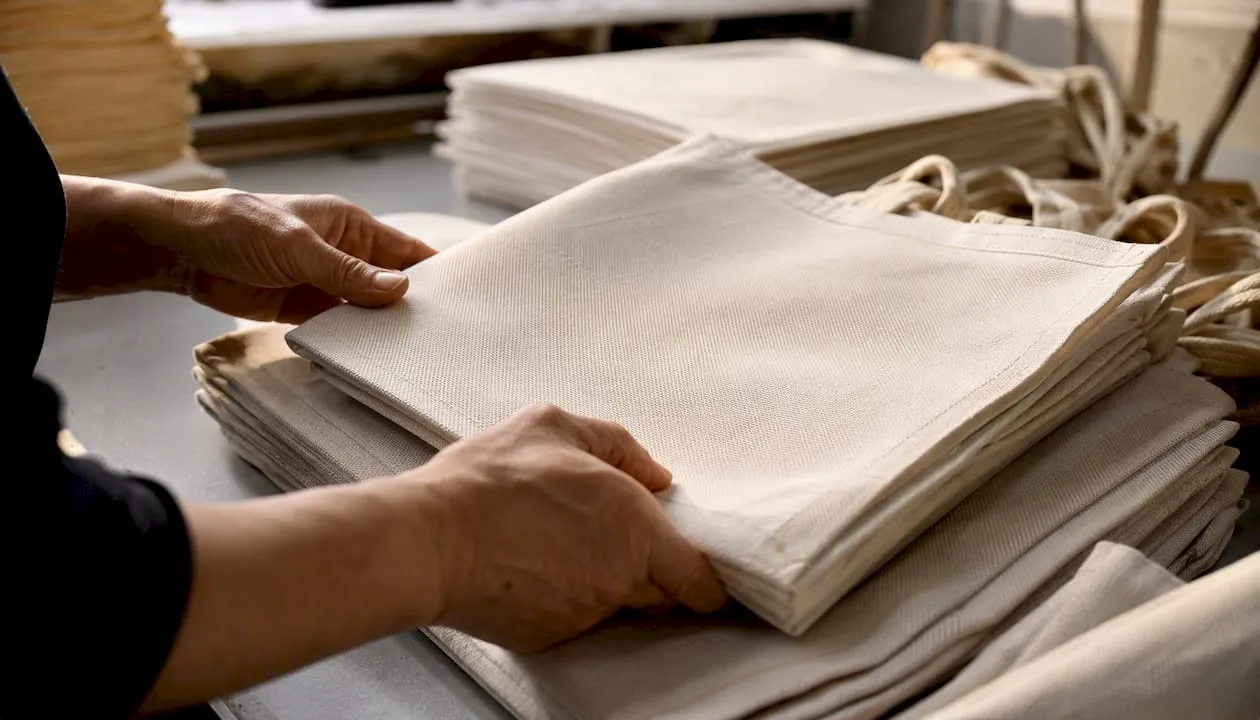
Custom printing on non-woven bags is commercially feasible for most promotional and retail applications, from short sample runs to bulk wholesale orders. The right print method depends on three variables: order quantity, color complexity, and substrate type.
- Fastest, lowest-cost entry point: Direct-to-bag UV digital or heat transfer for runs under a few hundred units. No screen setup fees, full-color capability, and turnaround as short as a few business days for production.
- Best value at volume: Screen printing or CI flexo for larger volume orders. Setup costs are front-loaded, but per-piece pricing drops as quantity increases.
Yuanpackaging has manufactured custom carrier bags and printed packaging for premium brands across beauty, spirits, and retail for over 25 years. To get a quote, submit your artwork and bag specifications directly to the Yuanpackaging team.
Pro Tip: Request a physical sample before committing to a full production run. Color, registration, and hand-feel on non-woven fabric can differ significantly from a digital proof.
Key Takeaways
Choosing the right print method and substrate at the outset controls cost, lead time, and final print quality for custom non-woven bag orders.
| Point | Details |
|---|---|
| Match method to quantity | Digital UV or heat transfer for under 250 units; screen or CI flexo for 500 and above. |
| Substrate determines detail | Laminated PP accepts fine UV detail; coarse spunbond PP suits bold screen or flexo graphics. |
| White underbase adds cost | Dark-colored bags require an opaque white layer, adding a print pass and increasing production time. |
| Sample before full run | A physical pre-production sample confirms color, registration, and hand-feel before committing to volume. |
| Verify eco-claims with documentation | Request recycled-content certificates and ink safety data sheets; avoid laminated bags if recyclability is a brand requirement. |
| Yuanpackaging for bulk orders | Yuanpackaging offers custom non-woven bag production with inline QA, spectrophotometric color matching, and international shipping to US destinations. |
Table of Contents
- Which non-woven bag types and materials can you print on?
- How do the main printing methods compare for non-woven bags?
- What pricing, MOQs, and lead times should you expect?
- How to prepare print-ready artwork for non-woven bags
- What does the ordering process look like from quote to delivery?
- What do “eco” non-woven claims mean, and which certifications matter?
- Why Yuanpackaging’s manufacturing capabilities matter for printed non-woven bags
- An editorial perspective on choosing the right supplier
- Yuanpackaging’s custom non-woven bag service and how to get started
- Sources
Which non-woven bag types and materials can you print on?
Spunbond polypropylene (PP non-woven) is the most common substrate for promotional and reusable bags, typically available in weights from 60 to 120 GSM. Lighter weights (60–80 GSM) suit economy giveaway bags; heavier weights (90–120 GSM) provide the structure needed for retail totes and gusseted shoppers. Other substrates include laminated PP (a PE-coated layer bonded to the non-woven base), cotton non-woven, and natural-fiber alternatives such as jute or hemp.
Common bag formats include:
- Tote bags with long fabric handles, typically printed on one or both faces
- Gusseted shoppers with a flat bottom and side gussets for volume capacity
- Die-cut handle bags where the handle is punched directly from the bag panel
- Rope-handle retail totes with a reinforced top hem and knotted cord handles
Laminated PP accepts fine-detail UV inks and photographic imagery because the smooth PE surface provides consistent ink adhesion. Coarse needle-punched non-wovens, by contrast, are better suited to simple flexo or screen work with bold graphics and limited color counts. Untreated PP has lower surface energy, usually requiring corona or plasma treatment to raise it to a level that supports reliable ink adhesion on most press systems.
Pro Tip: Lamination, reinforced sewn bottoms, and rope handles each add cost. If budget is the primary constraint, specify a standard die-cut handle on 80 GSM spunbond PP and limit print to one face.
How do the main printing methods compare for non-woven bags?
The method decision comes down to quantity, color count, and how quickly you need finished goods. For samples or very small runs, digital UV or heat transfer is the practical choice. For mid-volume runs, digital UV or flexo can be suitable. For high-volume production, screen printing or CI flexo typically delivers the lowest per-piece cost.

| Method | Best Quantity Range | Color Complexity | Setup Cost | Image Detail | Durability | Recommended Substrates |
|---|---|---|---|---|---|---|
| Screen printing | 500+ | 1–6 spot colors | Medium-high | Good for bold graphics | High | Spunbond PP, laminated PP |
| CI flexo | 1,000+ | Multi-color | High | High, ±0.1 mm registration | High | Spunbond PP, laminated PP |
| Heat transfer | 1–250 | Full color | None | High | Moderate | Most non-wovens |
| DTF (direct-to-film) | 10–500 | Full color | Low | High | Moderate-high | Most non-wovens |
| Direct-to-bag UV digital | 50–1,000 | Full CMYK + white | Low | Very high | High | Laminated PP, smooth spunbond |

Direct-to-bag UV inkjet cures inks instantly, allowing immediate stacking and packing. Systems using UV-curable ink sets support CMYK plus opaque white in a single pass, which is a meaningful advantage for dark-colored bags where a white underbase is required. CI flexo presses achieve registration accuracy of ±0.1 mm across multiple colors, making them the preferred choice for high-volume runs with tight brand-color tolerances.
Heat transfer methods carry no screen setup fee, which makes them economical for personalized or short-run orders. Screen printing becomes more cost-effective once setup costs are amortized across a larger quantity, typically above 500 units.
White ink is the most significant cost variable for dark bags. Any method printing on navy, black, or deep-colored non-woven fabric requires an opaque white underbase layer, which adds a print pass, increases ink consumption, and extends production time.
Pro Tip: For dark bags with photographic artwork, direct-to-bag UV digital with a white recirculation channel produces the most consistent result. Standard flexo or screen on dark substrates often requires multiple white passes to achieve adequate opacity.
What pricing, MOQs, and lead times should you expect?
Pricing structure follows the method’s cost architecture. Setup-heavy methods such as screen printing and CI flexo carry front-loaded costs (screen preparation, plate making, press setup) but deliver low per-piece pricing at scale. Screen printing and flexo are the volume leaders for simple multi-color logos, while digital and heat-transfer approaches avoid setup fees but maintain a higher per-piece cost at larger quantities.
Quantity bands and cost expectations:
- Sample (1–10 units): Economy pricing is not available. Expect sample fees plus a short-run digital or heat-transfer charge. Sample lead time is typically 3–10 business days.
- 50–250 units: Mid-range per-piece cost using digital UV or DTF. No plate or screen fees. Setup is minimal.
- 250–1,000 units: Per-piece cost decreases with flexo or screen. Setup fees apply but are distributed across the run. Premium finishes (lamination, rope handles) add cost.
- 1,000+ units: Lowest per-piece pricing via screen or CI flexo. Bulk discounts typically apply at 2,500, 5,000, and 10,000-unit thresholds.
Minimum order quantities vary by method. Digital UV and DTF suppliers often accept orders with no formal minimum. Screen printing and flexo operations typically set MOQs at 500 units or higher due to setup economics. Yuanpackaging operates on a project-based quote model; MOQ and pricing are confirmed at the quoting stage based on substrate, method, and finish specifications.
Standard production timeline:
- Proof approval: 1–3 business days
- Physical sample (if requested): 3–10 business days
- Full production run: 7–30 business days depending on quantity and method
- International shipping (sea freight): 15–35 days to US ports; air freight reduces this to 5–10 days
How to prepare print-ready artwork for non-woven bags
Supply vector files in AI, EPS, or PDF format wherever possible. For photographic or raster elements, provide flattened TIFF or PNG files at 300 DPI at the intended print size. Use CMYK color mode throughout, and include Pantone (PMS) references for any brand colors that require precise matching.
Artwork checklist:
- Resolution: 300 DPI minimum at final print dimensions
- Color mode: CMYK; include PMS references for spot colors
- Safe zone: keep critical text and logos at least 5 mm inside the trim line
- Bleed: extend background artwork 3–5 mm beyond the trim edge
- White underbase: indicate white layers separately if printing on dark fabric
- Transparent backgrounds: supply as PNG or layered PDF, not flattened JPEG
- Fonts: convert all type to outlines before submitting
- Placement: specify print location (front face, back face, gusset, handle area) on a dieline
Yuanpackaging publishes an artwork preparation guide with dielines for common bag sizes and file-format requirements. Referencing that guide before submission reduces proof cycles.
Testing on the actual substrate before committing to a full run is standard practice. Water-based inks on untreated PP non-wovens are prone to adhesion failure and bleeding; specify inks formulated for the substrate, and confirm pre-treatment (corona or plasma) is part of the production process.
Pro Tip: Request a pre-production proof and a physical strike-off sample before approving the full run. Color on non-woven fabric reads differently than on coated paper or screen, and registration on textured substrates can shift by 1–2 mm without proper press calibration.
What does the ordering process look like from quote to delivery?
The standard workflow for custom non-woven bag printing follows a defined sequence with clear decision points at each stage.
- Submit a request for quote (RFQ): Provide bag dimensions, substrate and GSM, handle style, print method preference, quantity, and delivery destination.
- Receive and approve the quote: Review pricing, MOQ, lead time, and payment terms. Confirm sample requirements.
- Submit artwork: Supply print-ready files per the artwork checklist. The supplier generates a digital proof (PDF or 3D render).
- Approve the digital proof: Review color, placement, and dimensions. Request revisions if needed. Typical turnaround: 1–3 business days.
- Order a physical sample (recommended): A pre-production sample confirms color, registration, and material hand-feel. Sample lead time: 3–10 business days.
- Issue a purchase order: Confirm quantity, delivery address, and shipping terms (FOB, CIF, or DDP).
- Production: The supplier runs the full order. Inline QA checks color consistency and registration throughout the run.
- Pre-shipment inspection: Final check of finished goods against approved sample. Defective units are segregated before packing.
- Shipping and delivery: Goods are packed, palletized, and dispatched. Track via the supplier’s logistics partner.
Questions to ask any supplier before placing an order:
- What is the MOQ for my chosen print method?
- What is your sample policy and sample fee?
- How do you handle color matching (spectrophotometer, Pantone library)?
- What QA checkpoints occur during production?
- What are your shipping terms, and do you offer DDP to US ports?
Pro Tip: For new supplier relationships or time-sensitive events, order an approved production sample at the start of the production run, not just a pre-production mock-up. This confirms that the press setup on the actual production batch matches the approved proof.
What do “eco” non-woven claims mean, and which certifications matter?
Polypropylene non-woven bags are marketed as reusable and, in some cases, recyclable. The distinction matters. Standard spunbond PP is technically recyclable through PP-stream facilities, but availability of those facilities varies across US municipalities. Bags with PE lamination or mixed-fiber construction are generally not recyclable through standard curbside programs because the bonded layers cannot be separated.
Recycled-content PP is available from some manufacturers, using post-industrial or post-consumer PP fiber. Buyers should request a recycled-content certificate or material data sheet to verify the claim. Natural-fiber alternatives such as jute and hemp carry a lower carbon footprint in raw-material terms but require different print methods and typically have coarser surfaces that limit fine-detail printing.
Certifications and documentation to request:
- Recycled-content certificate (percentage of post-consumer or post-industrial content)
- Material safety data sheet (MSDS) for inks used in production
- Low-VOC or food-contact ink compliance documentation where relevant (FDA 21 CFR for food-adjacent applications)
- ASTM D6400 or D6868 compostability certification if compostable claims are made
- Chain-of-custody documentation for any FSC or PEFC claims on paper components
A credible eco-claim from a supplier includes documentation, not just marketing language. Greenwashing in this category often takes the form of “recyclable” claims applied to laminated bags that no recycling stream currently accepts. Request the supplier’s test reports and ask specifically whether the bag construction is mono-material or multi-layer.
Yuanpackaging’s approach to sustainable packaging covers material selection and recycled-content sourcing for carrier bag production.
Pro Tip: If sustainability is a brand requirement, specify mono-material spunbond PP with no PE lamination. Print detail will be slightly lower than on laminated stock, but the bag remains recyclable through PP-stream facilities.
Why Yuanpackaging’s manufacturing capabilities matter for printed non-woven bags
Yuanpackaging has produced custom carrier bags and printed packaging for premium brands in beauty, spirits, cosmetics, and retail for over 25 years, operating from its manufacturing facility in Huai’an, China. The client base includes brand managers and procurement teams placing bulk orders where color consistency, registration accuracy, and material quality are non-negotiable.
| Capability | Detail |
|---|---|
| Substrates produced | Spunbond PP, laminated PP, cotton non-woven, jute/hemp, paper carrier bags |
| Print technologies | UV-curable digital, screen printing, flexo, heat transfer, specialty finishing |
| QA checkpoints | Inline color checks, registration verification, pre-shipment inspection |
| Sample policy | Pre-production samples available; sample fees and lead times confirmed at quoting stage |
| Finishing options | Lamination, rope handles, reinforced bottoms, sewn gussets, foil accents |
| Compliance | Material data sheets, recycled-content documentation, ink safety certificates on request |
Yuanpackaging’s production process includes inline color approval at press, spectrophotometric color matching against approved Pantone references, and a pre-shipment inspection before goods are packed for export. These controls reduce the risk of color drift across large runs and provide buyers with documented quality evidence before shipment.
The KBA Rapida press investment at Yuanpackaging’s facility supports consistent color output and tight registration across high-volume printed packaging, including carrier bags. Factory transparency is demonstrated through published manufacturing visits with the Jiangsu Printing Association.
Pro Tip: Ask any manufacturer for their pre-shipment inspection report format before placing an order. A supplier who cannot describe their inspection process in specific terms is a supplier whose QA process may not exist in practice.
An editorial perspective on choosing the right supplier
The right supplier for custom non-woven bag printing is not necessarily the one with the lowest unit price. Proofing speed, production controls, and transparent pricing are the three variables that determine whether an order arrives on time and on spec. Suppliers who publish clear MOQ bands and sample policies upfront are typically more reliable than those who negotiate these terms after receiving a deposit.
Red flags to watch for:
- Proof cycles that take more than 3 business days without explanation
- Vague lead times (“approximately 2–4 weeks”) with no production schedule
- No physical sample policy, or sample fees that are non-refundable against the order
- Inability to provide material data sheets or ink safety documentation
- Pricing that changes after artwork submission
Pro Tip: Run a quick supplier validation test: order three small-variation samples (different ink colors or two substrate weights) before committing to a full run. Response time, sample quality, and communication during this test are the most reliable indicators of how the supplier will perform at scale.
Yuanpackaging’s custom non-woven bag service and how to get started
Yuanpackaging produces custom non-woven carrier bags for brand clients requiring bulk printed promotional and retail bags with consistent color, verified material quality, and documented QA. The service covers substrate selection, artwork review, sample production, full-run manufacturing, and international shipping coordination to US destinations.
Getting a quote requires three inputs: your bag dimensions and substrate preference, your print-ready artwork or a brief describing the design, and your target quantity and delivery date. Yuanpackaging’s team reviews submissions and returns a detailed quote covering unit pricing, setup costs, sample options, and estimated lead time. For buyers who need file guidance before submitting, the artwork preparation guide covers dielines, file formats, and color-mode requirements. To review the full range of packaging products available, including rigid boxes, folding cartons, and labels, visit the product overview page. Submit your specifications to request a quote and confirm production availability.
Sources
- How to Print on Non Woven Bags: Methods & Machine Guide | RAZP
- Heat Transfer Printing vs Screen Printing: 10 Key Differences