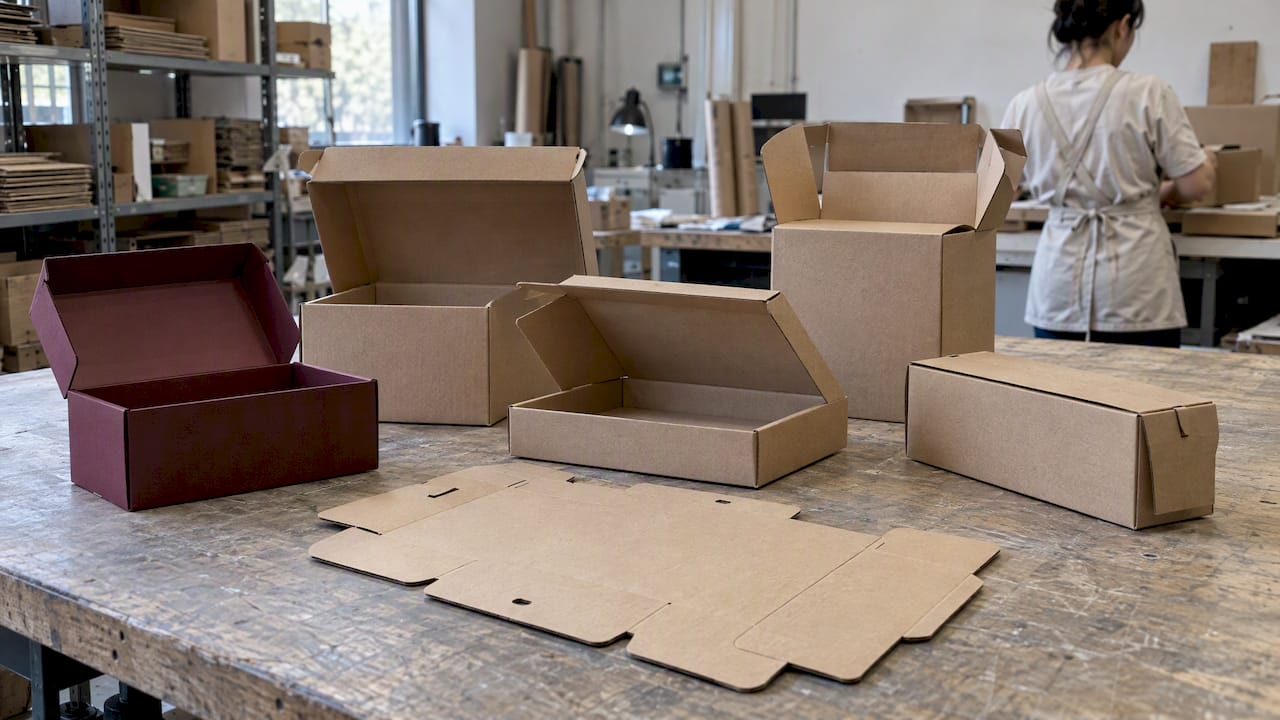
Corrugated box design is the process of matching a structural style, board grade, and flute profile to a product's weight, fragility, and shipping path, then validating the result against recognized strength standards. The practical starting point is a FEFCO code for the style, a flute and board grade suited to the contents, and an edgewise compression test (ECT) target confirmed before tooling. We treat those three decisions as the foundation every corrugated brief should settle first.
TL;DR:
- Use a FEFCO code to specify the box shape across suppliers, then request a downloadable dieline or 3D mockup before approving print.
- Choose A flute for cushioning, B for crush resistance, and E or F for fine print; add moisture resistant protection for humid routes.
- State whether dimensions are internal or external, list length, width, and depth in order, and confirm flute direction before requesting a physical sample.
- ECT measures board compression, while BCT tests the finished box; FEA overpredicted ECT by 19 to 43 kilonewtons per meter, so physically test both.
- Gummed paper tape bonds to board fibers and often stacks better than pressure sensitive tape, while staples can snag cartons or damage handling equipment.
Table of Contents
- 1. Which FEFCO style and template fits your product?
- 2. Choosing board grades, liners, and the right flute profile
- 3. How to size a box and build a production-ready dieline
- 4. What ECT and BCT numbers actually tell you
- 5. Pre-production checklist before sending dielines to the factory
- 6. How production realities shape better corrugated design
- 7. Closure methods and what they mean for stacking strength
- 8. How printing and finishing choices affect the structural design
- 9. Designing for sustainability without losing structural performance
- 10. Customization techniques that reinforce brand identity
- 11. Aligning structural choices with marketing goals
- 12. Right-sizing corrugated boxes for e-commerce shipping
- 13. Balancing brand look with supply-chain resilience
- 14. How we support your next corrugated design project
- FAQ
- Sources
1. Which FEFCO style and template fits your product?
FEFCO's four-digit code system gives designers and suppliers a shared language for box styles, so a brief that says "0201" means the same thing in a factory in Shenzhen as it does in one in Michigan. That precision matters once a project involves multiple vendors or overseas manufacturing, because a code removes the guesswork that comes from describing a shape in words. The FEFCO code catalog organizes designs into nine major categories, covering slotted, telescopic, folder, slide, rigid, ready-glued, retail and e-commerce, and interior fitment styles, with suffixes that flag glued or stitched variants.
A handful of styles cover most shipping and retail needs:
- RSC (FEFCO 0201): The Regular Slotted Container, the most common shipping box, with four flaps meeting at the center on both top and bottom.
- FOL styles: One-piece folders that wrap around a product, suited to flat or panel-shaped items.
- HSC (half-slotted container): An open-top tray often paired with a separate lid.
- Telescope designs: Two-piece boxes where a lid slides fully over a base, useful for added stacking strength.
- Trays and slide/rigid styles: Lower-profile formats common in retail and point-of-sale display.
Once a style is chosen, request a downloadable dieline or a 3D mockup from your supplier before committing to print, which catches proportion issues early.
2. Choosing board grades, liners, and the right flute profile
Board grade and flute profile decide how a box cushions its contents, how it stacks, and how cleanly it prints, and the three variables pull against each other more often than designers expect. Single-wall board suits most retail and lightweight shipping jobs, while double-wall adds stacking strength for heavier or palletized loads. Liner choice, usually tied to a board grade callout on the spec sheet, affects burst resistance and surface smoothness for graphics.
Flute selection is where the tradeoffs sharpen:
- A-flute: Thicker profile, strong cushioning, good stacking strength, but a coarser print surface.
- B-flute: Thinner and crush-resistant, a common choice for retail cartons and die-cut shapes.
- C-flute: A middle ground between A and B, widely used for general shipping cartons.
- E-flute: A micro-flute that supports fine print detail and compact folding, common in cosmetic and small-item boxes.
- F-flute: The thinnest micro-flute, chosen when print fidelity and a premium shelf look matter most.
Our guide to flute types and ECT breaks down how each profile affects compression values in more depth. Humidity also changes performance: uncoated board loses stiffness in damp conditions, so moisture-resistant coatings or laminations are worth specifying for cold-chain, outdoor, or high-humidity shipping routes.
Pro Tip: Match flute to the weakest link in your supply chain, not the strongest box your budget allows. A premium micro-flute print surface means little if the carton crushes in a humid warehouse.
3. How to size a box and build a production-ready dieline
Box dimensions are usually specified as internal measurements when fitting a product and external measurements when checking fit against a shipping lane or retail shelf, and mixing the two up is one of the most common causes of reprints. A clear brief states which measurement applies to length, width, and depth, in that order, and notes the flute direction since corrugated board behaves differently along and across the flute.
A practical sequence for building the dieline:
- Confirm internal dimensions against the product, adding clearance for any inserts or void fill.
- Calculate external dimensions by adding board thickness, which varies by flute profile.
- Set safe zones and bleeds for printed graphics, keeping text and logos clear of score lines and glue flaps.
- Mark scoring and perforation lines distinctly from cut lines in the file.
- Export in a production-ready format, typically a vector file compatible with CAD-to-die cutting tables.
- Request a physical sample before full production, since a 3D mockup on screen rarely reveals how a closure or joint will actually sit.
Communicating closure preferences early, whether tape, glue, or another method, keeps the sample round focused on fit and graphics rather than renegotiating the construction. Our gift box size guide walks through a comparable sample-round process for rigid boxes, and the same discipline applies to corrugated dielines.
4. What ECT and BCT numbers actually tell you
Edgewise compression test (ECT) and box compression test (BCT) values are the two figures that translate a material choice into a real-world stacking guarantee. ECT measures the compression resistance of the board itself, while BCT measures the finished box under top-to-bottom load, and both matter because a strong board can still underperform in a poorly constructed box. According to a finite element study on corrugated compression, ECT is a reliable predictor of overall compression strength, which is why it appears on most board specification sheets.
Test standards are not interchangeable:
- FEFCO No. 8 and TAPPI T 838 are widely referenced edgewise compression methods.
- KS M 7063-1, a Korean standard, can report different ECT magnitudes for the same board than FEFCO No. 8.
- ASTM references cover related compression and handling tests used in North American specifications.
A sourced figure worth noting: the same MDPI study found that finite element analysis (FEA) models overpredicted measured ECT by as much as 19 to 43 kilonewtons per meter when material and glue-line behavior were not modeled precisely. FEA is a useful screening tool early in design, letting engineers test several board configurations on screen before cutting a single sample, but it is not a substitute for physical ECT and BCT testing before a box goes into production.
5. Pre-production checklist before sending dielines to the factory
A short sign-off list catches most of the back-and-forth that otherwise delays a corrugated order.
- Confirm the FEFCO style code and note it directly on the brief.
- Verify internal and external dimensions, flute direction, and safe zones on the dieline.
- Specify board grade, flute type, and target ECT or BCT values in writing.
- Choose and document the closure method for the carton.
- Schedule a physical sample round before committing to full production.
Running through these five points before a file leaves your desk cuts down on the sample rounds that otherwise eat into a launch timeline.
6. How production realities shape better corrugated design
Over many years of manufacturing packaging for beauty, spirits, and lifestyle brands, we have learned that the best-looking dieline on screen is not always the one that runs cleanly on a die-cutting table. Joint types, die tooling limits, and finishing equipment all shape what a design can realistically achieve, which is why we review structural files alongside finishing specs before quoting. We have seen most of the design mistakes that cost a reprint, and we flag them at the brief stage rather than the sample stage.
A dieline that respects the factory's die limits and joint tolerances on day one almost always produces a better box than one revised after a failed sample run.
We also factor sustainable, responsibly sourced board options into corrugated and e-commerce projects from the start, since swapping materials late in a project usually forces a redesign of the structural file itself.
7. Closure methods and what they mean for stacking strength
The way a box closes affects its stacking performance as much as its board grade does, and the choice carries cost and speed tradeoffs worth weighing early. According to the Wikipedia overview of corrugated box design, common closure methods include adhesive, pressure-sensitive tape, staples, gummed paper tape, and strapping, each with different operational tradeoffs around speed, cost, and moisture sensitivity.
Hot-melt adhesive closures run fast on automated lines and hold up well under normal handling, making them a common default for high-volume shipping cartons. Pressure-sensitive tape is flexible for lower-volume runs and easy to apply by hand, though it can lift in humid conditions if the adhesive is not rated for it. Staples close a box quickly and cheaply but leave metal points that can snag other cartons on a pallet or damage automated handling equipment, so many retailers restrict their use. Gummed paper tape, activated with water, bonds directly to the board fiber and often outperforms pressure-sensitive tape on stacking strength because the bond becomes part of the fiber structure itself rather than sitting on the surface.

The closure method should be documented on the brief alongside the FEFCO style and flute choice, since a factory sizing flaps and glue tabs needs to know which method it is tooling for before cutting a sample.
8. How printing and finishing choices affect the structural design
Printing method and finishing touches are not purely cosmetic decisions on corrugated board. They interact directly with flute choice and can constrain what a structural designer is able to spec. Flexographic printing remains the standard for high-volume corrugated runs, handling large solid areas and simple graphics efficiently on coarser board surfaces like A or C flute. Digital printing suits shorter runs and more detailed artwork, and it performs noticeably better on finer micro-flutes like E or F, where the smoother liner surface holds detail that flexo would struggle to reproduce at the same resolution.
Coatings and varnishes add another layer of decision-making. A water-based varnish protects print without significantly changing the board's recyclability, while a laminate or plastic-based coating can improve moisture resistance but may complicate recycling depending on local waste streams. Matte and gloss finishes affect shelf presence but also interact with flute choice: a heavier coating on a thin micro-flute can add stiffness in ways that change how the box scores and folds.
Our retail-ready corrugated packaging line pairs finishing options with structural styles suited to point-of-sale display, where print quality and shelf durability both carry weight. Any finishing decision made late in a project should loop back to the structural team, since a coating or lamination chosen after the dieline is locked can change how the board behaves under the same ECT target.
9. Designing for sustainability without losing structural performance
Sustainable corrugated design starts with specifying recycled content and single-material construction wherever the product allows it, since mixed materials like foam inserts or plastic laminates complicate recycling streams even when the outer board itself is recyclable. A well-chosen flute and board grade can often replace an added plastic liner or foam insert, since corrugated's own cushioning properties, particularly in A-flute or double-wall constructions, reduce the need for supplementary protective material.
Right-sizing a box is itself a sustainability decision as much as a cost one: an oversized carton uses more board, more void fill, and more space on a shipping pallet than the product requires. Designing a dieline around accurate internal dimensions, rather than a generic stock size, cuts material use directly.
Water-based inks and adhesives support recyclability better than solvent-based or plastic-based alternatives, and specifying them on the brief avoids a late substitution that could affect color accuracy or bond strength. We manage custom corrugated and e-commerce box projects with responsibly sourced materials as a standard consideration rather than an upcharge, which keeps sustainable choices from becoming a separate negotiation late in a project.
Labeling a box's recyclability accurately also matters for brands under growing scrutiny on packaging claims: a coated or laminated carton should be described based on what local recycling facilities can actually process, not on the base material alone.

10. Customization techniques that reinforce brand identity
Structural customization gives a corrugated box a presence on a shelf or on a doorstep that a plain shipping carton cannot match, and several techniques achieve this without abandoning the base FEFCO style. Window cutouts let a product show through the packaging, which works well paired with a tray or FOL-style carton where the product sits securely behind the opening. Die-cut shapes beyond the standard rectangular footprint, such as a scalloped lid edge or a custom flap profile, add distinctiveness but require closer coordination with the factory's die tooling limits.
Embossing and debossing work on corrugated board when the liner surface is smooth enough to hold the impression, which usually means pairing the technique with a micro-flute like E or F rather than a coarser A or C flute. Foil stamping and spot varnish add contrast and shelf shine on logos or key graphic elements, and both perform best on a liner chosen with the finishing technique already in mind rather than applied as an afterthought.
Each of these techniques adds a production step, so a brief that specifies customization early, alongside the FEFCO style and flute choice, avoids the redesign that happens when a brand team requests a window cutout after the structural file is already locked. Coordinating structural and finishing specs from the same brief keeps a distinctive design manufacturable at the volumes a brand actually needs.
11. Aligning structural choices with marketing goals
A corrugated box is a marketing surface as much as a shipping container, and the strongest designs treat structure and branding as one decision rather than two separate handoffs. A box style chosen purely for stacking efficiency, like a straightforward RSC, can still carry strong branding through print and finishing, while a style chosen purely for shelf impact, like a window-cutout tray, needs to be checked against the stacking and transit demands it will actually face.
The order in which decisions get made matters. Settling the FEFCO style and flute profile first, then layering branding and finishing choices onto that foundation, produces fewer conflicts than starting from a marketing concept and trying to retrofit it onto a structural file. A marketing team that wants a specific unboxing sequence or a particular print finish should share that goal at the same brief stage as the shipping requirements, so the structural designer can account for both from the start.
This is also where production feedback earns its place early in a project: a factory that flags a die limit or a finishing constraint before tooling begins saves a brand from discovering the conflict after artwork is already approved. Treating the structural brief and the creative brief as a single document, rather than two documents that meet only at the sample stage, tends to produce packaging that holds up both on a loading dock and on a shelf.
12. Right-sizing corrugated boxes for e-commerce shipping
E-commerce shipping adds pressures that retail shelf packaging does not face: boxes move through automated sorting equipment, stack unpredictably in a truck or van, and need to protect a product through multiple handling points without a human unboxing it carefully at each stage. Right-sizing, building a dieline around a product's actual dimensions rather than a generic stock carton, reduces shipping costs tied to dimensional weight and cuts the void fill needed to stop a product from shifting in transit.
Flute and board grade selection for e-commerce leans toward profiles that balance weight savings with crush resistance, since shipping cost calculations often penalize unnecessary box weight as much as unnecessary size. A C-flute or B-flute single-wall construction covers most lightweight e-commerce shipments, while heavier or fragile products justify the added strength of double-wall board even at a higher material cost.
Protection during transit also depends on how the closure and internal fit work together: a box sized correctly but closed with an undersized strip of tape can still fail in transit, while a slightly oversized box with proper void fill can perform well if the cushioning is adequate. Our e-commerce mailers are built around these right-sizing principles for brands shipping direct to consumers.
13. Balancing brand look with supply-chain resilience
The best corrugated designs I have reviewed treat the factory as a design partner from the first sketch, not a vendor brought in after the creative work is done. A premium finish that cannot run on automated corrugated equipment will always need a workaround, and workarounds cost time. Loop in production before locking the dieline, and the brand's visual ambitions and the supply chain's realities tend to meet in the middle rather than collide at the sample stage.
— Anthony
14. How we support your next corrugated design project
We build custom dielines, run physical prototyping rounds, and manage printing and finishing in-house, which means your ECT and BCT targets get confirmed before a design ever reaches full production. Our team handles the structural and branding brief as one document, catching die limits and finishing constraints early rather than after a sample fails.
Whether you need a right-sized e-commerce mailer or a retail-ready corrugated carton with premium finishing, our corrugated and e-commerce box team can quote a production-ready spec from your dieline. Request a sample run or reach out for a quote, and we will walk your file through sizing, material, and strength checks before it goes to press.
FAQ
What does it mean if a box is corrugated?
A corrugated box is made from fluted paper sandwiched between one or more flat liners, a construction that gives the board cushioning and crush resistance well beyond a single sheet of cardboard. The fluted layer, available in profiles like A, B, C, E, or F, is what determines how much cushioning, stacking strength, and print quality the finished box offers.
What are the three types of boxes?
Corrugated packaging is commonly grouped into slotted designs like the Regular Slotted Container (RSC, FEFCO 0201), telescopic designs where a lid fits fully over a base, and folder or tray styles that wrap or cradle a product rather than fully enclosing it. FEFCO's design code system actually organizes styles into nine broader categories, but these three groupings cover most shipping and retail use cases.
How do I start corrugated box manufacturing?
Manufacturing a corrugated box starts with selecting a FEFCO style, a board grade, and a flute profile suited to the product, then producing a dieline with confirmed internal and external dimensions. From there, a physical sample is cut and tested against ECT or BCT targets before committing to a full production run, which is the stage where working with an experienced manufacturer like us can shorten the back-and-forth.
How do I make a small carton box at home?
A small carton box can be hand-folded from a single sheet of corrugated or cardboard stock using a basic FEFCO-style template, such as a simple tray or slotted design, scored and cut by hand with a ruler and craft knife. For anything beyond a one-off prototype, moving to a proper dieline and professional sample cut gives a far more reliable, repeatable result than hand-folding.
What is the difference between ECT and BCT testing?
ECT (edgewise compression test) measures the compression resistance of the corrugated board material itself, while BCT (box compression test) measures the finished, assembled box under a top-to-bottom load. Both figures matter because a board with strong ECT can still underperform in a poorly constructed box, which is why research on corrugated compression behavior treats ECT as a predictor rather than a complete substitute for physical BCT testing.
Sources
- FEFCO code (technical information)
- Finite Element-Based Simulation for Edgewise Compression Behavior of Corrugated Paperboard for Packaging of Agricultural Products
- Corrugated box design — Wikipedia
Recommended
- 5 Corrugated Flute Types for Packaging Buyers: Specs, ECT & Automation
- Retail-Ready Corrugated Packaging
- 5 Box Insert Options for Brands and Designers to Cut Damage and Waste
- Drawer Box Packaging That Looks Premium and Meets 4evergreen and ECMA
What does it mean if a box is corrugated?
A corrugated box is made from fluted paper sandwiched between one or more flat liners, a construction that gives the board cushioning and crush resistance well beyond a single sheet of cardboard. The fluted layer, available in profiles like A, B, C, E, or F, is what determines how much cushioning, stacking strength, and print quality the finished box offers.
What are the three types of boxes?
Corrugated packaging is commonly grouped into slotted designs like the Regular Slotted Container (RSC, FEFCO 0201), telescopic designs where a lid fits fully over a base, and folder or tray styles that wrap or cradle a product rather than fully enclosing it. FEFCO's design code system actually organizes styles into nine broader categories, but these three groupings cover most shipping and retail use cases.
How do I start corrugated box manufacturing?
Manufacturing a corrugated box starts with selecting a FEFCO style, a board grade, and a flute profile suited to the product, then producing a dieline with confirmed internal and external dimensions. From there, a physical sample is cut and tested against ECT or BCT targets before committing to a full production run, which is the stage where working with an experienced manufacturer like us can shorten the back-and-forth.
How do I make a small carton box at home?
A small carton box can be hand-folded from a single sheet of corrugated or cardboard stock using a basic FEFCO-style template, such as a simple tray or slotted design, scored and cut by hand with a ruler and craft knife. For anything beyond a one-off prototype, moving to a proper dieline and professional sample cut gives a far more reliable, repeatable result than hand-folding.
What is the difference between ECT and BCT testing?
ECT (edgewise compression test) measures the compression resistance of the corrugated board material itself, while BCT (box compression test) measures the finished, assembled box under a top-to-bottom load. Both figures matter because a board with strong ECT can still underperform in a poorly constructed box, which is why research on corrugated compression behavior treats ECT as a predictor rather than a complete substitute for physical BCT testing.