Custom Printed E-Commerce Mailer Boxes
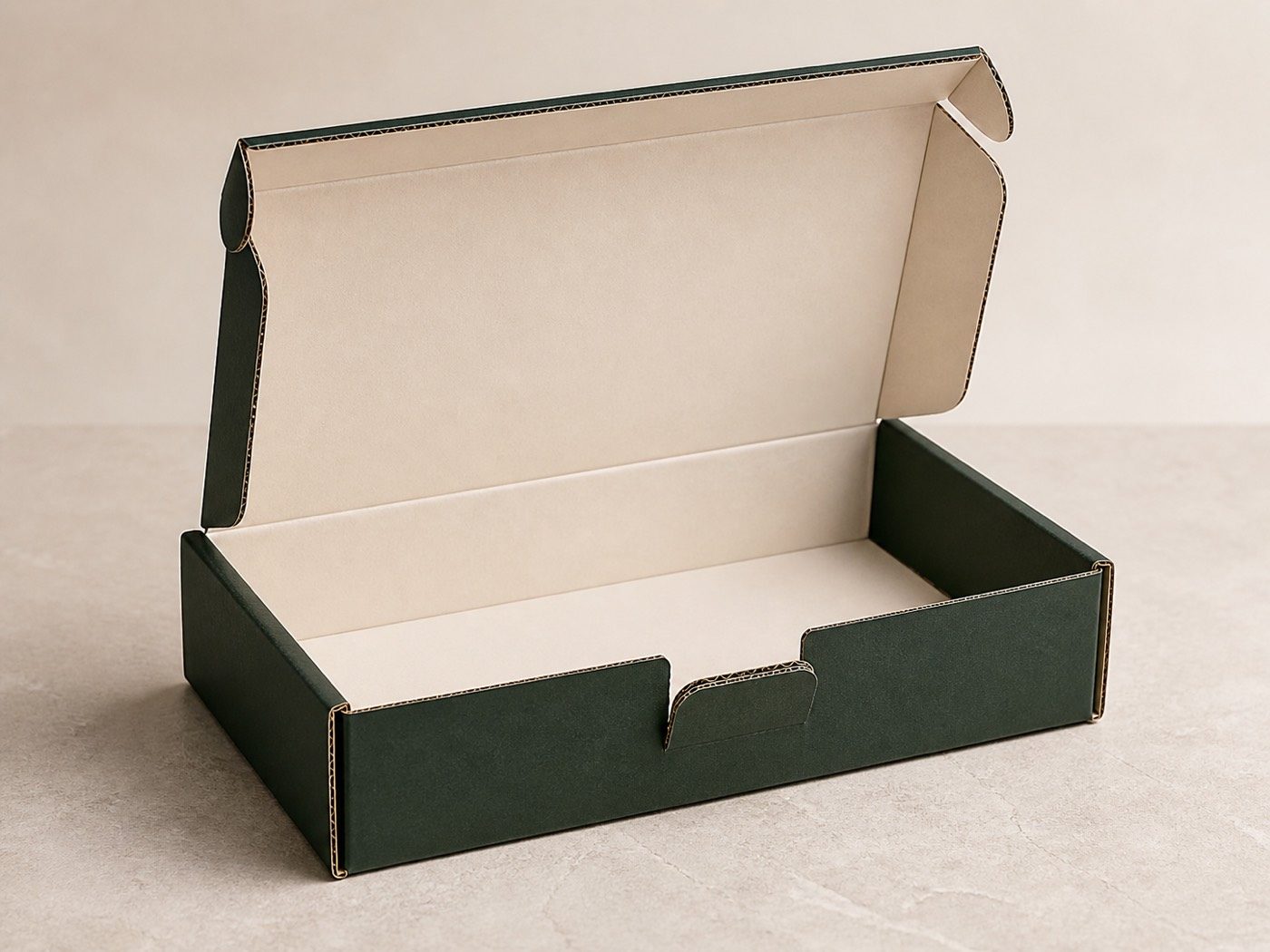
A product-sized corrugated mailer designed for the parcel journey and the opening moment, rather than selected from a stock-box list.
At a glance
- Minimum order quantity
- Standard cartons from 1,000 units
- Sampling
- Presentation-quality sample in 5–7 working days. The sample cost is credited against your first approved production order.
- Production lead time
- 15–20 working days after artwork approval
- Delivery to Europe
- DDP or DAP to the EU and the UK, DDP to Switzerland; your customs broker confirms duty and VAT rates
- Production
- Made to order (OEM/ODM)
- Country of origin
- Huai'an, Jiangsu, China
- Product-Sized Mailer
Overview
An e-commerce mailer has to perform two jobs in sequence: carry the product through a parcel network, then become the first physical brand surface the customer sees. Its internal dimensions therefore start with the product and any required fitment, while the opening panels and inner print are treated as part of the presentation rather than as unused shipping space.
Oversizing is expensive twice: it consumes more board and leaves more volume to fill and transport. The mailer is developed with the actual product loaded so movement, insert layout and the opening action can be reviewed together. Print method follows the role of the box, with retail-facing presentations handled differently from transit-only copy.
Most mailers are a single die-cut piece of corrugated board with no factory glue. The side walls fold over on themselves to double thickness, with tabs that lock into slots in the floor; the lid hinges from the back wall and closes with a tuck front, while dust flaps on the lid slip inside the side walls. Because it locks by folding, the box ships flat and is erected by hand without tape. Flute direction, wall height and the depth of the tuck are set so the folded walls stand square and the lid closes flush over the product and any insert.
What to decide for this format
Product Fit & Empty Space
Set the internal size from the product and fitment, then check movement and unused volume on a loaded sample.
Opening & Print Sequence
Plan what the recipient sees first, which inner surfaces carry copy and which panels must remain clear for shipping information.
Printed Mailer or Shipper With a Retail Box
A printed mailer can be the only box the customer receives, saving a layer of packaging, but its print travels through the parcel network and may arrive marked. A retail carton inside a plain shipper arrives cleaner, at the cost of a second box; choose the mailer when the parcel itself is the presentation.
Across the Corrugated & E-Commerce Boxes range
This page covers what is particular to this product. The full lists for the whole range are set out once, on the Corrugated & E-Commerce Boxes page:
- Materials and finishes
- What you can customise
- Applications
- How it is made
- What drives the cost
- Why work with us
What applies to this product
- Materials
- Single-Wall Corrugated; Double-Wall Corrugated; Litho Face Papers; Kraft Liners; Recycled & FSC-Certified Board
- Printing & Finishes
- Litho Lamination; Flexo Printing; Matte & Gloss Lamination; Foil & Spot UV; Die Cutting, Perforation & Gluing
- Applications
- E-Commerce & DTC
- How it is made
- Product, load & transit review; Structure & cube optimisation; Print method decision; Sampling; Printing, laminating & gluing; Inspection & dispatch
Specifications
| Minimum order quantity | Standard cartons from 1,000 units |
|---|---|
| Production lead time | 15–20 working days after artwork approval |
| Converting line | Fully automated line integrating printing, laminating and gluing |
| Print processes | Offset litho-lamination on the Rapida 106; six-colour flexo and water-based printing for direct liner print |
Terms for this specification
- Sampling
- Presentation-quality sample in 5–7 working days. The sample cost is credited against your first approved production order.
- Colour matching
- Pantone references and physical samples are used where the selected print process supports them. The approval method follows the substrate, artwork and process.
- Certifications
- ISO 9001, ISO 14001:2015, ISO 45001 and China Environmental Labelling (Ten-Ring). ISO 22000 applies to eligible food-contact work.
- Sustainable options
- FSC-certified or recycled-content paper and board, water-based inks and adhesives, and fibre-based fitments are available where the selected construction supports them.
Design & artwork
From an artwork check, through a dimensioned dieline and print-ready files, to a full concept package across a range — done by the factory that will make it.
Frequently asked questions
Can the mailer be printed on the inside?
Yes. Inner printing is one of the options for corrugated mailers. It should be planned with the opening sequence so the message lands on the first useful surface rather than disappearing beneath the product.
How do you decide the mailer size?
From the actual product, the number of units and any dividers or folded fitments required. A loaded sample then shows whether the contents move and whether the box carries unnecessary empty volume.
What do you need to quote a mailer box?
The product dimensions and weight, how many items go in each box and any insert or tissue you plan to use, whether you want print outside, inside or both, and two or three quantities. Telling us how the parcels are sent, and how far, helps match the board to the journey; for the mailers themselves, give the delivery country and, for the EU or the UK, whether you want DDP or DAP.
Does a mailer need tape to stay closed?
A tuck-front mailer stays shut through its tuck and dust flaps, so it can travel without tape. A plain tuck can be lifted and closed again unseen, so where the parcel must show that it has been opened, add a seal label across the front, or a peel-and-seal strip with a tear strip. Decide this before artwork, because a tear strip changes the dieline and the panel it runs across.
From the Journal
Related products
Request a custom packaging quote
What to send for a quote
- The product it is for, and the format you have in mind
- Size as length × width × height, and whether those are inside or outside dimensions
- Quantity, or two or three quantities if you want to compare unit prices
- Material and finish preferences, or the look you are after
- Artwork status: print-ready files, a draft, or nothing yet
- The date you need the goods by
- The destination country
Missing some of these? Send what you have, and we will ask about the rest.