For B2B packaging buyers, forest certification has moved from a nice-to-have to a procurement requirement. Retailers and brand owners increasingly demand that packaging board comes from responsibly managed forests, and the two schemes you will encounter are FSC and PEFC. They are often treated as interchangeable, but there are real differences in origin, recognition, and how the on-pack claim works. This guide explains both for buyers who need to specify certified packaging without getting lost in the detail.
Table of contents
- What FSC and PEFC have in common
- FSC and PEFC compared
- Chain of custody explained
- On-pack label types
- Which should you choose?
- Certification in the wider sustainability picture
- Certified packaging at volume
- What to confirm with your supplier
- Summary
- Frequently asked questions
What FSC and PEFC have in common
Both FSC and PEFC certify that wood and paper fibre comes from responsibly managed forests, and both operate a chain-of-custody system that tracks certified material from the forest through every step of the supply chain to the finished product. The goal of each is the same: to give buyers and consumers confidence that packaging is not contributing to deforestation or poor forest management. In practice, both are credible, widely accepted schemes — the differences are in their structure and reach.
FSC and PEFC compared
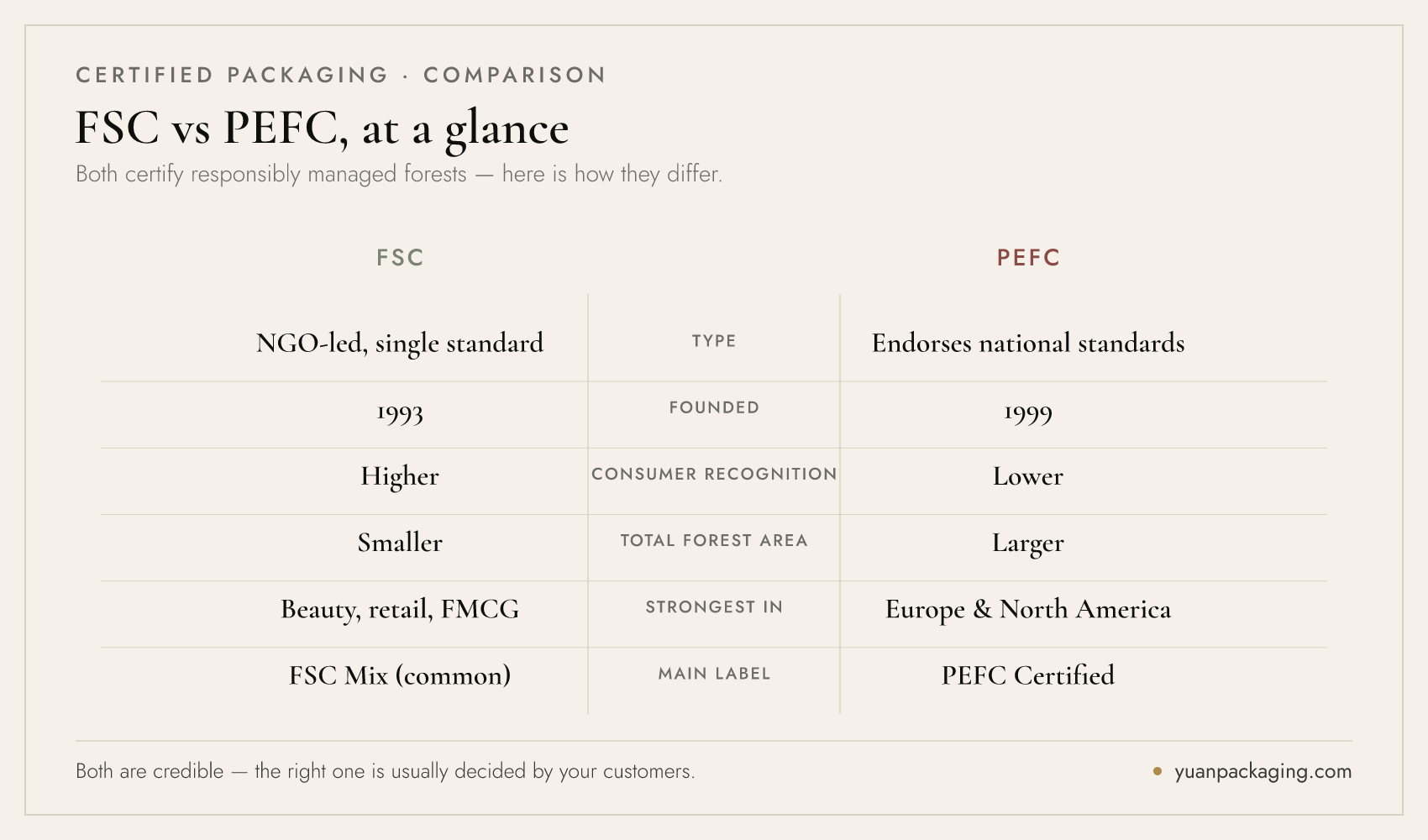
The Forest Stewardship Council (fsc.org) is an international, NGO-led scheme founded in 1993, with a single global standard and strong recognition among consumer-facing brands, particularly in beauty, retail, and FMCG. The Programme for the Endorsement of Forest Certification (pefc.org) is an umbrella organisation that endorses national forest-certification standards, which makes it especially strong where national schemes are well established, such as across much of Europe and North America. FSC tends to have higher brand-recognition with end consumers; PEFC certifies the larger total forest area globally.
Chain of custody explained
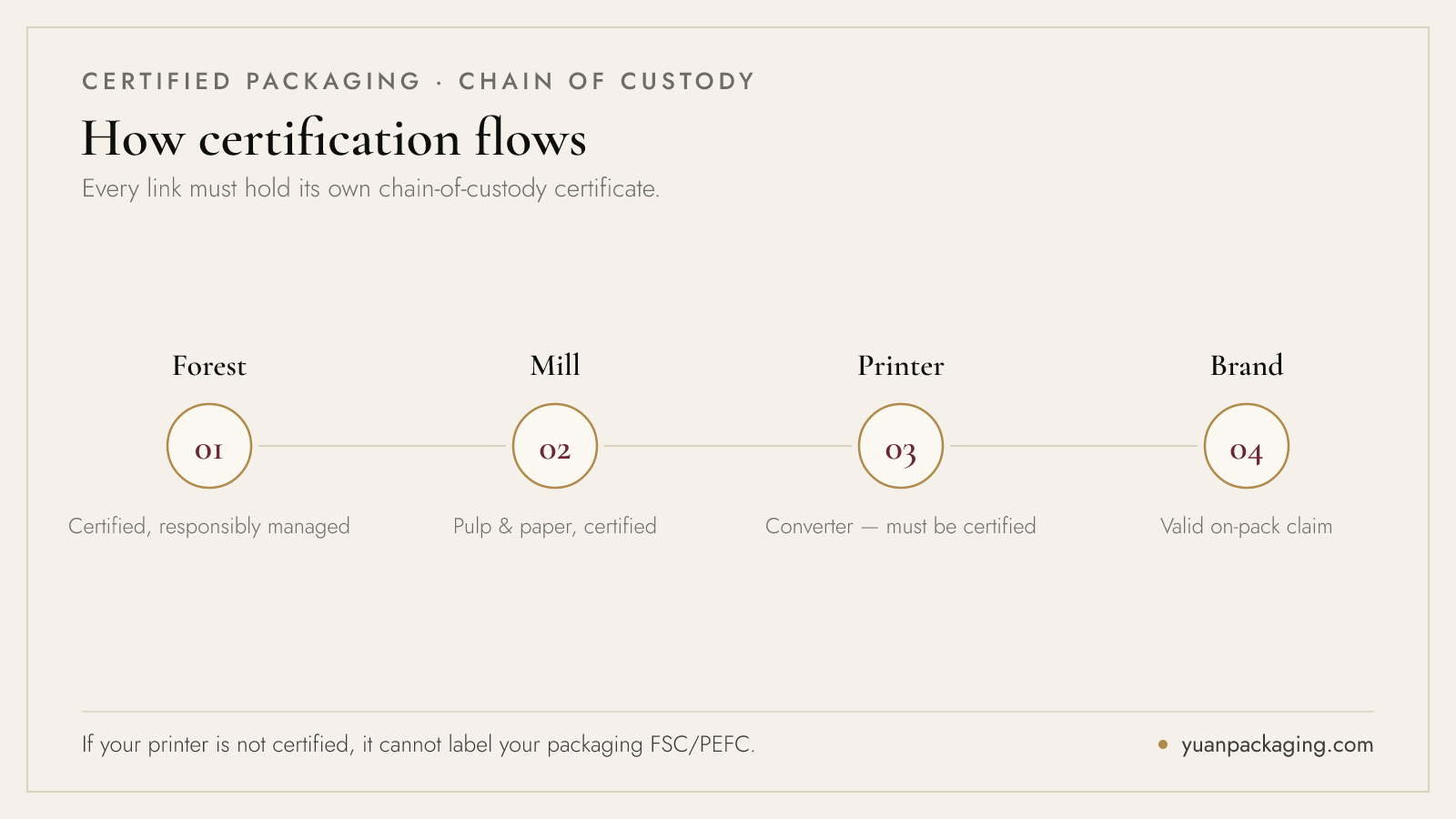
The chain of custody is the part that matters most to you as a packaging buyer. A certification claim is only valid if every link in the chain — the forest, the pulp mill, the paper mill, and the printer or converter — holds its own valid chain-of-custody certificate. If your packaging manufacturer is not chain-of-custody certified, it cannot legitimately apply an FSC or PEFC label to your packaging, even if the board it buys is certified. This is why the supplier’s certification, not just the material’s, is what enables your on-pack claim.
Discuss your packaging project
On-pack label types
Label types are a common source of confusion. FSC has three on-pack labels: FSC 100% (all material from FSC-certified forests), FSC Mix (a blend of certified, recycled, and controlled material), and FSC Recycled (reclaimed material). PEFC has equivalent certified and recycled claims. For most packaging, FSC Mix is the practical, widely used option. The specific label and licence code that appear on your packaging are governed by the supplier’s certificate, so the artwork claim must be confirmed with your manufacturer before print.
Which should you choose?
Which should you choose? In most cases the answer is driven by your customers and markets rather than a technical preference. If your retailers or brand guidelines specify FSC, specify FSC; many global beauty and FMCG brands default to it for its consumer recognition. If you are supplying markets or customers where PEFC is the established norm, PEFC is equally valid. Some buyers simply require “FSC or PEFC certified” to keep options open. The important thing is that the certification is real, current, and correctly claimed.
Certification in the wider sustainability picture
A certified material choice sits within a wider sustainability picture. Forest certification addresses where the fibre comes from, but recyclability, water-based inks, and avoiding unnecessary laminates and plastics matter too. Our work on sustainable packaging covers how certified board fits alongside these other decisions — and how to make them without compromising the premium finish brands depend on.
Certified packaging at volume
For enterprise and high-volume programmes, certified packaging needs to be deliverable consistently and documented properly at scale. Every order should be traceable to a valid certificate, with the correct claim and licence code on every unit and the chain-of-custody reference on the invoice. Our facility holds the certifications enterprise buyers require and runs certified board across our four production lines, from launch quantities to multi-million-unit annual programmes — so a sustainability commitment made in procurement is honoured in production.
What to confirm with your supplier
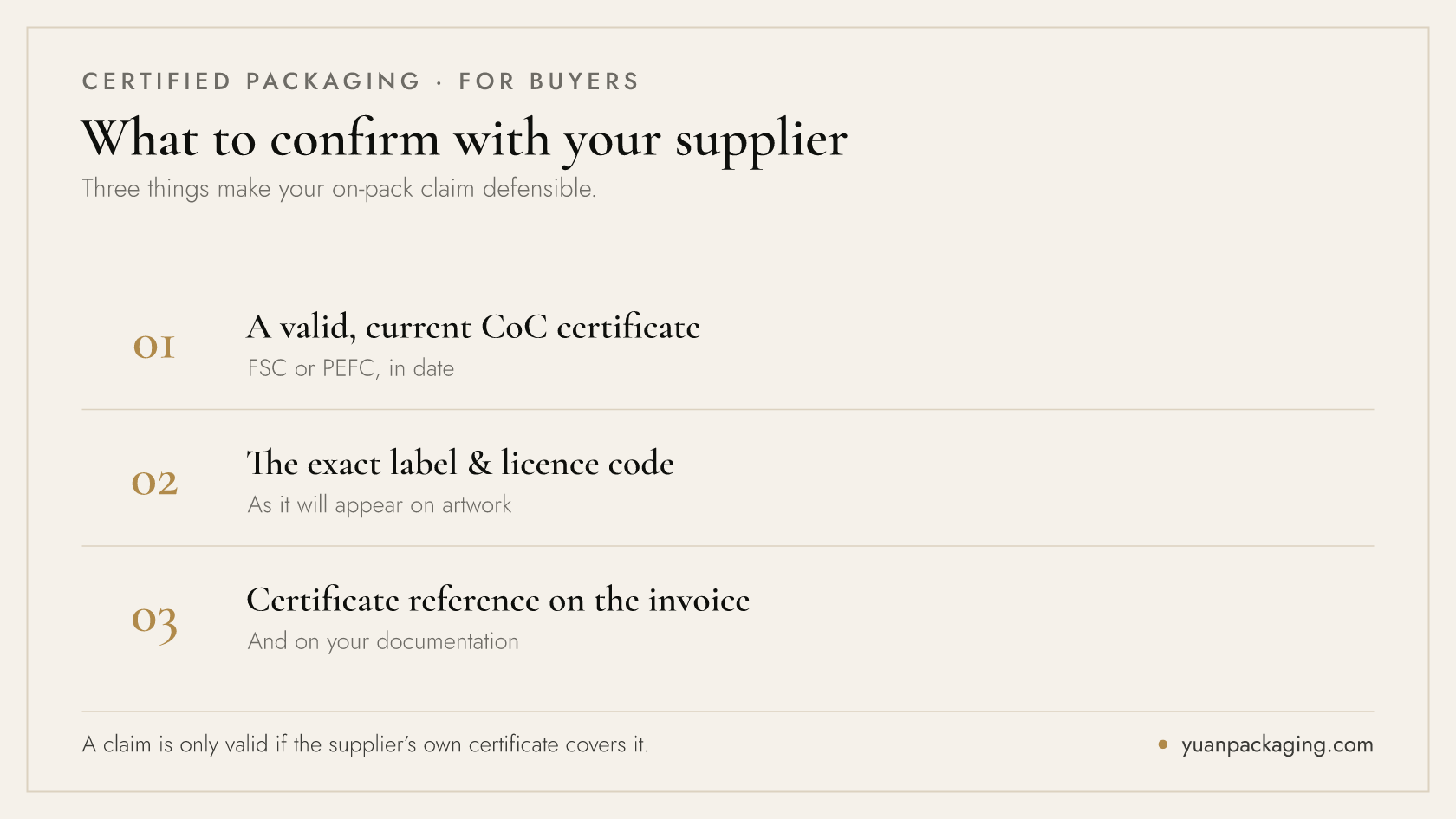
When specifying certified packaging, confirm three things with your supplier: that they hold a valid, current chain-of-custody certificate (FSC or PEFC), the exact on-pack label and licence code that will appear on your artwork, and that the certification reference will be stated on your invoice and documentation. Getting these confirmed up front means your sustainability claim is defensible if a retailer or auditor checks it. Shipping certified packaging into the EU or UK? Our guide for European brands also covers what the EU’s new packaging regulation (PPWR) asks of importers.
Summary
In short: FSC and PEFC are both credible forest-certification schemes; the right one is usually decided by your customers and markets, and the supplier’s own chain-of-custody certificate is what makes your on-pack claim valid. If you need FSC or PEFC certified packaging produced reliably at volume, tell us about your project and we will confirm the certification, label, and documentation your programme requires.
Frequently Asked Questions
What is the difference between FSC and PEFC?
Both certify responsibly managed forests with a chain-of-custody system. FSC is a single international NGO-led standard with strong consumer brand recognition; PEFC is an umbrella body endorsing national standards and certifies the larger total forest area. Both are credible and widely accepted.
Does my packaging supplier need to be FSC or PEFC certified?
Yes — to put an FSC or PEFC label on your packaging, the manufacturer must hold its own valid chain-of-custody certificate, not just buy certified board. Without it, the on-pack claim is not legitimate, so always confirm the supplier’s certificate, label type and licence code before print.
What do FSC 100%, FSC Mix and FSC Recycled mean?
FSC 100% means all material comes from FSC-certified forests; FSC Mix is a blend of certified, recycled and controlled material; FSC Recycled is reclaimed material. For most packaging, FSC Mix is the practical, widely used option. PEFC has equivalent certified and recycled claims.
Should I choose FSC or PEFC for my packaging?
It is usually decided by your customers and markets rather than a technical preference. If your retailers or brand guidelines specify FSC, use FSC; if you supply markets where PEFC is the norm, PEFC is equally valid. Some buyers simply require “FSC or PEFC certified” to keep options open.