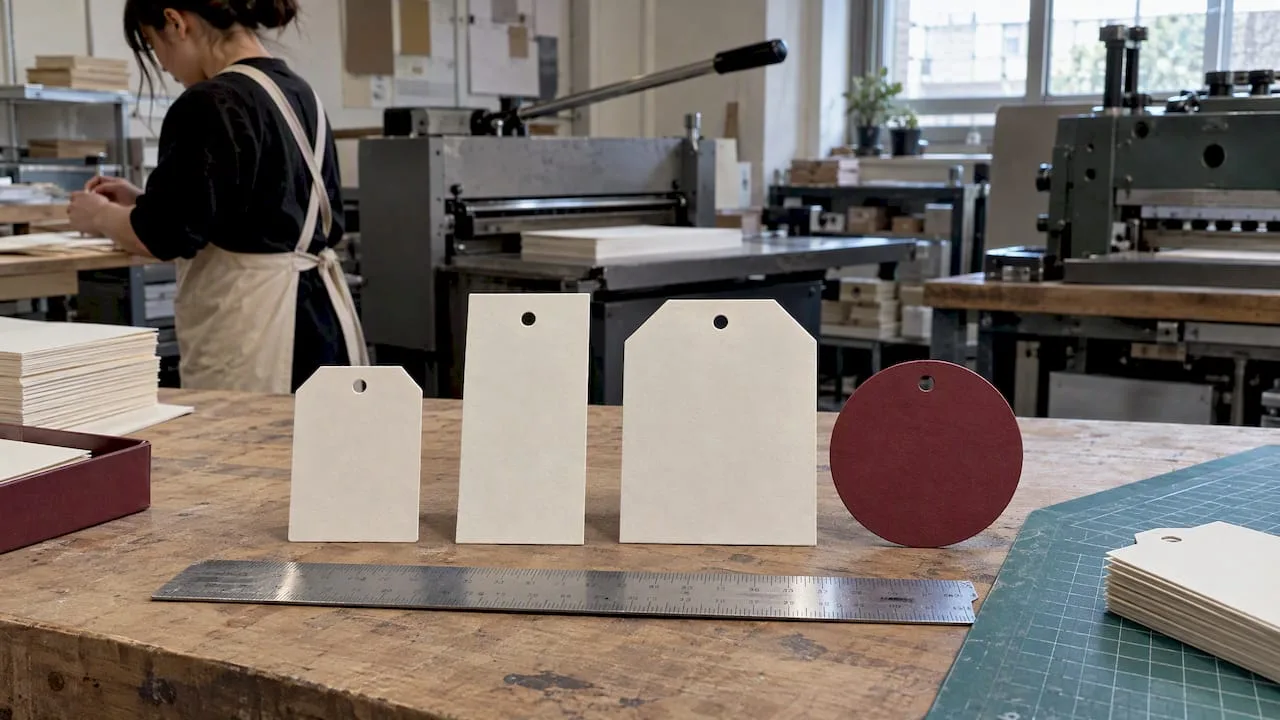
Most apparel brands order hang tags in one of four standard footprints: 2 × 3.5 inches (the business-card equivalent), 2 × 2 inches, 1.5 × 3 inches, or 2 × 4 inches for bulkier items. A simple rule of thumb is to size the tag proportionally to the product, using smaller sizes for jewelry and accessories, business-card dimensions for shirts and tops, and larger formats for outerwear to accommodate more copy. Whatever size you choose, hole placement and bleed need to be built into the spec from the start.
TL;DR:
- Using standard sizes like 2 × 3.5 inches for apparel and 1.375 × 2.75 inches for jewelry keeps costs predictable due to existing dieline options.
- Heavier garments such as outerwear benefit from larger tags like 2 × 4 inches to accommodate more information, while small accessories suit narrower formats.
- Including both logo and barcode on a tag requires at least one size step larger than initially planned, to prevent cramped layouts and reordering.
- Proper setup of bleed (0.125 inches), safe area, and hole placement (2.5 to 4 mm diameter, 6 to 8 mm from top) reduces printing errors and tag tearing.
- Opting for recycled stocks and simple shapes like rounded or clipped corners enhances sustainability and durability while controlling production costs.
Table of Contents
- Common standard hang tag sizes in inches and millimeters
- Choosing a hang tag size by garment or product type
- Setting up dielines, bleed, and hole placement for print
- Materials, stock weight, and finishing choices that shape the tag
- Shapes, corners, and attachment hardware that affect cost and durability
- How an experienced manufacturer implements these specifications
- How hang tag size affects printing costs and production efficiency
- Examples of popular hang tag sizes across industries
- Balancing brand impact with cost and sustainability
- Ordering custom hang tags built to your specifications
- FAQ
Common standard hang tag sizes in inches and millimeters
Hang tags come in a narrow set of footprints that printers and converters already have dielines for, which keeps tooling costs down and turnaround predictable. Working from this list rather than a custom footprint is the fastest way to a tag that prints cleanly on the first run.
- 1.375 × 2.75 in (35 × 70 mm): a compact size common on jewelry and small leather goods.
- 1.5 × 3 in (38 × 76 mm): a narrow format often used on accessories and scarves.
- 2 × 2 in (50 × 50 mm): the square option, popular for minimalist branding on bags and footwear.
- 2 × 3.5 in (50.8 × 88.9 mm): the business-card equivalent and the single most common size for shirts, tops, and general apparel.
- 2 × 4 in (50.8 × 101.6 mm): a taller format that suits outerwear and items needing more copy, such as care instructions.
- 2.625 × 4 in (66.7 × 101.6 mm): a larger panel used where brand storytelling or multiple languages are needed.
The business-card equivalent hang tag dimension of 2 × 3.5 inches is the default for a reason: it is big enough to carry a logo, price, and a line of copy without overwhelming a folded shirt or a hanging garment.
Standard hang tag sizing exists for a reason: printers stock dies and plates for these footprints, so ordering within the catalog keeps unit costs lower and sample turnaround faster than a fully custom cut.
Choosing a hang tag size by garment or product type
Matching tag size to product type is less about convention and more about proportion: a tag that dwarfs a pair of earrings or disappears against a parka reads as a sizing mistake, not a design choice.
- Jewelry and small accessories read best on 1.375 × 2.75 in or similar compact tags that do not overwhelm the item on the card or hook.
- Scarves, belts, and slim accessories suit the narrower 1.5 × 3 in format, which follows the product's own proportions.
- Tops, shirts, and general apparel are the natural home for the 2 × 3.5 in business-card equivalent, which balances logo space with copy.
- Bottoms and denim often carry the same 2 × 3.5 in size, sometimes with a folded or multi-panel tag for fit and wash information.
- Outerwear and heavier garments can support 2 × 4 in or larger tags, giving room for care instructions, fill details, or sizing charts.
- Bags and footwear frequently use the 2 × 2 in square, which reads cleanly on a structured surface like a handle or a shoebox strap.
- Home goods tend toward larger rectangular tags since they are often read at a distance on a shelf rather than handled first.
Before locking a size, weigh how much copy the tag needs to carry, how prominent the logo should be relative to the garment, and how the tag will be displayed, folded flat on a table, hanging from a rack, or clipped to packaging.
Pro Tip: If a tag needs both a logo and a barcode, choose a size at least one step larger than you think you need. Cramped layouts are the most common reason brands reorder tags mid-season.
Setting up dielines, bleed, and hole placement for print
Getting the artwork file right the first time saves a reprint. A standard bleed recommendation for small printed items like hang tags is typically 0.125 in (3 mm) beyond the trim line, with a safe area set 0.125 to 0.2 in inside the trim so that no text or logo gets clipped during cutting.
- Keep all critical text and logos inside the safe area, never touching the trim line.
- Extend background colors and images 0.125 in past the trim to avoid white edges after cutting.
- Place registration marks outside the bleed so they do not appear on the finished tag.
- Export print files as CMYK PDFs with embedded fonts and outlined vector artwork.
Hole placement follows its own small set of conventions. Typical hole diameters for hang tags range from about 2.5 mm to 4 mm, generally centered roughly 6 to 8 mm from the top edge depending on tag size, close enough to the corner for a clean hang but far enough to resist tearing.
Hole placement is not cosmetic: a hole punched too close to the edge is the leading cause of tags that tear off during handling or shipping, which makes this one of the few specs worth double-checking on every proof.

Materials, stock weight, and finishing choices that shape the tag
Stock weight does as much to communicate quality as the size itself. A common stock recommendation for hang tags is cover weight or card stock equivalent to roughly 300 to 400 gsm for a firm, premium feel, while lighter stocks in the 200 to 270 gsm range suit economy or high-volume tags where cost matters more than rigidity.
- Heavier stocks (300 to 400 gsm) hold their shape on display and feel substantial in hand, which matters for premium positioning.
- Lighter stocks (200 to 270 gsm) keep per-unit costs down for fast fashion or promotional runs.
- Lamination, soft-touch coatings, foil stamping, and embossing all add tactile and visual depth but typically require slightly larger safe margins to avoid cracking at fold lines or edges.
- Recycled and responsibly sourced papers are widely available as alternatives to virgin stock, often at a modest cost premium, and increasingly expected by retailers and consumers alike.
A tag's perceived size often has as much to do with its stiffness as its dimensions. A thin 2 × 3.5 in tag can feel smaller than a well-built 2 × 2 in square on heavier stock.
Shapes, corners, and attachment hardware that affect cost and durability
Shape and corner style are production decisions as much as design ones. Rounded corners improve durability and reduce snagging compared with square corners, while clipped corners add a measure of tear resistance while keeping a clean, modern look.
- Square corners are the cheapest to produce but the most prone to bending and tearing in transit.
- Rounded or clipped corners cost marginally more to die-cut but hold up better through handling.
- Fully custom die-cut shapes beyond a rectangle or rounded rectangle raise tooling costs and usually come with higher minimum order quantities.
- Eyelet reinforcement around the hole extends tag life significantly on heavier garments and reduces returns tied to torn tags.
- Cotton string, waxed cord, and elastic loop are the most common attachment types, each adding its own assembly step and per-unit cost.
Pro Tip: Reserve custom die-cut shapes for hero products or limited runs. The tooling cost rarely pays off on a tag that will only see one season.
How an experienced manufacturer implements these specifications
Turning a size and finish decision into a finished tag means translating the brief into production specs, running a proof, and checking fit before committing to volume. We build these checks into every custom hang tag project, from dieline approval through sample runs, and apply sustainability sourcing standards consistent with industry best practices across paper-based product lines.
How hang tag size affects printing costs and production efficiency
Size drives cost in ways that are easy to overlook at the design stage. Larger tags use more stock per unit, which raises material cost proportionally, and they also reduce how many tags fit on a single press sheet, which lowers press efficiency and can raise the per-unit price even before finishing is added.
Standard sizes keep costs predictable because printers already hold dies and plates for them, so a 2 × 3.5 in order slots into existing production runs rather than requiring new tooling. A custom or oversized footprint, by contrast, often means a dedicated die cut, which adds both cost and lead time, particularly on smaller order quantities.
Finishing compounds the effect. Foil stamping, embossing, and soft-touch lamination each add a separate production pass, and larger tags take proportionally longer to run through these finishing steps than smaller ones. For brands ordering across multiple sizes in a single collection, standardizing on one or two footprints, rather than a different size per garment type, is one of the more reliable ways to keep per-unit pricing consistent and avoid surprise costs on reorders.
Examples of popular hang tag sizes across industries
Fashion retailers overwhelmingly default to the 2 × 3.5 in business-card format for mainstream apparel, since it holds a logo, price, and size information without crowding a folded shirt or a pair of jeans on the rack. Outerwear and technical apparel brands tend to size up to 2 × 4 in or larger, giving room for fill weight, care instructions, and multi-language labeling that heavier garments often require.
Jewelry and small leather goods brands lean toward the compact 1.375 × 2.75 in size or similar, since anything larger overwhelms the product itself, both on display and in the customer's hand. Footwear and bag brands frequently choose the 2 × 2 in square, which sits neatly on a shoebox strap or bag handle and reads as a clean, minimal mark rather than a label competing with the product's own design.
Promotional and retail labeling outside of apparel follows its own conventions. A promotional label format like 78 × 48 mm, for example, shows how off-the-shelf sizing conventions extend well beyond clothing into general retail and point-of-sale applications, where a recognizable footprint keeps costs down in the same way it does for apparel tags.

Balancing brand impact with cost and sustainability
The sturdiest guiding principle is to prototype two sizes before committing to a production run. Save premium finishes, foil, embossing, heavier stock, for hero products where shelf impact matters most, and favor recycled stocks on higher-volume lines where cost and environmental footprint carry more weight. Request samples and check dielines with your manufacturer before the order is locked.
— Anthony
Ordering custom hang tags built to your specifications
We produce custom hang tags in the sizes, stocks, and finishes covered here, including foil stamping, embossing, and soft-touch lamination, on responsibly sourced paper. Our product lines cover hang tags alongside rigid boxes, labels, and cartons for brands that need matching packaging across a full collection.
| Decision point | What to check before ordering |
|---|---|
| Garment type | Match tag size to product scale and display method |
| Artwork file | Confirm bleed, safe area, and CMYK setup |
| Stock and finish | Choose gsm and lamination based on premium positioning |
| Hole and corner style | Specify diameter, placement, and corner type for durability |
Submit your specs or request a sample through our products page to start a production-ready proof.
FAQ
What is the standard size of a hang tag?
The most widely used standard size is 2 × 3.5 inches (50.8 × 88.9 mm), often called the business-card equivalent, common across general apparel. Smaller sizes like 2 × 2 in or 1.5 × 3 in are standard for accessories and jewelry, while 2 × 4 in suits outerwear.
What are the standard dimensions for hang tags?
Widely used dimensions include 1.375 × 2.75 in, 1.5 × 3 in, 2 × 2 in, 2 × 3.5 in, and 2 × 4 in, covering most apparel and accessory categories. The choice depends on the product's scale and how much copy the tag needs to carry.
What is the standard size of a hang tag?
The most widely used standard size is 2 × 3.5 inches (50.8 × 88.9 mm), often called the business-card equivalent, common across general apparel. Smaller sizes like 2 × 2 in or 1.5 × 3 in are standard for accessories and jewelry, while 2 × 4 in suits outerwear.
What are the standard dimensions for hang tags?
Widely used dimensions include 1.375 × 2.75 in, 1.5 × 3 in, 2 × 2 in, 2 × 3.5 in, and 2 × 4 in, covering most apparel and accessory categories. The choice depends on the product's scale and how much copy the tag needs to carry.