Custom Hang Tags, Sleeves & Printed Brand Components
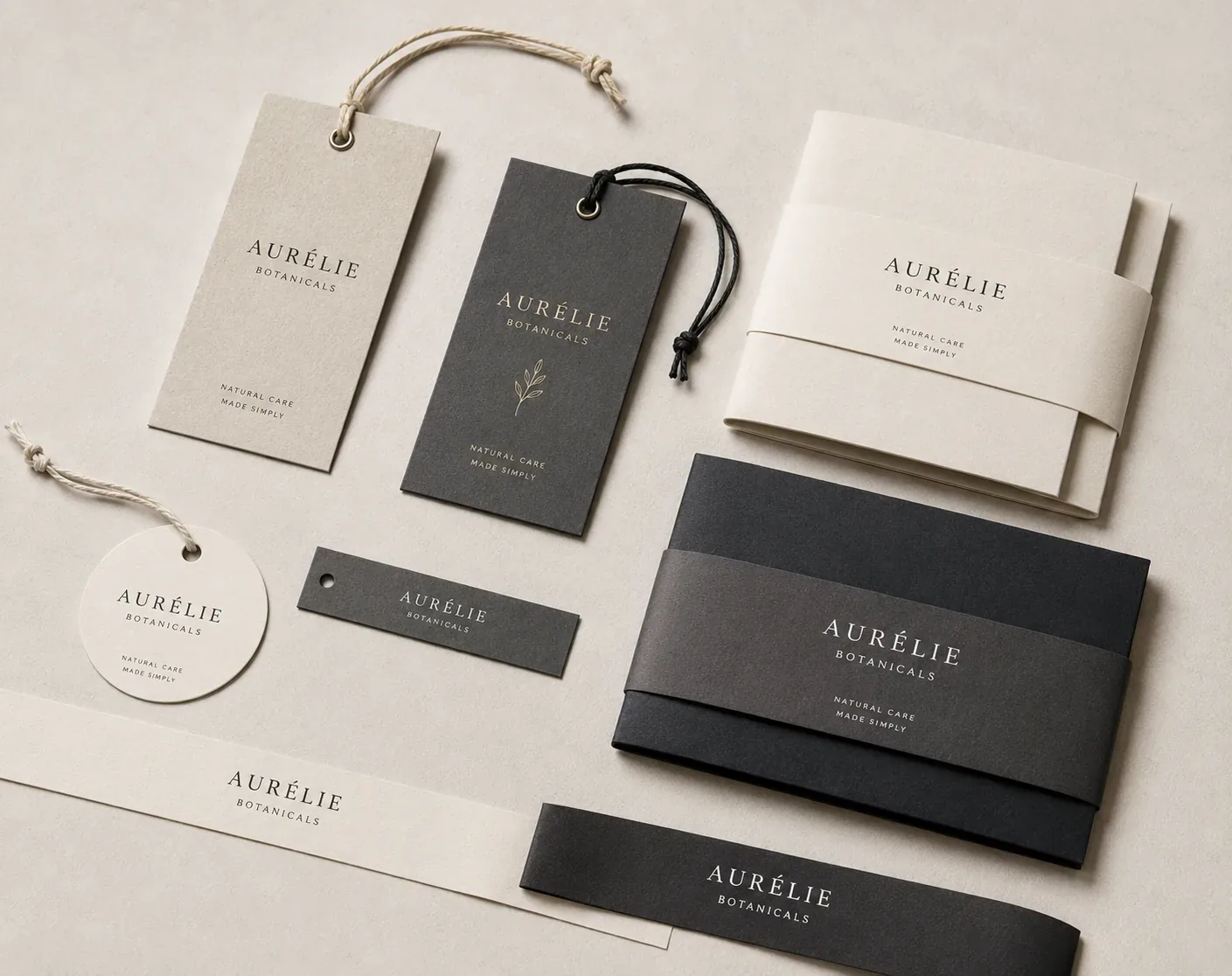
The small printed pieces a pack is judged on up close — tags, sleeves, bands and cards, made on the same presses and to the same colour standard as the box they belong to.
At a glance
- Minimum order quantity
- Digital printing supports very short runs; offset runs follow the standard 1,000-unit minimum
- Sampling
- Presentation-quality sample in 5–7 working days. The sample cost is credited against your first approved production order.
- Production lead time
- 15–20 working days after artwork approval; shorter for digital-only runs
- Delivery to Europe
- DDP or DAP to the EU and the UK, DDP to Switzerland; your customs broker confirms duty and VAT rates
- Production
- Made to order (OEM/ODM)
- Country of origin
- Huai'an, Jiangsu, China
- Low MOQ Digital
- Foil & Emboss
- Specialty Papers
- Precision Die-Cut
- Eyelets & Cord
- Variable Data
Overview
These are the pieces that get handled. A hang tag is held between finger and thumb, a belly band is slid off, a care card is read at home a week later — all at a distance where a soft edge, a slightly off brand colour or a cheap board is obvious in a way it never is on a shelf.
They are also often sourced separately, which increases the risk of visible colour drift between unlike stocks and print processes. A tag and box are handled together, so both still need side-by-side sample approval even when they use the same colour reference.
We produce these alongside the boxes, cartons and labels they accompany, on the same presses and against the same Pantone reference. Short runs and personalised or numbered pieces go to the digital press installed in 2022, so a launch quantity of tags does not force a full offset run.
Explore the range
- Hang Tags & Swing Tags — A handled brand component whose board, shape, attachment and finish are specified together with the pack it accompanies.
- Printed Packaging Sleeves — A printed outer layer that slides over an existing pack to carry a distinct edition without changing the base structure.
- Printed Packaging Belly Bands — A narrow printed wrap that adds an information or edition layer while leaving most of the underlying pack visible.
- Care & Instruction Cards — An inserted information piece designed for close reading after purchase and coordinated with the packaging that carries it.
- Certificates & Authenticity Cards — Hardback certificates that give a limited-edition bottle its record: foil-stamped covers, numbered pages and QR codes, made to the same standard as the box.
- Wrapping & Tissue Sheets — A lightweight inner wrap planned around the fold, reveal and colour relationship inside the finished pack.
Component Types
Hang Tags & Swing Tags
Die-cut tags with a reinforced or eyeletted hole, strung with cord, ribbon or elastic. Apparel, gifting and retail.
Sleeves
Printed sleeves that slide over a rigid box, carton or tube — a practical way to run seasonal or market-specific versions off one base pack.
Belly Bands
A narrow wrap around the middle of a pack, holding it closed and carrying campaign or edition copy without reprinting the box.
Care & Instruction Cards
Inserted cards carrying care instructions, provenance or usage guidance — read after purchase, when the pack is doing its second job.
Thank-You & Gift Cards
Small printed cards for e-commerce and gifting, including personalised or numbered runs on the digital press.
Certificates & Authenticity Cards
Hardback collection certificates and numbered authenticity cards for limited editions, with foil covers, QR codes and the same security options as our labels.
Wrapping & Tissue Sheets
Printed inner wraps and tissue that fill the space between the product and the box lid.
What drives the cost
These components are small in unit cost but visible at close range. Coordinating them with the pack keeps colour, fit and finish in one approval process and reduces the risk of a second sampling cycle.
Quantity
Most of the cost of a print job is set-up — plates, dies, make-ready, the first good sheet. Doubling a run rarely doubles the price, which is why it is worth asking for two or three volumes on the same quote.
Structure
A rigid box is formed, wrapped and often assembled by hand; a folding carton is die-cut and glued in one pass. Structure is usually the single biggest difference between two otherwise identical packs.
Material
Board grade and wrap stock. Specialty and textured papers cost more per sheet, but can replace a finishing pass — sometimes the cheaper route to the same effect.
Finishing passes
Each of foil, emboss, spot UV and lamination is a separate pass through a machine. Two effects cost roughly twice one, so the question is always which effect earns its place.
Tooling
Dies, emboss plates and foil blocks are one-off costs carried by the first order and reused on every repeat. Repeat runs of an approved specification are materially cheaper than the first.
Design & artwork
From an artwork check, through a dimensioned dieline and print-ready files, to a full concept package across a range — done by the factory that will make it.
Board & material options
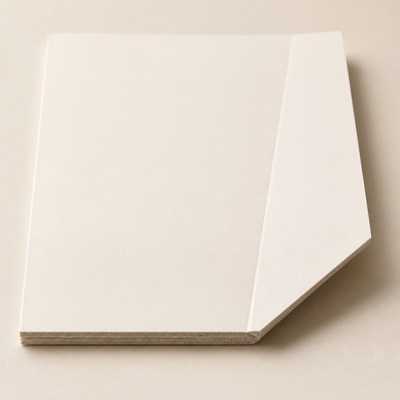
Ivory Board (FBB)
Bright folding boxboard with a smooth print face.
The standard carton stock in cosmetics and pharmaceutical work — clean creasing, reliable folding, white enough for small regulatory type.
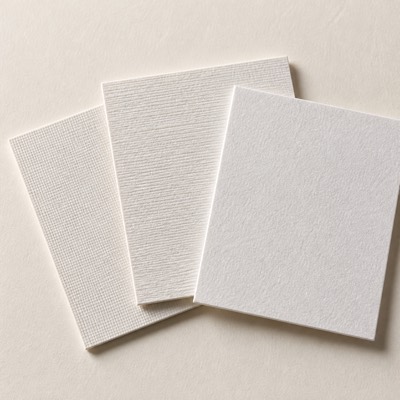
Textured & Felt-Marked
Embossed linen, laid and felt surfaces.
Carries a tactile identity with no extra finishing pass. Print sits softer on texture — fine detail and photographic images lose bite, so it suits type and blind emboss better than imagery.
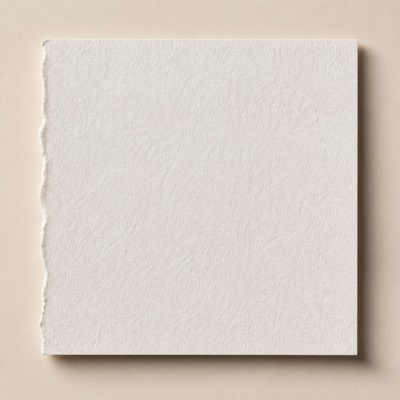
Cotton Paper
Cotton fibre rather than wood pulp — thick, soft and quiet.
Takes a deep blind deboss better than any other stock we carry. Does not suit photographic print.
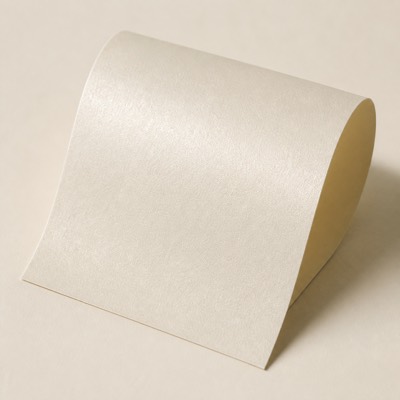
Pearl / Iridescent
A shimmer worked into the sheet itself.
Subtler than metallised board, and it still takes ink normally — so photography survives on it where it would not on foil paper.
Finishing options
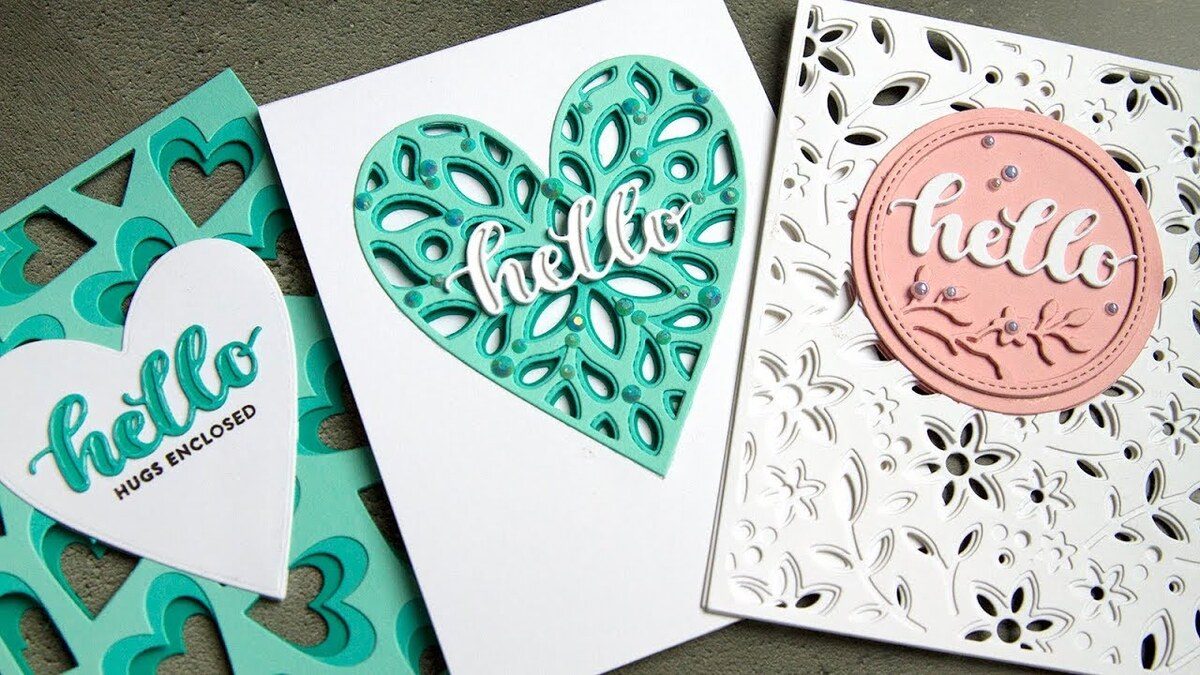
Die Cutting
Custom shapes, windows and cut-outs.
Windows, shaped lids, handle apertures and label outlines. A window can be left open or patched with clear film depending on whether the product needs protecting.

Hot Foil Stamping
Metallic foil applied by heated die, registered to the print.
Gold, silver, copper and coloured foils. Applied flat before any wrapping or forming, so registration is controlled on a sheet rather than on a curve.

Embossing
Raised relief pressed into the surface from behind.
Can be registered over foil for a sculpted metallic mark. Sequence matters: emboss after foil is standard, and reversing it damages the foil surface.
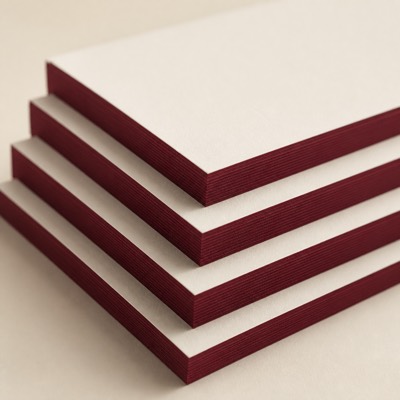
Edge Painting
Colour applied to the cut edge of a thick card.
Only works on stock thick enough to show an edge — usually duplexed. Visible from every angle the piece is held at.
Materials
Coated Board
The standard tag and card stock — sharp print, clean die-cut edges, takes foil and emboss predictably.
Uncoated & Textured Papers
Felt-marked, laid and cotton-look stocks. On a piece held this close, paper texture does more work than print does.
Kraft & Recycled Stocks
Recycled-content boards with water-based inks, for programmes with a materials policy.
Duplexed Board
Two stocks bonded back to back for a thicker tag with a different colour or texture on each face.
Cords, Ribbons & Eyelets
Cotton cord, ribbon, elastic and metal eyelets, fitted during finishing rather than left to you to assemble.
Printing & Finishes
Hot Foil Stamping
On a small piece, foil is usually the whole design rather than an accent. Registration matters more, not less, at this size.
Embossing & Debossing
Relief that is felt before it is seen — the reason a plain tag on textured stock can outperform a printed one.
Edge Painting & Duplexing
A coloured edge on a thick or duplexed card, visible from every angle the piece is held at.
Spot UV & Soft-Touch
Contrast finishes matched to the box the component ships with.
Precision Die Cutting
Custom outlines, rounded corners and reinforced string holes held consistently across the run.
Numbering & Variable Data
Sequential numbers, QR codes and personalisation printed digitally for editions and campaigns.
What you can customise
- Shape, size and die outline
- Board type, thickness and duplexing
- Cord, ribbon or elastic type, colour and length
- Eyelet finish and hole reinforcement
- Print, foil, emboss and edge treatment
- Numbering, QR codes and personalisation
- Matching the box, carton or tube it ships with
Specifications
| Minimum order quantity | Digital printing supports very short runs; offset runs follow the standard 1,000-unit minimum |
|---|---|
| Production lead time | 15–20 working days after artwork approval; shorter for digital-only runs |
| Print processes | Offset on the Rapida 106 and digital (installed 2022) for short runs, numbering and personalisation |
| Assembly | Cord, ribbon and eyelets fitted in-house so components arrive ready to apply |
Terms for this specification
- Sampling
- Presentation-quality sample in 5–7 working days. The sample cost is credited against your first approved production order.
- Colour matching
- Pantone references and physical samples are used where the selected print process supports them. The approval method follows the substrate, artwork and process.
- Certifications
- ISO 9001, ISO 14001:2015, ISO 45001 and China Environmental Labelling (Ten-Ring). ISO 22000 applies to eligible food-contact work.
- Sustainable options
- FSC-certified or recycled-content paper and board, water-based inks and adhesives, and fibre-based fitments are available where the selected construction supports them.
Applications
Apparel & Accessories
Swing tags supplied ready to attach, with care cards and size tags supplied to their approved format.
Spirits & Gifting
Neck tags, bands and certificates for limited editions and seasonal programmes.
Beauty & E-Commerce
Thank-you cards, sleeves and inserts that carry the brand into the unboxing moment.
Seasonal & Market Versions
A sleeve or band over a standard box — a new edition without retooling the pack.
Selected work

How it is made
Component & fit review
What the piece attaches to or wraps around, and the tolerance it needs to slide, hold or hang correctly.
Die & material selection
Shape, board thickness and whether duplexing or edge treatment carries the design.
Process selection
Digital for short runs, numbering and personalisation; offset where the piece must match an offset-printed box exactly.
Sampling
Samples strung and finished as they will ship, and slid onto the actual box where there is one.
Print, finish & die cut
Printing, foil, emboss and varnish, then precision die cutting and edge treatment.
Stringing, assembly & packing
Eyelets set, cord or ribbon fitted, then counted and packed with the box programme they belong to.
Why Yuan Packaging
- Printed against the same Pantone reference and reviewed beside the pack; final matching is confirmed on physical samples because stocks differ
- Digital press for launch quantities, numbered editions and personalisation without a full offset run
- Cord, ribbon and eyelets fitted in-house, so components arrive ready to apply
- Specialty and textured stocks — on a piece held this close, paper does more than print does
Frequently asked questions
Can you print small quantities of tags?
Yes. Our digital press supports very short runs, which is normally the right route for launches, limited editions and numbered pieces. Offset makes sense once quantities rise or when the tag has to match an offset-printed box exactly.
Do the tags arrive strung?
Yes — eyelets, cord, ribbon and elastic are fitted during finishing, so components arrive ready to attach rather than as a bag of parts for your team to assemble.
Will the tag colour match our box?
That is the main reason to order them together. Same Pantone reference, same press, same approval. Note that a colour still reads differently on uncoated tag stock than on a coated box wrap — matching is confirmed at sampling, not assumed from one file.
Can a sleeve create a seasonal version without a new box?
Yes. One base pack can stay in production while sleeves or belly bands carry seasonal, market-specific or campaign artwork. This avoids new box tooling for the version layer; quantity and price still depend on the selected print process and finish.
From the Journal
Related products
Request a custom packaging quote
What to send for a quote
- The product it is for, and the format you have in mind
- Size as length × width × height, and whether those are inside or outside dimensions
- Quantity, or two or three quantities if you want to compare unit prices
- Material and finish preferences, or the look you are after
- Artwork status: print-ready files, a draft, or nothing yet
- The date you need the goods by
- The destination country
Missing some of these? Send what you have, and we will ask about the rest.