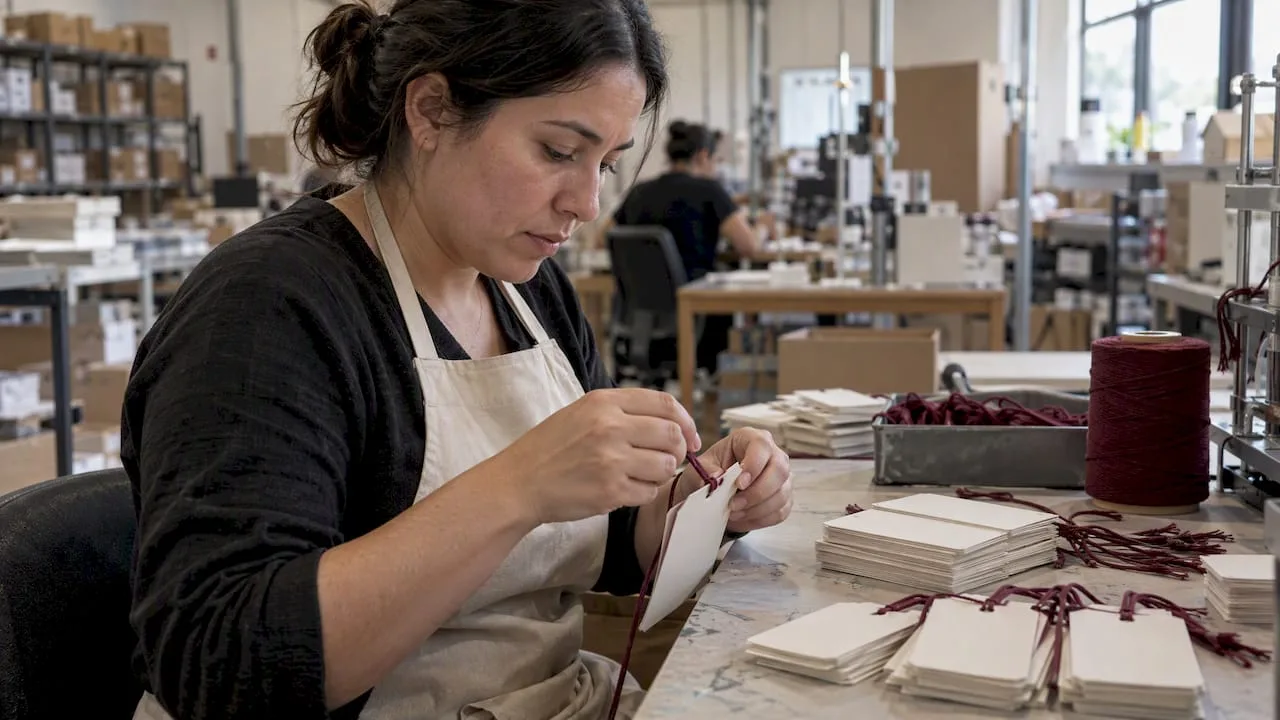
For most retail hang tags, braided polyester or cotton cord strikes the best balance of durability and finished appearance, and for small runs or retail-ready SKUs, pre-strung tags are the efficient choice. Larger orders or tags with custom finishes are better served by sourcing loose strings or contract-manufacturing the whole assembly. Before requesting quotes, finalize your quantities and pull samples so suppliers can confirm fit and finish.
TL;DR:
- Braided polyester or nylon cords are ideal for durability, especially for high-handling retail environments, while natural fibers suit premium, eco-conscious branding.
- Pre-strung tags are best for small orders and quick retail installations, but large runs or custom finishes often require sourcing loose strings or full contract manufacturing.
- Suppliers need clear specifications on fiber type, cord diameter, loop length, and attachment style, with samples matching the final product for accurate quotes.
- Equipment choice depends on volume: manual tools for low quantities, semi-automatic for mid-volume, and full-automatic machines for large-scale production, with outsourcing often more economical at scale.
- Basic quality checks include knot pull tests, dye transfer assessments, and loop length measurements, along with third-party testing for sustainability or strength claims.
Table of Contents
- Quick buyer checklist for purchasing hang-tag strings and services
- Hang-tag string and fastener types, with best uses and tradeoffs
- Stringing and knotting equipment: picking the right machine or deciding to outsource
- How to write a production-ready hang-tag stringing spec for suppliers or factories
- Quality checks, sampling, and tests for hang-tag stringing
- Manufacturer perspective: balancing look, durability, and sustainability
- How Yuan Packaging can handle hang-tag stringing and full production
- FAQ
Quick buyer checklist for purchasing hang-tag strings and services
Before you send out requests for quotes, a short internal review saves weeks of back-and-forth with suppliers. Procurement teams that walk into sampling with firm answers on these five points typically get accurate quotes on the first pass rather than the third.
- Confirm the SKU use-case (garment, jewelry, bottle neck, accessory) and how much handling the tag will see at retail.
- Decide whether you need pre-strung tags, bulk loose strings, or full contract stringing, and document why.
- Specify fiber type, cord diameter, finished loop length, knot style, and whether eyelets or grommets are required.
- Set target quantities alongside expected minimum order quantities (MOQs), lead times, and preferred packing format for cartons or pallets.
- List any sustainability requirements or certifications the material must meet before it reaches your warehouse.
Pro Tip: Request a physical sample strung exactly the way you plan to order it, not a generic swatch; loop length and knot tightness look different in hand than they do in a product photo.
Hang-tag string and fastener types, with best uses and tradeoffs
Material choice drives everything downstream: how the tag feels on the shelf, how it survives shipping and handling, and how fast your supplier can produce it. Cotton cord remains the most common choice for premium retail tags because it takes dye well, knots cleanly, and reads as a natural, tactile material next to kraft or textured paper stock. Linen and jute twine deliver a rougher, more rustic look, often paired with recycled paper hang tags for brands leaning into an eco-conscious shelf presence.
Nylon and polyester braided cords outperform natural fibers on tensile strength and resist fraying through repeated handling, which matters for garments that get tried on and re-tagged multiple times in a fitting room. Coated cords add a glossy or matte finish and a bit of stiffness, useful when a tag needs to hold its loop shape rather than go limp. Elastic cord suits tags that loop around a bottle neck or a folded garment where some give makes attachment faster on a packing line, while non-elastic cord is the default for tags that hang freely and need to stay at a fixed length.
- Pre-strung tags arrive with the loop already knotted and the hole punched, ready for immediate attachment on a packing line.
- Loose strings or loops ship separately and require in-house or contract assembly, giving you flexibility to match cord batches to specific product runs.
- Plastic fasteners (barbs or loop pins) skip string entirely and attach through a fabric weave, a common substitute for garment tags that don't call for a cord look at all.
Typical finished loop lengths run from about 3 to 6 inches depending on product category, with cord diameters commonly between 1 and 2 millimeters for standard paper tags. Jewelry and small accessory tags often use finer cord and a smaller punched hole, while garment tags can support a slightly thicker cord and a reinforced eyelet. Marketplace listings for price tags with string consistently call out finished loop length and color match as the details buyers check first, which is a useful signal for what to specify up front. Sustainable material options, including recycled cotton blends and uncoated natural fibers, are increasingly available but tend to carry longer lead times, a tradeoff worth flagging early in your sourcing timeline.
Stringing and knotting equipment: picking the right machine or deciding to outsource
The right production route depends almost entirely on volume. A small operation stringing a few thousand tags a month has different needs than a manufacturer running hundreds of thousands of units through a single facility, and matching your equipment choice to that volume keeps unit costs predictable.
- Manual tools (hand knotting jigs, simple loopers) suit low volumes, typically under 5,000 units per run, where labor cost is low or the tag design changes frequently.
- Semi-automatic machines handle mid-volume runs efficiently, feeding cord and forming loops with an operator guiding each tag, a good fit once you're stringing tens of thousands of units per month and need consistent loop length without a full capital investment.
- Full-automatic stringing machines support high throughput and can knot and cold-cut non-elastic cords across materials including cotton, gold or silver metallic cord, and various synthetics, making them the standard choice for large manufacturers running continuous production lines.
When you request quotes on equipment, ask suppliers to specify units produced per minute, compatible cord diameters, power requirements and machine footprint, routine maintenance schedule, and expected lead time on spare parts. A machine that looks efficient on paper but has a six-week wait for a replacement part can stall a production line fast.
For most retailers and even many mid-sized manufacturers, buying and maintaining stringing equipment outright rarely pencils out against contract manufacturing. The total cost of ownership includes not just the machine itself but operator training, maintenance, floor space, and the opportunity cost of managing another piece of equipment. Contract manufacturing becomes the more economical route once you factor in that a packaging partner running the same equipment across multiple clients spreads that fixed cost over far more units than a single retailer ever could on its own line.
How to write a production-ready hang-tag stringing spec for suppliers or factories
A clear, complete spec is the single biggest lever you have for avoiding costly revisions once production starts. Suppliers can quote accurately and start sampling faster when every field below is filled in rather than left to assumption.
- Tag dimensions and hole location: exact size in inches or millimeters, plus the hole's distance from the tag edge.
- Eyelet type: reinforced grommet, unreinforced punch, or no eyelet at all.
- String material and diameter: fiber type (cotton, nylon, polyester, coated cord) and diameter in millimeters.
- Color codes: Pantone or CMYK values for both the tag stock and the cord, since dye lots can shift between runs.
- Finished loop length and knot style: overhand, square knot, or a looped slip style, specified with acceptable tolerance in millimeters.
- Packaging instructions: how tags are bundled, bagged, and labeled on cartons or pallets for receiving.
Include a sample approval flow in the contract: who signs off on the pre-production sample, how long they have to respond, and what happens if the sample misses spec. A sample checklist should cover loop length, knot tightness, color match against the agreed codes, and overall finish before anyone authorizes full production. Document rejection criteria in writing, including what tolerance triggers a rework at the supplier's cost versus a negotiated adjustment, so there's no ambiguity if a batch comes back off spec.
Pro Tip: Keep one approved physical sample on file as the production reference; a photo or a written spec alone leaves too much room for interpretation on something as tactile as a knot.

Quality checks, sampling, and tests for hang-tag stringing
A handful of simple checks catch most of the defects that otherwise show up after tags have already shipped to retail. In-house, a knot pull test (tugging the loop by hand to confirm it holds under moderate force) and a visual scan for fraying, loose fibers, or dye transfer onto the tag stock cover the basics on every batch.
- Run a pull-to-failure test on a small sample to confirm the cord and knot hold under more force than normal handling will apply.
- Check for dye transfer by pressing a damp cloth against the cord and the tag paper to confirm colorfastness.
- Measure finished loop length across a sample set to confirm consistency within your specified tolerance.
- Inspect eyelets or punched holes for tearing, which signals the paper stock is too thin for the hole size or cord tension.
For claims around biodegradability or specific tensile strength ratings, request third-party lab testing rather than relying on a supplier's description alone, particularly when a sustainability claim will appear on your own packaging. Sampling plans based on acceptable quality limits (AQL) are standard practice in textile and packaging manufacturing, with sample sizes scaling up as order quantity increases; a supplier experienced in retail packaging should be able to propose an AQL sampling plan appropriate to your order size without you having to specify the statistics yourself. Common defects to watch for include knot slip (the loop loosens under light pressure), inconsistent loop length across a batch, and eyelet tear-out, each of which should have a documented remediation step, whether that's a full re-run of the affected units or a negotiated discount for an in-tolerance deviation.
Manufacturer perspective: balancing look, durability, and sustainability
The tension in most hang-tag projects isn't really about which cord looks best. It's about how much design fidelity a brand wants versus how much assembly complexity that fidelity adds to a production line. A hand-tied silk cord with a custom bead looks distinctive, but it slows a line down and raises per-unit cost in a way a braided polyester loop never will.

We've found that premium fibers and special finishes are worth specifying when the tag is a visible part of the unboxing moment, a spirits bottle neck tag or a gift box closure, for instance, where the tactile detail reinforces the rest of the packaging. For high-volume apparel tags that mostly get cut off at checkout, that same investment rarely pays back. Sustainability requests follow a similar pattern: recycled cord and uncoated natural fibers are available, but they tend to come with longer lead times and higher MOQs than standard synthetic cord, so they're worth planning for well ahead of a launch date rather than requesting at the last minute.
Our practical framework starts with use-case, not aesthetics: decide what the tag needs to survive first, then choose the fiber, then select the attachment and production method that fits your volume.
— Anthony
How Yuan Packaging can handle hang-tag stringing and full production
We produce custom hang tags alongside the rest of your packaging run, so your tags, boxes, and labels can come off a coordinated production schedule instead of three separate supplier timelines. We supply pre-strung tags for brands that want a ready-to-apply product, and we source sustainable string and cord options when sustainability commitments call for recycled or natural fiber materials. Eyelets, reinforced holes, and finishing touches like foil stamping or embossing on the tag itself are handled as part of the production process.
Our sample-to-production workflow starts with a physical sample strung to your exact spec, so you can confirm loop length, knot style, and color match before committing to a full run. From there, customization covers material, finish, and quantity, scaled to your order size.
- Custom hang tags, delivered pre-strung and knotted, ready to attach
- Sustainable and recycled cord sourcing
- Eyelet and reinforcement finishing
- Coordinated production with boxes, labels, and carrier bags
| Capability | What it covers |
|---|---|
| Hang tag production | Pre-strung tags, stringing and knotting, eyelets, finishing |
| Material sourcing | Cotton, polyester, coated cord, recycled and sustainable fibers |
| Coordinated manufacturing | Tags produced alongside boxes, labels, and bags |
Browse our full product catalog to see the complete range of packaging we manufacture, or get in touch to request a sample and a quote for your next hang-tag run.
FAQ
What string material works best for retail hang tags?
Braided polyester or nylon cord holds up best under repeated handling, while cotton cord is the common choice when a softer, more natural look matters more than maximum tensile strength. The right choice depends on how much handling the tag will see between the factory and the final sale.
Should I buy pre-strung hang tags or order loose strings?
Pre-strung tags are efficient for small runs and standard retail SKUs, since they arrive ready to attach with no extra labor on your end. Loose strings or full contract stringing make more sense for larger orders or tags with custom knot styles, since they give you more control over material batches and finish.
What size string or cord diameter should I specify?
Most standard paper hang tags use cord between 1 and 2 millimeters in diameter, with finished loop lengths commonly running from about 3 to 6 inches depending on the product category. Jewelry and small accessory tags typically call for a finer cord and a smaller punched hole than garment tags.
How do I find pre-strung tags for a small retail order?
Marketplace listings, including bulk pre-strung paper tags sold in packs ranging from small to moderate quantities, are a common source for small retailers who need a quick, low-cost option. For custom branding, color matching, or larger volumes, working directly with a packaging manufacturer typically gets better pricing and finish control.
What quality checks should I require before accepting a hang-tag shipment?
A basic acceptance check includes a knot pull test, a visual scan for fraying or dye transfer, and a measurement of finished loop length against your specified tolerance. For sustainability claims or specific strength ratings, third-party lab testing is worth requesting rather than relying on a supplier's description alone.
What string material works best for retail hang tags?
Braided polyester or nylon cord holds up best under repeated handling, while cotton cord is the common choice when a softer, more natural look matters more than maximum tensile strength. The right choice depends on how much handling the tag will see between the factory and the final sale.
Should I buy pre-strung hang tags or order loose strings?
Pre-strung tags are efficient for small runs and standard retail SKUs, since they arrive ready to attach with no extra labor on your end. Loose strings or full contract stringing make more sense for larger orders or tags with custom knot styles, since they give you more control over material batches and finish.
What size string or cord diameter should I specify?
Most standard paper hang tags use cord between 1 and 2 millimeters in diameter, with finished loop lengths commonly running from about 3 to 6 inches depending on the product category. Jewelry and small accessory tags typically call for a finer cord and a smaller punched hole than garment tags.
How do I find pre-strung tags for a small retail order?
Marketplace listings, including bulk pre-strung paper tags sold in packs ranging from small to moderate quantities, are a common source for small retailers who need a quick, low-cost option. For custom branding, color matching, or larger volumes, working directly with a packaging manufacturer typically gets better pricing and finish control.
What quality checks should I require before accepting a hang-tag shipment?
A basic acceptance check includes a knot pull test, a visual scan for fraying or dye transfer, and a measurement of finished loop length against your specified tolerance. For sustainability claims or specific strength ratings, third-party lab testing is worth requesting rather than relying on a supplier's description alone.