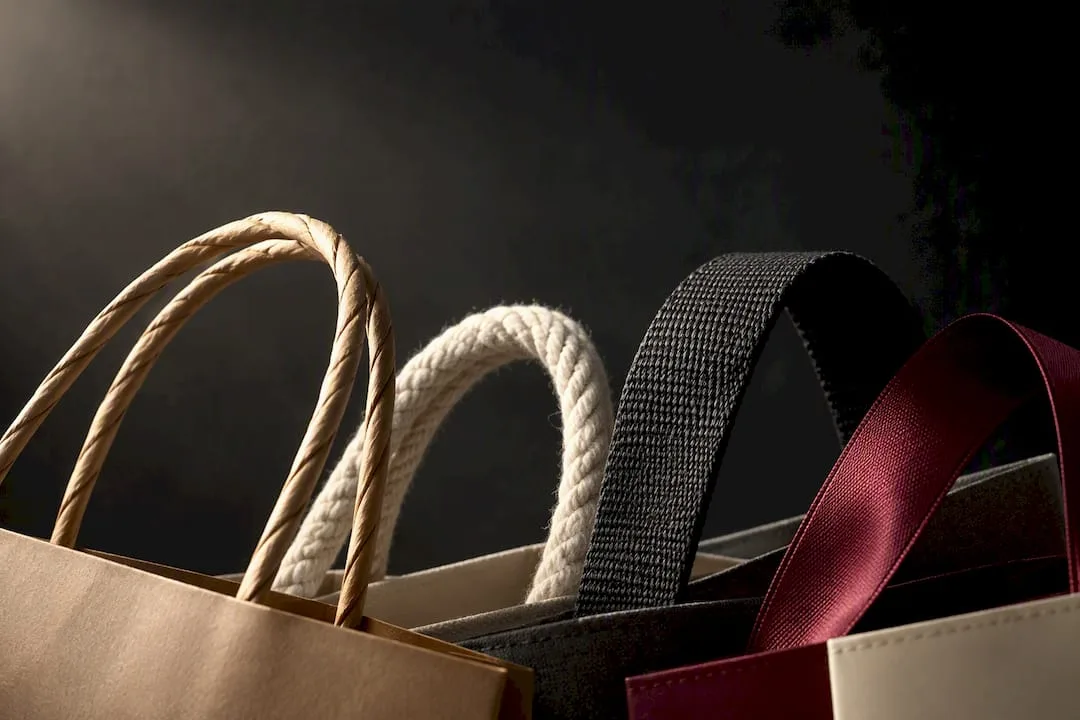
Six handle families cover nearly every bag on the market: twisted paper, flat and die-cut paper, cotton or PP/nylon rope, ribbon, and leather, PU, or rigid metal and wood. The rule that actually matters is simple: match the handle’s material and construction to the expected carrying weight, then layer in the tactile and visual feel your brand wants. Everything else, from attachment method to reinforcement, follows from that one decision. The sections below walk through each family’s load capacity, attachment options, and the specification questions your supplier needs to hear.
TL;DR: Handle material and construction must align with the bag’s expected weight and usage environment to prevent failure, especially in humid conditions. Twisted paper handles are suitable for moderate loads like books and bakery goods, while die-cut handles work best for lightweight retail items. Heavier loads require webbing or padded rope handles with reinforced attachment methods such as rivets or cross-stitching to ensure durability. Ribbon handles prioritize aesthetics but are only appropriate for very light items and should include hidden attachment points to prevent fraying and facilitate recycling. Reliable production depends on choosing a handle family that matches load expectations, environmental conditions, and ensuring supplier capabilities for reinforcement and quality control.
Table of Contents
- Paper Handle Types: Twisted, Flat, and Die-Cut
- Rope, Cotton, and Webbing Handles for Heavier Loads
- Ribbon Handles: When Aesthetics Lead the Decision
- Leather, PU, Metal, and Wooden Handles for Luxury Packaging
- Attachment Methods and Load Guidance That Actually Hold Up
- How to Choose: A Checklist and Sample Spec for Your RFQ
- Why Manufacturing Depth Matters for Handle Selection
- The Real Trade-Off Nobody Talks About
- Get Custom Carrier Bags Built to Your Handle Spec
- Sources
- FAQ
Paper Handle Types: Twisted, Flat, and Die-Cut
Paper handles dominate retail packaging because they’re cheap, recyclable, and fast to produce. There are three constructions worth knowing, and each solves a different problem.
Twisted paper handles are made by spinning kraft or coated paper into a rope-like cord, then anchoring it inside the bag with a knot backed by a reinforcing patch, or through a metal eyelet. The twisting process distributes tension along the length of the cord rather than concentrating it at one weak point, which is why twisted rope has become the default handle for retail and grocery bags. Diameters typically run from 4mm to 6mm, and a well-anchored twisted handle handles moderate weight comfortably, think books, boutique purchases, or bakery boxes.
Flat paper handles are strips of folded paper glued or stitched flat against the bag’s inner wall. They cost less to produce than twisted rope and stack flatter for shipping, which matters when a retailer is ordering by the pallet. The trade-off is durability: flat handles rely entirely on adhesive bond strength, and that bond is the first thing to fail if the bag gets damp or the load shifts unevenly. Takeout bags and bakery packaging are the natural fit here, where trip distance is short and load is light.
Die-cut handles skip the separate handle piece entirely. The carrying grip is cut directly into the bag’s own paper body, which cuts a manufacturing step and a material cost. The catch is that the bag’s paper needs enough body to survive that cutout under load without tearing.
Choosing among the three paper options usually comes down to:
- Expected trip distance and weight (grocery vs. gift vs. takeout)
- Budget per unit and order volume
- Whether stackability or shelf presentation matters more
- Tolerance for humidity exposure during use or storage
A die-cut handle bag works well for lightweight retail items where cost efficiency outweighs heavy-duty carrying needs.
Rope, Cotton, and Webbing Handles for Heavier Loads
Once a bag needs to carry more than a light retail purchase, paper handles reach their limit fast. This is where cotton rope, PP/nylon rope, and webbing take over, and the differences between them are more than cosmetic.
Cotton rope comes braided or twisted, and the round cross-section is worth paying attention to: it distributes hand pressure more evenly than a flat strap, which is why cotton rope shows up so often on premium gift bags and wine carriers where comfort during a short carry matters as much as strength. Diameters generally run 5mm to 8mm, and cotton rope handles are commonly rated for moderate to heavy loads depending on braid density and anchor quality.
PP and nylon rope trade a bit of that soft hand-feel for resistance. These synthetic ropes hold up better against moisture and UV exposure than cotton, and PP rope handles are frequently rated in the 8 to 12 kilogram range, making them a sensible choice for wine and spirits packaging that might sit in a warm car trunk or a humid storeroom.
Flat cotton webbing and seatbelt-style webbing are the heavy lifters of the group. Tested webbing has shown tensile break strengths in the 28 to 38 kilogram range, according to supplier guides, and the flat profile sits comfortably on the shoulder for longer carries, which is why webbing dominates reusable tote and grocery bag design. A technical look at cotton webbing durability confirms that stitch pattern matters as much as the webbing material itself when it comes to real-world lifespan.

Pro Tip: For anything expected to carry more than 5 kilograms repeatedly, specify a cross-box “X” stitch pattern at the anchor point rather than a straight double-stitch. It spreads load across more thread and dramatically reduces the chance of the handle pulling loose at the seam.
Padded or foam-core round rope earns its keep on heavier or longer-duration bags, things like wine gift sets carried for blocks rather than yards, where a thin cord would dig into the palm.

Ribbon Handles: When Aesthetics Lead the Decision
Ribbon handles exist for one reason: presentation. Satin ribbon has a soft sheen and drapes elegantly, grosgrain offers a ribbed texture with more structure, and organza brings a sheer, delicate look suited to florals or occasion packaging. Common widths run 15mm, 25mm, and 38mm, with wider ribbon generally chosen for larger or heavier bags simply to spread the load across more surface area.
Ribbon is not a heavy-duty handle. It’s best reserved for genuinely lightweight items, cosmetics, small gift boxes, boutique retail, where the visual softness outweighs any need for serious carrying capacity. Attachment through a hidden internal panel or a sewn seam distributes stress better than a simple surface stitch, and some designers add small D-rings to let the ribbon pivot slightly under load rather than fraying at a fixed stitch point.
A few things worth building into the spec:
- Confirm ribbon width scales with bag weight, not just visual proportion
- Specify hidden-panel or D-ring attachment for anything beyond featherlight contents
- Note that ribbon usually needs manual removal before the paper body goes into recycling
That last point matters more than it seems. A gorgeous ribbon-handled bag that a customer can’t easily separate for recycling undercuts a brand’s own sustainability messaging.
Leather, PU, Metal, and Wooden Handles for Luxury Packaging
At the top of the cost and prestige ladder sit leather, PU, and rigid handles in metal or wood. These aren’t everyday retail choices, they’re built for brands where the unboxing moment itself is part of the product.
Leather and PU handles are typically folded or stitched into a strap shape, then secured through rivets rather than adhesive or simple stitching, since rivets distribute pulling force across a metal point rather than relying on thread alone. Full-grain leather straps finished this way can reach tensile loads suitable for executive gift bags, the kind of packaging a spirits brand might use for a limited bottle release. PU leather delivers a similar visual effect at a lower cost per unit, which makes it the practical choice for mid-volume runs where the luxury look matters more than the material’s actual origin.
Metal and wooden rigid handles change the entire ergonomics of the bag. Instead of a flexible strap that molds to the hand, a rigid handle holds its shape, which some designers prefer for a structured, boutique aesthetic but which can feel less comfortable over a longer carry. Secure attachment almost always requires rivets or an internal reinforcement panel, since a rigid handle concentrates stress at just two anchor points rather than spreading it along a length of cord.
The trade-off across this whole category is straightforward:
- Leather and metal handles cost significantly more per unit than paper or rope
- They carry a brand-perception payoff that’s hard to replicate with cheaper materials
- Maintenance matters: leather needs occasional conditioning, and metal hardware can tarnish without a protective coating
Attachment Methods and Load Guidance That Actually Hold Up
Choosing the right handle family solves half the problem. How it’s attached to the bag determines whether it survives the trip home.
Four attachment methods cover almost every bag on the market:
- Knot plus internal patch. The handle end is knotted, then backed with a cardboard or paper patch glued to the inside wall, spreading the knot’s pulling force across a wider area instead of one stress point.
- Eyelet. A metal or plastic ring reinforces the hole the handle passes through. Industry guidance suggests sizing the eyelet diameter at 1.5 to 2.0 times the rope’s own diameter to avoid the rope fraying against a too-tight edge.
- Rivets. Common on leather, PU, and rigid handles, rivets bite through multiple layers and hold under repeated stress far better than adhesive alone.
- Hidden panel. An internal reinforcement layer, often used with ribbon or lightweight webbing, that spreads load across a broader stitched area rather than a single seam.
Load tiers to design around:
- Light (roughly 0 to 2 kg): ribbon, flat paper, thin twisted paper
- Medium (roughly 2 to 8 kg): twisted paper with reinforced patches, cotton rope, PP rope
- Heavy (8 kg and up): flat cotton webbing, seatbelt webbing, riveted leather or PU
For unreinforced or die-cut handles, paper stock of at least 150 GSM is generally recommended to prevent tearing at the cutout. Anything lighter needs an internal cardboard or liner insert to survive real-world handling. Humidity is the quiet threat across every paper-based attachment: moisture weakens the adhesive bonds behind flat and die-cut handles long before the paper itself gives out, which is why bags destined for humid climates or refrigerated retail deserve a synthetic rope or webbing upgrade even at light loads.
How to Choose: A Checklist and Sample Spec for Your RFQ
Before you send a request for quote, run through this checklist:
- Expected weight. Light, medium, or heavy, based on the tiers above.
- User comfort. Round cross-sections (rope) feel better in-hand than flat straps for short carries; webbing wins for longer ones.
- Storage and stackability. Flat handles and die-cut bags pack flatter for shipping and shelving.
- Recycling goals. Fully paper constructions recycle easiest; ribbon, leather, and rope generally need removal first.
- Budget and minimum order quantity. Cost climbs with material and manual assembly steps, die-cut and flat paper sit at the bottom, leather and rigid handles at the top.
- Lead time. Custom rivet or reinforced-panel work adds production days versus a standard knotted handle.
When you talk to a supplier, ask directly about paper GSM, tensile test results for rope or webbing, available attachment options, sample lead time, and what reinforcement comes standard versus optional. A supplier who can’t answer GSM or tensile numbers on the spot is a red flag worth noting.
Pro Tip: Copy this into your RFQ: “Handle type: [family]. Load target: [kg]. Attachment: [method]. Paper GSM (if applicable): [number]. Reinforcement: [patch/eyelet/rivet]. Sample quantity needed: [number].” Suppliers respond faster and more accurately to a spec than a description.
Why Manufacturing Depth Matters for Handle Selection
Specifying the right handle on paper is one thing. Getting a supplier who can actually execute reinforcement, GSM control, and finish quality at scale is another. A packaging manufacturer has delivered many units to thousands of brands worldwide, building bespoke labels, rigid gift boxes, and carrier bags for beauty, spirits, and lifestyle companies for over two decades. That track record shows up in practical terms: consistent eyelet placement across a 10,000-unit run, reinforcement patches that hold under the load tiers above, and sustainable material sourcing for brands that need FSC-certified stock. The sample-to-production workflow typically moves from a design and dieline review, through prototyping and load testing, into a production run sized to your minimum order quantity and lead-time needs.
The Real Trade-Off Nobody Talks About
Most handle guides treat this as a purely aesthetic decision, ribbon versus rope versus paper, based on what looks premium. That’s backwards. The load tier should come first, always. A gorgeous grosgrain ribbon handle on a bag holding a two-bottle wine gift set isn’t a design choice, it’s a returns problem waiting to happen.
The bigger blind spot in conventional advice is humidity. Plenty of packaging guides list load capacities as if they’re fixed numbers, when in practice a twisted paper handle rated for a comfortable retail load can fail well below that threshold after a week in a humid stockroom. If your bags travel through variable climates or sit in storage for more than a few weeks, treat the moisture question as seriously as the weight question.
My honest take: buyers should stop asking “what handle looks right for this brand” first. Ask “what’s the heaviest realistic load, and what environment will this bag sit in” first. The aesthetic choice narrows naturally once those two answers are locked in, and you’ll spend a lot less time dealing with handle failures after launch.
— Anthony
Get Custom Carrier Bags Built to Your Handle Spec
A packaging manufacturer turns handle decisions into production reality, custom paper carrier bags with twisted paper, cotton rope, ribbon, or die-cut handles, each built with reinforcement and GSM control as outlined in this guide. Unlike a generic print shop working off a template, the manufacturer designs, prototypes, and load-tests the handle attachment before the order goes to full production, so the bag that arrives matches the spec you actually need, not a best guess.
Whether you’re sourcing lightweight retail bags or heavy-duty gift carriers for a spirits launch, the custom paper carrier bags product line covers the full range of handle families in this guide. Request a quote and sample set to see the reinforcement and finish quality firsthand before committing to a production run.
Sources
FAQ
What Are the Main Bag Handle Types?
The main bag handle types fall into six families: twisted paper, flat and die-cut paper, cotton rope, PP or nylon rope, ribbon, and leather, PU, or rigid metal and wood. Each family suits a different combination of expected load and desired look, from lightweight retail bags to heavy-duty gift carriers.
What’s the Difference Between Rope and Ribbon Handles?
Rope handles, whether cotton, PP, or nylon, are built for actual carrying strength and typically hold moderate to heavy loads depending on diameter and construction. Ribbon handles prioritize visual softness over strength and work best on lightweight items like cosmetics or small gift boxes rather than anything with real weight behind it.
How Do I Know What Load a Handle Can Carry?
Load capacity depends on material, diameter, and attachment method rather than the handle family alone. As a general guide, light loads (under 2 kg) suit ribbon and thin paper, medium loads (2 to 8 kg) suit reinforced twisted paper or cotton rope, and heavy loads (8 kg and up) call for flat webbing rated to 28 to 38 kg tensile strength or riveted leather.
What Handle Attachment Method Is Strongest?
Rivets generally provide the strongest attachment for heavier handles like leather or PU, since they bite through multiple material layers rather than relying on adhesive. For rope handles, a knot backed by an internal cardboard patch or a properly sized eyelet performs well within its load tier without needing hardware.
Does Yuanpackaging Offer Custom Handle Options?
Yes, Yuanpackaging produces custom paper carrier bags with a range of handle options including twisted paper, cotton rope, ribbon, and die-cut construction, each built to a buyer’s specific load and finish requirements. Pricing depends on the specific handle type, materials, and order volume, so current quotes are available directly through the product page.