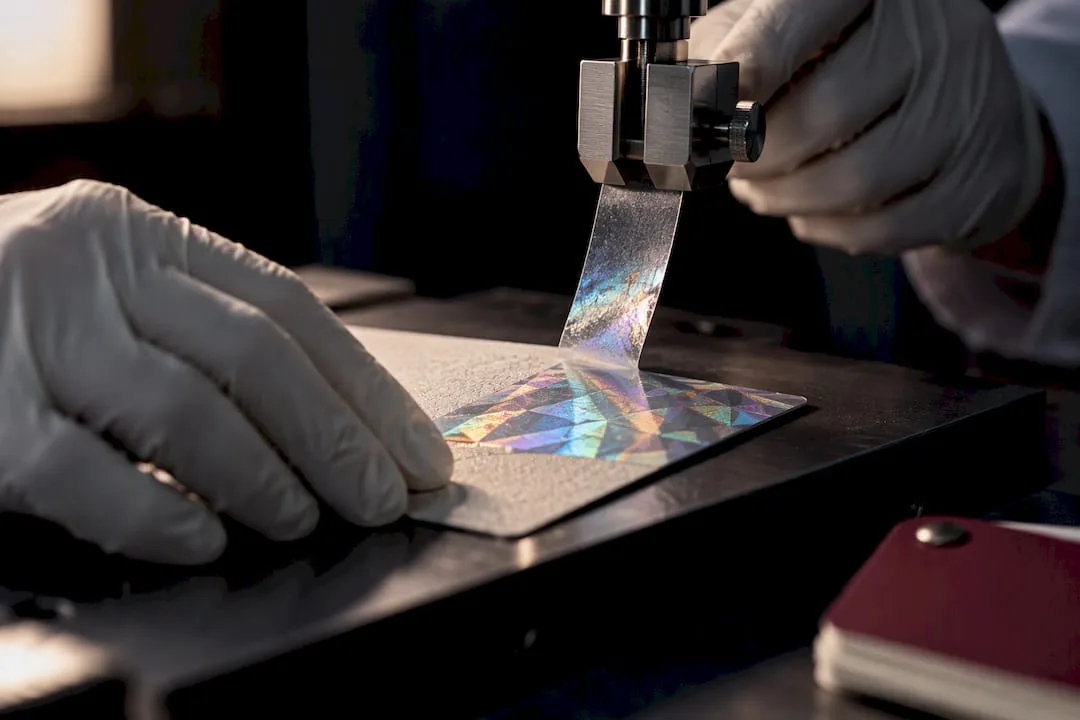
Holographic foil stamping is a hot-stamping process that transfers a metallized, holographically embossed film onto a substrate using heat, pressure, and a custom die. Brands choose it when they need a shifting, dimensional visual effect on packaging, labels, or security seals, and when durability matters more than cost. Choose hot stamping for short-run premium tactile work or any application requiring tamper-evident authentication; choose an alternative when you need high-volume CMYK overprint at the lowest per-piece cost.
TL;DR: Stock holographic patterns are more affordable and faster to produce than custom registered holograms, which require extensive tooling and lead times. Substrates like coated paperboard, plastics, and leather typically accept holographic foil well, but heat-sensitive materials may need testing to prevent damage. Brass dies offer the longest lifespan, capable of exceeding one million impressions, but are more costly, making them ideal for high-volume reorders. Holographic foil cost per piece ranges from $0.025 to $0.06 for 50,000 units, with custom patterns adding 30% to 80% to foil expenses. Use holographic foil for premium packaging or security labels where shelf impact or anti-counterfeit features justify the premium; avoid overuse, which can seem gaudy.
Table of Contents
- How Does Holographic Foil Stamping Work?
- What Types of Holographic Foils Exist?
- Which Substrates Work With Holographic Foil Stamping?
- How Do You Set Up the Press and Die for Consistent Results?
- What Artwork Rules Matter Most for Holographic Stamping?
- What Does Holographic Foil Stamping Cost, and When Should You Choose Cold Foil Instead?
- Where Does Holographic Foil Stamping Deliver the Most Value?
- What Yuan Packaging’s Production Scale Means for Your Project
- Editorial Perspective: Balancing Impact, Cost, and Sustainability
- How Yuan Packaging Helps With Holographic Foil Projects
- Sources
- FAQ
How Does Holographic Foil Stamping Work?
Holographic hot-stamping foil is a multi-layer film, not a single sheet of shiny plastic. Each layer does a specific job, and understanding the stack tells you why the finished effect survives handling, light, and time.
- PET carrier film — the clear backbone that holds everything together during the transfer.
- Release layer — lets the decorative layers separate cleanly from the carrier once heat is applied.
- Holographic embossing layer — the microstructure that diffracts light into the shifting rainbow foil stamping effect.
- Metallized layer — a vacuum-deposited aluminum coating that gives the pattern its brightness and depth.
- Protective topcoat — shields the image from scuffing, UV exposure, and handling wear.
- Heat-activated adhesive — bonds the transferred layer to the substrate once pressure and heat are applied.
Production moves through five steps: die preparation, foil loading, heated impression against the substrate, transfer of the decorative layers, and stripping away the spent carrier film. This layered approach to holographic foil printing is what separates a durable, indoor-and-outdoor-rated finish from foil that flakes after a few months on a shelf. A quality topcoat with UV inhibitors extends outdoor lifespan considerably; without it, expect fading and edge lifting well before a product’s shelf life ends.
What Types of Holographic Foils Exist?
Not every holographic effect on the market is created equal, and the choice between stock and custom patterns shapes both your budget and your brand-protection strategy.
- Rainbow and prismatic patterns — the classic shifting spectrum, widely used for decorative accents.
- Dot-matrix and pillar patterns — geometric, high-density diffraction grids that read as more technical than decorative.
- Confetti and oil-slick effects — irregular, organic-looking patterns often chosen for cosmetics and spirits packaging.
- Registered OVDs (optically variable devices) — custom, serialized holograms tied to a specific brand or product batch.
Standard patterned foils are typically the most affordable holographic option, since they run off existing cylinders with no custom tooling. Registered holograms, by contrast, are the premium tier, reserved for brands that need serialized security or provable authentication, according to the hologram stamping guidance from Kluge. If counterfeiting risk is low and you just want shelf impact, stock patterns win on cost and lead time every time.
Which Substrates Work With Holographic Foil Stamping?
Substrate choice determines whether your holographic foil printing project succeeds on the first pass or comes back with adhesion failures.
- Confirm the base material. Coated and uncoated paperboard, rigid PVC, ABS plastics, and leather all accept hot stamping reliably.
- Flag problem substrates early. Very soft foams and thin, heat-sensitive films can scorch or deform under stamping temperatures, so run a sample before committing to a full production plan.
- Run an adhesion test. Apply the foil to a production-representative sample and check for lifting after 24 to 48 hours, especially if the piece will see outdoor exposure or repeated handling.
- Match the die to the surface. Curved or uneven surfaces, such as bottle caps or molded plastic components, typically need silicone or rubber dies instead of rigid metal, since they conform to contour without cracking the foil.
- Specify UV topcoats for outdoor use. Any label or carton expected to sit in direct sunlight needs a protective coating rated for UV resistance, or the metallic finish will dull within weeks.
Skipping the adhesion test is the single most common cause of reprints in holographic foil production.
How Do You Set Up the Press and Die for Consistent Results?
Getting a clean, registered holographic transfer depends on matching press class, die material, and process windows to your run length and level of detail.
- Press class. Tabletop presses suit prototypes and runs under a few thousand units; fully automatic flatbed presses handle continuous high-volume production with tighter registration control.
- Die material. Magnesium dies are inexpensive and appropriate for short runs, generally holding up for roughly 20,000 to 50,000 impressions. Copper dies capture finer detail and last through mid-length runs of about 150,000 to 250,000 impressions. Brass dies, CNC-engraved for premium detail, often exceed 1,000,000 impressions before wearing out, according to supplier guides.
- Operating windows. Die temperature typically runs between 95°C and 145°C, nip pressure between 3 and 12 bar, and dwell time between 0.2 and 1.5 seconds, all adjusted for substrate and foil family, per hot stamping process benchmarks.
- Registration tolerance. Security applications demand precision as tight as ±0.012 inch, achievable with dedicated registration hardware like fiber-optic sensors and vision cameras.
Statistic to remember: brass dies can run considerably longer than magnesium dies before replacement, which changes the entire cost math on any job you expect to reorder.
What Artwork Rules Matter Most for Holographic Stamping?
Holographic effects live or die on the artwork file long before the piece hits a press.
- Build everything as vector art. Rasterized elements produce ragged edges once engraved into a die.
- Mirror the design for the die. Foil dies stamp in reverse, so any asymmetric logo or type needs a mirrored file sent to the die maker.
- Respect minimum line weights. Fine positive lines and thin negative space (the gaps between foil elements) need generous margins, since brass holds finer detail than magnesium but still has physical limits.
- Plan combination finishes deliberately. Pairing holographic foil with embossing or spot UV requires careful trapping so the effects register to each other rather than overlapping sloppily.
- Use restraint. A holographic accent on a logo or border reads as premium; covering an entire panel in shifting foil often reads as gaudy rather than luxurious.
Pro Tip: Test your holographic pattern under both fluorescent and warm retail lighting before finalizing artwork. Rainbow foil stamping can look dramatically different under an LED shelf light than it does on a designer’s monitor.
What Does Holographic Foil Stamping Cost, and When Should You Choose Cold Foil Instead?
Three factors drive the price of any holographic foil job: foil consumption, die amortization, and press time. According to supplier guides, a typical all-in unit cost for a 50,000-piece luxury carton run with a single standard foil color lands around $0.025 to $0.06 per piece, and holographic or registered foils typically add 30% to 80% to that foil line, depending on complexity and whether the pattern requires custom tooling.
- Stock foils ship fast, often within days, with low minimums.
- Custom holographic and registered OVD foils require die creation and hologram origination, adding real lead time, sometimes several weeks, before the first production run.
- Choose hot foil when you need tactile depth, embossed dimension, or you’re printing on uncoated stock in shorter luxury runs.
- Choose cold foil when you’re running very high volumes inline with CMYK overprint and lowest per-piece cost is the priority, since cold foil is an offset-based process built for that scale rather than tactile effect.
The two methods are complementary, not competitors. Run length and whether you need overprint color on the foil itself should decide the call, not habit.
Where Does Holographic Foil Stamping Deliver the Most Value?
Holographic foil stamping earns its cost premium in two distinct categories: shelf impact and security.
- Packaging and branding. Premium cartons, wine and spirits labels, book covers, business cards, and edge gilding all use holographic accents to signal quality at a glance.
- Security and authentication. Tamper-evident labels, serialized holograms, event tickets, vouchers, and anti-counterfeit seals rely on registered OVDs that are difficult to reproduce, a use case that has been standard since holographic foils entered mainstream anti-counterfeit applications in the 1980s.
- Outdoor and exposed applications. Anything facing sunlight or repeated handling needs a UV-rated topcoat and should be tested under accelerated aging before full production commits.
A wine label with a registered hologram does double duty: it looks expensive on the shelf and makes counterfeiting the bottle measurably harder.
What Yuan Packaging’s Production Scale Means for Your Project
Specification decisions get easier when you can test before you commit. Yuan Packaging produces bespoke labels, rigid boxes, and serialized security labels at a scale that spans over 100 million units delivered to more than 5,000 brands, giving production teams real data on which die materials and foil families hold up across long runs.
Before locking a spec, request a swatch pack showing actual holographic patterns under different lighting, then run adhesion and abrasion tests on your target substrate rather than a generic sample. Specify die material against your expected reorder volume, not just your first run, since a magnesium die bought for a 20,000-unit job will need replacing fast if that product reorders quarterly.

Editorial Perspective: Balancing Impact, Cost, and Sustainability

Holographic foil earns its premium when the product genuinely needs shelf differentiation or fraud protection, not because a mockup looks striking in isolation. Spirits and cosmetics brands facing counterfeiting pressure get real value from registered holograms; a mass-market snack box usually doesn’t need one.
Sustainability doesn’t have to be a trade-off here. Specifying FSC-certified board, recyclable adhesive systems, and a UV topcoat that extends usable life all reduce waste from reprints and premature fading. My strongest recommendation: prototype at small scale, run the adhesion and light tests, and only then commit to a full production order. Skipping that step is where most holographic projects go over budget.
— Anthony
How Yuan Packaging Helps With Holographic Foil Projects
Some packaging manufacturers combine traditional craftsmanship with modern production technology, which matters most on holographic work because pattern fidelity and adhesion consistency depend on process control that generic print shops often can’t guarantee.
If you’re weighing custom holographic designs against stock patterns, or trying to figure out whether your brand needs registered security foil versus a decorative accent, start with a swatch pack rather than a full commitment. Yuan Packaging’s custom labels line covers everything from wine and spirits labels to cosmetic packaging, with holographic and anti-counterfeit security label options built into the same production infrastructure. For premium cartons that pair holographic panels with embossing or foil edges, the rigid gift boxes line handles that combination in-house rather than farming out finishing to a third party. Submit your artwork for a prototype quote, and you’ll get a real production sample instead of a rendered mockup, which is the only way to know how a holographic pattern actually behaves on your substrate. For broader manufacturing context on how packaging partners structure production relationships, the interview with Francesco Polano at AFG Packaging offers a useful industry perspective.
Sources
For deeper technical specs, consult the hot stamping process guide, Kluge’s hologram stamping reference, and manufacturer datasheets for exact press windows and adhesion requirements before finalizing a spec.
- What Are Holographic Stamping Foils? Hot Stamping Process Explained » Holoseal
- The Users’ Guide to Hologram Stamping (Kluge)
- Understanding the Differences Between Cold Foil and Hot Foil Printing (2026 Guide)
FAQ
How Does Holographic Foil Work?
Holographic foil works by embossing a microstructure into a metallized film that diffracts light into shifting colors, then transferring that film onto a substrate using heat and pressure. The layered foil stack includes a carrier, release layer, holographic embossing, metallized coating, and adhesive that bonds it permanently to the surface.
How Much Does Foil Stamping Cost?
Costs depend on foil consumption, die amortization, and press time, with a typical 50,000-piece luxury carton run costing roughly $0.025 to $0.06 per piece for standard foil. Yuan Packaging’s current pricing is available directly through its custom labels page.
How Do You Add Holographic Foil to Cards or Packaging?
Adding holographic foil requires a custom or stock die, a hot-stamping press, and artwork prepared as mirrored vector files with appropriate line weights for the die material. Most brands start with a swatch pack and a small prototype run to confirm adhesion and visual effect before committing to full production.
What Are the Different Types of Foil Stamping?
The main categories are hot stamping, which uses heat and a die to transfer foil with tactile depth, and cold foil, an offset-based inline process suited to high-volume runs with CMYK overprint. Within holographic foil specifically, options range from stock patterns like rainbow and dot-matrix to custom registered OVDs used for brand security and anti-counterfeit applications.