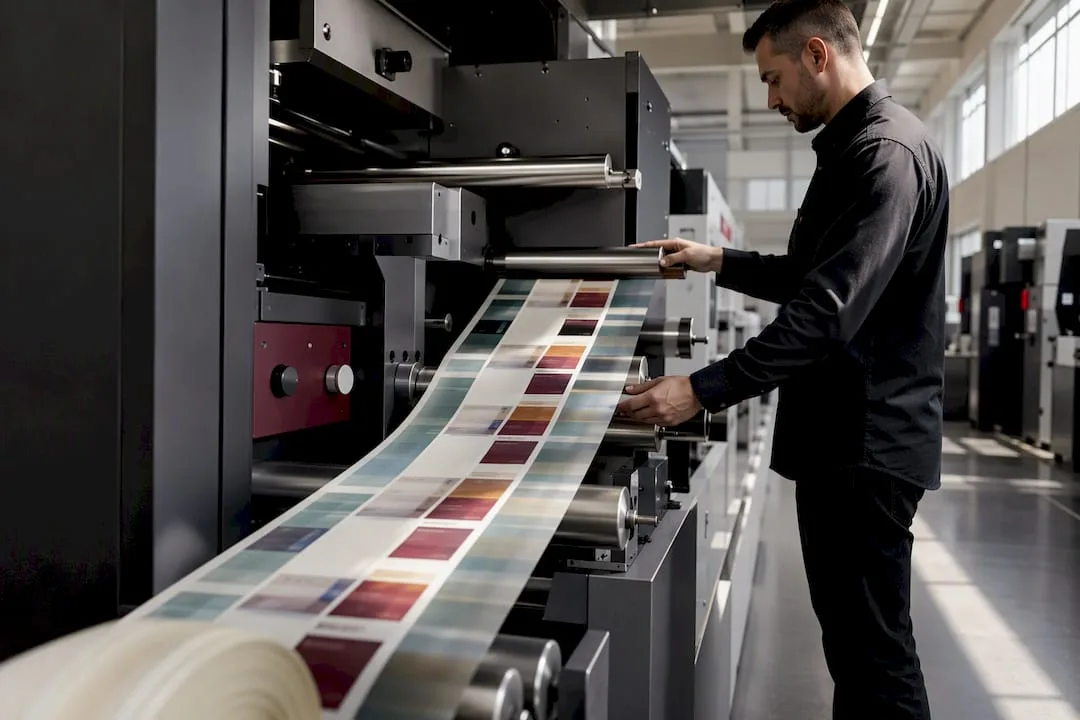
Waterproof label printing produces pressure-sensitive labels, typically BOPP, polyester (PET), or vinyl facestocks, printed and finished to resist water, oil, and abrasion during shipping, storage, and everyday handling. If you’re sourcing labels for a bottle, jar, or tube, the fastest path to a durable result is to choose the right film for your exposure conditions, match it to a compatible print process, and request a physical sample before committing to a production run.
TL;DR: Choosing the right waterproof film, such as BOPP for general use or polyester for high heat, is essential to meet the specific environmental conditions of your product. Digital presses with solvent, UV, or latex inks are ideal for full-color waterproof labels, whereas consumer-grade inkjet and laser printers cannot reliably handle film facestocks without additional lamination. Applying lamination or coating significantly enhances water resistance and durability, especially for labels exposed to heavy handling, moisture, or oily fingers, though it may slightly alter the label’s appearance. Testing adhesive bonds and ink adhesion on your actual container and environmental conditions before approval prevents failures, as visual samples alone are insufficient. Working with an experienced label manufacturer that provides detailed data sheets and sample workflows reduces the risk of mismatched materials and ensures the final product’s compliance and performance.
Table of Contents
- Waterproof label materials and how to choose between them
- Printing methods and printer compatibility for waterproof labels
- Protective finishes, lamination and coatings that make labels waterproof
- Design and technical specs: templates, dielines, barcodes, color, and resolution
- Ordering logistics: formats, minimums, lead times, samples, and cost drivers
- Regulatory legibility and content requirements (cosmetics and packaged goods)
- Why work with a professional label manufacturer
- What buyers get wrong about waterproof labels
- How Yuan Packaging can help with custom waterproof label printing
- Sources
- FAQ
Waterproof label materials and how to choose between them
The facestock you choose determines whether your label survives the shower, the ice bucket, or the warehouse floor. BOPP (biaxially oriented polypropylene) is the workhorse for cosmetics and personal care: white BOPP gives you an opaque background for bold graphics, while clear BOPP creates a “no label” look on tinted glass or plastic. Polyester (PET) costs more but holds up under higher heat and longer chemical exposure, which makes it the better call for anything that sits near a heat source or gets handled repeatedly over months. Vinyl conforms well to curved or irregular containers, and specialty metallic or holographic facestocks add shelf shine when brand presentation matters as much as durability.
Adhesive selection matters just as much as the film. A few starting points:
- Permanent adhesives suit most retail packaging where the label should never come off cleanly.
- Removable adhesives work for promotional labels or applications where residue-free removal matters.
- High-tack adhesives are built for low-surface-energy plastics like polypropylene bottles, where standard adhesives struggle to bond.
Service temperature ranges vary by product, so always test on your actual container material and expected environment rather than assuming one film fits every substrate. Manufacturers publish this data on request, including facestock caliper, peel adhesion values, and temperature tolerance, in product data sheets that list service temperatures and application guidance for the specific facestock you’re evaluating.
Pro Tip: Ask your supplier for a data sheet before you approve artwork, not after; peel adhesion and temperature specs can rule out a film you already liked visually.
Printing methods and printer compatibility for waterproof labels
Not every printer produces waterproof output, and picking the wrong one wastes both film and time. Thermal transfer printing, which uses resin ribbons instead of wax, bonds well to synthetic facestocks and holds up to moisture, chemicals, and abrasion, making it a common choice for barcode and variable-data labels that need to survive rough handling. Digital presses running solvent, eco-solvent, UV, or latex inks adhere directly to film facestocks and are generally the better route for full-color waterproof labels, since thermal and digital printing methods built for film substrates produce more consistent water resistance than desktop equipment designed for paper.
Consumer-grade inkjet and laser printers were built for paper, not film, so their standard inks often smear or lift when they get wet unless you add overlamination or switch to pigment-based waterproof cartridges. Before you commit to any printer, run through this compatibility checklist:
- Confirm the printer accepts your film’s media caliper (thickness) without jamming.
- Check whether your job needs roll feed or sheet feed, since not every printer handles both.
- Verify the printer uses the specific ribbon or ink type your facestock requires for proper adhesion.
Protective finishes, lamination and coatings that make labels waterproof
Lamination and coatings add a second layer of protection on top of whatever the base film already resists. Overlaminate films come in matte or gloss finishes, both of which shield printed ink from scuffing, moisture, and UV fading, while pressure-sensitive laminates apply cold without heat-activated adhesives. UV-cured coatings offer a thinner, glossier alternative that boosts scratch resistance without adding much thickness to the label stack.
Lamination usually makes more sense than relying on an inherently waterproof film alone when a label faces heavy handling, direct water contact, or oily fingers, though it adds a production step and can shift the label’s look slightly glossier or duller than the unlaminated print.
- Reflective or metallic finishes can interfere with barcode scanners, since highly reflective surfaces cause read errors that matte panels avoid.
- Reserve a matte, non-reflective zone for any barcode or QR code on an otherwise glossy or metallic label.
Pro Tip: Always scan test the finished, laminated label, not a proof, since coatings and film thickness can change how a scanner reads the same barcode.
Design and technical specs: templates, dielines, barcodes, color, and resolution
Clean file setup prevents the delays and reprints that eat into a project’s timeline. Before you send artwork to production, confirm the following:
- Build files at 300 DPI in CMYK (or the specific spot colors your printer requests) to avoid color shifts between screen and print.
- Include the dieline as a separate layer, with a 1/8 inch bleed and a defined safe zone to keep text and logos away from trim edges.
- Check minimum type sizes against your product category. Cosmetics sold in the United States must meet FDA legibility rules that set ingredient type no smaller than 1/16 of an inch.
- Test barcode contrast and placement, avoiding glossy or metallic panels that reduce scan reliability.
- Request a printable PDF proof and a physical production sample before approving a full run, since screen color and finished film color rarely match exactly.
Ordering logistics: formats, minimums, lead times, samples, and cost drivers
Roll labels suit automated dispensers and high-volume lines, since they feed continuously through applicators without manual handling. Sheet labels work better for smaller runs applied by hand or through desktop equipment, where a full roll setup would be overkill.
Minimum order quantities vary by supplier and material, and small custom runs typically cost more per unit because setup costs get spread across fewer labels. A few factors that move both price and timeline:
- Finishing steps like lamination, varnish, or intricate die-cutting add production days beyond a basic printed label.
- Sample or press-check requests add a short delay upfront but prevent costly reprints if colors or adhesion don’t match expectations.
- Material, ink type, color count, and adhesive choice are the main cost drivers on most quotes, more than the label’s size or shape alone.
Choosing engineering priorities before you request quotes, rather than after, keeps the back-and-forth to a minimum; suppliers who work in part marking and industrial labeling make substrate, environment, and permanence the first questions they ask, and label buyers benefit from the same discipline.
Regulatory legibility and content requirements (cosmetics and packaged goods)
Cosmetics sold in the United States fall under labeling rules that govern where information appears and how large it must be printed. The FDA’s cosmetics labeling summary requires a principal display panel showing product identity and net quantity, plus an information panel listing ingredients in descending order of predominance.
Placement and type-size rules are codified in 21 CFR Part 701, which sets ingredient declaration type no smaller than 1/16 of an inch and defines acceptable panel layouts. A label that fades, smears, or peels risks becoming illegible, which raises misbranding exposure regardless of how compliant the original artwork was. When package space runs short, some markets outside the U.S. permit ingredient information on an attached leaflet or tag instead of the primary label, so confirm the applicable rule for your specific market before finalizing layout.

Why work with a professional label manufacturer
A custom label and packaging manufacturer has produced labels and packaging for beauty and spirits brands for over 25 years, delivering large volumes to thousands of brands worldwide. That volume means routine access to manufacturer-grade product data sheets, adhesion testing, and sample workflows that catch material mismatches before they reach a production run. For brands without in-house press equipment or film expertise, partnering with an experienced converter for cosmetic and beauty label printing typically shortens the path from design file to compliant, durable label far more than testing waterproof printing in-house.
What buyers get wrong about waterproof labels
Most buyers spend their attention on the film and skip the sample step, which is backward. A BOPP or PET facestock will resist water on paper, but the actual failure points are the adhesive-to-substrate bond and the ink-to-laminate bond, and neither shows up until you test the finished label on your real container under your real conditions.

The overrated variable is finish glossiness. Brands chase a premium shine and then discover it interferes with barcode scanning or shows every fingerprint from an oily lotion bottle. Durability and legibility should drive the finish choice first, with visual polish as a secondary filter among options that already pass those tests.
If you take one thing from this guide, request a physical sample on your own packaging before approving any print run. A proof on someone else’s substrate tells you almost nothing about how the label will perform on yours.
— Anthony
How Yuan Packaging can help with custom waterproof label printing
If you’re weighing materials, adhesives, and print methods on your own, Yuan Packaging offers a shortcut: custom pressure-sensitive labels built for cosmetics, spirits, and lifestyle packaging, with finishing options that include foil stamping, embossing, and anti-counterfeit features like holographic elements for brands that need both durability and shelf presence.
- Cosmetic and beauty labels engineered for oil and water exposure on jars, tubes, and bottles.
- Wine and spirits labels finished for condensation, ice buckets, and repeated handling.
- Anti-counterfeit and security label options for brands protecting against counterfeiting.
Sustainable and FSC-certified material options are available for brands prioritizing responsible sourcing alongside durability. Request a quote or sample through the custom labels page to get a project-specific recommendation on film, adhesive, and finish before you commit to a full run.
Sources
- Summary of Cosmetics Labeling Requirements | FDA
- eCFR :: 21 CFR Part 701 – Cosmetic Labeling
- AW0288F - Product Data Sheet | Avery Dennison
FAQ
Can I print my own waterproof labels?
You can print waterproof labels on standard equipment only if you use printers compatible with film facestocks and the correct ink or ribbon type, since ordinary paper-based inkjet and laser printers typically smear or lift when wet. Consumer printers usually need overlamination added afterward to reach real water resistance.
Which label printer can print waterproof labels?
Thermal transfer printers using resin ribbons, along with digital presses running UV, latex, or solvent inks, are built to bond with waterproof film facestocks and are the most reliable printer types for this purpose. Standard desktop inkjet and laser printers generally require added lamination to match that performance.
Is there a label maker that prints waterproof labels?
Some desktop label makers designed for industrial or outdoor use can print on synthetic film with compatible ribbons, producing water-resistant results for smaller runs. For full-color, high-volume waterproof labels, most brands still turn to a converter using digital or thermal transfer presses rather than a desktop device.
Where can I get waterproof stickers printed?
Custom label converters and packaging manufacturers that stock BOPP, polyester, or vinyl facestocks can print waterproof stickers to your specifications, including adhesive and finish options suited to your container. Requesting a sample on your actual product surface before ordering a full run is the most reliable way to confirm performance.