Anti-Counterfeit & Security Labels
Layered brand protection built into the label itself — visible features for consumers, verifiable features for your distributors and auditors.
At a glance
- Minimum order quantity
- Standard labels from 1,000 units; the digital line supports very short runs for pilot authentication programmes
- Sampling
- Presentation-quality sample in 5–7 working days. The sample cost is credited against your first approved production order.
- Production lead time
- 15–20 working days after artwork approval
- Delivery to Europe
- DDP or DAP to the EU and the UK, DDP to Switzerland; your customs broker confirms duty and VAT rates
- Production
- Made to order (OEM/ODM)
- Country of origin
- Huai'an, Jiangsu, China
- Holographic Positioning
- Security Foils
- Tamper-Evident Seals
- Serialised QR
- Variable Data
- NFC Smart Labels
Overview
Counterfeiting is a supply-chain problem before it is a printing problem. A refilled bottle, a diverted case, a parallel-market shipment and an outright fake all fail differently, and each is defeated by a different feature. The useful question is not "which security label is best" but "at which point in the chain do you need to be able to tell, and who is doing the checking".
Our label line has produced anti-counterfeiting and holographic positioning work for domestic liquor and pharmaceutical brands for years — sectors where authentication is routine rather than optional. Holographic positioning registers the diffractive element to the artwork rather than repeating it randomly across the web, which is what makes it a security feature instead of decoration.
The digital press installed in 2022 adds the second layer: unique serialised codes, batch data and QR printed per label. Combined with the NFC smart-packaging work we introduced for product tracking and authentication, that gives you a consumer-facing check and a trade-facing record from the same label.
Security Feature Types
Holographic Positioning
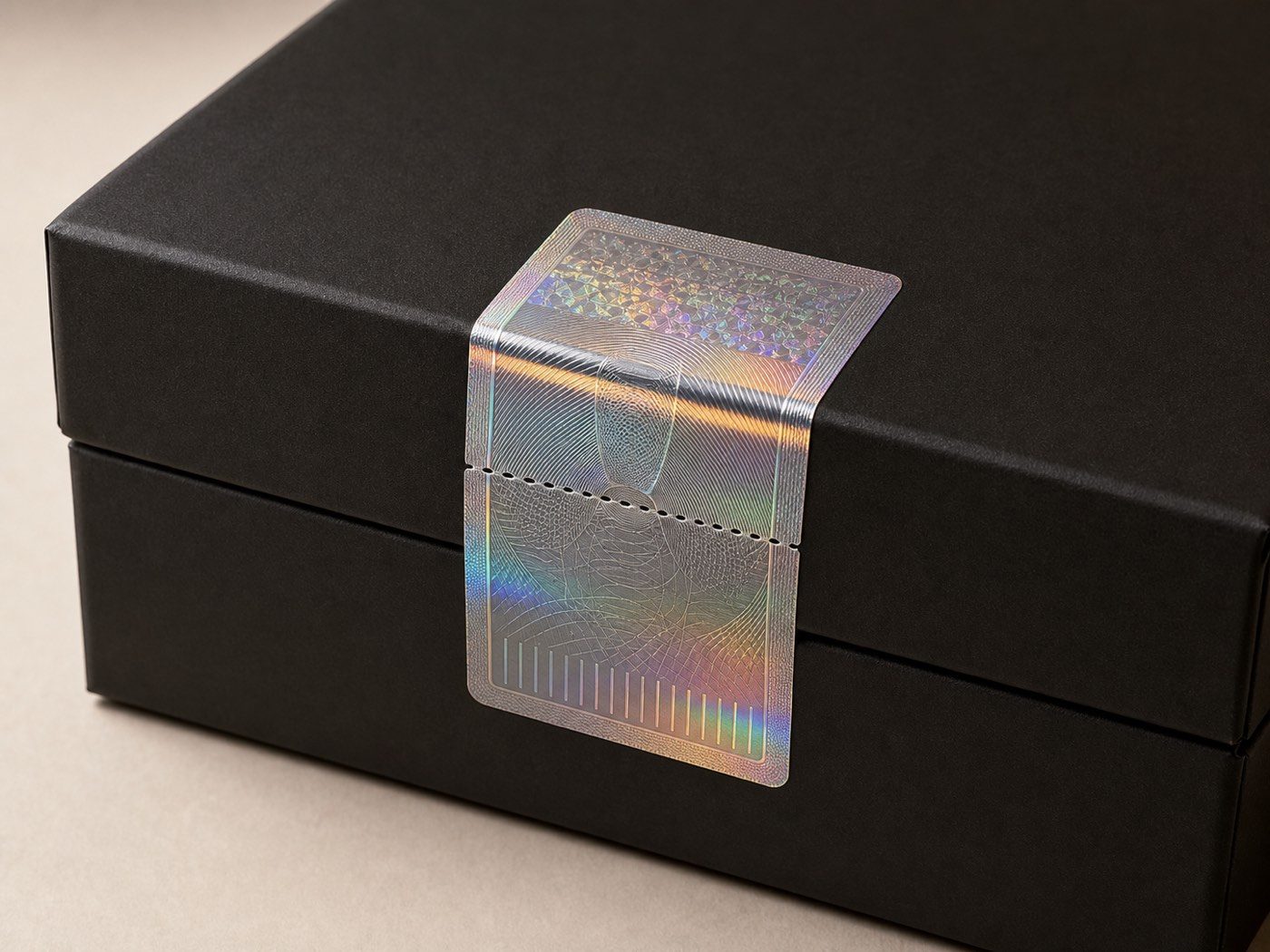
A diffractive element registered to a fixed point in the artwork. Random-repeat holographic film is decorative; positioned holography is a security feature because it has to be made deliberately.
Security Foil Stamping
Foils carrying embedded effects, applied by heated die and registered to the print — visible, tactile and hard to reproduce with desktop equipment.
Tamper-Evident Seals
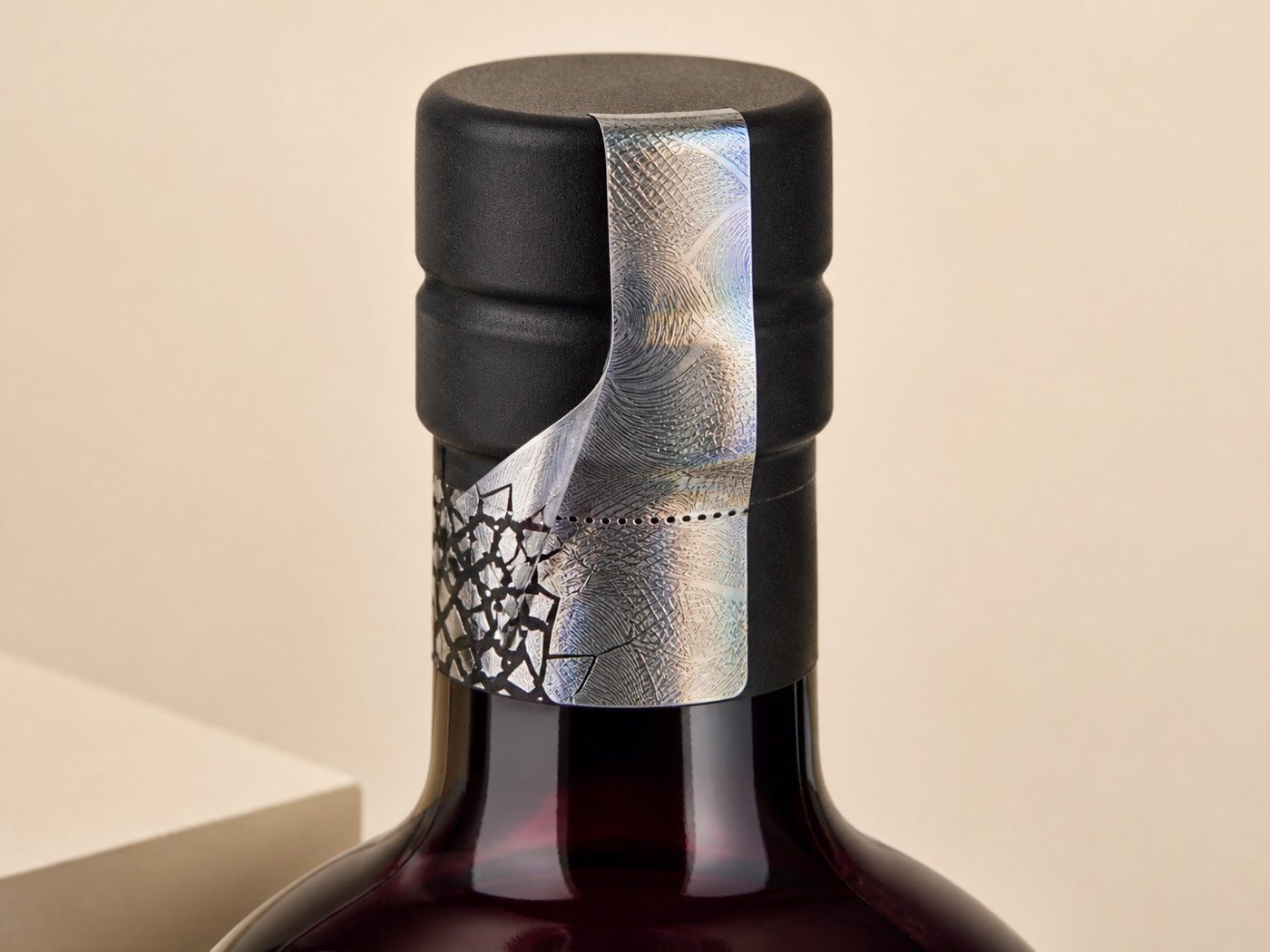
Closure seals across a cap, lid or carton flap that show visible evidence once opened, so refilling and repacking cannot pass unnoticed.
Serialised Codes & QR
A unique code per label printed digitally, so a consumer or distributor can verify one specific unit rather than a design.
Variable Data & Batch Tracking
Batch, line, date and destination data printed per run, which is what turns an authentication feature into a diversion-tracking tool.
NFC Smart Labels
Near-field chips for product tracking, authentication and interactive consumer experiences, introduced through our smart packaging programme.
Selected work
Materials
Holographic Film
Diffractive substrate used as the label face or as a positioned patch within a paper label.
Security Foils
Stamping foils selected for the effect they carry and for how difficult they are to source and match.
Paper Face Stocks
Coated and uncoated papers where the security layer is added by finishing rather than by the substrate.
Film Face Stocks
PP and PET where the seal has to resist moisture, abrasion or chemical contact in transit.
Adhesive Systems
Chosen against the surface and the intended behaviour — a seal meant to show tampering behaves differently from one meant to stay put.
Printing & Finishes
Registered Holography
Holographic elements positioned to the design, in-line with printing rather than applied afterwards.
Foil & Emboss Combination
Foil with registered embossing creates a sculpted metallic mark that flat reproduction cannot imitate convincingly.
Micro-Detail Printing
Fine line work and small-scale detail that degrades visibly when photographed and reprinted.
Digital Serialisation
Unique codes, QR and batch data printed per unit on the digital press.
Overvarnish & Lamination
Protection so codes stay scannable and seals stay intact through distribution.
Across the Custom Labels range
This page covers what is particular to this product. The full lists for the whole range are set out once, on the Custom Labels page:
What you can customise
- Which layers you need — consumer-visible, trade-verifiable, or both
- Holographic element design and where it registers in the artwork
- Seal format and where it sits on the closure
- Code structure, serialisation range and data handover format
- Whether codes are printed on the main label or a separate seal
- NFC integration for track-and-trace or consumer engagement
Specifications
| Minimum order quantity | Standard labels from 1,000 units; the digital line supports very short runs for pilot authentication programmes |
|---|---|
| Production lead time | 15–20 working days after artwork approval |
| In-house security capability | Holographic positioning, security foil stamping, embossing and digital serialisation on our own label line |
| Smart packaging | NFC-enabled labels for product tracking, authentication and interactive consumer experiences |
| Sectors served | Liquor and spirits, pharmaceutical, agricultural chemical and daily chemical |
Terms for this specification
- Sampling
- Presentation-quality sample in 5–7 working days. The sample cost is credited against your first approved production order.
- Colour matching
- Pantone references and physical samples are used where the selected print process supports them. The approval method follows the substrate, artwork and process.
- Certifications
- ISO 9001, ISO 14001:2015, ISO 45001 and China Environmental Labelling (Ten-Ring). ISO 22000 applies to eligible food-contact work.
- Sustainable options
- FSC-certified or recycled-content paper and board, water-based inks and adhesives, and fibre-based fitments are available where the selected construction supports them.
Design & artwork
From an artwork check, through a dimensioned dieline and print-ready files, to a full concept package across a range — done by the factory that will make it.
Applications
Spirits & Baijiu
Refill prevention and channel control on premium bottles, where a single counterfeit case does lasting brand damage.
Pharmaceutical
Batch traceability and tamper evidence on regulated packaging, a long-standing sector for our label line.
Agrochemical & Daily Chemical
Authentication for products sold through wide distributor networks where diversion is the main risk.
Premium Consumer Goods
Limited editions and collectible releases where serialisation doubles as a consumer engagement mechanic.
How it is made
Threat & checkpoint review
Where in the chain verification has to happen, and who does it — consumer, distributor, auditor or all three.
Feature layering
One overt feature anyone can check, one covert or data feature only you can verify. Layering beats any single feature.
Artwork & holographic registration
The holographic element is positioned in the design and separated onto its own layer with the foil and emboss.
Sampling
Samples in 5–7 working days so the features can be checked under the light conditions they will actually be checked in.
Production & serialisation
Conventional printing and finishing, with digital serialisation applied per unit and code data handed over in your format.
Verification & delivery
Code scan checks and visual inspection before winding and export packing.
Why Yuan Packaging
- Holographic positioning and security foil applied in-line on our own label press, not outsourced
- Digital serialisation for unique codes, QR and batch data at unit level
- NFC smart-label capability for track-and-trace and consumer authentication
- Years of anti-counterfeiting work for domestic liquor and pharmaceutical brands
Frequently asked questions
Which anti-counterfeiting feature should we start with?
Start from the checkpoint, not the feature. If consumers verify, you need something obvious and checkable without equipment — positioned holography or a tamper seal. If your own team verifies in the trade, serialised codes carry more information. Most effective programmes use one of each.
What is the difference between holographic film and holographic positioning?
Holographic film repeats a pattern randomly across the web — decorative, and available to anyone. Positioning registers a specific holographic element to a fixed point in your artwork, which requires deliberate set-up on press and is far harder to replicate casually.
Can you print unique codes on every label?
Yes. Our digital press handles variable data, so each label can carry its own serial number, QR code or batch record. Tell us the code structure and how you want the data handed over — usually a file per production run.
Do you supply NFC labels?
Yes. NFC-enabled smart labels were introduced through our smart packaging programme for product tracking, authentication and interactive consumer experiences. The right integration depends on your platform, so this is scoped project by project.
Will security features slow the production schedule?
Holographic positioning and security foil are applied on the same line as the rest of the label, so they do not add a separate outsourced stage. Standard lead time is 15–20 working days after artwork approval; serialisation data needs to be agreed before plates rather than during the run.
From the Journal
Related products
Request a custom packaging quote
What to send for a quote
- The product it is for, and the format you have in mind
- Size as length × width × height, and whether those are inside or outside dimensions
- Quantity, or two or three quantities if you want to compare unit prices
- Material and finish preferences, or the look you are after
- Artwork status: print-ready files, a draft, or nothing yet
- The date you need the goods by
- The destination country
Missing some of these? Send what you have, and we will ask about the rest.