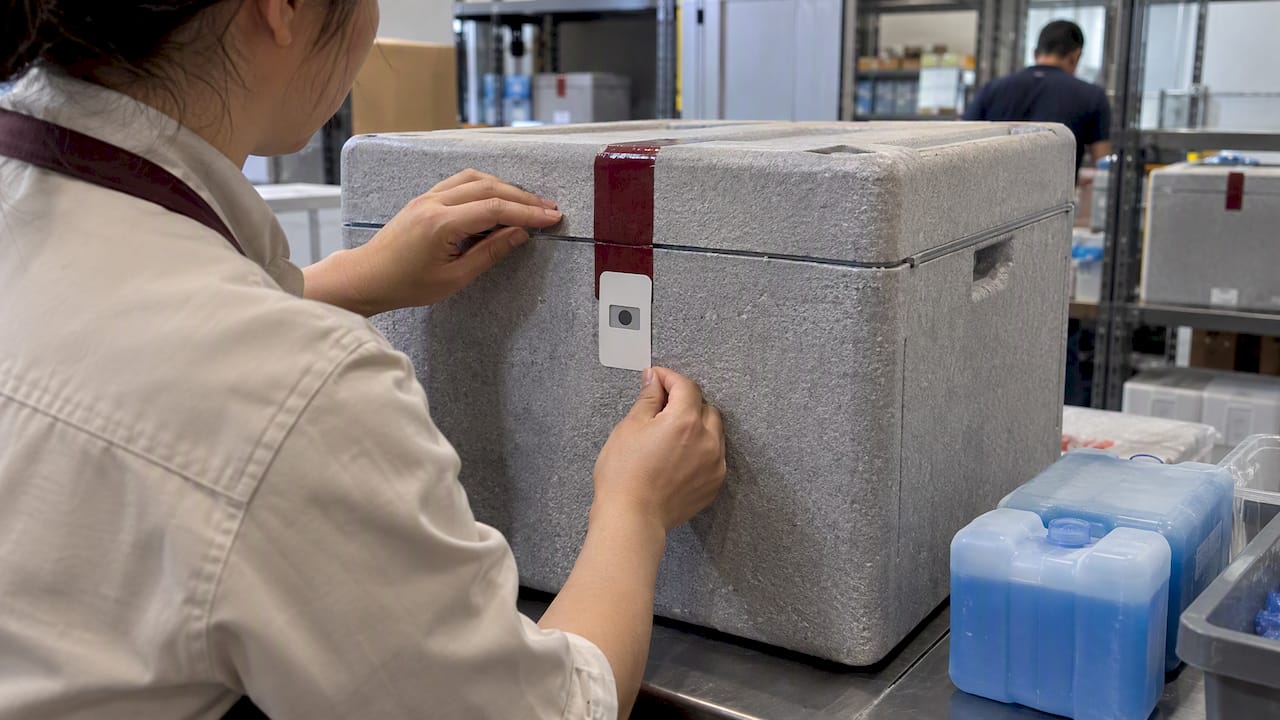
Temperature indicator labels are visual, often single-use sensors that give a permanent or reversible record of temperature exposure. We recommend them when you need cost-effective visual verification or an audit trail rather than continuous calibrated logging. They fall into three broad families, irreversible threshold indicators, progressive time-temperature integrators, and reversible liquid crystal strips, and the right choice depends entirely on whether your product cares about a single spike or cumulative heat over time.
TL;DR:
- Liquid crystal strips read the contacted surface, not ambient air, and poor contact can distort results; clean and dry application surfaces before use.
- Indicators used once rarely include individual calibration certificates, so buyers needing traceable audit records should verify available documentation before ordering.
- Set the temperature range, response time, and tolerance in the specification, then pilot labels on actual packaging to catch adhesion or activation problems.
- Food transport rules vary by country and product, while pharmaceutical cold chains follow WHO guidance; verify local requirements rather than assuming one standard applies everywhere.
Table of Contents
- Types of Temperature Indicator Labels
- How Temperature-Indicating Labels Work
- Accuracy, Tolerances, Standards, and Documentation
- How to Choose Temperature Indicator Labels
- Applications and Real-World Use Cases
- Application, Handling, and Storage Best Practices
- Yuan Packaging Note: Materials, Adhesives, and Custom Label Options
- Regulatory Compliance and Standards Across Industries
- Integrating Temperature Labels Into Packaging Design
- Environmental Impact and Disposal of Temperature Labels
- Practical Takeaway for Procurement and QA Teams
- How to Get Samples and Spec Review From Yuan Packaging
- FAQ
- Sources
- Key Manufacturer Datasheets and WHO Guidance
Types of Temperature Indicator Labels
Each label family answers a different question about thermal exposure, and matching the type to the question is the first decision any procurement or QA specification needs to get right.
Threshold or irreversible indicators change color permanently once a product crosses a defined temperature point, commonly used at single critical thresholds like 8°C or 25°C for cold chain shipments. Progressive time-temperature integrators, or TTIs, accumulate exposure over time rather than reacting to one spike, which makes them suited to biologics and perishables where total heat load, not a momentary excursion, determines product stability, as WHO guidance on transport monitoring describes. Reversible liquid crystal strips respond to surface contact temperature and reset once conditions change, making them useful for repeated spot checks on equipment or surfaces rather than permanent records.
- Threshold indicators use wax or chemical compounds that melt at a fixed temperature and stay changed.
- Progressive TTIs use diffusion or polymerization reactions that advance with both time and heat.
- Liquid crystal strips shift color reversibly based on molecular alignment at the surface.
- Printed polymer variants combine any of the above with custom branding or batch codes.
How Temperature-Indicating Labels Work
The mechanism behind each label type explains both its strengths and its blind spots, and understanding it helps you set realistic expectations before you specify a device for a critical shipment.
- Phase-change chemistry drives most irreversible indicators: a wax or chemical compound melts once it reaches its rated temperature and is absorbed into an indicating window, producing a permanent color change that cannot reset, as the Thermax irreversible strips data sheet describes.
- Liquid crystal behavior depends on direct surface contact; the crystals realign reversibly with temperature, so readings reflect the immediate surface rather than ambient air, and poor contact produces unreliable results.
- Time-temperature integration relies on a reaction rate that accelerates with heat, so the indicator estimates a temperature-equivalent value integrated over the whole exposure window rather than a single peak, per WHO's description of TTI chemistry.
- Thermal contact and substrate both influence response speed: a label on a poorly conductive surface or applied over residue will lag behind the actual product temperature, which is why surface prep matters as much as chemistry.
Accuracy, Tolerances, Standards, and Documentation
Buyers often assume a label behaves like a calibrated instrument, but the two categories serve different purposes and carry different documentation.
Electronic monitors typically offer accuracy with response times around 20 minutes in some device classes, according to WHO's performance specification for integrated electronic thermometers. That benchmark matters because labels do not log continuous data or carry the same calibration traceability; they give a single visual signal rather than a time series, which is appropriate for one-time audits but not for continuous shipment analytics.
Single-use indicators rarely ship with individual calibration certificates, while reusable electronic devices generally do, so if your audit trail requires traceable calibration records, confirm which category you are buying before you sign a purchase order. Request available documentation from suppliers before committing to a run, including lot traceability records and any certificates supported by the device class, along with storage and shelf-life information.
How to Choose Temperature Indicator Labels
A procurement checklist built around the product's actual stability profile avoids the most common buying mistake: ordering a generic indicator that doesn't match the critical control point it's meant to protect.
- Match the label type to the stability profile: use threshold indicators for single excursion limits and TTIs for cumulative degradation risk.
- Define temperature range, response time, and tolerance explicitly in the user requirement specification rather than relying on a supplier's default.
- Confirm surface and adhesive compatibility for the actual packaging material, including curved, cold, or oily surfaces.
- Decide single-use versus reusable based on whether you need a permanent audit record or repeated spot checks.
- Build lot traceability and sample acceptance testing into the purchase agreement before the first production run.
Pro Tip: Run a small pilot batch through your actual shipping lane before committing to a full production order, since real-world handling often reveals adhesion or activation issues a data sheet won't predict.
Applications and Real-World Use Cases
Temperature indicator labels earn their place across industries wherever a visual, low-cost check is more practical than continuous electronic monitoring.
- Vaccine and pharmaceutical cold chain: labels paired with Vaccine Arrival Reports confirm a shipment stayed within its required window during transit.
- Food transport auditing: short-haul shipments use threshold indicators to flag breaks in refrigeration without the cost of a full data logger.
- Equipment heat-exposure checks: maintenance teams use reversible liquid crystal strips to spot-check bearings or motors for overheating as part of predictive maintenance.
- Industrial heat-treatment verification: irreversible indicators confirm a part reached a required curing or annealing temperature during processing.
- Inspection paperwork: a used label is photographed or retained alongside shipment documents as physical evidence that a threshold was or wasn't crossed.
Application, Handling, and Storage Best Practices
Getting a reliable reading starts well before the shipment leaves the dock, and most false readings trace back to handling errors rather than defective labels.
- Clean and dry the application surface, removing any grease or residue, since adhesion directly affects thermal contact and read accuracy, per Thermax's application guidance.
- Store unused labels at the conditions the manufacturer specifies, often room temperature with controlled humidity, to avoid premature activation before use.
- Pre-condition labels that require it, such as refrigerating certain chemical indicators before application, so the compound starts in the correct state.
- Retain activated labels with shipment paperwork as part of the audit trail, and dispose of spent labels according to local waste guidance for the materials used.
Pro Tip: Keep a labeled reference sample from each batch in your QA files so you have a known-good comparison if a field reading looks ambiguous.
Yuan Packaging Note: Materials, Adhesives, and Custom Label Options
We work with pressure-sensitive substrates and adhesive families chosen for the surface and environment a label will face, from cold, condensing packaging to warm industrial equipment. Our custom label printing capabilities let us add lot codes, activation instructions, or tamper-evident features directly onto the label face without compromising the indicator chemistry.
- We help select substrate and adhesive combinations suited to curved bottles, cold packaging, or high-heat surfaces.
- Our finishing options include printed instructions, batch codes, and anti-counterfeit features on the same label.
- We recommend a sample round before production to confirm adhesion and legibility under real conditions, similar to the process outlined in our pressure-sensitive label specification guide.
Regulatory Compliance and Standards Across Industries
Regulatory expectations for temperature indicator labels differ by sector, and the right standard to reference depends on what the label is protecting.
Pharmaceutical and vaccine cold chains generally follow WHO guidance on transport monitoring, which recommends selecting indicators based on a product's stability profile rather than a one-size-fits-all threshold, and integrating them into a broader quality management system rather than relying on the indicator alone. The WHO transport monitoring guidance also distinguishes electronic logging devices, which carry formal performance specifications for accuracy and calibration, from simpler visual indicators used for spot audits.
Food shipments are typically governed by national food safety authorities' cold chain rules, which vary by country and by product category, so a label's suitability for food transport should be confirmed against the specific jurisdiction's requirements rather than assumed from pharmaceutical standards. Industrial and manufacturing applications, such as heat-treatment verification, usually follow internal quality procedures or sector-specific process standards rather than a universal temperature-indicator regulation.

Across all sectors, the common thread is documentation: a label's value in an audit depends on being able to show lot traceability, storage conditions, and, where applicable, a calibration certificate alongside the activated label itself. Buyers operating across borders should confirm the relevant national or regional requirement for their category rather than relying on a single global standard, since no single regulation covers every industry or every country's cold chain rules uniformly.
Integrating Temperature Labels Into Packaging Design
A temperature indicator doesn't have to look like a stray sticker bolted onto finished packaging. When the label is planned alongside the structural and graphic design rather than added afterward, it can sit within the brand's color palette, typography, and finish instead of breaking the visual story a shelf or unboxing moment is meant to tell.
For beauty, spirits, and lifestyle brands shipping temperature-sensitive products, such as certain formulations or specialty ingredients, placing the indicator on a neck label, base panel, or interior flap keeps the functional information visible to handlers while staying out of the primary brand graphic. Our cosmetic and beauty label work shows how finishes like soft-touch lamination or foil accents can coexist with a functional indicator window on the same substrate, so the label still reads as premium rather than purely industrial.

Curved surfaces, bottle necks, and tight folding carton panels each present different application challenges for an indicator window, which is why substrate choice and label geometry should be part of the same conversation as adhesive selection. Our production-ready neck label guidance covers how to plan label placement on curved surfaces without compromising either the brand graphic or the indicator's thermal contact with the product. Getting this right at the design stage avoids a late-stage scramble to retrofit a functional label onto packaging that wasn't built to carry one.
Environmental Impact and Disposal of Temperature Labels
Temperature indicator labels are typically single-use, and that disposability raises legitimate questions about material choice and end-of-life handling, particularly for brands shipping high volumes.
Most indicators combine a paper or polymer substrate, a chemical or liquid crystal active layer, and a pressure-sensitive adhesive, and the mix of materials can complicate recycling compared to a plain paper label. Buyers focused on sustainability should ask suppliers directly which substrate and adhesive combinations are recyclable or responsibly sourced, since this varies by product line and isn't something a generic indicator spec will state on its own.
Disposal guidance also depends on the chemical compound used in the indicating window: some phase-change compounds are inert once reacted, while others may carry local waste handling requirements depending on jurisdiction, so checking the manufacturer's safety data sheet before bulk disposal is worth the few minutes it takes. For shipments generating large volumes of used labels, such as recurring cold chain lanes, batching disposal and separating substrate types where possible reduces landfill mixing.
We source materials responsibly across our label lines and can discuss lower-impact substrate options for brands that want to pair functional temperature indicators with a broader sustainability commitment, without treating that choice as a trade-off against performance.
Practical Takeaway for Procurement and QA Teams
Match the label's function, threshold, progressive, or reversible, to your product's actual stability profile before anything else, and keep supplier storage and calibration guarantees on file as part of your QA records. Codify handling steps into your SOPs so results don't depend on who applied the label that day.
— Anthony
How to Get Samples and Spec Review From Yuan Packaging
Once you've settled on the label type and documentation your product needs, matching that spec to a real substrate and adhesive combination is the next step, and that's where our label manufacturing work fits.
- We produce custom pressure-sensitive labels with material and finish options suited to temperature-sensitive and regulated products.
- Our team can walk through adhesive and substrate selection against your specific surface and storage conditions.
- We run sample rounds before full production so you can verify adhesion and legibility under real handling.
Visit our custom label products page to request a sample round or a technical specification review for your next production run.
FAQ
What is the best temperature indicator?
There is no single best indicator; the right choice depends on whether you need a permanent record of a single threshold, a cumulative exposure measurement, or a repeatable surface check. Irreversible strips suit one-time threshold verification, TTIs suit cumulative stability risk, and liquid crystal strips suit repeated spot checks, as described in WHO's transport monitoring guidance.
How accurate are temperature stickers?
Temperature stickers are visual threshold or integration devices, not calibrated instruments, so their accuracy is defined by the manufacturer's data sheet rather than a universal figure. For comparison, electronic monitors used in cold chain settings can offer accuracy around ±0.5°C with response times of 20 minutes or less in some device classes, according to WHO's performance specification, while stickers give a simpler pass or fail style signal.
What are the different types of temperature indicators?
The main types are irreversible threshold indicators, which change permanently at a set temperature, progressive time-temperature integrators, which accumulate exposure over time, and reversible liquid crystal strips, which respond to surface contact and reset when conditions change. Each type is built around different chemistry, phase-change compounds, diffusion reactions, or liquid crystal alignment, matched to a specific monitoring need.
Sources
- Thermax ® Irreversible Temperature Recording Strips data sheet
- Temperature and humidity monitoring systems for transport operations (WHO TRS961 Annex 9, supp15)
- PQS performance specification: integrated electronic thermometer (WHO PQS_E006_TH06.2)
Key Manufacturer Datasheets and WHO Guidance
Consult the Thermax irreversible strips data sheet and WHO's transport monitoring guidance to verify specs, and request supplier certificates of traceability and calibration where applicable.
Recommended
- What Is a Pressure-Sensitive Label? Materials and Adhesives
- Packaging Quality Control for QA & Procurement: ISO 2859, AQL, 3 Tests
- Anti-Counterfeit Labels: Security Features and Costs
- Avoid 1/16 Inch Failures: FDA Cosmetic Label Rules for U.S. Brands
What is the best temperature indicator?
There is no single best indicator; the right choice depends on whether you need a permanent record of a single threshold, a cumulative exposure measurement, or a repeatable surface check. Irreversible strips suit one-time threshold verification, TTIs suit cumulative stability risk, and liquid crystal strips suit repeated spot checks, as described in WHO's transport monitoring guidance.
How accurate are temperature stickers?
Temperature stickers are visual threshold or integration devices, not calibrated instruments, so their accuracy is defined by the manufacturer's data sheet rather than a universal figure. For comparison, electronic monitors used in cold chain settings can offer accuracy around ±0.5°C with response times of 20 minutes or less in some device classes, according to WHO's performance specification, while stickers give a simpler pass or fail style signal.
What are the different types of temperature indicators?
The main types are irreversible threshold indicators, which change permanently at a set temperature, progressive time-temperature integrators, which accumulate exposure over time, and reversible liquid crystal strips, which respond to surface contact and reset when conditions change. Each type is built around different chemistry, phase-change compounds, diffusion reactions, or liquid crystal alignment, matched to a specific monitoring need.