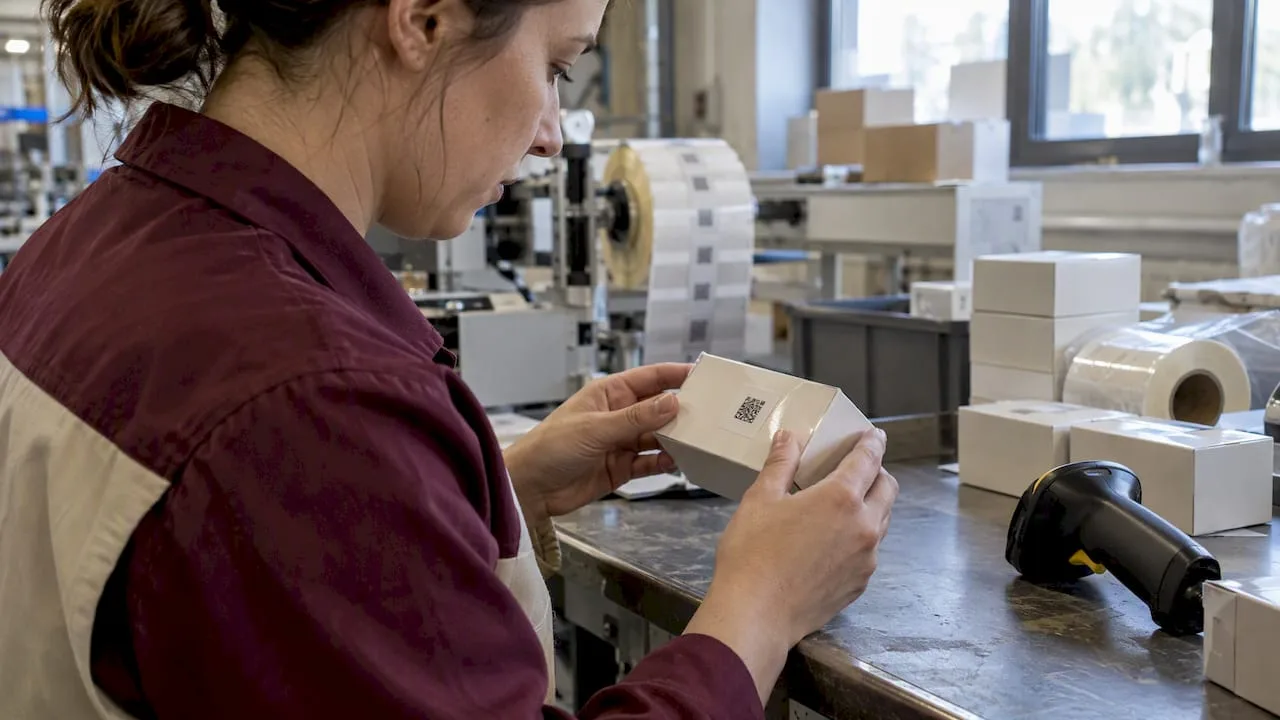
Track and trace labels are serialized security labels that give brands per pack traceability and a verifiable anti counterfeit layer. They turn a single carton or bottle into a trackable record, letting a brand confirm its authenticity, trace its path through the supply chain and respond fast if a batch needs recalling. This guide walks through the technologies behind these labels, the regulations shaping them and the production details that determine whether a serialization program actually works on the line.
TL;DR: Serialization at the unit level provides precise traceability but increases production costs compared to batch-level coding, which narrows recalls but covers many units under one ID. Technologies such as GS1 Digital Link enhance barcode functionality, enabling both supply chain management and consumer verification from a single QR or DataMatrix code. Compatibility with finishes like laminates and foils is crucial, as these can impact scan reliability; pre-production testing ensures codes remain readable under real handling conditions. Fulfilling regulatory requirements involves integrating traceability databases and following standards like DSCSA or EU FMD, with specific content and authentication features depending on the industry. Combining serialization with overt and covert authentication features creates a more effective anti-counterfeiting barrier, since serial numbers alone are easier to replicate.
Table of Contents
- Why Brands Adopt Track and Trace Labels
- The Technology Behind Scannable, Verifiable Codes
- Regulatory Rules That Shape What Goes on the Label
- Production Choices That Decide Whether Codes Actually Scan
- Implementation Checklist for a Serialization Rollout
- What Years of Packaging Production Teach You About Serialization
- How Yuan Packaging Supports Serialized Label Programs
- Standards and Guidance Worth Keeping on File
- Sources
- FAQ
Why Brands Adopt Track and Trace Labels
A serialized label does more than look official. For regulated and premium brands, it answers questions that matter the moment something goes wrong: which batch is affected, where did it ship, and is this unit genuine. That capability touches several parts of the business at once.
- Recall readiness: a serialized label lets a brand isolate the exact lot or unit involved instead of pulling entire product lines.
- Diversion detection: unit-level codes expose gray-market movement by showing where a product was scanned against where it was meant to be sold.
- Consumer trust: a scannable code gives shoppers a way to confirm a product is genuine before they buy it.
- Regulator requests: pharmaceutical and food brands are often required to produce traceability records on demand.
The granularity you choose shapes what you can answer later. Batch or lot level coding groups thousands of units under one identifier, which is cheaper and faster to apply but only narrows a recall to a production run. Instance level serialization assigns a unique number to every single unit, which costs more to implement but lets you trace one bottle or carton from the factory to the shelf. Counterfeiters target packaging and labels specifically because they are often the weakest link in an otherwise secure product. Customs data on fake goods shows that packaging materials, labels and authentication components account for roughly 20% of seizures, out of a counterfeit trade estimated at close to $467 billion globally in 2021. That is the scale of the problem a well designed label program is built to push back against.
The Technology Behind Scannable, Verifiable Codes
Most track and trace programs start with a 2D barcode, usually a QR code or a GS1 DataMatrix, printed or applied directly to the label. These codes carry more than a simple product number. A properly structured code encodes the GTIN along with variable data such as a serial number, batch or lot, and expiry date, all in one scan.
GS1 Digital Link adds a meaningful upgrade to this setup. It lets a single barcode serve two audiences at once: supply chain systems that need the GTIN and qualifiers for logistics, and consumers who scan the same code with a phone camera and land on a web page with authentication or product information. The code stays GS1 conformant while also acting as a consumer touchpoint, which is a shift from older barcodes that only worked for backend systems.
RFID is worth the added cost in specific situations:
- Case and pallet level reads where dozens of units need to be captured in one pass without individual scanning.
- No line of sight environments, such as inventory stored in sealed cartons, where optical codes cannot be read without opening the box.
- High-value or high-risk categories, such as spirits or pharmaceuticals, where the premium is justified by the exposure to diversion or counterfeiting.
RFID tags cost more per unit than printed codes and require reader infrastructure at every checkpoint, which is often not justified for lower-value consumer goods.
Combining identification with authentication is where real protection comes from. Serialization tells you what a product is and where it has been. Authentication tells you whether the physical unit in your hand is genuine. Layering overt features, like color-shifting ink or holographic foil that a consumer can check by eye, with covert features that only brand security teams can verify, makes counterfeit replication substantially harder. Guidance from the World Health Organization recommends exactly this combination: standardized serialized coding paired with overt and covert authentication and tamper evident packaging, maintained together as a chain of custody rather than as separate measures.
None of this works without a source of truth. A serial number is only meaningful if it resolves against a database confirming it was issued, where it was shipped, and whether it has already been scanned elsewhere. Without that backend, a code is just a printed number.
Regulatory Rules That Shape What Goes on the Label
Regulated sectors do not leave label content to brand discretion. In the United States, the Drug Supply Chain Security Act requires a package-level product identifier combining the National Drug Code, a serial number, lot number and expiry date, all in both machine-readable and human-readable form. FDA guidance also mandates electronic exchange of transaction data between trading partners, which means the label is only one piece of a larger compliance chain that includes IT systems on both ends.
The European Union’s Falsified Medicines Directive takes a related but distinct approach. It requires a unique identifier and an anti-tampering device on specified medicinal packs, and it restricts authentication to the officially designated 2D code rather than any barcode a brand chooses to add.
For brands outside pharmaceuticals, GS1 standards still shape sound label design even without a legal mandate:
- Identifier structure: GTINs, batch or lot numbers and serials follow a consistent format recognized across the supply chain.
- Digital Link compatibility: building toward GS1 Digital Link now avoids a redesign later if regulations tighten.
- Granularity decisions: choosing batch versus unit level serialization early avoids rework once packaging is in production.
- Placement rules: human-readable text and machine-readable codes both need to survive printing, handling and shelf display without obstruction.
Production Choices That Decide Whether Codes Actually Scan
Serialized data cannot be pre-printed in bulk the way static artwork can, since every unit needs its own unique number. That typically means post-print coding, applied by inkjet or laser directly onto the label or carton after the base design is already printed. This step adds time to the line, and the speed impact depends on the coding method, the substrate and the resolution required for a clean scan.
Material choices carry real consequences for scan reliability and security:
- Substrate: textured or uncoated stocks can scatter light and reduce contrast on a printed code.
- Finish: soft-touch laminates and heavy metallic foils reduce optical reflectivity and can lower 2D code read rates, so pre-run verification on the finished material is worth doing before a full production run.
- Adhesive: a tamper-evident adhesive that fractures or leaves a residue pattern when removed prevents a genuine label from being lifted off and reapplied to a counterfeit unit.
Tamper-evident features matter because a serialized code can be copied or harvested from a genuine pack and reused on a fake if there is no physical evidence that the original seal was broken.
Pro Tip: Run a pilot batch through your actual filling and labeling line, not just a desktop printer test, before locking in a substrate or finish.
Before signing off on a full run, test under real conditions: scan rates at target conveyor speed, code integrity after exposure to humidity or temperature swings expected in transit, and legibility after standard handling.
Implementation Checklist for a Serialization Rollout
A serialization program moves through distinct phases, and skipping ahead usually costs more later than it saves now.
- Specification: define identification granularity, choose GS1 identifiers, and decide which authentication features will layer onto the base code.
- Sample and pilot: run a small batch through production equipment to confirm scan rates and material compatibility.
- IT integration: connect serial issuance, the source-of-truth database and any EPCIS or resolver infrastructure to existing ERP systems.
- Scale-up: move from pilot volumes to full production once acceptance criteria are consistently met.
| Phase | Primary focus | Typical cost driver |
|---|---|---|
| Specification | Identifier structure and authentication layering | Design and GS1 registration |
| Sample and pilot | Scan reliability on finished material | Pilot run and testing |
| IT integration | Database, resolver and ERP connections | Software and system setup |
| Scale-up | Full production throughput | Line retrofitting or new equipment |
Aggregation, meaning the parent-child link between a case and the serialized units packed inside, needs to be captured at the moment of packing rather than reconstructed later. A sound pilot acceptance target is a high, consistent read rate at your actual conveyor speed, confirmed before committing to full-scale production.
What Years of Packaging Production Teach You About Serialization
The most common mistake is treating serialization as a design decision instead of a production one. Brands pick a finish for shelf appeal, skip post-print validation, and discover at scale that soft-touch lamination is swallowing their scan rate. The fix is simple: prototype early, build on GS1 identifiers from day one, and settle your database and resolver architecture before the first production run, not after.
— Anthony
How Yuan Packaging Supports Serialized Label Programs
Brands commissioning serialized or security labels need a manufacturing partner who treats finishing and compliance as one job, not two separate conversations. Yuan Packaging brings over 25 years of experience producing custom labels alongside rigid boxes, cartons and tags for beauty, spirits and pharmaceutical brands, with the finishing control needed to keep codes scannable through foil stamping, embossing or soft-touch lamination.
Services include anti-counterfeit label production, material sourcing aligned with sustainability commitments, and finishing decisions made with scan reliability in mind from the start, not corrected after a failed pilot. If you are specifying a serialized label program for an upcoming launch, visit our products page to review label and packaging options, or reach out for a technical consultation on your next pilot run.
Standards and Guidance Worth Keeping on File

For deeper technical reference, consult GS1 Digital Link and the GS1 Global Traceability Standard, the European Commission’s page on falsified medicines, WHO guidance on serialization, and FDA guidance on DSCSA product identifiers.
Sources
- Mapping the value and nature of global trade in fake goods (EUIPO)
- FDA guidance on product identifiers under DSCSA
- GS1 Digital Link
- WHO guidance on traceability and serialization
FAQ
What is the difference between batch level and unit level serialization?
Batch or lot level coding groups many units under one shared identifier, which narrows a recall to a production run rather than a single item. Unit level, or instance-level, serialization assigns each individual unit its own number, allowing a brand to trace one specific bottle or carton through the entire supply chain.
Do all industries need to follow DSCSA or EU FMD rules?
No, these are sector-specific regulations. The DSCSA applies to certain prescription drugs in the United States, and the EU Falsified Medicines Directive applies to specified medicinal products sold in the European Union, so brands outside pharmaceuticals follow these only as a model for sound practice rather than as a legal requirement.
Why do some labels fail to scan after printing?
Finishes like soft-touch laminates and heavy metallic foils can reduce the optical reflectivity a scanner needs, lowering 2D code read rates even when the underlying code was printed correctly. Testing the finished material with your actual scanners before a full production run catches this before it becomes a line-wide problem.
Can a track and trace label alone stop counterfeiting?
Not on its own. Guidance from WHO and other authorities recommends combining serialized identification with overt and covert authentication features and tamper-evident packaging, since a serial number alone can be copied from a genuine pack onto a counterfeit.
Does Yuan Packaging produce anti-counterfeit labels?
Yes, Yuan Packaging manufactures custom labels, including anti-counterfeit options, as part of its broader packaging offering for beauty, spirits and pharmaceutical brands. Details on available label types and finishes are listed on its products page.