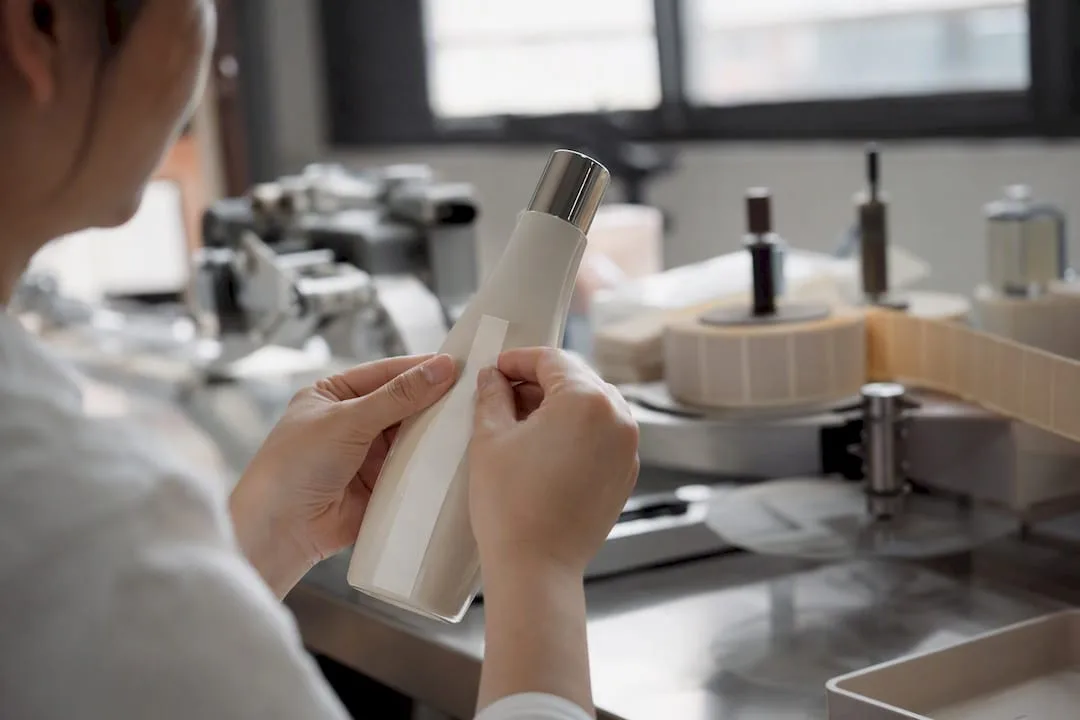
Pressure sensitive labels are self-adhesive labels built from three layers: a face stock, an adhesive, and a release liner. They stick with light pressure instead of heat or water. That construction makes them the default choice for most packaged goods: fast to apply, compatible with dozens of materials, and flexible enough to carry almost any finish a brand wants.
What “pressure-sensitive” means: the name refers to the adhesive. The Pressure Sensitive Tape Council (PSTC) describes a pressure-sensitive adhesive (PSA) as permanently tacky at room temperature, bonding under light finger pressure without having to dry or cure. So a pressure-sensitive label is simply peeled off its release liner and pressed on, with no heat, water, or solvent needed to activate it.
Pressure sensitive labels (often called PSL in the industry) work as the right default for the majority of consumer and industrial product labeling. Alternatives like glue-applied paper labels or shrink sleeves still have their place, but they demand more equipment and time.
- Three-layer construction: face stock, adhesive, release liner
- Applies by hand or machine, no heat or water required
- Works across paper, film, foil, and vinyl substrates
- Supports digital, flexo, and offset printing plus premium finishes
Key Takeaways
Pressure sensitive labels succeed when buyers match adhesive chemistry and face stock to their specific substrate, environment, and production line before selecting finishes.
| Point | Details |
|---|---|
| Construction drives performance | Face stock, adhesive, and release liner each affect durability, so specify all three together. |
| Adhesive chemistry follows environment | Acrylic suits UV and chemical exposure, rubber grabs fast on rough surfaces, silicone handles temperature extremes. |
| Request conditioned test data | Ask for peel, tack, shear, and environmental conditioning results, not just fresh-sample performance. |
| Converting specs prevent line jams | Confirm core size, roll diameter, and wind direction match your applicator before full production. |
| Yuan Packaging supports premium categories | Yuan Packaging offers custom label printing with tamper-evident and anti-counterfeit options for spirits, cosmetics, and pharmaceutical brands. |
Table of Contents
- What Is the Construction of a Pressure Sensitive Label?
- Which Adhesive Chemistry and Performance Metrics Matter Most?
- How Do You Choose a Printing Method and Finish?
- What Production and Application Details Should You Confirm?
- What Are the Most Common Pressure Sensitive Label Applications?
- How Do You Specify a Pressure Sensitive Label for Quotes?
- What Testing and Compliance Standards Should You Request?
- Why Work With Yuan Packaging on Your Label Project?
- What Should You Prioritize First When Buying Pressure Sensitive Labels?
- Get a Sample Run Started With Yuan Packaging
- Frequently Asked Questions
- Sources
What Is the Construction of a Pressure Sensitive Label?
Every pressure sensitive label is a sandwich. The top layer, the face stock, carries your design and takes the printing. Underneath it sits a layer of adhesive, and beneath that, a release liner that peels away right before application. Get any one of these three wrong and the whole label underperforms, no matter how good your artwork looks.
| Layer | What it does | Common options |
|---|---|---|
| Face stock | Carries the print and finish, and largely sets how well the label copes with moisture, heat, chemicals, and UV | Paper, BOPP, PET, vinyl, foil |
| Pressure-sensitive adhesive | Bonds the label to the product under light pressure, and decides hold strength, removability, and temperature range | Acrylic, rubber-based, or silicone; permanent, removable, or repositionable |
| Release liner | Protects the adhesive and carries the labels through printing, die-cutting, and dispensing; peeled away at application | Silicone-coated paper, or film for high-speed automated lines |
Face stock options vary widely in look, cost, and durability:
- Paper is the most economical choice and prints beautifully, but it tears and softens with moisture unless coated or laminated.
- BOPP (biaxially oriented polypropylene) resists water and oils, making it a workhorse for personal care, food, and beverage labels.
- PET (polyester) handles heat, chemicals, and UV exposure better than paper or BOPP, which is why it shows up on industrial and outdoor products.
- Vinyl stretches and conforms to curved or flexible packaging without wrinkling.
- Foil adds a metallic, premium look often used on spirits and cosmetics packaging where shelf presence matters.
The release liner matters more than most buyers assume. Silicone-coated paper liners are standard and cost-effective for most runs. Film liners run smoother and faster on high-speed automated equipment, which matters when a production line is applying thousands of labels per hour.
Your face stock and liner selection also dictate what printing and finishing options are available later. A textured or uncoated paper face stock, for instance, won’t hold foil stamping the way a smooth BOPP or PET stock will. Decide the face stock first, then move to adhesive chemistry and printing method.
Which Adhesive Chemistry and Performance Metrics Matter Most?
The adhesive layer determines whether your label survives its intended life cycle, or fails in the warehouse before it ever reaches a shelf. Three chemistries dominate the market, and each solves a different problem.

Acrylic adhesives offer strong UV stability and chemical resistance, which makes them the workhorse choice for outdoor labels, industrial containers, and anything exposed to sunlight or solvents over time. Rubber-based adhesives provide high initial tack, meaning they grab fast, even on rough, cold, or slightly uneven surfaces. Silicone adhesives hold their bond across extreme temperature swings, from freezer units to high-heat sterilization, according to Midwest Label Supply’s technical breakdown.
Beyond chemistry, you need to specify adhesive type:
- Permanent adhesives are meant to stay put for the product’s life, ideal for retail branding and compliance labels.
- Removable adhesives allow clean peel-off without residue, common on promotional stickers or pricing labels.
- Repositionable adhesives let you reposition a label multiple times before it sets, useful for planogram testing or short-term signage.
- Specialty adhesives target unusual substrates like low-surface-energy plastics or curved glass.
Pro Tip: Match the adhesive to the substrate’s surface energy, not just to the product category. Low-energy plastics like polyethylene often need specialized formulations, and skipping this test step is one of the most common causes of field label failure.
When you request samples, ask suppliers for four specific performance numbers: tack (how quickly the label grabs on contact), peel (the force required to remove it), shear (resistance to sliding under sustained load), and dwell time (how long adhesive needs to reach full bond strength). Testing protocols covering peel, tack, shear, and environmental conditioning are standard practice for predicting how a label will hold up months after it leaves the production line, not just on day one.
How Do You Choose a Printing Method and Finish?
Your print method should follow your run size and color needs, not the other way around. Choosing the wrong process either inflates your unit cost on a short run or slows down a long one.
Digital printing suits short runs and variable data, think sequential numbering, QR codes, or region-specific text, without the setup cost of plates. Flexo printing becomes more efficient as volume climbs, since plate costs amortize across larger runs. Offset printing delivers the tightest color control, which matters when a brand’s Pantone reference has to match exactly across every production batch, according to Labels Unlimited’s process comparison.
Finishing is where labels go from functional to persuasive:
- Overlaminates protect ink from abrasion, moisture, and UV fading, extending shelf life in rough handling environments.
- Varnish adds a lighter layer of gloss or matte protection at lower cost than full lamination.
- Soft-touch coatings give a velvety tactile feel that signals premium positioning, common on cosmetics and spirits packaging.
- Foil stamping and embossing add dimension and shine for luxury shelf presence.
If your product ships outdoors, gets handled roughly, or sits in a cooler with condensation, prioritize a laminate or UV coating over a varnish. Varnish and soft-touch finishes work well when the label lives in controlled retail conditions and the priority is look and feel rather than survival. Buyers weighing tactile finishes for premium spirits or cosmetics lines can find more detail in this soft-touch lamination specification guide.
What Production and Application Details Should You Confirm?
Converting decisions, the technical steps that turn a printed roll into an applied label, cause more line stoppages than adhesive or printing choices combined. Confirm these before your first production run:
- Die-cutting and slitting specs. Your label shape and roll width must match the tooling your converter already has, or you’ll pay for custom dies.
- Core size and roll diameter. Applicators are built around specific core sizes (commonly 3 inches) and maximum roll diameters. Mismatched specs mean your labels physically won’t fit the machine.
- Wind direction. Rolls wind either face-out or face-in, and getting this backward means labels feed upside down into your applicator.
- Hand-apply vs. automated compatibility. Hand-applied labels tolerate more variation in liner speed and tack; automated lines need consistent dispensing speed and liner strength to avoid jams.
- Applicator requirements. Share your applicator’s make and model with your converter early. Overlooked converting mismatches between roll specs and applicator hardware are a frequent, avoidable cause of production delays.
Run a small pilot batch through your actual line before committing to full production. A label that performs perfectly in a supplier’s lab can still jam on your specific equipment.
What Are the Most Common Pressure Sensitive Label Applications?
Different industries push pressure sensitive labels toward different material and adhesive decisions, and knowing your sector’s common failure points saves a round of costly trial and error.
- Food and beverage labels need moisture and washdown resistance, plus attention to FDA food-labeling guidance when adhesive or face stock touches food-contact surfaces or packaging that comes near food.
- Cosmetics and spirits brands lean into premium finishes, foil, soft-touch, embossing, and need adhesives that conform to curved or textured glass without lifting at the edges.
- Pharmaceutical and medical labels often require serialization for track-and-trace compliance, tamper-evident features, and adhesives that survive sterilization processes without degrading.
- Industrial labeling demands solvent resistance and stability across wide temperature extremes, since asset tags and equipment labels often sit outdoors or near machinery for years.
Brands in regulated or premium categories frequently combine several of these needs at once. A tamper-evident spirits label, for example, has to satisfy both the conformability demands of glass bottles and the security expectations buyers now associate with anti-counterfeit label features.
How Do You Specify a Pressure Sensitive Label for Quotes?
Getting comparable quotes from multiple converters means giving them identical, specific data, not a general description of what you want.
- Document your substrate’s surface energy. Low-energy plastics need different adhesive formulations than glass or coated paperboard.
- State your production line speed. Faster lines need liners and adhesives engineered for quick, clean dispensing.
- Specify your temperature and humidity range. A label destined for a refrigerated case needs different adhesive chemistry than one sitting on a dry-goods shelf.
- Set a realistic lifetime expectation. A promotional label needs to survive weeks; an industrial asset tag needs to survive years.
- Flag any regulatory constraints. Food contact, pharmaceutical compliance, or export requirements should be on the table before your first sample request, not after.
Pro Tip: Request conditioned samples, not just fresh ones. A label that peels cleanly on day one can fail after a week in a hot warehouse or a humid shipping container. Ask your converter to run environmental conditioning before you sign off on a material.
Cost drivers worth understanding before you negotiate: face stock choice, adhesive chemistry, print method, and finish each add incremental cost, and it’s easy to overspec a label with premium finishes the end use doesn’t actually need. Balance the aesthetic your brand wants against the functional survival your product requires, and don’t let a beautiful mockup override a failed shear test.
What Testing and Compliance Standards Should You Request?
Ask your converter directly which tests back up their technical datasheet, because a spec sheet without test data behind it is just a claim.
- ASTM standards, including guides like ASTM D7932-17, cover adhesive property testing and give buyers a consistent benchmark to compare converters against, rather than relying on marketing language alone.
- Peel, tack, and shear tests should come back with numeric results you can compare across suppliers, not vague descriptions like “strong hold.”
- Environmental conditioning results tell you how a label performs after exposure to heat, cold, or humidity, not just fresh off the press.
- FDA food-labeling guidance applies directly when your label or adhesive touches food-contact surfaces; ask suppliers for a food-contact declaration if your product falls in that category.
A supplier technical datasheet without independent lab backing is a starting point, not a guarantee. When your product sits in a regulated category, food contact, pharmaceutical, or export markets with their own labeling rules, ask for third-party lab evidence before committing to a full production run.
Why Work With Yuan Packaging on Your Label Project?
Yuan Packaging has spent more than 25 years manufacturing packaging for premium brands, and that experience shows up in the label division specifically. The company has delivered over 100 million units to more than 5,000 brands across beauty, spirits, cosmetics, and pharmaceutical categories, categories where label failure isn’t just a cosmetic problem, it’s a compliance and brand-trust problem.
What Yuan Packaging brings to a label project:
- Custom label printing built specifically for spirits and premium brand positioning, from foil stamping to soft-touch finishes.
- Tamper-evident and anti-counterfeit label options for categories where brand protection is non-negotiable.
- A structured sample and technical consultation process before committing to full production runs.
- Experience navigating pharmaceutical and luxury cosmetics compliance, categories with tighter labeling scrutiny than most consumer goods.
Buyers evaluating spirits packaging specifically can review project examples and technical detail in the label printing guide for premium spirits.
What Should You Prioritize First When Buying Pressure Sensitive Labels?
Most label buying guides push readers straight into a materials chart and call it a day. That misses the actual failure point in most label projects: buyers spec the label to match a mockup, not to match their production line and product environment. A gorgeous soft-touch finish on a bottle that spends six months in a humid warehouse is a bet against physics, not a design decision.
The research here supports a specific order of operations, and it’s not the order most procurement teams follow. Adhesive chemistry and substrate surface energy should get locked down before anyone picks a finish. Converting specs, roll diameter, core size, wind direction, deserve the same early attention, because a label that looks perfect in a sample book can jam an applicator on day one of a production run.
The conventional advice treats testing as a final checkbox before sign-off. It should be the filter you run every serious candidate through before you ever compare pricing. A cheaper label that fails shear testing costs more in reprints, recalls, and damaged retail relationships than a slightly pricier one that passes on the first try.

Get a Sample Run Started With Yuan Packaging
Yuan Packaging gives brand teams a direct path from spec sheet to production, without the back-and-forth of sourcing separate vendors for printing, finishing, and compliance review. Where many converters specialize narrowly, Yuan Packaging’s 25-plus years serving beauty, spirits, and pharmaceutical clients means the same team that quotes your adhesive chemistry can also advise on tamper-evident features or food-contact declarations, cutting out the guesswork of coordinating multiple suppliers.
If your product sits in a regulated or premium category, cosmetics, spirits, pharmaceuticals, gourmet foods, the packaging journal covers additional ground on tamper-evident design requirements and artwork preparation for custom printing worth reviewing before you finalize a spec sheet. When you’re ready to move from research to a real quote, request samples and a technical consultation through the custom label printing page to get conditioned test samples matched to your exact substrate and production line.
Frequently Asked Questions
What are pressure sensitive labels used for? Pressure sensitive labels cover most packaged consumer goods, food and beverage containers, cosmetics, spirits bottles, pharmaceutical packaging, and industrial asset tags, because they apply without heat or water and adapt to nearly any substrate.
What’s the difference between permanent and removable adhesive? Permanent adhesive is designed to hold for the product’s full life cycle without intentional removal, while removable adhesive releases cleanly without leaving residue, useful for promotional labels or pricing stickers.
How do I know which face stock to choose? Match face stock to your environment and budget: paper for cost-sensitive dry-goods labeling, BOPP for moisture resistance, PET for heat and chemical exposure, vinyl for curved or flexible packaging, and foil for premium shelf presence.
Do pressure sensitive labels meet food-contact requirements? Some do, depending on adhesive chemistry and face stock. Ask your supplier for a food-contact declaration referencing FDA food-labeling guidance if your label touches food-contact surfaces.
What tests should I request before a full production run? Request peel, tack, and shear test results along with environmentally conditioned samples, ideally referencing recognized standards like ASTM’s adhesive testing guides, so results are comparable across suppliers. Buyers sourcing into the United States can find minimums, sample timings and customs guidance on our United States sourcing page.
Sources
- Food Labeling Guide (FDA)
- Adhesive label — Wikipedia
- Pressure Sensitive Labels Manufacturer | Custom PS Labels | Midwest Label Supply
- ASTM D7932-17 — Standard Guide for…
- Custom Pressure-Sensitive Labels — Labels Unlimited
- PSA Tape Defined — Pressure Sensitive Tape Council (PSTC)