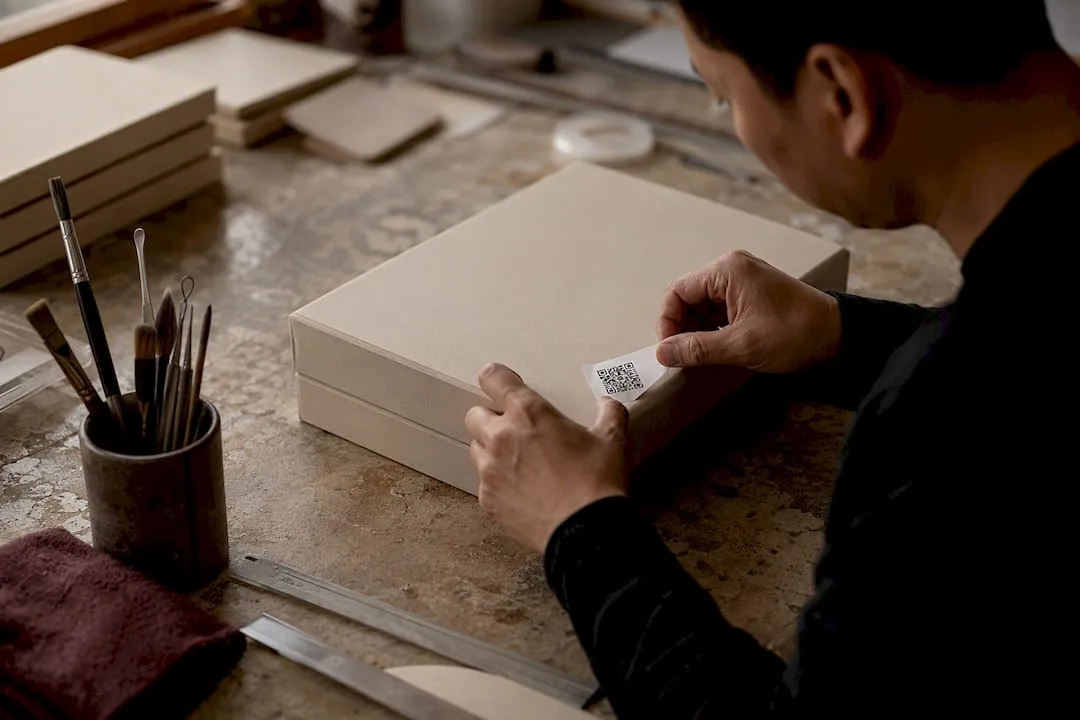
For premium brands, bespoke QR code labels earn their place on packaging when they enable provenance storytelling, authentication, warranty registration, or a digital product passport. They fall short when a code gets bolted onto finished artwork as an afterthought instead of built into the label design from the start. The path to reliable scanning runs through production proofs on your actual material, not a PDF mockup on a designer’s screen.
TL;DR: Serialized QR codes linked to verification systems offer stronger protection against counterfeiting than static codes, especially for high-value items. Ensuring contrast with dark modules on light backgrounds and customizing the code size to at least 2 centimeters improves scan reliability across diverse materials. Testing proofs on actual substrates and under lighting conditions typical of retail environments reduces the risk of scanner failure in final production. Metallic finishes, embossing, or varnishes require dedicated non-metallic zones and pre-production scan tests to prevent scanning issues. Embedding logos in codes demands higher error correction and precise final artwork testing to maintain readability while enhancing aesthetic appeal.
Table of Contents
- Why Luxury Brands Use QR Code Labels
- Design and Material Rules for Scannable Luxury Labels
- Production Specifications That Keep Codes Reliable
- Secure QR Options: Serialization and Verification Models
- How QR Labels Affect Cost, MOQ, and Timelines
- What Manufacturing Experience Teaches About Luxury QR Codes
- Get Custom QR Code Labels Built for Scan Reliability
- Sources
- FAQ
Why Luxury Brands Use QR Code Labels
The best QR code labels solve a specific business problem, not a general one. Marketing teams use them to open a microsite that tells a provenance story: where a fabric was woven, which distillery cask a bottle came from, or how a bag was hand-finished. After-sales teams use them for warranty registration and repair scheduling. Legal and brand-protection teams use them to verify authenticity at resale, which matters enormously in categories like watches and handbags where secondhand markets now rival primary retail.
Retail operations benefit too, since a single scan can pull up care instructions without cluttering a swing tag with fine print.
Track these outcomes once the label program launches:
- Scan-to-conversion rate: how many scans reach the intended landing action, whether that’s registration or a purchase.
- Registration rate: the percentage of buyers who complete warranty sign-up after scanning.
- Provenance-check frequency: how often resale-market buyers verify authenticity, a useful signal for counterfeit exposure.
A tool like Yuan Packaging’s smart packaging integrations can help teams tie these metrics back to the physical label run that generated them.
Design and Material Rules for Scannable Luxury Labels
A QR code that looks elegant but fails to scan is worse than no code at all. Treat the code as a brand asset, not an add-on. Luxury houses commonly customize the module colors and center a logo inside the code, but that customization only holds up when contrast stays strong enough for the scanner to read the pattern reliably, as Supercode’s guidance on luxury QR implementation makes clear.
Follow these rules during dieline and artwork review:
- Size and quiet zone by placement. A box panel can carry a larger code than a swing tag or inner flap; keep a clear margin around every code equal to at least four modules on all sides.
- Contrast over decoration. Dark modules on a light background scan far more reliably than tone-on-tone luxury palettes, even when the brand aesthetic favors subtlety.
- Logo-in-code headroom. If you embed a logo, raise the error-correction level to compensate for the lost data area, and test the exact final artwork, not a placeholder.
- Finish-specific mitigation. Hot foil, metallic ink, high-gloss varnish, and embossing all interfere with scanner contrast recognition. A lacquer window or a dedicated non-metallic print zone around the code solves most of these conflicts.
- Placement that protects the unboxing moment. Put the code where a phone can reach it flat, such as an inner flap or a care label, rather than forcing it onto a curved or textured surface just to save space.
Pro Tip: Run your foil-stamped or embossed proof through a scan test under warm retail lighting before locking the dieline. Metallic substrates that scan fine under office fluorescents often fail under a boutique’s dimmer, warmer bulbs.
Production Specifications That Keep Codes Reliable
Send vector files, not raster exports, whenever possible. SVG or PDF at 1:1 scale keeps the module edges crisp regardless of final print size; if a raster file is unavoidable, deliver it at a resolution high enough that no module edge softens under magnification. Labelmaker points to sizing, contrast, and material testing as the three places most production runs go wrong.
Error correction matters more on premium packaging than people assume, because logo overlays and decorative finishes both eat into the code’s usable data area. A longer destination URL increases module density and shrinks the margin for error, so shorter is almost always better for small-format labels.
- Use branded short domains instead of long tracking URLs; this reduces symbol density on compact swing tags and care labels, a point PassportPro’s packaging design guide backs with its own sizing recommendations.
- Recommended minimum physical size sits around 2 to 2.5 centimeters for most packaging applications, adjusted upward for textured or low-contrast substrates.
- Build a device and lighting test matrix: at minimum two phone operating systems, three lighting conditions, and a range of scan angles from directly overhead to a steep 45 degrees.
- Add abrasion and wear testing for any label that will be handled repeatedly, since foil edges and varnish layers degrade differently than uncoated paper stock.
Most QR failures in production trace back to one of three points treated as an afterthought: the code itself, the printed surface, or the real-world scanning context, according to Labelmaker. Testing all three together, on final material, catches problems a proof sheet never reveals.
Decide early whether the payload is a static baked-in URL or a dynamic redirect. Dynamic redirects let you update the destination content after the label ships, which matters for long production runs where a microsite might change before the last case leaves the warehouse.

Secure QR Options: Serialization and Verification Models
A static QR code, identical on every unit, works fine for marketing and care instructions. It does nothing for authentication, because anyone can photograph and reproduce it. Brands serious about counterfeit protection move to unique-per-item serialized codes tied to a back-end verification system.
- Static codes suit provenance storytelling and care instructions where every unit shares the same content.
- Serialized QR codes assign a unique code to each item, checked against a verification server on first scan; this is the common architecture luxury houses use for anti-counterfeiting, often integrated with CRM to capture first-scan ownership registration.
- GS1 Digital Link structures the QR payload around a standardized product identifier, useful once a brand needs the same code to serve marketing, inventory, and compliance functions simultaneously.
- NFC as a complement, not a replacement, adds a tap-based verification layer for items where a customer expects a more premium interaction than a scan.
Very small or permanent items, like rings or watch components, often can’t rely on a packaging-mounted QR code at all. Scandit’s analysis of digital product passport requirements notes that permanent identifiers for tiny parts frequently require a laser-etched Data Matrix directly on the item, since the packaging and the product may separate long before the product’s useful life ends. Yuan Packaging’s own anti-counterfeit labels guide covers how serialized labels fit into a broader brand-protection strategy.
How QR Labels Affect Cost, MOQ, and Timelines
A realistic production timeline runs through five stages, and skipping any one of them is where rework starts.
- Concept and dieline integration. Build the QR placement into the artwork from day one, not after the design is “finished.”
- Material and finish selection. Choose foil, varnish, or embossing treatments with scan reliability in mind, not just aesthetics.
- Proof and scan testing. Test physical proofs across your device and lighting matrix before approving plates or digital print files.
- Pre-run sampling. Pull a small batch from the actual production line and re-test, since press conditions differ from proofing conditions.
- Full production run and final QA. Spot-check scan performance across the run, not just at the start.
Cost drivers include specialty finishes, whether the run uses variable-data or serialized printing, and whether you’re paying for plate setup versus a digital short run. Digital printing tends to make more economic sense below a few thousand units per SKU, while plate-based methods gain an edge at higher volumes. Ask any manufacturer for a documented sample scan pass rate, a wear-test result, and confirmation that a fallback human-readable URL sits near the code for units that fail to scan.
What Manufacturing Experience Teaches About Luxury QR Codes
Twenty-five years of hand-finishing rigid boxes and specialty labels has taught us that the finish a brand wants and the finish that scans reliably aren’t always the same choice, until you test early. At Yuan Packaging, that means sample testing on final substrates, carving out non-metallic print windows around codes on foiled labels, and building serialization into the workflow rather than layering it on late. Our clearest recommendation: test on final material before the first production proof, and write a scan pass-rate target into the contract itself.
— Xavier
Get Custom QR Code Labels Built for Scan Reliability
Yuan Packaging is the manufacturing partner for brands that need bespoke QR code labels without sacrificing the foil, varnish, or embossed finishes that define a premium unboxing moment. Our services cover custom pressure-sensitive labels with specialty finishes, variable-data and serialized printing for authentication programs, and smart-packaging integrations for provenance and warranty use cases.
What sets our approach apart is the testing discipline built into every run: sample proofs on your actual substrate, scan verification across device and lighting conditions, and production experience specific to spirits and premium goods where foil and metallic finishes are the norm, not the exception. If your current supplier hands you a print-ready file and calls it done, that gap is exactly where scan failures start. Request samples or submit an RFP through our custom label printing page to get a production-tested proposal for your next run.
Sources
- QR Codes for Luxury Brands (2026) | Supercode
- QR Code Anti-Counterfeiting Serialization: Technical Guide
- Luxury Retail Digital Product Passports: The Big Problem of Tiny Codes
- QR Code Labels Best Practices That Actually Scan
- How to Add a Digital Product Passport to Your Product Packaging: A Step-by-Step Design Guide | PassportPro Blog
FAQ
What size should a QR code be on premium packaging?
Most packaging applications need a minimum physical size of roughly 2 to 2.5 centimeters, adjusted upward for low-contrast or textured substrates.
Can a QR code include a logo without hurting scan reliability?
Yes, but only if you raise the error-correction level to offset the lost data area and test the exact final artwork, since logo-in-code customization requires maintaining sufficient contrast to scan reliably.
Should every unit have a unique QR code?
For authentication and resale-provenance programs, yes: serialized per-item QR codes verified against a back-end server are the standard approach, while static codes suit marketing and care-instruction content.
Why do foil-stamped QR codes fail to scan sometimes?
Metallic ink and high-gloss varnish reduce the contrast a scanner needs, which is why manufacturers often use a lacquer window or a separate non-metallic print zone around the code, tested on final material before full production.
Does Yuan Packaging offer serialized QR code labels?
Yes, Yuan Packaging produces custom label printing with serialization capabilities for spirits and premium brands, alongside specialty finishes like foil, UV, and embossing.