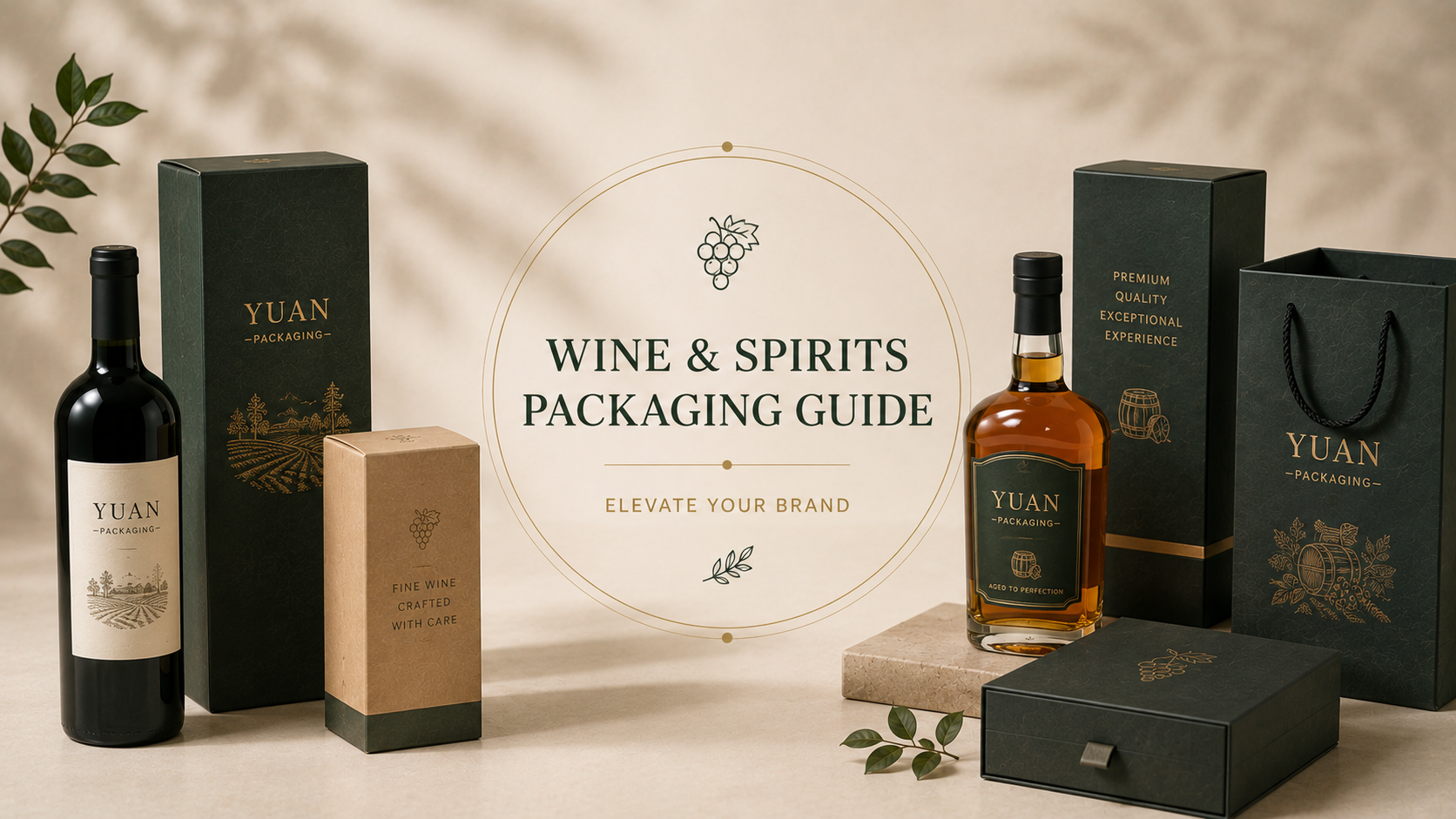
Wine and spirits is a category where packaging does an unusual amount of work. On a back-bar or a retail shelf, the label and the box carry the brand’s entire story — heritage, craft, and price positioning — in a single glance. Premium drinks buyers judge quality by the weight of a box and the texture of a label before they taste anything. This guide covers the main packaging components for wine and spirits, the materials and finishes that signal quality, and what to specify when briefing a manufacturer.
Table of contents
- What drinks packaging includes
- Labels: materials and printing
- Finishing for premium shelf presence
- Rigid presentation boxes
- Multi-bottle carriers and gift packs
- Labelling compliance
- Producing at volume
- How to brief a drinks packaging project
- Summary
- Frequently asked questions
What drinks packaging includes
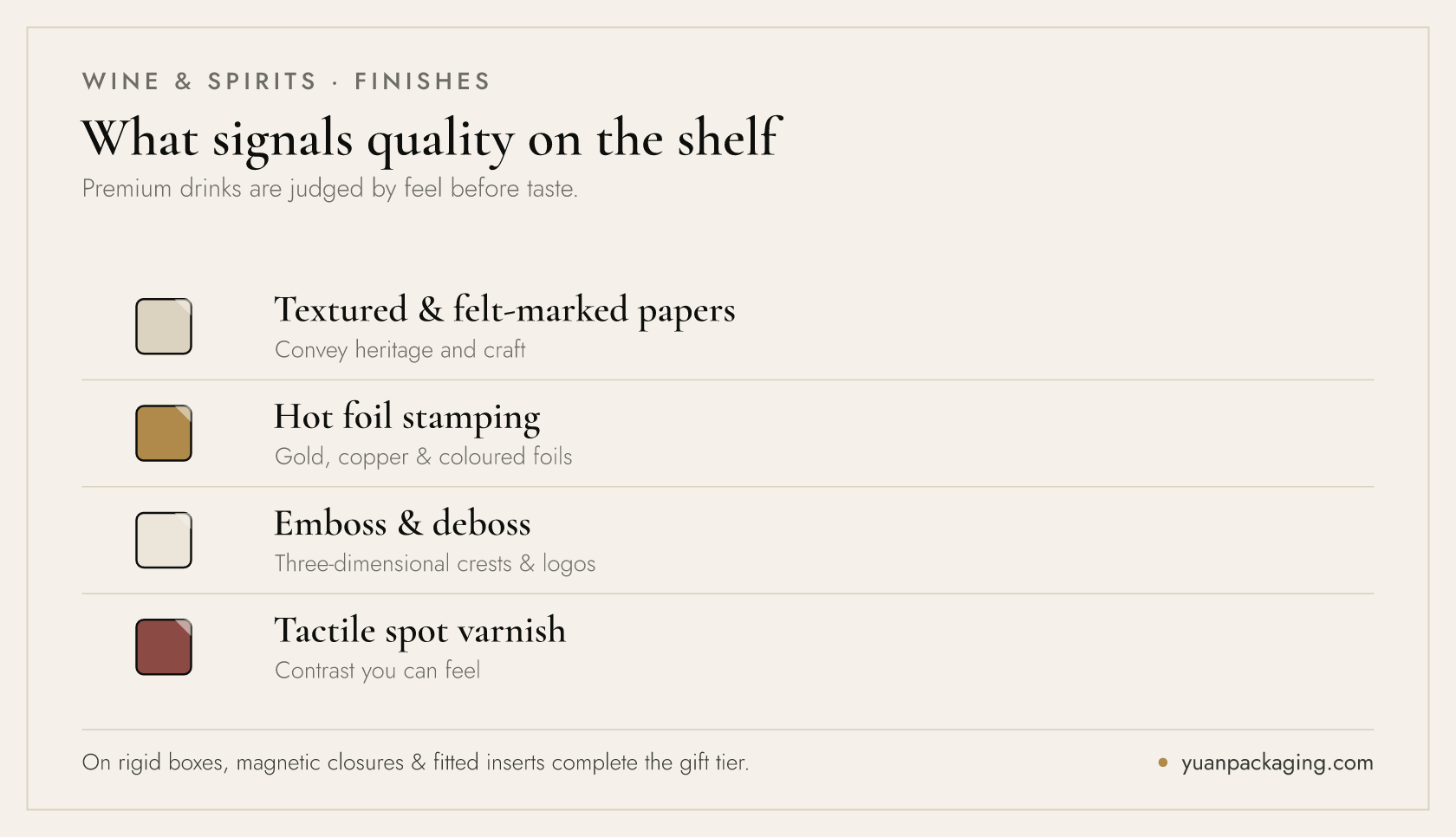
The packaging for a drinks brand spans several components. Labels — front and back, plus neck or shoulder labels — are the primary canvas. Rigid presentation boxes elevate a bottle into a gift or a premium tier. Multi-bottle carriers and gift packs serve retail promotions and travel-retail. And outer shipping cartons protect the product in transit. Each is an opportunity to reinforce the brand, and each has its own material and production considerations.
Labels: materials and printing
Labels are where most of the craft sits in wine and spirits. Material choice matters enormously: textured and felt-marked papers convey heritage; cotton and tactile stocks suggest craft and authenticity; metallised and clear films enable modern, high-impact looks. Because bottles are chilled, handled, and sometimes immersed in ice, wet-strength and water-resistant materials and adhesives are often essential — a label that curls or peels in an ice bucket undoes all the design work. Our label printing experience goes deeper on premium spirits labels specifically.
Finishing for premium shelf presence
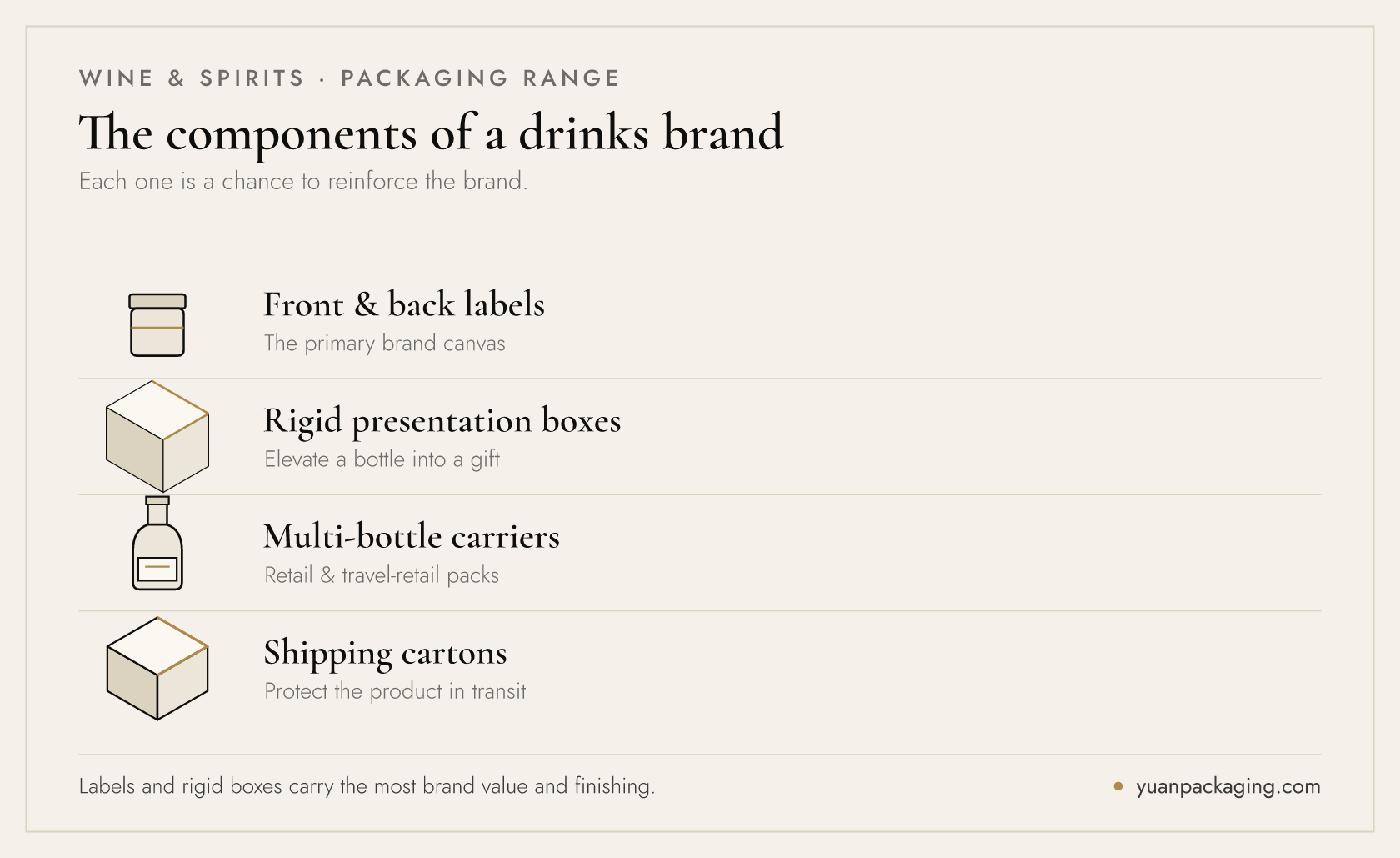
Finishing is what separates a premium spirit from a standard one on the shelf. Hot foil stamping in gold, copper, or coloured foils delivers the metallic shine associated with luxury; embossing and debossing add a tactile, three-dimensional quality to crests and logos; and tactile spot varnishes create contrast a customer feels as much as sees. On rigid presentation boxes, the same finishes plus magnetic closures and fitted inserts create the controlled, weighty unboxing that defines a gift-tier spirit.
Discuss your packaging project
Rigid presentation boxes
Rigid presentation boxes turn a bottle into a gift, and they follow the same principles as luxury rigid box construction: greyboard wrapped in specialty paper, with a fitted insert that holds the bottle securely and presents it well when opened. For spirits sold as gifts — whisky, cognac, premium gin — the box is often the deciding purchase factor, and the insert must be engineered to the exact bottle dimensions to avoid movement and damage.
Multi-bottle carriers and gift packs
Multi-bottle carriers and gift packs serve a different job: retail promotion, seasonal gifting, and duty-free. A well-engineered carrier protects two, three, or six bottles, presents them as a set, and survives handling — which means the structural design and board specification matter as much as the print. These are also where volume economics come in, as promotional and travel-retail programmes often run at significant scale.
Labelling compliance
Compliance is non-negotiable in drinks packaging. Alcohol labelling must carry the required information for each market — alcohol by volume, net contents, allergens, health and government warnings, and importer details — and these differ significantly between the EU, US, and other markets. Barcodes and, increasingly, traceability codes must scan reliably. As with cosmetics, getting regulatory content right at artwork stage avoids costly reprints and customs problems.
Producing at volume
Wine and spirits packaging frequently runs at volume — annual label programmes, seasonal gift-box runs, and travel-retail promotions all involve large, repeatable quantities. This is where a manufacturer’s scale matters: colour and foil must stay consistent across hundreds of thousands of labels and boxes, batch after batch. Our four production lines are built for high-volume drinks programmes, from a single premium gift box to multi-million-unit annual label runs, with the colour management that brand-critical packaging requires.
How to brief a drinks packaging project
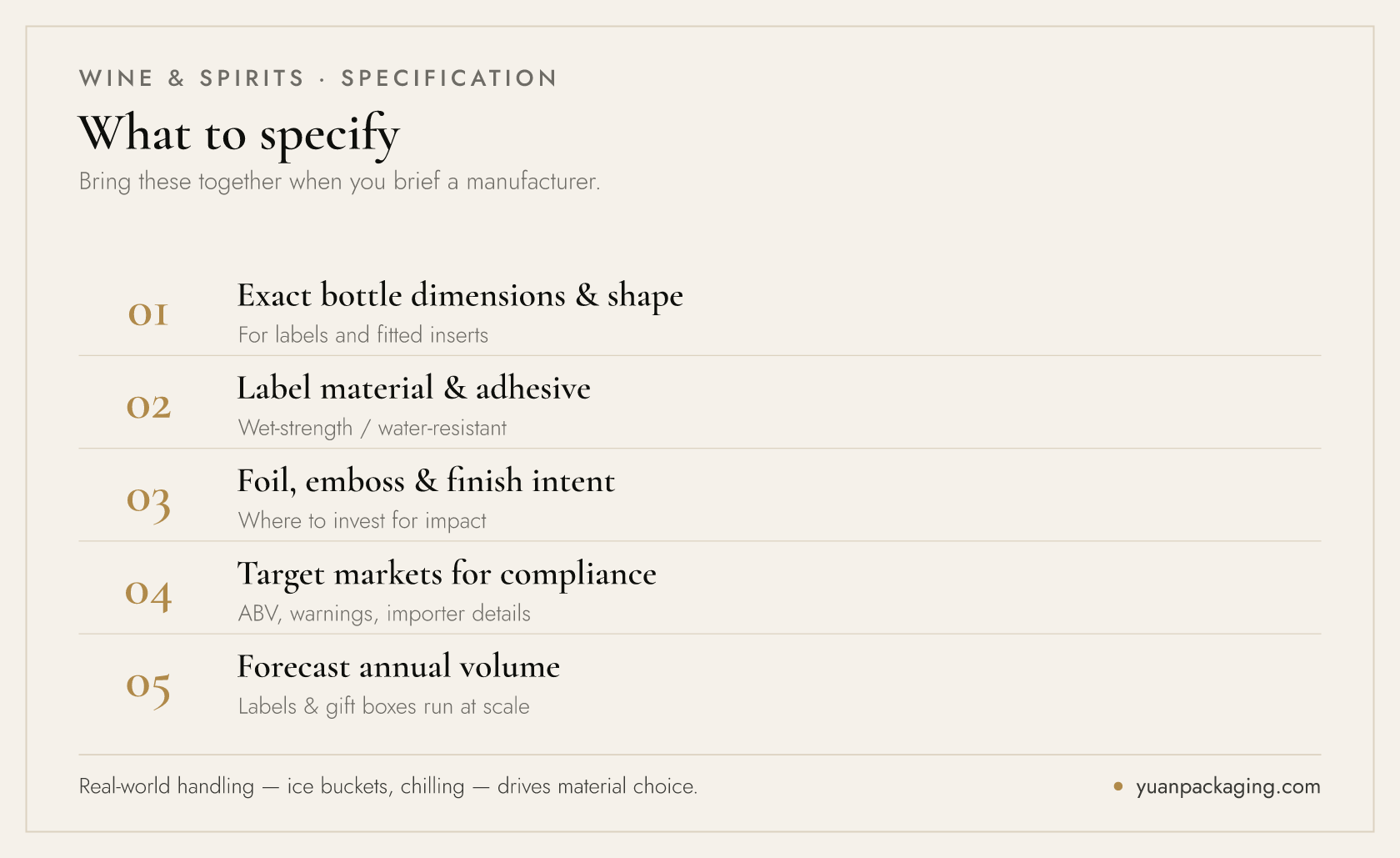
When briefing a drinks packaging project, provide the exact bottle dimensions and shape, the label material and finish intent, the foil and emboss requirements, your target markets for compliance, and your forecast annual volume. The earlier these come together, the better a manufacturer can advise on materials that survive real-world handling and finishes that deliver impact within your budget.
Summary
In short: wine and spirits packaging is judged by feel and finish, so material, foil, and structure carry the brand — and at volume, consistency is everything. Whether you need premium labels, rigid gift boxes, or multi-bottle carriers for a drinks range, tell us about your project and our team will help you specify packaging that performs on the shelf and at scale.
Frequently Asked Questions
What packaging do wine and spirits brands need?
Typically front and back labels (plus neck labels), rigid presentation boxes for gift tiers, multi-bottle carriers and gift packs for retail and travel-retail, and outer shipping cartons. Labels and rigid boxes carry the most brand value and finishing.
What label material is best for wine and spirits?
It depends on positioning: textured and felt-marked papers convey heritage, cotton and tactile stocks suggest craft, and metallised or clear films give a modern look. Because bottles are chilled and handled, wet-strength and water-resistant materials and adhesives are often essential.
What finishes make spirits packaging look premium?
Hot foil stamping in gold, copper or coloured foils, embossing and debossing for crests and logos, and tactile spot varnishes that create contrast you can feel. On rigid presentation boxes, magnetic closures and fitted inserts add the weighty, controlled unboxing of a gift-tier spirit.
Can you produce wine and spirits packaging at high volume?
Yes. Annual label programmes, seasonal gift-box runs and travel-retail promotions all run at scale, and our four production lines are built to hold colour and foil consistency across hundreds of thousands of labels and boxes — from a single premium gift box to multi-million-unit annual label runs.