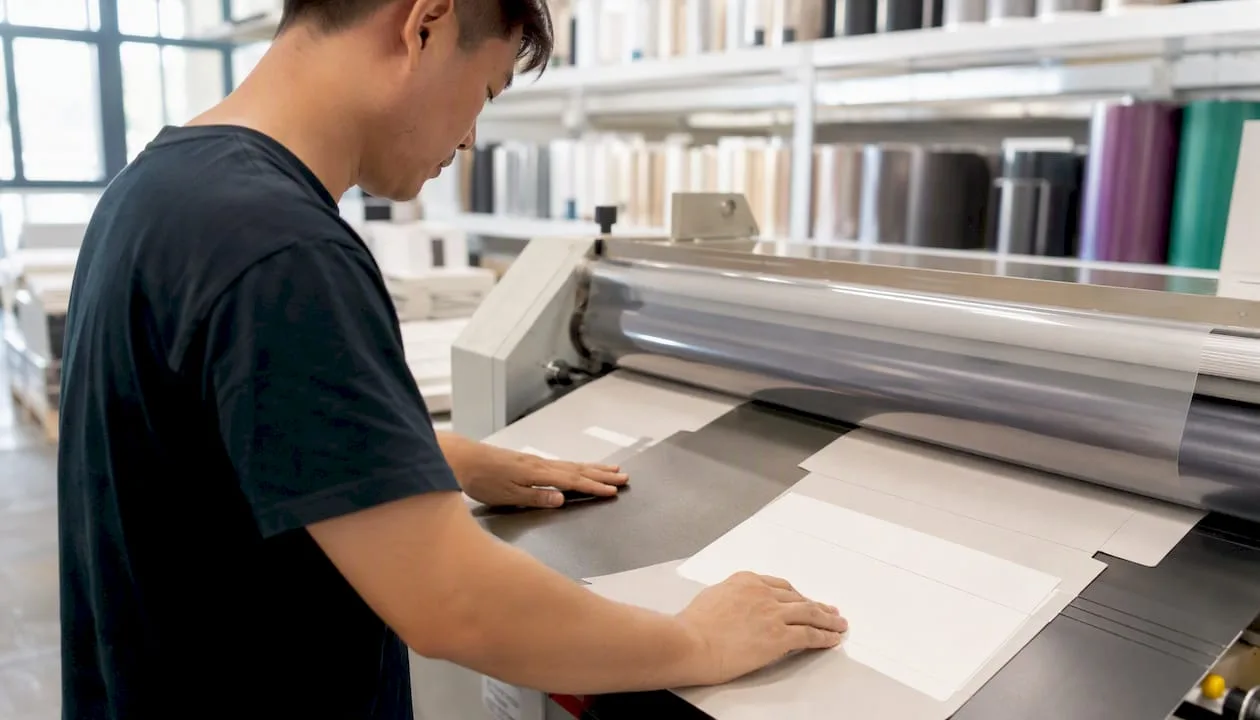
Soft touch lamination bonds a micro-textured BOPP or polyurethane-acrylic film to a printed substrate using heat and pressure, producing a velvety, suede-like surface and a deep matte visual effect. Specify it for premium packaging, high-touch retail collateral, and any application where tactile differentiation is part of the brand brief. The trade-offs are real: the finish attracts fingerprints more readily than gloss and is more susceptible to scuffing under abrasion, so it requires deliberate handling and substrate selection.
Soft touch lamination is not a drop-in replacement for standard matte. It is a deliberate brand tool that signals quality through touch before the consumer reads a single word on the pack.
When to specify it:
- Rigid boxes, folding cartons, and cosmetics packaging where unboxing experience drives perceived value
- Premium business cards, art-book covers, and high-end brochures where tactile warmth reinforces brand positioning
- Spirits and fragrance labels where shelf differentiation is the primary objective
When to reconsider: high-wear environments (shipping mailers, items handled with wet hands), applications requiring writability, or budgets that cannot absorb the film cost premium over standard matte.
Key Takeaways
Soft touch lamination delivers a velvety matte surface and deeper color appearance than standard matte, but requires precise substrate selection, adhesive matching, and a laminated drawdown approval before production.
| Point | Details |
|---|---|
| Film gauge range | Specify 12–30 microns for standard packaging; 43-micron variants suit high-rigidity applications. |
| Substrate selection | Coated stocks (C1S, SBS board) deliver more consistent adhesion and lower curl risk than uncoated. |
| Adhesion risk factors | Toner prints and aqueous coatings require high-strength adhesive or primer to prevent laminate failure. |
| Drawdown approval | Always approve a laminated color drawdown on production stock before signing off on a run. |
| Yuanpackaging capability | Yuanpackaging issues laminated drawdowns and produces soft touch combined with foil, emboss, and spot UV on rigid boxes and cartons. |
Table of Contents
- What does soft touch lamination actually involve?
- How does soft touch differ from standard matte lamination?
- What formats and specs must buyers include in an RFQ?
- How do coated and uncoated stocks behave under soft touch lamination?
- How is soft touch lamination applied, and what can go wrong?
- What drives cost, and how should buyers structure sample requests?
- How durable is soft touch lamination, and what are the sustainability considerations?
- When does soft touch work best with foil, emboss, and spot UV?
- What questions should buyers ask suppliers before approving a run?
- How Yuanpackaging specifies soft touch on a premium packaging run
- When to specify soft touch and when to choose an alternative
- Yuanpackaging’s soft touch lamination capabilities
- Sources
What does soft touch lamination actually involve?
Soft touch lamination applies a specialized film with a micro-textured surface to printed substrates. The film is activated by heat and pressure in a thermal laminator, bonding permanently to the substrate surface. The micro-texture scatters light, producing the matte visual effect, while the surface topography creates the characteristic velvet or suede feel.
Key technical specs at a glance
| Spec field | Typical range / value |
|---|---|
| Film type | BOPP with polyurethane-acrylic micro-texture coating |
| Film thickness | 12–30 microns (approx. 0.5–1.2 mil) for standard rolls; up to 43 microns for heavy-duty variants |
| Core size | 1-inch and 3-inch cores (confirm with supplier) |
| Adhesive type | Thermal hot-melt (standard); higher-strength grades for digital/toner prints |
| Laminator type | Thermal roll laminator (industrial); cold laminate versions available |
| Operating temperature | Typically 200–250°F (93–121°C); confirm per film spec |
| Sided application | Single-sided (most packaging); double-sided available |
Variants matter. Silk soft touch and matte soft touch differ in drag coefficient and sheen level. Silk variants produce a slightly higher sheen with less drag; matte variants are flatter and have more pronounced tactile resistance. Specify the variant explicitly in your tech pack.
Key spec callouts for a datasheet or RFQ:
- Film name and variant (e.g., “matte soft touch BOPP, 17 micron”)
- Side(s) to laminate (single or double)
- Core size and roll length
- Adhesive grade (standard or high-strength for toner/digital)
- Compatible laminator model or type
- Recommended temperature and pressure settings
How does soft touch differ from standard matte lamination?
The distinction is primarily tactile. Standard matte lamination delivers a visual matte effect with a smooth, flat surface. Soft touch adds a micro-texture layer that creates physical drag and warmth under the fingertip. The visual difference is subtler but measurable: soft touch absorbs more light and produces a deeper, richer color appearance than flat matte, particularly on dark backgrounds.
Finish comparison
| Property | Soft touch lamination | Standard matte lamination | Gloss lamination |
|---|---|---|---|
| Tactile effect | Velvety, suede-like drag | Smooth, no tactile texture | Smooth, slick |
| Visual effect | Deep matte, color-rich | Flat matte | High sheen, bright |
| Fingerprint visibility | Moderate (more than gloss) | Moderate | Low (wipes clean easily) |
| Scuff resistance | Lower than gloss | Moderate | High |
| Cost relative to matte | Higher | Baseline | Similar to matte |
| Premium perception | High | Moderate | Moderate to high |
Soft touch lamination reduces visible fingerprints compared with some finishes but is more susceptible to scuffing than high-gloss laminate. For packaging that will be handled repeatedly in retail environments, gloss or a durable matte may be the more practical choice.
The coating vs. laminate question also belongs here. Soft touch results can be achieved with an inline liquid coating or a laminate film. Coatings cost less and integrate into the press workflow, but film lamination typically delivers greater durability and more consistent tactile depth. For premium packaging where finish uniformity across a production run matters, film lamination is the more reliable specification.
What formats and specs must buyers include in an RFQ?
Soft touch film is available in two primary formats: roll-to-roll (thermal rolls for industrial laminators) and pre-cut pouches or sheets for office-grade thermal laminators.
Roll-to-roll format is standard for commercial packaging production. It offers consistent tension control, compatibility with high-speed industrial laminators, and the ability to laminate large sheet sizes. Pre-cut pouches (typically 3–5 mil, designed for office thermal laminators) are suitable for short-run proofing or low-volume applications but are not appropriate for production-scale packaging work.
Common film gauges
| Gauge | Microns | Typical application |
|---|---|---|
| Thin | 12–17 µm | Flexible packaging, labels, lightweight cartons |
| Standard | 17–25 µm | Folding cartons, book covers, brochures |
| Heavy | 25–30 µm | Rigid box wraps, premium covers |
| Extra heavy | 43 µm | High-rigidity applications, demanding print types |
Presco lists specific roll widths, lengths, and a 43-micron variant, and recommends Level 7 (higher-strength) adhesive for challenging print types including heavy digital toner coverage. Confirm core size (1-inch vs. 3-inch) with your laminator manufacturer before ordering.
RFQ spec fields to include:
- Film name, variant, and gauge (microns and mils)
- Roll width and length (or pouch dimensions)
- Core size
- Adhesive grade
- Side(s) to laminate
- Laminator type (thermal roll, cold)
- Substrate type and grammage
- Any downstream finishes (foil, emboss, spot UV)
How do coated and uncoated stocks behave under soft touch lamination?
Stock selection is one of the most consequential decisions in a soft touch specification. Coated papers deliver sharper images because ink sits on the surface; uncoated papers absorb ink and produce a warmer, more tactile appearance. Both can accept soft touch lamination, but they behave differently in production.

Coated stocks (C1S, C2S, SBS board) offer better ink holdout, lower curl risk, and more predictable laminate adhesion. They are the standard substrate for premium folding cartons and rigid box wraps. Uncoated stocks laminate successfully but require careful drying and may need a primer coat to prevent adhesion failure, particularly with aqueous inkjet or heavy toner coverage.
Substrate and ink compatibility notes:
- Toner-based digital prints can crack under lamination if ink is not fully fused; confirm cure time and fusing temperature with the print provider before laminating
- Aqueous coatings applied inline can interfere with laminate adhesion; specify “no aqueous coating” or use a lamination-compatible primer
- Heavy solids and metallic inks on uncoated stock may mottle; request a laminated drawdown before approving production
- Grammage below 250 gsm on large sheet sizes increases curl risk; specify heavier board or use double-sided lamination to balance tension
Coated stocks are the recommended choice for image-heavy pieces requiring sharp detail; uncoated or soft-touch laminated stocks suit applications where tactile warmth and a more organic surface quality are the design intent.
Pro Tip: Request a laminated color drawdown on the actual production stock before approving a run. Soft touch deepens color appearance, and what looks correct on an unlaminated proof will read differently after the film is applied.
How is soft touch lamination applied, and what can go wrong?
The production sequence for a soft touch laminated piece runs: print, dry or cure fully, laminate (heat and pressure activation), then trim and finish. Each stage has failure points.
Standard production workflow
- Print the substrate and allow full ink or toner cure (confirm drying time with the print provider).
- Feed stock into the thermal laminator at the film manufacturer’s recommended temperature (typically 200–250°F) and pressure settings.
- Run a test strip at the start of each job to verify adhesion, sheen uniformity, and absence of wrinkles.
- Trim laminated sheets to final dimensions; allow the laminate to cool and stabilize before die-cutting.
- Apply downstream finishes (foil stamp, emboss, spot UV) in the correct sequence.
Common defects and corrections
- Blocking: sheets sticking together after lamination; reduce temperature or increase cooling time before stacking
- Edge lifting: adhesion failure at sheet edges; increase nip pressure or check substrate moisture content
- Wrinkles: film tension too high or substrate moisture uneven; adjust web tension and check stock conditioning
- Sheen banding: uneven temperature across the nip roller; recalibrate roller temperature profile
- Toner cracking: insufficient fusing or incompatible adhesive; switch to high-strength adhesive grade and confirm fusing temperature
Downstream finish compatibility requires testing. Foil stamping on soft touch laminate is widely used, but adhesion varies by foil type and laminate brand. Always run a foil adhesion test on a laminated drawdown before committing to production. Spot UV applied over soft touch requires a UV-compatible primer; without it, the UV coating may peel. Embossing works well on soft touch and enhances the tactile contrast between raised and flat areas.
Pro Tip: Include pass/fail criteria for abrasion resistance and visual uniformity in the purchase order. A simple tape-pull test and a 50-rub abrasion check on a production sample will catch adhesion and scuff issues before the full run ships.
What drives cost, and how should buyers structure sample requests?
Film gauge, roll length, custom widths, and minimum order quantities are the primary cost variables. Thicker films cost more per square foot and require higher laminator temperatures. Custom roll widths (non-standard sizes) typically carry a setup surcharge. Additional finishing steps (foil, emboss) add cost per unit but are often specified together with soft touch on premium packaging.
Primary cost drivers:
- Film gauge (thicker = higher material cost)
- Roll length and width (standard widths are less expensive)
- Minimum order quantities (MOQs vary by supplier; confirm before quoting)
- Adhesive grade (high-strength grades carry a premium)
- Downstream finishes added to the same run
Typical lead time ranges:
- Swatch samples: 3–7 business days from most suppliers
- Laminated proofs on customer-supplied stock: 5–10 business days
- Production runs: 15–30 business days depending on volume and finishing complexity
How to request samples effectively
- Specify the exact film variant, gauge, and adhesive grade in the sample request.
- Supply the actual production stock (same grammage, coating, and ink coverage) for the laminated proof.
- Request a laminated color drawdown alongside the swatch so color shift under the film is visible.
- Ask for the supplier’s recommended laminator settings (temperature, speed, pressure) with the sample.
- Confirm shelf life of the film roll and storage conditions (temperature, humidity) at the time of sample delivery.
Sample request language for RFQs:
How durable is soft touch lamination, and what are the sustainability considerations?
Soft touch lamination adds meaningful protection over unlaminated stock but sits below high-gloss laminate in abrasion resistance. The finish is more susceptible to scuffing than gloss laminate, and fingerprints are more visible than on a gloss surface, though less so than on standard matte. For retail packaging handled repeatedly, set realistic expectations with the client and specify handling instructions on the inner carton.
Durability profile:
- Scuff resistance: moderate (lower than gloss, higher than unlaminated)
- Fingerprint visibility: moderate; wipes clean with a dry cloth
- Moisture resistance: good; the film provides a barrier against light moisture exposure
- Writability: none; the laminate surface does not accept most inks or ballpoint pens
Sustainability considerations:
Laminated board is more difficult to recycle than unlaminated board because the film must be separated from the fiber. This is a real end-of-life consideration for brands with recycling commitments. Steps to take:
- Request FSC-certified substrate from your supplier; this covers the paper component of the laminated product
- Ask whether the adhesive is solvent-free; solvent-free formulations reduce VOC emissions during production
- Confirm whether the film is recyclable as a mono-material or requires separation at a specialist facility
- For brands with active sustainability programs, evaluate whether a soft touch coating (rather than a film laminate) better aligns with recyclability goals, noting that coatings generally offer lower durability than film lamination
Yuanpackaging’s eco-friendly packaging capabilities include FSC-certified substrates and solvent-free adhesive options for clients with sustainability requirements.
When does soft touch work best with foil, emboss, and spot UV?
Soft touch lamination performs best as part of a finish combination rather than as a standalone treatment. The matte surface creates a neutral base that makes contrast finishes read more dramatically.
The most effective pairing for quiet luxury is matte soft touch combined with matte or satin foil and blind emboss. The foil catches light against the flat matte ground; the emboss adds a second tactile layer. This combination is standard on premium rigid boxes for cosmetics, spirits, and fragrance.
High-impact finish combinations:
- Soft touch + matte foil + blind emboss: maximum tactile and visual hierarchy, appropriate for rigid boxes and premium cartons
- Soft touch + spot UV: gloss accents on a matte ground create strong contrast; protect spot UV areas from laminate adhesion failure by using a UV-compatible primer
- Soft touch + gloss foil: higher contrast than matte foil; suits brands with a more contemporary or bold aesthetic
Product categories where these combinations deliver the highest perceived value: rigid boxes for cosmetics and spirits, folding cartons for premium food and fragrance, and art-book covers.
Pro Tip: Prefer matte or satin-finish foils on soft touch surfaces. Gloss foil on soft touch reads well, but matte foil on a soft touch ground produces a more cohesive, restrained luxury effect that photographs better for e-commerce and editorial use.
For detailed guidance on foil sequencing and adhesion testing, see Yuanpackaging’s foil stamping guide.
What questions should buyers ask suppliers before approving a run?
A structured supplier checklist reduces production risk and makes quotes directly comparable. The following items should appear in every RFQ and pre-production approval process.
Supplier checklist:
- Film spec: name, variant, gauge (microns and mils), adhesive grade
- Shelf life of the film roll and recommended storage conditions
- Compatible laminator models and recommended temperature/pressure/speed settings
- Sample availability: can the supplier provide a laminated drawdown on customer-supplied stock?
- MOQ for standard and custom roll widths
- Lead time for samples and production quantities
- Warranty or quality guarantee on finish uniformity and adhesion
Quality benchmarks to request:
- Laminated color drawdown on production stock (same ink coverage, same substrate)
- Abrasion test result (number of rubs before visible scuffing)
- Tape-pull adhesion test on a laminated sample
- Production-run sample approval process (who signs off, at what stage)
Sample email template for foil and emboss compatibility
- State the film variant, gauge, and adhesive grade you are evaluating.
- Describe the downstream finishes: foil type (matte/gloss/holographic), emboss depth, spot UV coverage percentage.
- Ask explicitly: “Has this film been tested with [foil brand/type]? What adhesion results were observed?”
- Request a combined swatch: soft touch laminate + foil stamp on the production substrate.
- Confirm whether a primer is required for spot UV adhesion over this film.
How Yuanpackaging specifies soft touch on a premium packaging run
A representative production scenario: a cosmetics brand requires a rigid box with soft touch lamination, matte foil logo, and blind emboss on the lid panel. The substrate is 1,200 gsm greyboard wrapped in 128 gsm C1S art paper.
Yuanpackaging’s production process for this specification:
- Issue a laminated color drawdown on the actual C1S wrap stock before production approval; the drawdown includes the full ink coverage and is laminated with the specified film variant and gauge
- Confirm laminator settings (temperature, nip pressure, web speed) against the film manufacturer’s datasheet and run a test strip at job start
- Apply soft touch lamination to the wrap stock before foil stamping; foil is applied after lamination in the correct sequence to ensure adhesion
- Blind emboss is applied after foil stamping using a registered die; emboss depth is confirmed on the drawdown sample
- QC checkpoints: adhesion tape-pull after lamination, color comparison against approved drawdown, foil adhesion check, emboss registration check, final visual inspection under controlled lighting
Swatch and approval policy: Yuanpackaging issues laminated swatches and drawdowns as part of the pre-production approval process. Each swatch is logged against the job specification, and production does not proceed without written client sign-off on the laminated drawdown.
Specifying soft touch without a laminated drawdown on the production stock is the single most common source of color and finish disputes in premium packaging. The film changes how color reads. Approve the laminated proof, not the flat print proof.
When to specify soft touch and when to choose an alternative
Soft touch lamination is the right specification when tactile differentiation is a primary brand objective and the packaging will be handled in a controlled retail or gifting context. Cosmetic packaging, spirits cartons, premium rigid boxes, and high-end retail bags all benefit from the finish. The unboxing experience is measurably different, and the perceived quality signal is immediate.
There are situations where alternatives perform better. High-wear environments, such as shipping mailers or packaging handled with wet hands, are better served by high-gloss lamination, which offers superior scuff resistance and wipes clean more easily. Applications requiring writability (e.g., labels that need to be written on, pharmaceutical cartons with variable data fields) cannot use soft touch laminate. Where budget is constrained and tactile depth is secondary, a standard matte laminate or a durable matte varnish delivers acceptable results at lower cost.
Varnish solutions are worth considering when recyclability is a hard requirement. A soft touch coating applied inline avoids the film separation issue at end of life, though the tactile effect is less pronounced and durability is lower than film lamination.
Yuanpackaging’s soft touch lamination capabilities
Yuanpackaging produces soft touch laminated rigid boxes, folding cartons, and premium labels for beauty, spirits, and lifestyle brands. The production workflow covers the full specification: laminated drawdowns on customer stock, foil stamping in the correct post-lamination sequence, blind emboss, and spot UV combinations. MOQs and lead times are confirmed at the quoting stage based on substrate, gauge, and finishing complexity.
The next step is straightforward: submit your substrate details, film variant preference, and downstream finish requirements, and Yuanpackaging will issue a laminated swatch and a production quote. Request a drawdown on your actual production stock before approving any run. Contact Yuanpackaging at Yuanpackaging to start the process.
Sources
The following resources provide technical datasheets, specification ranges, and comparative guidance for soft touch lamination and substrate selection.
- Soft-Touch Lamination for Premium Print Products | QinPrinting
- What Is Soft Touch Lamination and Why It So Popular in Premium Packaging? - Sinstar
- Soft Touch Coating vs Soft Touch Lamination, A Complete Guide to Finishing Options - Emenac Packaging AU
- Coated vs uncoated paper: when to use which - Domtar