Custom Printed Regular Slotted Cases
The conventional corrugated transit case, specified around units per case, stacking, the journey and the information the shipper must carry.
At a glance
- Minimum order quantity
- Standard cartons from 1,000 units
- Sampling
- Presentation-quality sample in 5–7 working days. The sample cost is credited against your first approved production order.
- Production lead time
- 15–20 working days after artwork approval
- Delivery to Europe
- DDP or DAP to the EU and the UK, DDP to Switzerland; your customs broker confirms duty and VAT rates
- Production
- Made to order (OEM/ODM)
- Country of origin
- Huai'an, Jiangsu, China
- Transit Case Format
Overview
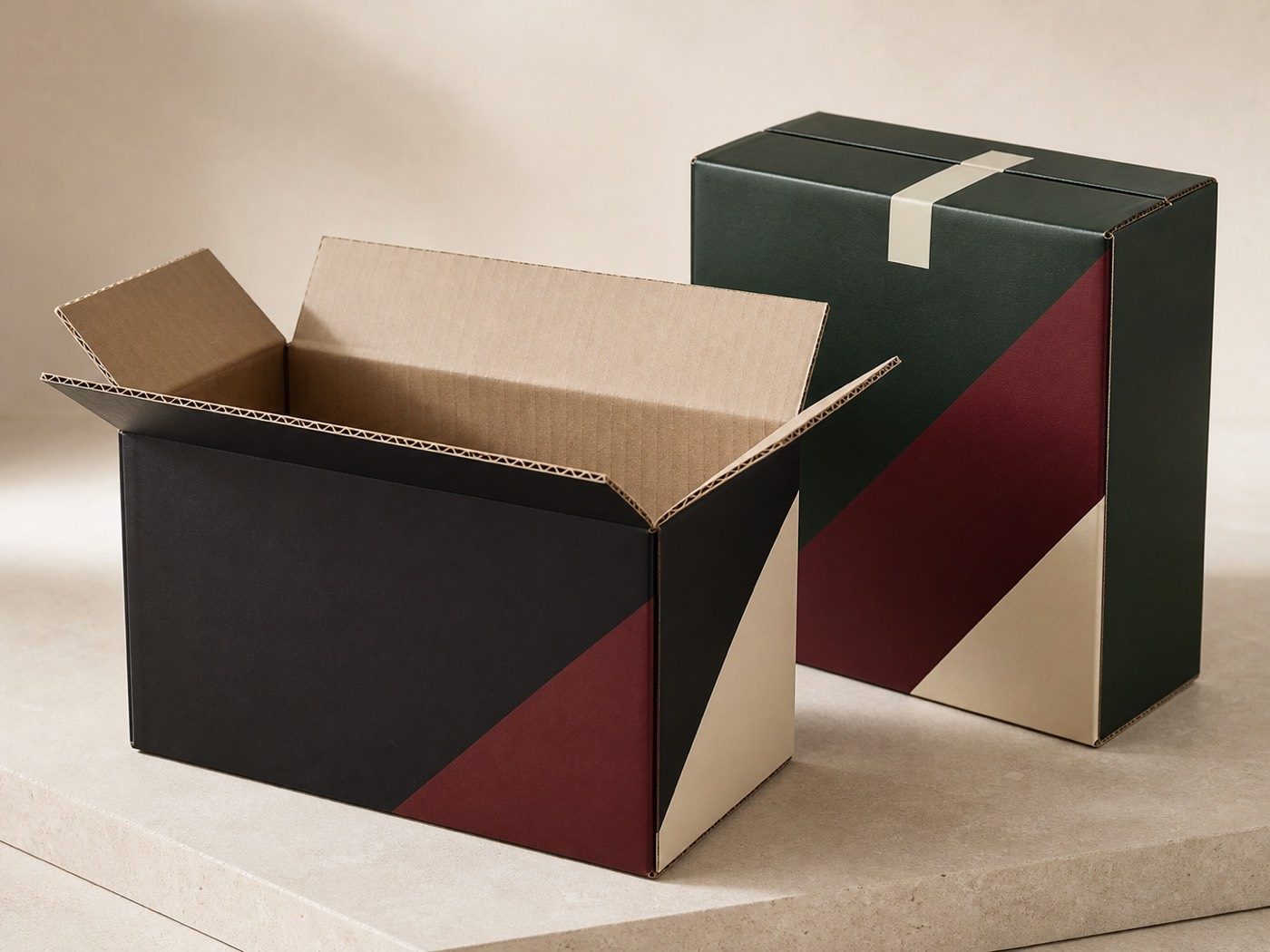
The regular slotted case is the workhorse outer carton: a rectangular corrugated case whose closing flaps meet to form the top and bottom. Its value is efficiency and predictability, but the useful specification still begins with the contents — product dimensions, units per case, total load and the route the packed case will travel.
Because an RSC is usually a transport surface before it is a retail surface, direct print is commonly used for brand, batch, storage and handling information. Where the case will also be seen by the customer, the print decision can be reviewed against the more presentation-led litho-laminated formats in the same family.
An RSC is cut and slotted from one sheet: four wall panels in a row, a joint flap that is glued to close the body, and at each end four flaps of the same depth. That depth is half the case width, so the two outer flaps meet in the middle while the two inner flaps sit underneath without meeting. Only the joint is closed at the factory; the case travels flat and is sealed with tape, glue or staples when it is packed. Because the flaps come from the same sheet as the walls, very little board is wasted, but the gap between the inner flaps means the closure depends on the outer flaps and whatever seals them.
What to decide for this format
Case Count & Internal Size
Fix how many units travel together and their orientation before calculating the case dimensions.
Transit Information
Define the brand, batch, storage, handling and shipping-mark information that must remain legible through distribution.
Slotted Case or Die-Cut Mailer
An RSC uses board efficiently, stacks squarely on pallets and usually needs no cutting die, but it is taped shut and opens plainly. A die-cut mailer needs its own die and more board per unit, and closes without tape; choose the RSC for warehouse and retail deliveries, or as a plain outer shipper around a retail box, and the mailer when the box itself is what the customer opens.
Across the Corrugated & E-Commerce Boxes range
This page covers what is particular to this product. The full lists for the whole range are set out once, on the Corrugated & E-Commerce Boxes page:
What applies to this product
- Materials
- Single-Wall Corrugated; Double-Wall Corrugated; Kraft Liners; Recycled & FSC-Certified Board
- Printing & Finishes
- Flexo Printing
- Applications
- Spirits & Beverage; Pharmaceutical & Industrial
- How it is made
- Product, load & transit review; Structure & cube optimisation; Print method decision; Sampling; Printing, laminating & gluing; Inspection & dispatch
What you can customise
- Internal dimensions calculated from the product and how many go in a case
- Board grade and wall construction against stacking and transit
- Print method — litho-laminated, flexo, or plain
- Shipping marks, carton counts and pallet configuration
Specifications
| Minimum order quantity | Standard cartons from 1,000 units |
|---|---|
| Production lead time | 15–20 working days after artwork approval |
| Converting line | Fully automated line integrating printing, laminating and gluing |
| Print processes | Offset litho-lamination on the Rapida 106; six-colour flexo and water-based printing for direct liner print |
Terms for this specification
- Sampling
- Presentation-quality sample in 5–7 working days. The sample cost is credited against your first approved production order.
- Colour matching
- Pantone references and physical samples are used where the selected print process supports them. The approval method follows the substrate, artwork and process.
- Certifications
- ISO 9001, ISO 14001:2015, ISO 45001 and China Environmental Labelling (Ten-Ring). ISO 22000 applies to eligible food-contact work.
- Sustainable options
- FSC-certified or recycled-content paper and board, water-based inks and adhesives, and fibre-based fitments are available where the selected construction supports them.
Design & artwork
From an artwork check, through a dimensioned dieline and print-ready files, to a full concept package across a range — done by the factory that will make it.
Frequently asked questions
What information should be supplied before the RSC is drawn?
Provide the product dimensions, weight, units per case, packing orientation, stacking conditions and journey. Those inputs determine the case size and the board recommendation before artwork or shipping marks are placed. For the quote, add the country the empty cases are delivered to and, for the EU or the UK, whether you want DDP or DAP.
Can the outer case match the packaging inside it?
Yes. The corrugated case and the retail packaging inside it are produced on the same site, so dimensions, carton count, colour references and shipping information can be reviewed as one specification.
Should the case be single-wall or double-wall?
It follows the weight in each case, how high the cases are stacked and for how long, and the route: a long sea journey with warehouse storage asks more of the board than a short road delivery. Send those details and a construction is proposed; if you or your retailer specify a compression or drop test for the packed case, send it with the enquiry so the board is chosen against it.
Can the case carry brand artwork as well as shipping marks?
Yes. Direct print on the liner suits logos, line artwork and text; graphics that need retail print quality usually move to a litho-laminated case instead. Leave clear areas for the shipping labels and barcodes added at packing, and tell us whether the case is stored upright or on its side, so the print reads the right way.
From the Journal
Related products
Request a custom packaging quote
What to send for a quote
- The product it is for, and the format you have in mind
- Size as length × width × height, and whether those are inside or outside dimensions
- Quantity, or two or three quantities if you want to compare unit prices
- Material and finish preferences, or the look you are after
- Artwork status: print-ready files, a draft, or nothing yet
- The date you need the goods by
- The destination country
Missing some of these? Send what you have, and we will ask about the rest.