Custom Crash-Lock Base Cartons
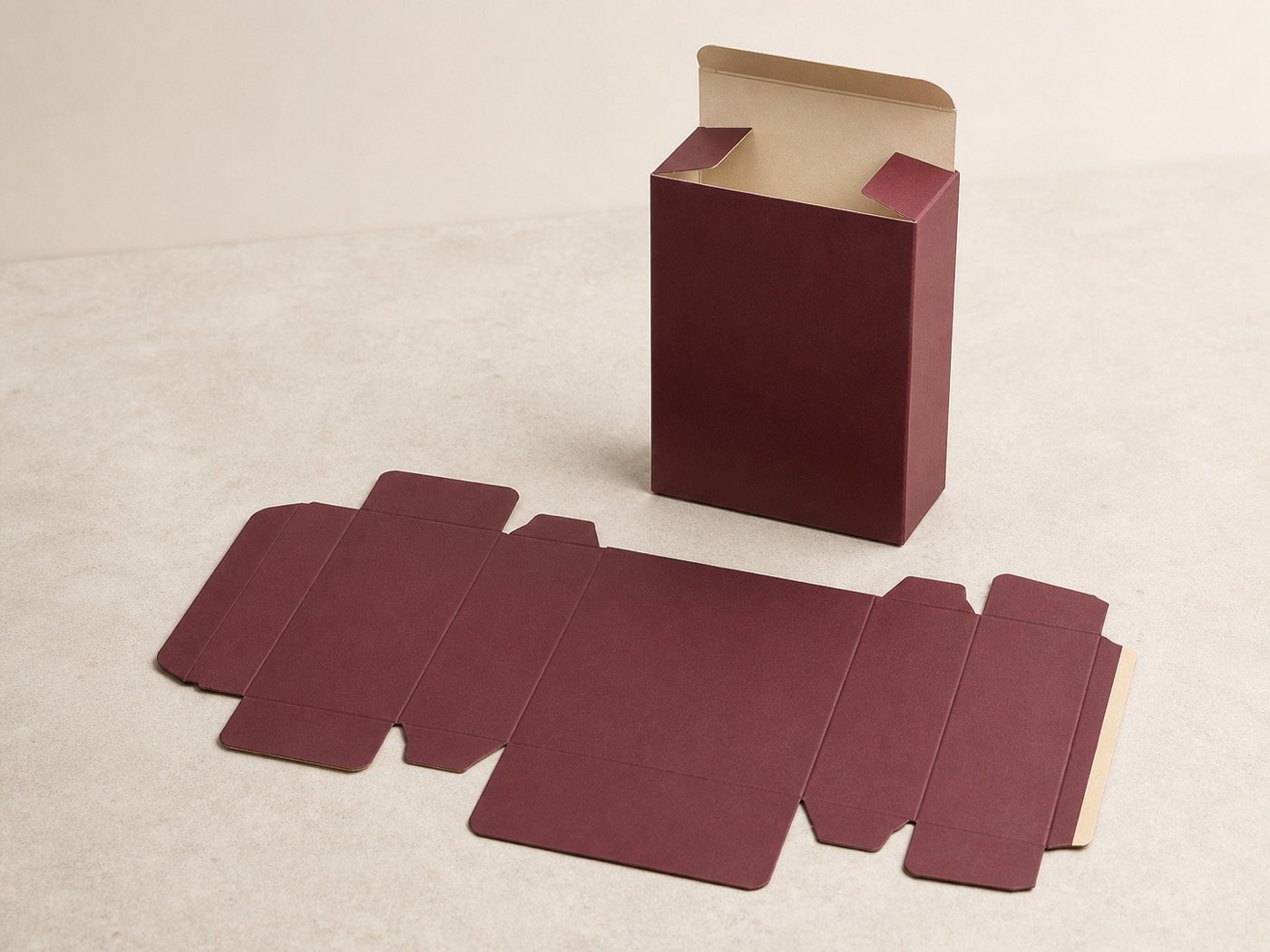
A folding carton whose pre-glued base opens into position with the body, reducing a separate bottom-closing step during packing.
At a glance
- Minimum order quantity
- Standard cartons from 1,000 units
- Sampling
- Presentation-quality sample in 5–7 working days. The sample cost is credited against your first approved production order.
- Production lead time
- 15–20 working days after artwork approval
- Delivery to Europe
- DDP or DAP to the EU and the UK, DDP to Switzerland; your customs broker confirms duty and VAT rates
- Production
- Made to order (OEM/ODM)
- Country of origin
- Huai'an, Jiangsu, China
- Pre-Glued Locking Base
Overview
A crash-lock base adds folding and gluing work at the converting stage so the packer has less to do later. When the flat carton is opened, the pre-glued bottom panels move into their locked position instead of being folded one flap at a time. That makes the format useful when repeated hand erection is a meaningful part of the packing operation.
The base is not selected in isolation. Product footprint, weight, loading direction and the amount of pressure used during packing all affect the dieline and crease behaviour. The erected sample therefore needs to be judged with the real product inside, not only for appearance but for whether the base opens cleanly and stays square.
The base is built from four flaps, one hinged to each body panel. Two of them carry glue areas that are bonded to their neighbours while the carton is still flat, so the folded base lies inside the collapsed tube. When the body is squared, the glued flaps swing the others round until they overlap and lock into a floor, and nothing is folded by hand. The top usually closes with a tuck flap and dust flaps, so the format pairs a self-forming bottom with a conventional, reclosable top. Glue position and crease depth on the base are what make it open cleanly, which is why both are checked on the made-up sample.
What to decide for this format
Packing Method
Confirm who erects and fills the carton, in which direction the product enters, and where handling time is currently spent.
Loaded Base Behaviour
Review the base on a made-up sample with the actual product so opening, squareness and closure are assessed under load.
Crash-Lock or Hand-Folded Lock Bottom
A hand-folded lock bottom needs no pre-gluing, so converting is simpler, but every base takes several folds at packing. A crash-lock base moves that work into converting and erects in one movement; choose it when cartons are packed in volume and the saved folding outweighs the extra gluing.
Across the Folding Cartons range
This page covers what is particular to this product. The full lists for the whole range are set out once, on the Folding Cartons page:
What applies to this product
- Materials
- Coated Board; Kraft & Uncoated Board; FSC-Certified & Recycled Board; Specialty Papers
- Printing & Finishes
- Offset Printing; Matte, Gloss & Soft-Touch Lamination; Hot Foil Stamping; Embossing & Debossing; Spot UV; Die Cutting, Creasing & Gluing
- Applications
- Beauty & Skincare; Pharmaceutical; Food & Confectionery; Retail & E-Commerce
- How it is made
- Structure & dieline; Artwork on dieline; Sampling; Offset printing; Lamination & finishing; Die cutting, creasing & gluing; Inspection & export packing
What you can customise
- Structure and dieline developed for your product and packing method
- Board type, grade and thickness
- Print — CMYK plus Pantone spot colours
- Lamination, foil, emboss and spot UV combination
- Crash-lock or straight-glued base for line packing
- FSC-certified or recycled board with water-based inks
- Export carton count, labelling and pallet configuration
Specifications
| Minimum order quantity | Standard cartons from 1,000 units |
|---|---|
| Production lead time | 15–20 working days after artwork approval |
| Printing | Koenig & Bauer Rapida 106 eight-colour offset — 0.1 mm register at 18,000 sheets per hour |
| Converting | Fully automated line integrating printing, laminating and gluing |
| Food-contact capability | ISO 22000 food-safety certified for food and beverage packaging work |
Terms for this specification
- Sampling
- Presentation-quality sample in 5–7 working days. The sample cost is credited against your first approved production order.
- Colour matching
- Pantone references and physical samples are used where the selected print process supports them. The approval method follows the substrate, artwork and process.
- Certifications
- ISO 9001, ISO 14001:2015, ISO 45001 and China Environmental Labelling (Ten-Ring). ISO 22000 applies to eligible food-contact work.
- Sustainable options
- FSC-certified or recycled-content paper and board, water-based inks and adhesives, and fibre-based fitments are available where the selected construction supports them.
Design & artwork
From an artwork check, through a dimensioned dieline and print-ready files, to a full concept package across a range — done by the factory that will make it.
Frequently asked questions
When is a crash-lock base worth choosing?
It is most useful when cartons are erected repeatedly by hand and closing a conventional bottom would add a separate operation. The saving depends on the real packing method, so the decision should be made after comparing made-up samples rather than from the dieline alone.
Does a crash-lock carton still ship flat?
Yes. The base is pre-glued during converting and the carton is collapsed for delivery. When opened for packing, the folded base panels move back into their working position.
What do you need to quote a crash-lock carton?
The product dimensions and weight, how the carton is filled and from which end, the board and print you have in mind, two or three quantities, and the delivery country (for the EU or the UK, also whether you want DDP or DAP). If the cartons will be erected or filled on equipment, tell us which, so the base and glue positions can be checked against it at sampling.
Is a crash-lock base stronger than a tuck-end bottom?
It usually carries more weight, because the floor is formed from overlapping glued flaps rather than a single tucked panel. The real limit still depends on the board, the carton footprint and the product, so the base is judged on a sample loaded with the actual product before artwork is approved.
From the Journal
Related products
Request a custom packaging quote
What to send for a quote
- The product it is for, and the format you have in mind
- Size as length × width × height, and whether those are inside or outside dimensions
- Quantity, or two or three quantities if you want to compare unit prices
- Material and finish preferences, or the look you are after
- Artwork status: print-ready files, a draft, or nothing yet
- The date you need the goods by
- The destination country
Missing some of these? Send what you have, and we will ask about the rest.