Custom Tuck-End Folding Cartons
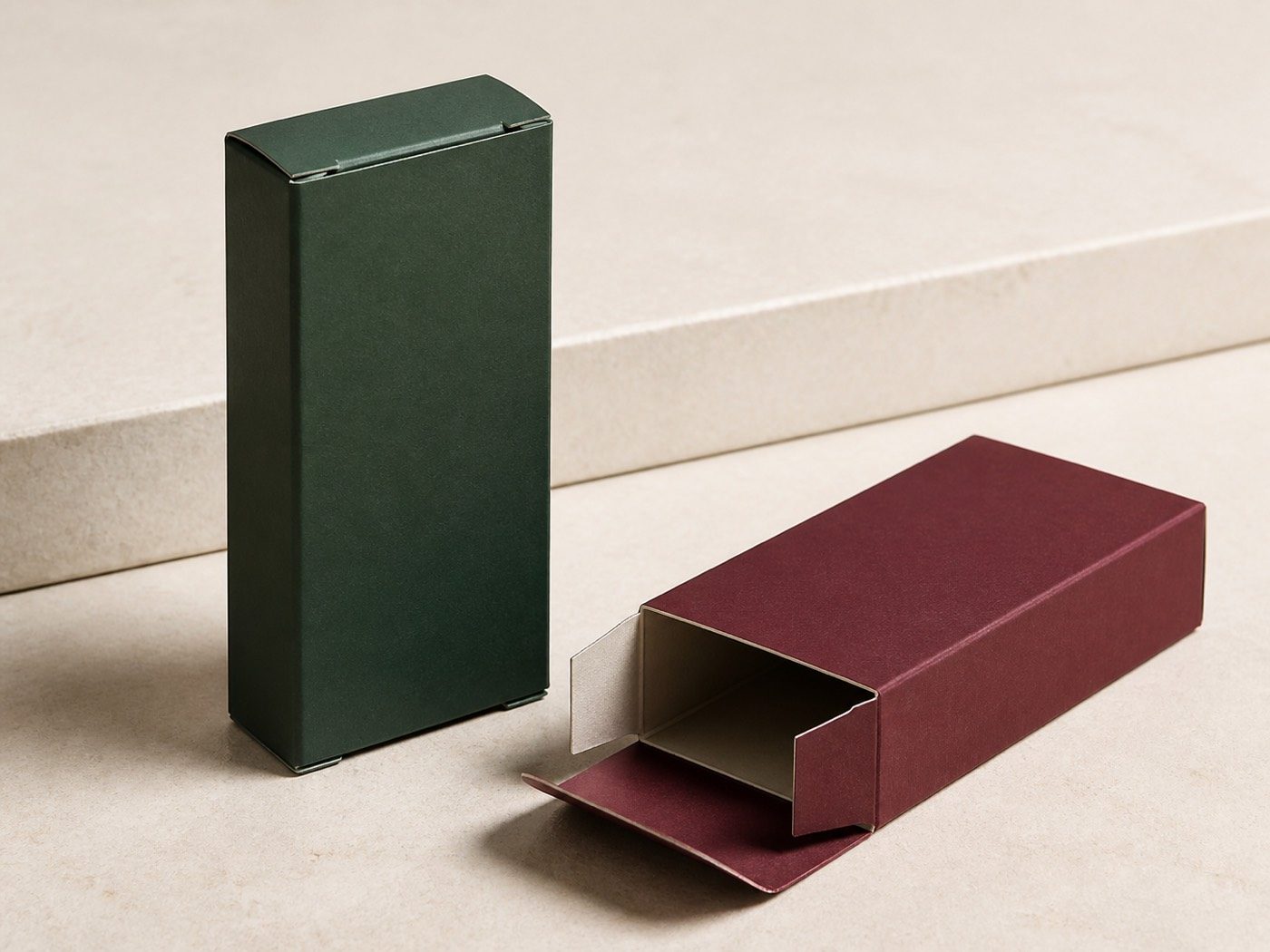
A compact folding carton with tuck-in end flaps, developed around the product, the artwork and the way the pack will be filled.
At a glance
- Minimum order quantity
- Standard cartons from 1,000 units
- Sampling
- Presentation-quality sample in 5–7 working days. The sample cost is credited against your first approved production order.
- Production lead time
- 15–20 working days after artwork approval
- Delivery to Europe
- DDP or DAP to the EU and the UK, DDP to Switzerland; your customs broker confirms duty and VAT rates
- Production
- Made to order (OEM/ODM)
- Country of origin
- Huai'an, Jiangsu, China
- Straight or Reverse Tuck
Overview
Tuck-end cartons are the standard starting point for small retail packs because they use a simple flat blank, arrive already side-glued and can be opened and closed without a separate lid. The important choice is not the name of the style but how its top and bottom flaps relate to the front panel, the glue seam and the way the product enters the box.
The dieline is developed around the actual bottle, tube, jar, blister or other product rather than a nominal outside size. Panel widths, crease positions and the available artwork area are reviewed together, then a cut and creased sample is folded with the product inside before the print layout is approved.
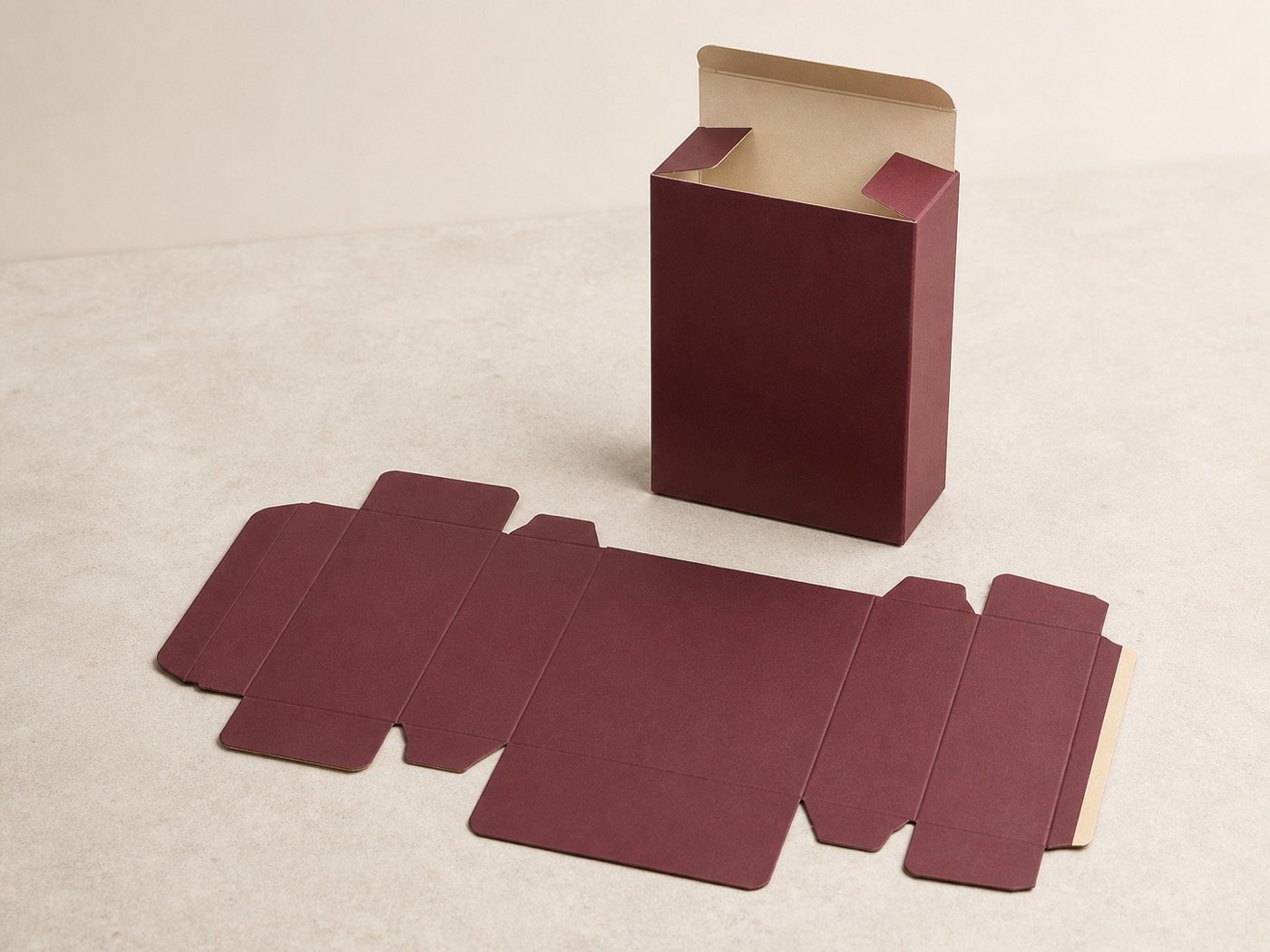
Structurally, the carton is one die-cut blank: four body panels in a row, a narrow glue flap along one edge, and at each end a closing panel with a tuck flap and two dust flaps. The side seam is the only glue point, so the carton leaves the factory as a flat tube. To close an end, the dust flaps fold in first, then the closing panel comes over and its tuck slides inside the body, where small locking slits at the base of the tuck hold it against the dust flaps. In a reverse tuck the top and bottom closing panels hinge from opposite body panels, which usually lets the blanks nest more closely on the printed sheet; in a straight tuck both hinge from the same panel, so both ends open towards the same face.
What to decide for this format
Tuck Direction
Choose the flap arrangement against the front-panel artwork, glue seam and the direction used to load the product.
Product Fit & Panel Layout
Set internal dimensions and crease positions from the real product, then place copy and finishing clear of folds and closures.
Tuck-End or Crash-Lock Base
A tuck-end bottom needs only the side seam glued and is the usual form on a horizontal cartoner. When cartons are erected by hand, every tuck base is a separate closing step; a crash-lock base removes that step, at the cost of extra gluing at converting, and also suits heavier products.
Selected work
Across the Folding Cartons range
This page covers what is particular to this product. The full lists for the whole range are set out once, on the Folding Cartons page:
What applies to this product
- Materials
- Coated Board; Kraft & Uncoated Board; FSC-Certified & Recycled Board; Specialty Papers
- Printing & Finishes
- Offset Printing; Matte, Gloss & Soft-Touch Lamination; Hot Foil Stamping; Embossing & Debossing; Spot UV; Die Cutting, Creasing & Gluing
- Applications
- Beauty & Skincare; Pharmaceutical; Food & Confectionery; Retail & E-Commerce
- How it is made
- Structure & dieline; Artwork on dieline; Sampling; Offset printing; Lamination & finishing; Die cutting, creasing & gluing; Inspection & export packing
What you can customise
- Structure and dieline developed for your product and packing method
- Board type, grade and thickness
- Print — CMYK plus Pantone spot colours
- Lamination, foil, emboss and spot UV combination
- FSC-certified or recycled board with water-based inks
- Export carton count, labelling and pallet configuration
Specifications
| Minimum order quantity | Standard cartons from 1,000 units |
|---|---|
| Production lead time | 15–20 working days after artwork approval |
| Printing | Koenig & Bauer Rapida 106 eight-colour offset — 0.1 mm register at 18,000 sheets per hour |
| Converting | Fully automated line integrating printing, laminating and gluing |
| Food-contact capability | ISO 22000 food-safety certified for food and beverage packaging work |
Terms for this specification
- Sampling
- Presentation-quality sample in 5–7 working days. The sample cost is credited against your first approved production order.
- Colour matching
- Pantone references and physical samples are used where the selected print process supports them. The approval method follows the substrate, artwork and process.
- Certifications
- ISO 9001, ISO 14001:2015, ISO 45001 and China Environmental Labelling (Ten-Ring). ISO 22000 applies to eligible food-contact work.
- Sustainable options
- FSC-certified or recycled-content paper and board, water-based inks and adhesives, and fibre-based fitments are available where the selected construction supports them.
Design & artwork
From an artwork check, through a dimensioned dieline and print-ready files, to a full concept package across a range — done by the factory that will make it.
Frequently asked questions
Should we use a straight or reverse tuck-end layout?
It depends on which panel is the retail face, where the side seam should sit and how the product will be loaded. Send the product and the intended front panel; the two dielines can then be compared before artwork is placed.
Can tuck-end cartons be supplied flat?
Yes. They are printed, die-cut, creased and side-glued, then packed flat. A physical sample is still important because it proves the opening action, the product fit and how the printed panels meet after erection.
What should we send to get a tuck-end carton quoted?
Send the product, or its exact dimensions and weight, how it is loaded into the carton, the board and finishes you have in mind, and two or three order quantities, because set-up drives carton pricing. Say which country the cartons are delivered to and, for the EU or the UK, whether you want DDP or DAP. If you already have a dieline, include it; if not, one is drawn from the product and checked on a cut sample before artwork is placed.
How heavy a product can a tuck-end carton carry?
There is no single figure: it depends on the board, the carton footprint and how the product presses on the bottom tuck. Tubes, small bottles and blister packs usually sit well on a tuck bottom. When the product is heavy for its size, or the carton is lifted by its top, the loaded sample normally shows that a crash-lock base or a heavier board is needed.
From the Journal
Related products
Request a custom packaging quote
What to send for a quote
- The product it is for, and the format you have in mind
- Size as length × width × height, and whether those are inside or outside dimensions
- Quantity, or two or three quantities if you want to compare unit prices
- Material and finish preferences, or the look you are after
- Artwork status: print-ready files, a draft, or nothing yet
- The date you need the goods by
- The destination country
Missing some of these? Send what you have, and we will ask about the rest.