Peptide vial & serum gift boxes
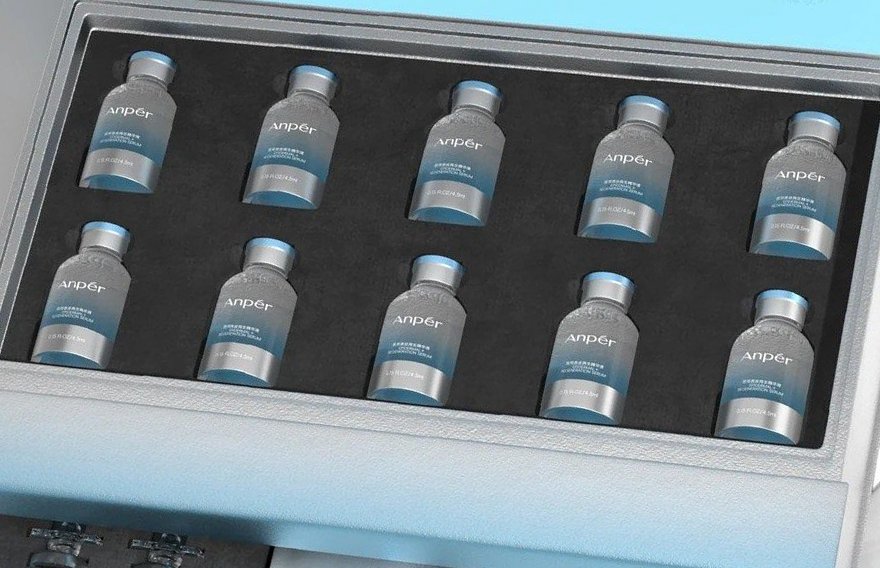
Luxury rigid gift boxes for peptide skincare, nutricosmetics and clinic vial kits — built around an insert that holds every vial still, square and easy to lift out.
At a glance
- Minimum order quantity
- 500 boxes
- Sampling
- A prototype with the insert cut to your vials in 7–10 days. The sample cost is credited against your first approved production order.
- Production lead time
- 15–20 days after sample approval
- Delivery to Europe
- DDP or DAP to the EU and the UK, DDP to Switzerland; your customs broker confirms duty and VAT rates
- Production
- Made to order (OEM/ODM)
- Country of origin
- Huai'an, Jiangsu, China
- Kits of 1–12 Vials
- Inserts Cut to Your Vials
- Magnetic, Drawer, Lid & Base
- LOT / EXP Panel
- From 500 Boxes
- Samples in 7–10 Days
Overview
A peptide product rarely sells as a single bottle. It sells as a kit — a row of 2 ml or 5 ml vials, a serum bottle, a few sachets, sometimes ampoules and applicators — and the gift box has to hold every piece still in transit and present it in order when the lid comes off. That makes the insert the real product: the box is the frame, and the insert decides whether the kit arrives intact and opens the way a premium skincare kit should.
We build these as rigid boxes — magnetic book-style, drawer, lid-and-base or window display — wrapped and finished in our Huai'an factory, with the cavities cut to your actual vials rather than to a catalogue size. A cavity slightly too large lets a vial rattle; slightly too small and it is hard to seat and lift out. So the insert is cut against the containers you will fill, and the fit is checked on the prototype.
This page is about the packaging. Yuan Packaging makes the boxes, inserts and labels for peptide skincare, nutricosmetic and clinic vial kits; the product inside, its claims and its label content are the brand's to approve, and the buyer is responsible for the product's regulatory compliance and labelling in each market where it is sold.
Variants
Magnetic Book-Style Vial Box
A hinged cover with concealed magnets that opens like a book onto the vial tray. The inside cover can carry the routine or the brand story, and the box closes firmly between uses.
Drawer Vial Box
A tray that draws out of a wrapped sleeve on a ribbon pull — the format for two-level kits, with vials on top and sachets or applicators in a second tray below.
Lid & Base Vial Box
The classic two-piece box with a fitted insert, and the most economical rigid structure for a single row of up to twelve vials.
Window & Display Box
A die-cut window in the lid, open or patched with clear PET, so the vials show on a clinic counter or a retail shelf without opening the box.
Peptide vial formats & inserts
Vial & Container Formats
2, 3, 5 and 10 ml vials, single or in kits of 1 to 12, plus ampoules, serum and dropper bottles and supplement sachets in the same box. Send the containers you will fill — cap, crimp and shoulder height all change the cavity.
Flocked EVA Insert
Dense foam with a velvet flocked surface, cut cavity by cavity. The firmest hold and the most premium look; it is a plastic foam, so it does not go into paper recycling with the box.
IXPE Foam Insert
Cross-linked polyethylene foam with a fine, smooth closed-cell surface and crisp cut edges, lighter than EVA. Also a plastic foam, kept out of the paper stream.
Moulded Pulp Insert
Paper fibre pressed to the shape of the vial. Paper-based, so it can go into paper recycling with the box in most collection schemes; it needs its own mould, which suits stable, repeating kits.
Paperboard Insert
Die-cut, folded board, wrapped or printed to match the box. It keeps the whole pack paper-based, and it is the quickest insert to change when the kit changes.
PET Tray
A thermoformed clear or tinted tray for window and display kits. It adds a second, plastic material, so design it to lift out of the box for separate recycling.
Tamper evidence, coding & compliance
Tamper-Evident Seals
A printed or holographic seal across the lid edge that tears or marks visibly at first opening, made on our label line to the same colour standard as the box.
LOT & EXP Panel
An area left free of lamination and varnish on the base or side, where your filler prints or labels the batch number and expiry date. Agree its size and the coding method before the wrap is printed.
Serialised & QR Labels
Unique codes, QR and batch data printed per label on our digital press, for kits that need traceability or authentication alongside the seal.
EU Compliance Support
The EU Packaging and Packaging Waste Regulation (PPWR) applies from 12 August 2026. Tell us what your compliance team needs — material specifications, FSC-certified board, test reports — and we confirm what we can supply with your quote.
Vial kit formats & details


What you can customise
- Internal dimensions built around your product
- Board thickness against weight and opening feel
- Wrap material, print and finishing combination
- Insert material, cavity layout and lining colour
- Ribbon, closure and hardware detail
- Export carton count and pallet configuration
Specifications
| Minimum order quantity | 500 boxes |
|---|---|
| Prototype sample | 7–10 days, with the insert cut to your vials |
| Production lead time | 15–20 days after sample approval |
| Vial capacity | 1–12 vials per kit; 2, 3, 5 and 10 ml vials, ampoules, serum bottles and sachets |
| Insert materials | Flocked EVA, IXPE foam, moulded pulp, paperboard or PET |
| Pricing | Quoted to your specification — no price list |
| Printing | Koenig & Bauer Rapida 106 eight-colour offset — CMYK and Pantone spot colours |
| Box forming | Two Hongming 6418K automated box lines, with hand wrapping and assembly for detail work |
Terms for this specification
- Sampling
- A prototype with the insert cut to your vials in 7–10 days. The sample cost is credited against your first approved production order.
- Colour matching
- Pantone references and physical samples are used where the selected print process supports them. The approval method follows the substrate, artwork and process.
- Certifications
- ISO 9001, ISO 14001:2015, ISO 45001 and China Environmental Labelling (Ten-Ring). ISO 22000 applies to eligible food-contact work.
- Sustainable options
- FSC-certified or recycled-content paper and board, water-based inks and adhesives, and fibre-based fitments are available where the selected construction supports them.
Applications
Peptide Skincare & Serum Sets
Vial and serum-bottle kits for at-home routines, where the box stays on a bathroom shelf for weeks and has to close neatly after every use.
Nutricosmetic & Supplement Kits
Drinkable vials, ampoules and sachets for beauty-from-within and supplement ranges, often sold as several days' supply in one box.
Clinic & Med-Spa Vial Kits
Professional skincare kits opened in front of a client, where every vial has to sit square and the pack has to look clean and orderly.
Launch, Gift & PR Boxes
Limited runs for launches, influencer seeding and gifting, where the opening is part of the campaign — from 500 boxes.
Vial kit projects for European clients
Cosmeceutical and aesthetic clinic distributor, Frankfurt
The client shipped serum vial kits across the EU by courier. In standard paperboard trays the vials shifted and collided at transit hubs, and routine 2°C–8°C clinic refrigeration softened the trays through moisture absorption. We built a 2.0mm greyboard magnetic book-style box wrapped in 157gsm coated art paper with a waterproof soft-touch BOPP film, around a closed-cell, hydrophobic EVA insert (38° Shore C) laser-cut to 0.3mm negative tolerances, and delivered it DDP to the client's logistics hub in Germany.
Transit breakage down from 2.4% to zero across 15,000 sets; reordered every 60 days.
UK laboratory supplies distributor, London
The kit had to fit 10 x 2ml vials plus a diluent vial slot within standard Royal Mail and DPD small-parcel dimensions, to keep courier costs to a minimum. We built a space-optimised two-piece rigid sliding drawer box with an integrated pull ribbon and a custom-fit paper slipcase, in anti-scratch matte lamination with subtle spot UV geometric patterns, and custom break-away, serialised tamper-evident foil labels bridging the sleeve seam.
Outer carton shipping volume down 32%, saving the client an estimated £1.40 per outbound parcel.
Dermatological skincare and bio-infusion brand, Stockholm
Nordic regulatory and consumer pressure meant eliminating non-recyclable plastics, but the existing paper pulp trays shed fine cellulose dust onto vial stoppers and aluminium crimps. We built an FSC-certified 1200gsm greyboard box wrapped in unbleached FSC virgin kraft paper and printed with low-VOC vegetable-based soy inks, with a dust-free, food-grade micro-flocked paper pulp tray in an anti-static finish that holds 5 ampoules and 5 freeze-dried vial units without generating dust.
100% FSC-certified across all secondary packaging components; European retail cosmetic compliance audits passed with zero particulate contamination.
Across the Rigid Gift Boxes range
This page covers what is particular to this product. The full lists for the whole range are set out once, on the Rigid Gift Boxes page:
What drives the cost
On a vial kit the insert moves the price as much as the box does. Twelve flocked EVA cavities cost more than a paperboard tray for four, and a moulded-pulp insert adds its own mould. Settle the vial count and the insert material first; the wrap and the finish are easier to trade afterwards. If a single vial needs a retail pack rather than a gift box, a printed tuck-end carton does the job at a lower unit cost than a rigid box.
Quantity
Most of the cost of a print job is set-up — plates, dies, make-ready, the first good sheet. Doubling a run rarely doubles the price, which is why it is worth asking for two or three volumes on the same quote.
Structure
A rigid box is formed, wrapped and often assembled by hand; a folding carton is die-cut and glued in one pass. Structure is usually the single biggest difference between two otherwise identical packs.
Material
Board grade and wrap stock. Specialty and textured papers cost more per sheet, but can replace a finishing pass — sometimes the cheaper route to the same effect.
Finishing passes
Each of foil, emboss, spot UV and lamination is a separate pass through a machine. Two effects cost roughly twice one, so the question is always which effect earns its place.
Tooling
Dies, emboss plates and foil blocks are one-off costs carried by the first order and reused on every repeat. Repeat runs of an approved specification are materially cheaper than the first.
Design & artwork
From an artwork check, through a dimensioned dieline and print-ready files, to a full concept package across a range — done by the factory that will make it.
Why Yuan Packaging
- Inserts cut to your actual vials and proven on a physical prototype in 7–10 days
- Two Hongming 6418K automated box lines, with detail wrapping and insert fitting finished by hand
- Box, seal and label made on one site to one colour standard, with the insert fitted during assembly
- Many of our current clients are in the EU and the UK, supplied by sea or air
Frequently asked questions
What is the minimum order for peptide vial gift boxes?
The minimum is 500 boxes. Ask for pricing at two or three quantities on the same quote: on a rigid box with a cut insert, the unit price usually falls faster than people expect.
How long do samples and production take?
A prototype with the insert cut to your vials takes 7–10 days. Production then takes 15–20 days after you approve the sample, plus freight — so when you plan a launch in Europe, add the sea or air transit to those figures.
Which insert should we choose for vials?
Flocked EVA holds firmest and looks most premium; IXPE is lighter with a cleaner cut edge; moulded pulp and paperboard keep the pack paper-based for recycling; PET suits window and display kits. Send the actual vials — cap and crimp height change the cavity — and we cut the prototype insert to them.
Can the box carry batch numbers and expiry dates?
Yes. We leave an area free of lamination on the base or side for your filler to print or label the LOT number and expiry date, and our label line can supply the labels. Agree the area and the coding method before the wrap is printed.
How do you make the box tamper-evident?
Usually with a printed or holographic seal across the lid edge. Where the kit also needs authentication, a serialised or QR label can sit alongside the seal. You specify what the destination market requires; we prove the construction on the sample.
Can you deliver to Europe, and who handles customs?
Yes. Production usually ships by sea and samples by air, and we ship DDP or DAP to the EU and the UK. Which suits you depends on who acts as importer of record and who can recover the import VAT; under DAP, confirm duty and VAT with your customs broker.
What can you provide for the EU packaging rules (PPWR)?
The PPWR applies from 12 August 2026 and phases in requirements on recyclability, materials and documentation. Tell us what your compliance team needs — material specifications, FSC-certified board, test reports — and we confirm what we can supply with your quote. Where recyclability is the goal, a paper-based insert makes a mono-material pack simpler.
Do you make or fill the product itself?
No. We make the packaging only — boxes, inserts, labels and outer cartons. The formulation, the claims and the label content are the brand's, and the buyer is responsible for the product's regulatory compliance and labelling in each market.
From the Journal
Related products
Request a custom packaging quote
What to send for a quote
- The product it is for, and the format you have in mind
- Size as length × width × height, and whether those are inside or outside dimensions
- Quantity, or two or three quantities if you want to compare unit prices
- Material and finish preferences, or the look you are after
- Artwork status: print-ready files, a draft, or nothing yet
- The date you need the goods by
- The destination country
Missing some of these? Send what you have, and we will ask about the rest.