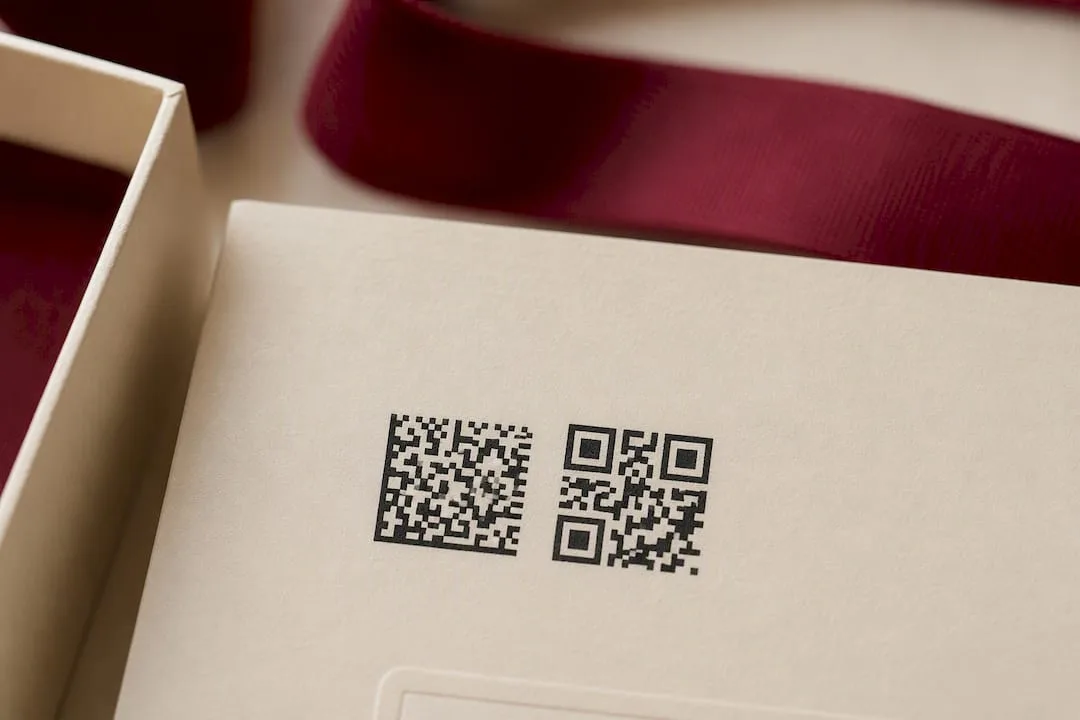
For small-part traceability and regulated supply chains, use GS1 DataMatrix. For consumer-facing packaging that needs a phone scan, use a QR code carrying GS1 Digital Link. That split holds up across GS1’s guidance and both formats’ respective ISO standards, and it is the framework packaging teams should design around, not an afterthought bolted onto artwork at the end.
- Data Matrix follows ISO/IEC 16022; QR Code follows ISO/IEC 18004. Both are recognized machine-readable formats, but built for different jobs.
- Yuan Packaging has produced label and carton runs carrying both symbol types for a large number of units and brands, including pharmaceutical and premium cosmetics packaging where compliance is non-negotiable.
| Feature | Data Matrix (ISO/IEC 16022) | QR Code (ISO/IEC 18004) |
|---|---|---|
| Structure | Solid L-shaped border on two sides and an alternating clock track on the other two; square or rectangular | Three large finder squares in three corners; square |
| Smallest symbol | 10 × 10 modules plus a 1-module quiet zone (12 × 12 in total); rectangular from 8 × 18 | 21 × 21 modules (version 1) plus a 4-module quiet zone (29 × 29 in total) |
| Data capacity | Lower ceiling: up to 2,335 alphanumeric characters, ample for GTIN, batch, expiry date and serial number | Higher ceiling: up to 4,296 alphanumeric characters; either code holds a GS1 Digital Link web address with room to spare |
| Error correction | Reed-Solomon (ECC 200); the correction share is set by symbol size, not chosen by the designer | Reed-Solomon; four selectable levels that restore roughly 7% (L), 15% (M), 25% (Q) or 30% (H) of codewords |
| Who scans it | Industrial imagers and 2D-ready retail scanners; phones only through an app or camera software that supports it | Phone cameras natively (iOS and Android), plus 2D-ready retail scanners |
| Where it is required or standard | GS1’s standard carrier in healthcare; required for the unique identifier on most EU prescription-medicine packs (Delegated Regulation (EU) 2016/161) | Consumer-facing retail packs, carrying a GS1 Digital Link URI that a phone opens as a web page; GS1 and retailers aim for tills to read 2D codes, QR and Data Matrix alike, by the end of 2027 (“Sunrise 2027” in the US) |
Which one for pharma cartons vs retail packs? On most prescription-medicine cartons for the EU market, the choice is already made: Delegated Regulation (EU) 2016/161 requires the unique identifier (product code, serial number, batch number, expiry date and, where a member state asks for it, a national reimbursement number) to be encoded in a Data Matrix, and bars any other visible 2D code used to identify or authenticate the pack; a QR code used for other purposes, such as patient information, is not prohibited, as the European Commission’s Q&A on safety features confirms. On a retail pack, put a QR code carrying GS1 Digital Link on the consumer-facing panel: shoppers can scan it with a phone camera, and it is one of the 2D codes retail tills are expected to read by the end of 2027 under GS1’s 2D transition, known in the US as Sunrise 2027.
Size callout: For the same data, a Data Matrix usually takes up less printed area than a QR code, largely due to its finder geometry. That difference decides whether a code even fits on a syringe label or a microchip.
Key Takeaways
Data Matrix wins on space efficiency and industrial reliability; QR Code wins on consumer accessibility, and packaging teams increasingly print both.
| Point | Details |
|---|---|
| Match code to scanner | Use Data Matrix for industrial imagers and regulated traceability; use QR for consumer phone scans. |
| Size efficiency matters | Data Matrix usually needs less printed area than QR for the same data. |
| Standards govern feasibility | Data Matrix follows ISO/IEC 16022 and QR follows ISO/IEC 18004; GS1 endorses DataMatrix for healthcare serialization. |
| Verify before full production | Pilot print at multiple module sizes and confirm scans with a certified verification scanner first. |
| Dual coding resolves conflicts | Printing both Data Matrix and QR on one package, common in Yuan Packaging’s label and carton projects, satisfies compliance and consumer engagement together. |
Table of Contents
- Datamatrix vs QR Code: The Technical Differences That Matter
- Printing and Direct-Part Marking Considerations
- How Scanner Type Shapes Which Code Wins
- Data Matrix and QR Code Use Cases Across Industries
- How to Choose Between Data Matrix and QR Code
- Why Yuan Packaging Gets the Print Details Right
- Does Color and Design Customization Affect Code Readability?
- What Experience Teaches About Choosing Between These Codes
- Get Your Codes Right Before You Print
- Sources
- FAQ
Datamatrix vs QR Code: The Technical Differences That Matter
The gap between these two formats isn’t cosmetic. It comes down to geometry, and geometry dictates how small you can print a symbol before it stops scanning.
QR Code uses three large finder patterns in three of its four corners, plus a timing pattern and alignment patterns scattered through the interior for larger versions. That overhead buys robust orientation detection, which is part of why phone cameras lock onto QR so quickly. Data Matrix, by contrast, uses a simpler L-shaped solid border on two adjoining sides plus an alternating “clock track” on the other two. Less structural overhead means more of the symbol’s area goes to actual data.
Quiet zone requirements compound this. QR Code generally needs a clear margin equal to four modules on every side. Data Matrix typically needs a margin of just one module because its solid-border finder pattern doubles as part of the quiet zone boundary. On a label already tight for space, that difference between a four-module and a one-module buffer can be the reason a code is legible or blurred into the surrounding print.
Data capacity tells a similar story. A QR Code can hold up to about 7,089 numeric characters or 4,296 alphanumeric characters at its largest version, more than most packaging applications ever need. Data Matrix maxes out lower, around 2,335 alphanumeric characters, but for GS1 element strings (a GTIN, batch number, expiration date, and serial number) that ceiling is rarely a constraint.
Error correction is where trade-offs show up in print size. Higher error correction protects against ink smudging or partial occlusion, at the cost of a physically larger symbol for the same payload. Data Matrix, per GS1 India’s technical comparison, offers similar resilience with less area penalty. That is the core reason ISO barcode standards and industry labeling specs recommend Data Matrix wherever component surfaces are already at a premium.
- QR Code: four selectable ECC levels, larger finder overhead, higher max capacity.
- Data Matrix: efficient L-shaped finder, smaller quiet zone, tighter minimum footprint at equivalent payload.
Printing and Direct-Part Marking Considerations
Choosing the symbol on a spec sheet is the easy part. Getting it to survive a production line and still scan is where packaging projects usually run into trouble.
Label printing (flexographic or digital) handles both formats well down to roughly a 0.3 mm module size on coated stock, assuming adequate contrast between the code and its background. Laser etching, common for glass, metal, and rigid plastic components, favors Data Matrix because its smaller footprint suits the tight marking zones typical of caps, closures, and hardware. Dot-peen marking, used on raw metal parts in electronics and automotive supply chains, is almost exclusively a Data Matrix application. QR’s larger finder patterns and four-module quiet zone rarely fit the marking windows dot-peen systems are built for.
Contrast and gloss matter as much as module size. High-gloss varnishes, metallic foils, and spot UV coatings can wash out the contrast a scanner needs, even when the symbol geometry is technically correct. Curved surfaces, like a bottle shoulder or a tube cap, distort module spacing and raise the risk of misreads near the code’s edges.
- Set a minimum acceptable module size in the artwork brief, based on marking method and scan distance.
- Run a pilot print batch on the actual substrate and finish, not a proof on plain stock.
- Verify every pilot symbol with a certified verification scanner, not a general-purpose reader, and score against ISO grading criteria.
- Set an acceptance threshold before full production, not after.
Pro Tip: Never approve a Data Matrix or QR Code for production based on a proof print alone. Finishes like spot UV or metallic foil behave differently under scanner light sources than they do under office lighting, and that gap is where most field failures originate.
How Scanner Type Shapes Which Code Wins
Native smartphone camera support is the single biggest reason QR Code owns consumer scanning. iOS has decoded QR natively since 2017, and modern Android devices handle it through the built-in camera or Google Lens, with no app download required. That frictionless path is why QR shows up on everything from wine labels to event tickets.
Data Matrix tells a different story on the shop floor. Industrial imagers, tuned for fixed working distances and consistent lighting, read small, dense Data Matrix symbols with high reliability, which is exactly the environment supply-chain and manufacturing scanning happens in.
Here’s the part decision-makers often miss: most modern phones can technically decode Data Matrix too. The gap isn’t capability, it’s behavior. Consumers are trained to recognize and scan QR; they rarely attempt it with Data Matrix.
- Dual-code packaging (Data Matrix for the supply chain, QR for the consumer) resolves this behavioral gap without forcing a single-format compromise.
- Calibrate industrial imagers to your specific substrate and finish, not factory defaults, before locking in production settings.
Data Matrix and QR Code Use Cases Across Industries
Pharma and healthcare. GS1 DataMatrix is the endorsed carrier for serialization and Unique Device Identification in most regulated markets, and barKoder’s standards comparison confirms procurement rules for donated or regulated medical products often mandate it outright. Blister packs and small vials rarely have room for anything else.
Electronics and direct part marking. Components under roughly 6 mm by 6 mm essentially force the decision. Field practice from GS1 India confirms Data Matrix is typically the only viable 2D option at that scale, laser-etched directly onto PCBs, connectors, and metal housings.
Retail, FMCG, and consumer engagement. QR paired with GS1 Digital Link turns a package into a web-accessible touchpoint, linking to product provenance, recipes, or loyalty programs, exactly the kind of integration Yuan Packaging has explored in its own smart packaging development work.
The hybrid answer. For brands managing both regulatory traceability and consumer marketing, printing both codes on the same package, Data Matrix for the case or unit level, QR for the shelf-facing panel, is often the most practical path rather than a compromise.

How to Choose Between Data Matrix and QR Code
Start with three questions: who is scanning this code, what data does it need to carry, and how much physical space do you actually have?
- Define the scanning audience. Warehouse imagers and phones behave differently; design for whichever one will scan the code most often in production.
- List the required data elements. A GTIN and batch number needs far less room than a full GS1 element string with expiration date and serial number.
- Measure your available print area under magnification, not by eye, especially on curved caps or small components.
- Match the marking method to the substrate: label, laser etch, or dot-peen each have their own minimum reliable module size.
- Pilot before committing. Print at three candidate module sizes, scan with representative imagers and phone models across roughly 200 reads, and set your acceptance threshold before full production, not during it.
Watch for three red flags: skipping verification scanning entirely and trusting a visual check, ignoring how a finish like foil stamping or spot UV will affect contrast, and relying on consumer phone scans for data that regulation requires an industrial-grade read to confirm.
Pro Tip: If your product touches a regulated supply chain anywhere in its lifecycle, design for the industrial imager first and the phone camera second. Retrofitting compliance after a QR-only rollout costs far more than building it in from the artwork stage.
Why Yuan Packaging Gets the Print Details Right
Getting a Data Matrix or QR Code to survive real production, not just a design proof, takes packaging experience most brands don’t have in-house.
- Over 25 years producing custom rigid boxes, cartons, and labels for premium beauty, spirits, and pharmaceutical brands.
- More than 100 million units delivered to over 5,000 brands, including projects requiring compliant, verifiable serialization.
- In-house label printing expertise covering the contrast, gloss, and substrate variables that determine whether a small code scans reliably.
Small-format compliance codes fail more often from finish choices, like a metallic foil or spot UV coating that kills contrast, than from the underlying symbol design itself. Catching that at the artwork stage, before a full production run, is what separates a working pharma label from a costly reprint.
Yuan Packaging integrates GS1 DataMatrix or QR artwork directly into existing label and carton production workflows, running verification checks before committing to full print volume.
Does Color and Design Customization Affect Code Readability?
Yes, and this is where marketing instincts and technical requirements collide most often. Both Data Matrix and QR Code depend on strong luminance contrast between the code’s dark and light modules, not on color per se. A dark navy code on a light gold background can scan perfectly if the luminance gap is wide enough, while a bold red code on a bright green background, visually striking but tonally similar in luminance, can fail entirely.

Rounded corners, embedded logos, and custom module shapes are common on consumer QR codes, and most scanning engines tolerate them within limits. Data Matrix, used almost exclusively for industrial and regulatory marking, is rarely customized this way. Its job is legibility under a fixed-position imager, not shelf appeal.
Reversed codes (light modules on a dark background) are legal in both standards but demand extra verification, since some older scanning engines default to expecting dark-on-light. Gradient backgrounds are the riskiest customization; they can shift contrast unpredictably across the symbol’s surface, passing a scan test in one lighting condition and failing in another.
The safest rule for consumer-facing QR on premium packaging: protect the contrast ratio first, then style around it. Test any color or design variation with an actual verification scanner under the lighting your product will be scanned under at retail, not under studio lighting on a design mockup.
What Experience Teaches About Choosing Between These Codes
Three rules hold up: never let branding override the quiet zone, never assume phone-scannability equals compliance, and never finalize artwork before a verification scan on the real substrate.
Bring your packaging vendor in during the artwork stage, not after. Verification testing is cheap early and expensive as a reprint.
— Steven
Get Your Codes Right Before You Print
Choosing between Data Matrix and QR is only half the job. Getting either one to survive a foil stamp, a spot UV coat, or a curved cap without breaking scannability is where most packaging projects actually stumble, and it’s the part a generic printer rarely tests properly before running full volume.
Yuan Packaging builds verification into the production process itself, running pilot prints and scanner checks on your actual substrate and finish before committing to a full run. Whether you need a compliant GS1 DataMatrix on a pharmaceutical carton or a consumer-facing QR code on a spirits label, our custom label printing services handle the artwork integration, substrate testing, and quality checks that keep small codes scannable at scale. If your project involves rigid boxes or folding cartons carrying either symbol, request a quote and we’ll walk your artwork through a pilot verification before full production.
Sources
For compliance details, consult GS1’s organizational guidance directly rather than a third-party summary. For symbol specification and print grading, ISO’s standards pages cover the technical baseline behind ISO/IEC 16022 and 18004. For a side-by-side technical breakdown of size and capacity trade-offs, GS1 India’s comparison is worth a read before finalizing artwork specs.
- GS1 Sweden: What is the difference between DataMatrix, GS1 DataMatrix and QR code?
- QR code vs Data Matrix vs 2D barcode: what’s the difference? — Digital Link
- GS1 (organizational guidance pages)
- Commission Delegated Regulation (EU) 2016/161 (EUR-Lex)
- GS1 DataMatrix Guideline (GS1)
- QR Code versions and module counts (DENSO WAVE)
FAQ
Is a Data Matrix a Barcode?
Yes. Data Matrix is a two-dimensional barcode standardized under ISO/IEC 16022, distinct from linear (1D) barcodes because it stores data in a grid pattern rather than a single row of bars.
What Are the Two Types of QR Codes?
The most common distinction is between standard QR Code, used broadly for URLs and general data, and GS1 QR Code, which carries structured GS1 Digital Link data for product identification and traceability.
How Do You Scan a Data Matrix Code?
Most Data Matrix codes are read with industrial imagers designed for fixed-distance scanning, though many modern smartphone cameras can decode them too if the app or camera software supports the format.
Can the Same Package Carry Both a Data Matrix and a QR Code?
Yes, and it’s a common practice: Data Matrix handles unit-level or case-level traceability while a separate QR code on the consumer-facing panel supports GS1 Digital Link engagement.
Does Yuan Packaging Print Both Code Types on the Same Label?
Yes. Yuan Packaging’s label printing capabilities support integrating both Data Matrix and QR artwork into a single production run, including verification testing before full-volume output.