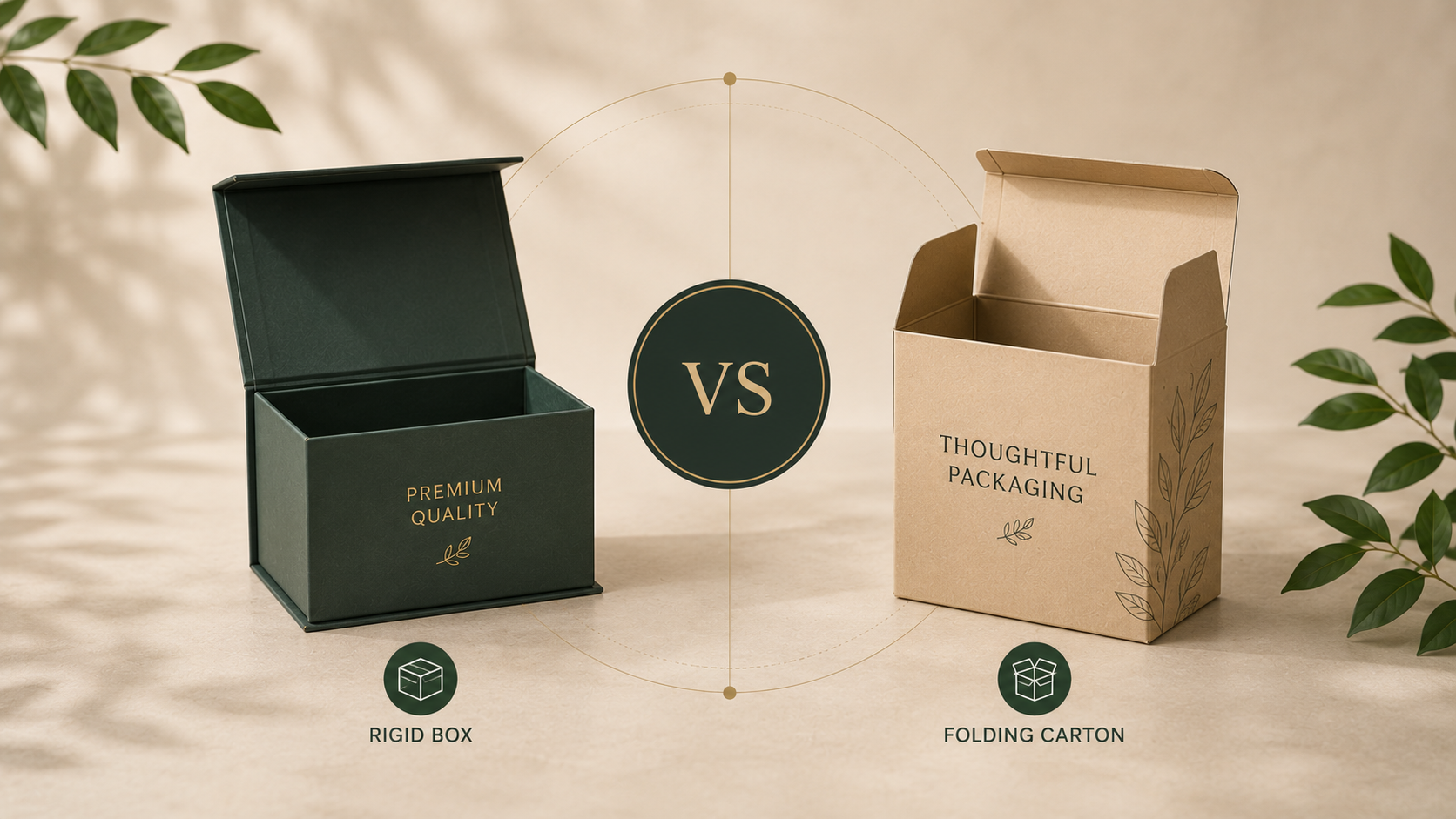
Rigid boxes and folding cartons are the two most common structures in premium printed packaging, and choosing between them shapes your cost, your perceived value, your shipping bill, and your minimum order quantity. They look similar in a render but are made very differently, and each is suited to a different kind of product and volume. This guide compares the two so you can specify the right structure for your brand with confidence.
Table of contents
- What is a rigid box?
- What is a folding carton?
- Rigid box vs folding carton at a glance
- Construction and feel
- Cost and minimum order quantity
- Shipping and storage
- When to choose each
- Middle paths
- At high volume
- Summary
- Frequently asked questions
What is a rigid box?
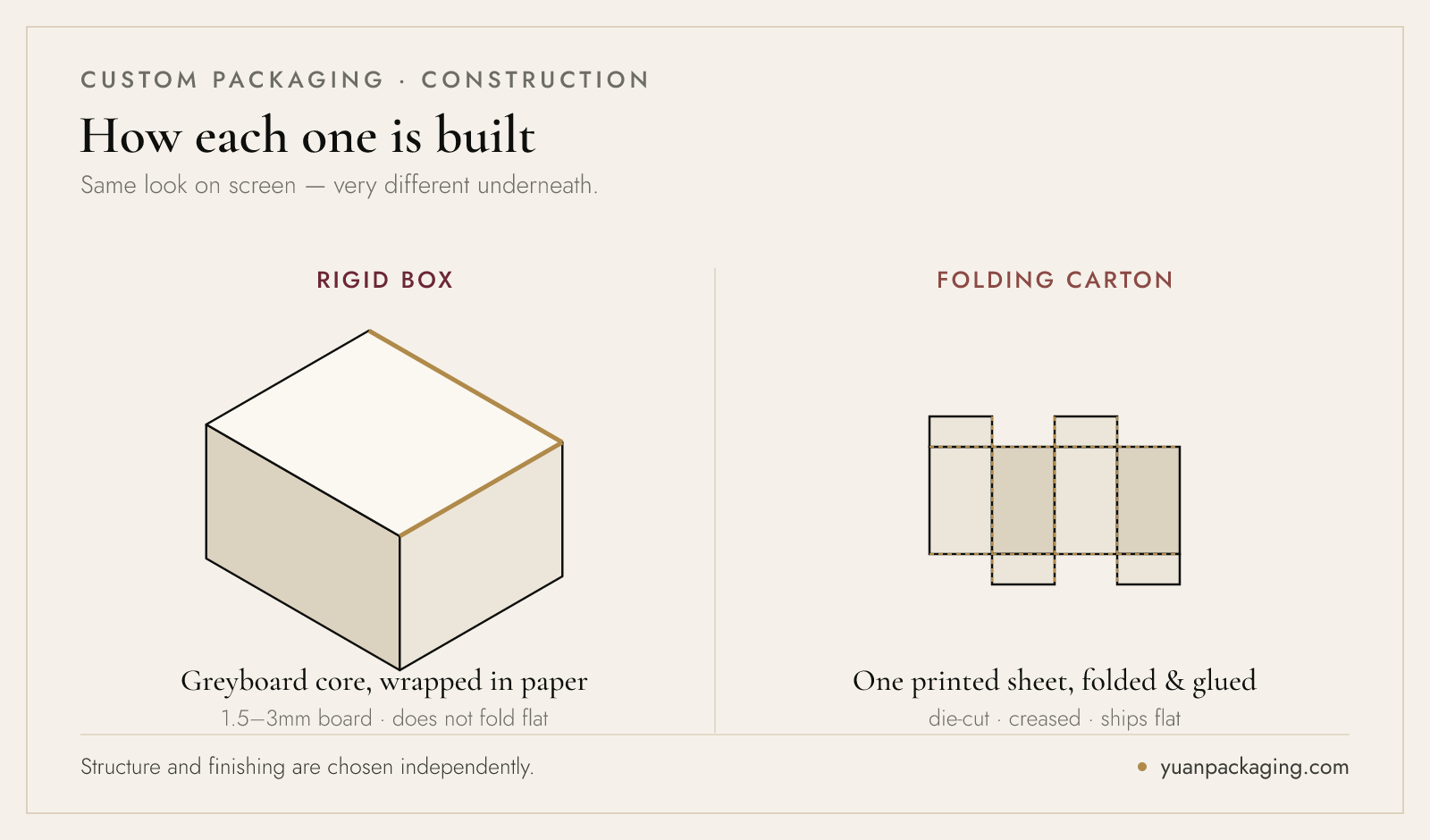
A rigid box — also called a set-up box or gift box — is built from thick greyboard, typically 1.5 to 3mm, that is cut, formed, and then wrapped with a separately printed paper or specialty material. It does not fold flat; it arrives fully formed and holds its shape under weight. This is the structure behind luxury gifting, premium beauty sets, fine spirits presentation, and limited editions. The rigidity, the weight in the hand, and the controlled opening action are what make a rigid box feel expensive.
What is a folding carton?
A folding carton is made from a single sheet of folding boxboard or SBS, printed, die-cut, creased, folded, and glued. It ships and stores flat, then is erected at the point of packing. Folding cartons are light, fast to produce, highly cost-effective at volume, and are the workhorse of retail and FMCG packaging — from cosmetics cartons and medicine boxes to food and beverage secondary packaging. Almost any printed finish a rigid box can carry, a folding carton can carry too.
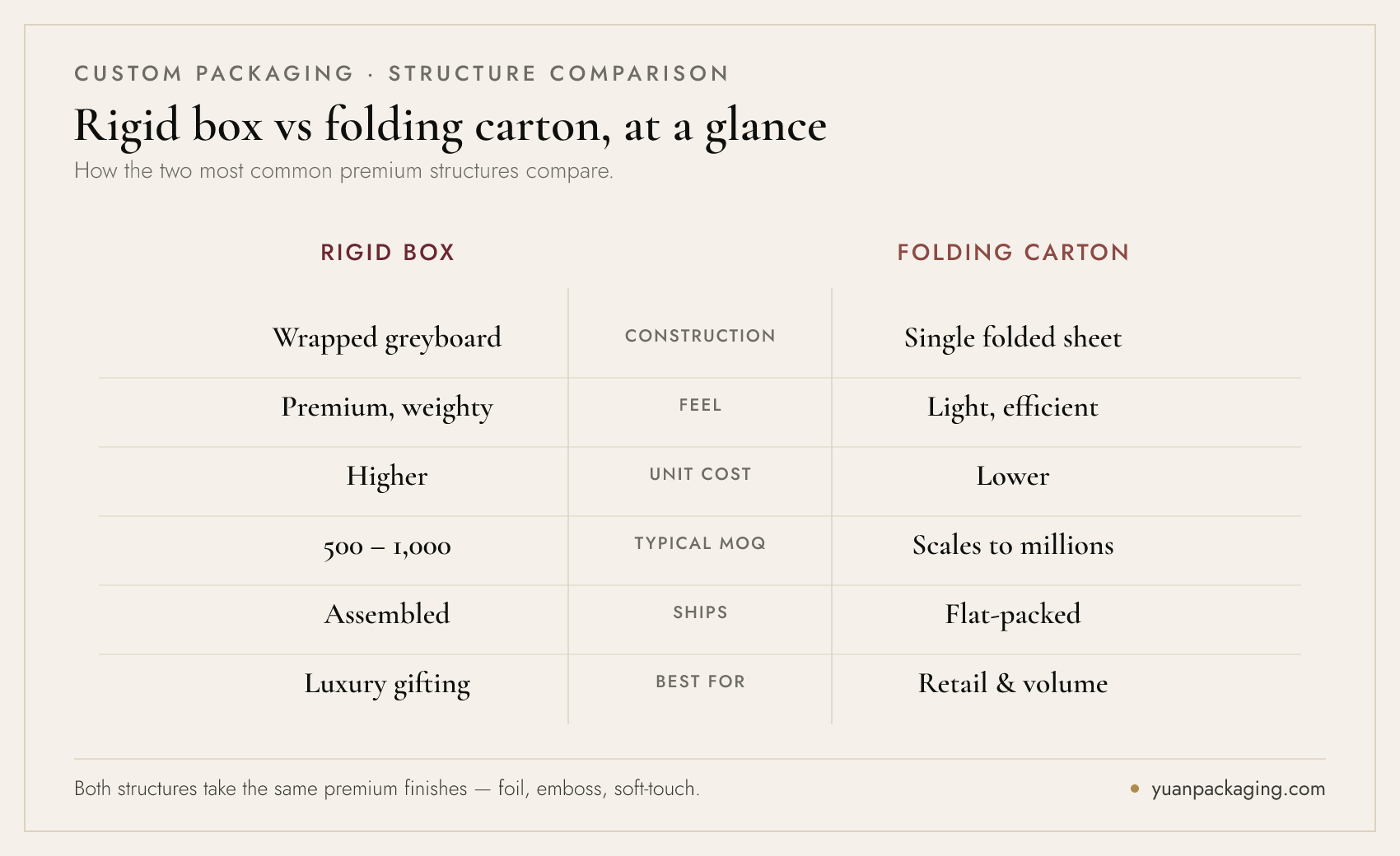
Rigid box vs folding carton at a glance
| Rigid box | Folding carton | |
|---|---|---|
| Construction | Greyboard 1.5–3mm, cut, formed and wrapped | Single sheet, printed, die-cut, folded and glued |
| Ships | Assembled | Flat |
| Unit cost | Higher | Lower |
| Typical MOQ | Higher | Lower |
| Best for | Luxury gifting, premium beauty and fragrance, fine spirits | Retail volume, cosmetics, food and pharmaceutical cartons |
Construction and feel
The core difference is construction and feel. A rigid box is a multi-part, partly hand-assembled object with structural weight and a premium unboxing experience. A folding carton is a single engineered sheet optimised for efficiency, shelf presence, and scale. Neither is better in the abstract — they solve different briefs. The right question is what job the packaging needs to do: protect and present a hero product as a gift, or carry a product efficiently through retail at volume.
Discuss your packaging project
Cost and minimum order quantity
Cost and minimum order quantity differ accordingly. Rigid boxes carry a higher unit cost and a higher MOQ — typically from around 3,000 units — because of the greyboard, the wrapping, the hand-assembly, and the additional tooling. Folding cartons have a lower unit cost, run far faster on press, and scale efficiently into the hundreds of thousands and millions. If you are weighing minimums, our guide to MOQ for custom packaging explains what drives the numbers for each.
Shipping and storage
Shipping and storage are an underrated difference. Because a rigid box does not fold flat, it ships and stores assembled — taking up far more space and adding freight and warehousing cost, unless it is engineered as a collapsible rigid box. A folding carton ships flat, so a carton filling a single pallet might equal many pallets of pre-assembled rigid boxes. At high volume this difference becomes a significant line on the total landed cost, and is often the deciding factor for large programmes.
When to choose each
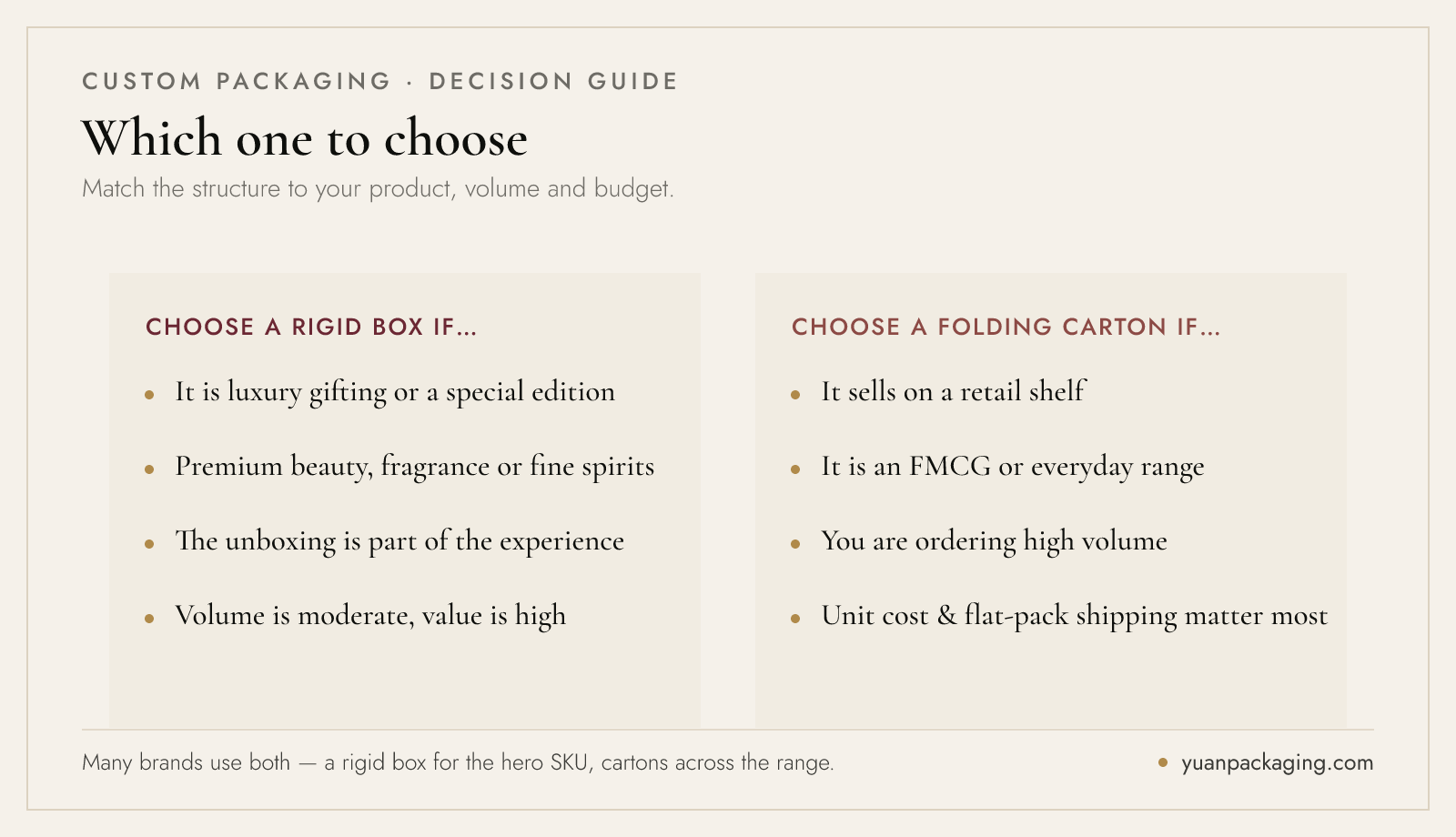
When to use each comes down to value and volume. Choose a rigid box for luxury gifting, premium beauty and fragrance, fine spirits, and limited editions — anywhere the packaging is part of the product experience and the volume is moderate. Choose a folding carton for retail shelf products, FMCG ranges, secondary packaging, and any high-volume programme where unit cost and shipping efficiency dominate. Many brands use both: a rigid box for the hero or gift SKU and folding cartons across the wider range.
Middle paths
There are also middle paths. Collapsible rigid boxes with magnetic closures combine a premium feel with flat shipping. Heavier folding cartons with soft-touch lamination, foil, and embossing can deliver much of a rigid box’s perceived quality at a fraction of the cost and MOQ. Every premium finish — hot foil, embossing, spot UV, soft-touch — applies to both structures, so the structural choice and the finishing choice can be made independently. Browse our product range to see both in context.
At high volume
At scale, the structural choice has real operational weight. For high-volume annual programmes, folding cartons are extremely efficient — our offset presses run them at speed into the millions of units, and they ship flat to keep landed cost down. Rigid boxes are also produced at volume on dedicated lines, with the assembly and freight planning that larger quantities require. Whichever structure fits your product, our four production lines are built to deliver it at programme scale, with a single point of contact from sampling to delivery.
Summary
In short: rigid boxes win on perceived value and unboxing; folding cartons win on cost, speed, and shipping efficiency at volume. Define your product’s positioning, your budget, and your annual volume, and the right structure usually becomes clear. If you would like samples of both against your specification — or advice on which suits your launch and volume — tell us about your project and our team will recommend the most effective option.
Frequently Asked Questions
What is the difference between a rigid box and a folding carton?
A rigid box is built from thick greyboard wrapped with printed paper, does not fold flat, and feels premium — used for luxury gifting. A folding carton is a single printed sheet that is die-cut, folded and glued, ships flat, and is cost-effective at volume — used for retail and FMCG packaging.
Which is more expensive, a rigid box or a folding carton?
Rigid boxes cost more per unit because of the greyboard, wrapping, hand-assembly and extra tooling, and they cost more to ship as they do not fold flat. Folding cartons have a lower unit cost, run faster on press, and ship flat — making them far more economical at high volume.
Which has a lower MOQ?
Folding cartons generally have a lower effective MOQ and scale more cheaply, while rigid boxes typically start from around 3,000 units due to tooling and hand-assembly. Your exact MOQ depends on size, materials and finishing — see our MOQ guide for detail.
Should I choose a rigid box or a folding carton for my product?
Choose a rigid box for luxury gifting, premium beauty, fine spirits and limited editions where the unboxing is part of the experience. Choose a folding carton for retail shelf products, FMCG ranges and high-volume programmes where unit cost and flat-pack shipping matter most.