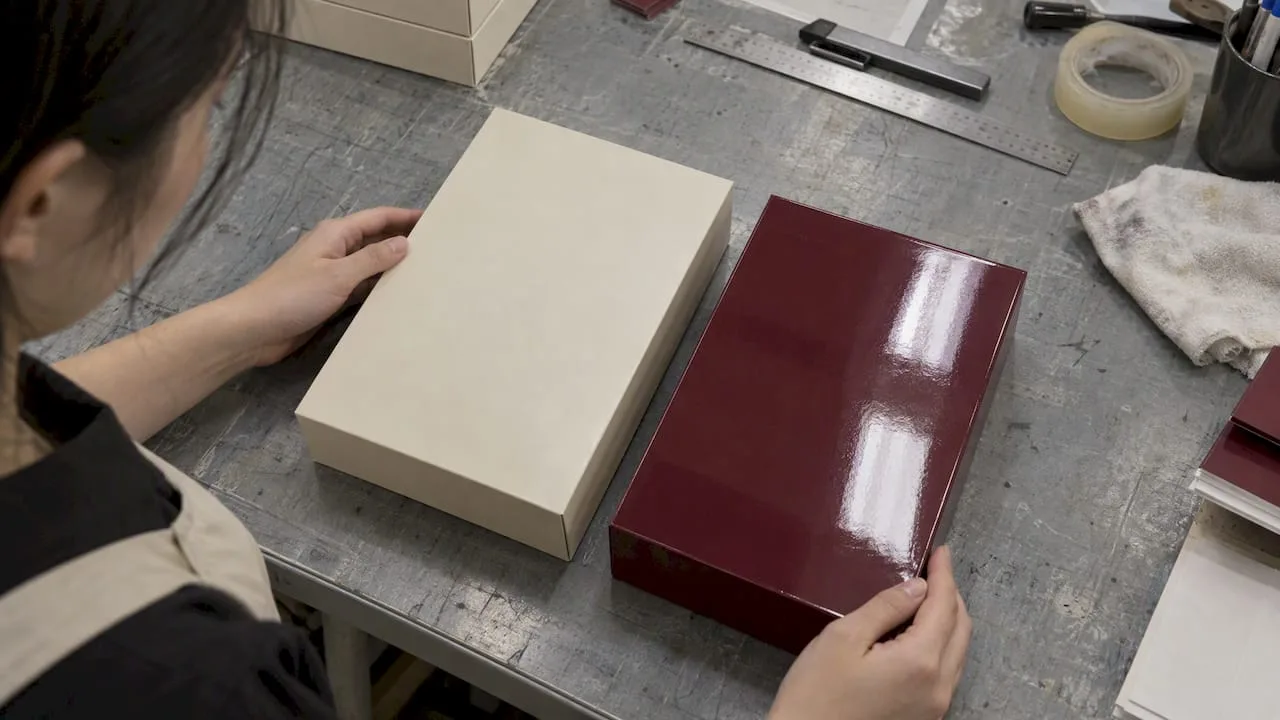
For packaging that lives under bright retail lights and needs to be handled, matte lamination is the safer default; for controlled-display pieces where color punch matters more than glare, gloss wins. Most brands land between the two with luster or soft-touch finishes, which deliver much of gloss's saturation with far less glare and fingerprinting.
TL;DR:
- Gloss delivers about 22% higher perceived contrast than matte, but produces roughly 3.7 times more glare under common indoor lighting.
- Toner based digital prints face greater delamination or silvering risk than offset prints, so require adhesion tests and inspect sample edges before production.
- For easier paper recycling, specify one sided lamination where possible and ask whether a peelable film or water soluble adhesive can separate at the mill.
- Before approving production, compare samples under actual display lighting and request gloss readings at 60 degrees, color shift measurements, and humidity checks.
Table of Contents
- What lamination is and how it's applied
- Gloss lamination: visual, tactile, and performance profile
- Matte lamination: visual, tactile, and performance profile
- Luster, satin, and soft-touch: the middle options
- How to choose: a practical checklist for your next print run
- Recyclability and sustainability of laminated packaging
- Practical specs to check on proofs
- Yuan Packaging perspective: what 25 years of finish testing has taught us
- Quick rules of thumb by packaging sector
- How we help you choose and produce the right finish
- FAQ
- Sources
What lamination is and how it's applied
Lamination bonds a thin plastic film, typically polypropylene (BOPP) or polyester (PET), to a printed sheet under heat or pressure. It differs from a coating like aqueous or UV varnish, which is a liquid sprayed or roller-applied and cured directly onto the surface rather than bonded as a separate film layer. Coatings tend to be thinner and cheaper per unit; laminates add more physical protection and a distinct hand-feel, which is why rigid boxes, labels, and carrier bags for premium brands usually specify film lamination over varnish alone.
Common film choices include:
- BOPP film: the standard low-cost option for cartons and bags, available in gloss, matte, and soft-touch variants.
- PET film: higher clarity and stiffness, often chosen for labels that need scuff resistance.
- Soft-touch (velvet) film: a textured laminate that adds a suede-like feel, popular on rigid gift boxes.
- One-side vs two-side lamination: single-side jobs (most folding cartons) cost less and simplify recycling; two-side lamination adds rigidity and moisture protection for items like menus or outdoor signage.
Application methods vary by volume and film type. Thermal lamination uses heat-activated adhesive and runs well on most commercial presses. Cold lamination relies on pressure-sensitive adhesive and suits heat-sensitive substrates or short runs. Extrusion lamination coats the film with molten polymer during bonding, which is common for high-barrier packaging. Each method shifts lead time and cost: thermal lamination is fastest for standard runs, while extrusion adds setup time but delivers stronger barrier performance for food or spirits packaging.
Gloss lamination: visual, tactile, and performance profile
Gloss film works by reflecting light specularly rather than scattering it, which boosts perceived contrast and color saturation. The smoother, higher-refractive-index surface acts almost like a mirror at certain viewing angles, which is why gloss packaging looks vivid under store lighting and photographs well for e-commerce listings.
That same mechanism creates the finish's main drawback. Glossy surfaces reflect a large share of incident light at mirror angles, which produces visible glare under typical indoor lighting and makes fingerprints and smudges far more noticeable than on a matte surface. Cleaning gloss packaging back to its original shine often takes multiple wipe cycles, according to smudge-test comparisons reported by Frame & Focal.
Glossy surfaces can reflect a very high percentage of incident light at mirror angles (measured at 60° under ASTM E430-19), compared with very low reflectance for matte equivalents, a gap that explains why gloss packaging looks dramatically different depending on where it sits relative to overhead lighting, per measurements reported by Frame & Focal.
Where gloss earns its place:
- Shelf impact: gloss raises perceived contrast by about 22% compared with matte, a meaningful edge for products competing on visual pop at point of sale.
- Scratch and moisture resistance: the film layer protects ink and substrate from handling damage and light moisture exposure.
- Controlled display: gloss performs best when lighting and viewing angle are predictable, such as a backlit display case or a photographed product listing.
For packaging that gets picked up, compared side by side under fluorescent or LED retail lighting, or handled repeatedly by consumers, that same glare and smudge sensitivity becomes a liability rather than an asset.
Matte lamination: visual, tactile, and performance profile
Matte film scatters light diffusely instead of reflecting it in one direction, which is the physical reason matte packaging looks consistent no matter where the viewer stands. That diffuse scattering reduces glare dramatically and keeps color appearance stable across a range of lighting angles, which matters for packaging displayed under mixed or bright ambient light.
Matte finishes cut luminance non-uniformity by roughly 68% in multi-angle viewing tests, according to controlled testing from Frame & Focal, which is a large part of why matte packaging reads as calmer and more premium under store lighting rather than flashy.
The tradeoff shows up in peak performance rather than everyday use. For most packaging applications, that loss is invisible to the average shopper and is outweighed by what matte gains in practical handling.
Matte's handling advantages include:
- Fingerprint resistance: the textured surface hides oils and smudges far better than a smooth gloss film.
- Bright-room stability: matte packaging looks nearly identical under harsh fluorescent light, daylight, or warm LED, which reduces surprises between design proofs and store conditions.
- Perceived sophistication: matte's softer, less reflective look is why it dominates premium cosmetics, spirits labels, and minimalist retail branding.
Matte is the stronger default whenever packaging will be touched, stacked, or displayed under lighting you cannot fully control, which covers most retail shelf and e-commerce fulfillment scenarios.
Luster, satin, and soft-touch: the middle options
Luster and satin finishes sit between gloss and matte in both film texture and reflectivity, usually achieved by a finer surface pattern than full matte but without gloss's mirror-like smoothness. Soft-touch laminate goes a different direction: it adds a velvety texture rather than altering gloss level alone, which changes how packaging feels in hand as much as how it looks.

These finishes are the default choice in a few recurring scenarios: portrait and photo books, where printers have long favored luster for exactly this reason, and luxury rigid boxes, where soft-touch lamination signals craftsmanship on cosmetics or spirits packaging without gloss's glare problem.
Industry guidance from print professionals backs this pattern directly: ArtisticHive recommends luster or satin when a project needs much of gloss's color punch but better glare control and handling, a compromise that maps cleanly onto packaging decisions as well as photo prints.
Key benefits of intermediate finishes:
- Reduced glare without matte's full contrast loss, useful for packaging photographed for online retail.
- Better fingerprint resistance than gloss, though not quite matte's level.
- Distinct tactile cues (soft-touch especially) that reinforce premium positioning at the shelf.
How to choose: a practical checklist for your next print run
Choosing a finish gets easier when you separate the decision into project context, technical fit, and vendor verification, rather than picking based on looks alone.
- Define the viewing environment. Will the piece sit under bright retail lighting, in a dim display case, or get photographed under studio light?
- Account for handling. Packaging that gets picked up repeatedly, like a cosmetics box or a hang tag, should favor matte or soft-touch for fingerprint resistance.
- Consider display format. Framed art, posters, or backlit panels often benefit from gloss's contrast since viewing angle is fixed.
- Check substrate and ink compatibility. Digital toner prints behave differently under lamination than offset prints, and mismatched combinations raise the risk of adhesion failure.
- Decide one-side vs two-side lamination. Single-side coverage is usually enough for cartons and keeps recycling simpler; two-side suits items needing moisture protection on both faces.
- Confirm regulatory or food-contact needs if the piece touches product directly, such as inner liners for food or pharmaceutical cartons.
- Order sample runs before full production, checking color, gloss level, and adhesion under your actual retail lighting rather than office light.
- Ask your vendor specific questions: what adhesive and film weight are you using, can you supply a peelable laminate sample, what is your measured gloss level at 60 degrees, and have you tested this substrate and ink combination before.
Pro Tip: Request two sample rounds, one in gloss and one in matte or soft-touch, under the same lighting where the packaging will actually be displayed or handled before locking in a finish.
Recyclability and sustainability of laminated packaging
Laminated packaging can still be recycled, but the plastic film layer changes how easily a paper mill can process it. FEFCO's recyclability guidelines recommend minimizing non-paper constituents, favoring one-sided lamination over two-sided coverage, and choosing peelable laminates or water-soluble adhesives where separation at the mill is feasible.
Practical design choices that support circularity:
- Specify one-side lamination whenever the project allows it, since it leaves more exposed paper fiber for standard recycling streams.
- Request peelable laminate options for packaging where recyclability is a stated priority, particularly rigid boxes and folding cartons.
- Run mill compatibility tests early, before committing to a film and adhesive combination at scale.
- Document end-of-life handling on the packaging itself when local programs support separating laminate from paper fiber.
When a project needs barrier properties, like moisture control for food packaging, lamination selection has to balance that barrier function against recyclability. In those cases, FEFCO guidance points toward peelable liners and early mill testing rather than defaulting to full-coverage two-side lamination.
Practical specs to check on proofs
Decisions about finish should rest on measured proofs, not visual impression alone. A handful of parameters tell you almost everything you need to know before committing to a production run.
- Gloss level (GU at 60°): high-gloss laminates typically measure above 85 GU, while matte laminates fall closer to 4 to 10 GU, based on ASTM E430-19 testing reported by Frame & Focal.
- Color accuracy (ΔE / CIELAB): ask your vendor for ΔE readings comparing the laminated proof against the unlaminated digital file to confirm color shift stays within an agreed tolerance.
- Ambient lighting (lux): test proofs under the lux level of the actual retail or display environment, since glare and perceived contrast both shift with ambient light.
- Humidity expansion: for packaging stored or shipped across climates, check for dimensional changes in the substrate after lamination.
Lamination adhesion risk is not uniform across printing methods: electrophotographic (toner-based) digital prints carry a higher risk of delamination or silvering than offset prints, according to technical observations on lamination compatibility. If your print run uses digital toner printing, flag adhesion testing explicitly during the sample round and inspect proofs closely for any silvering or lifting at the edges before approving a full production run.
Yuan Packaging perspective: what 25 years of finish testing has taught us
We have run press tests comparing aqueous and UV coatings against film lamination for many years, work we document on our finishes and print effects page. That volume of testing across beauty, spirits, and lifestyle packaging runs has shown us that the right finish depends less on trend and more on where a box actually lives: a shelf under fluorescent light, a gift set unwrapped at home, or a label scanned at checkout.
Our typical sample workflow starts with two or three finish variants on the same dieline, measured for gloss level and color consistency, then reviewed under lighting conditions that match the retail or display context. When recyclability is a stated priority, peelable lamination options are included in the sample round rather than treated as an afterthought.
If you're deciding between finishes right now, consider requesting a finish sample pack, specifying the test metrics you want measured, and asking for a peelable option alongside standard lamination.
Quick rules of thumb by packaging sector
Cosmetics packaging generally favors matte or soft-touch for its handled, bright-counter environment; spirits labels often split between gloss for shelf drama and matte for restrained luxury branding. Food cartons lean matte or luster for readability under store lighting, electronics boxes favor gloss for a sharp, modern look, and books or catalogs almost always default to luster. Whatever the sector, order a test print under your real display lighting before finalizing.
— Anthony
How we help you choose and produce the right finish
Picking between matte, gloss, and the intermediate finishes is only half the job. Partnering with a manufacturer who tests those finishes under real conditions and builds in recyclability options from the start is the other half, and sample-round processes add the most value.
Comparative sample rounds across gloss, matte, luster, and soft-touch lamination on actual dielines and substrates measure gloss level and color consistency, and highlight any adhesion risk tied to the printing method before full production. When recyclability matters, peelable laminate options can be included in the same round rather than as a separate request. Browse our full product range or start with rigid gift boxes to request a finish sample pack and get your next packaging run tested before it's committed to press.
FAQ
Which is better, matte lamination or gloss lamination?
Neither finish is universally better: gloss suits controlled-display packaging where color punch and contrast matter most, while matte suits handled items and bright, mixed-lighting retail environments. Testing from Frame & Focal found gloss delivers about 22% higher perceived contrast but roughly 3.7 times more glare than matte under common indoor lighting.
Which laminate is good, glossy or matte?
The right choice depends on how the piece will be viewed and handled: matte reduces glare and resists fingerprints better, while gloss offers higher contrast and stronger scratch resistance for display pieces. Packaging that gets picked up often, like cosmetics boxes or hang tags, generally benefits more from matte or soft-touch lamination.
Sources
- Glossy vs Matte Photos: Surface Finish Impacts Color, Contrast & Longevity | Frame & Focal
- Corrugated Packaging Recyclability Guidelines Design for Circularity
- Glossy vs Matte Photos: Which Finish Is Better? | ArtisticHive
- Lamination of electrophotographic prints
Recommended
- Aqueous vs UV Coating for Packaging: Durability, Finish, Eco Impact
- Packaging Finishes & Print Effects
- Embossing vs Debossing: The Difference and What Each Costs
- Spot UV Printing: How It Works, File Setup and Costs
Which is better, matte lamination or gloss lamination?
Neither finish is universally better: gloss suits controlled-display packaging where color punch and contrast matter most, while matte suits handled items and bright, mixed-lighting retail environments. Testing from Frame & Focal found gloss delivers about 22% higher perceived contrast but roughly 3.7 times more glare than matte under common indoor lighting.
Which laminate is good, glossy or matte?
The right choice depends on how the piece will be viewed and handled: matte reduces glare and resists fingerprints better, while gloss offers higher contrast and stronger scratch resistance for display pieces. Packaging that gets picked up often, like cosmetics boxes or hang tags, generally benefits more from matte or soft-touch lamination.