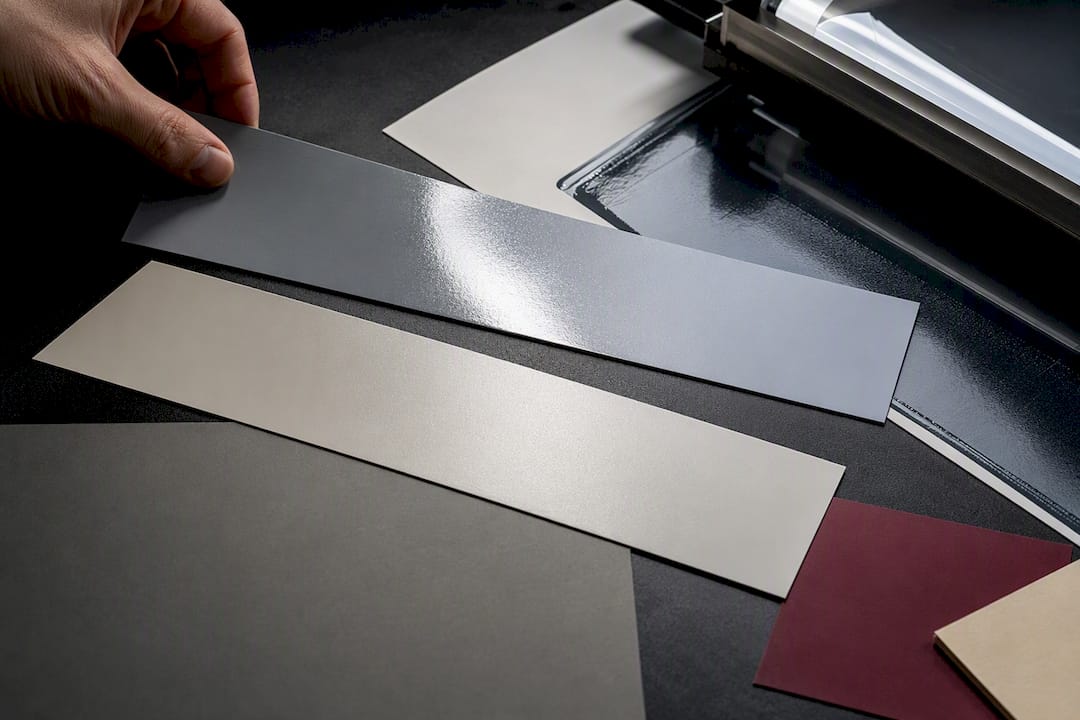
Choose aqueous coating for foldable cartons, writable surfaces, and sustainability-driven packaging; choose UV coating when you need maximum gloss and abrasion resistance. The split comes down to how each cures: aqueous relies on water evaporation, UV cures instantly through photochemical reaction under light exposure. That difference shapes everything from press turnaround to shelf durability, which is why the production teams test both on the actual substrate before locking in a production spec.
**TL;DR:** Aqueous coatings rely on water evaporation and are preferable for flexible, foldable, and recyclable packaging, while UV coatings cure instantly for high-gloss, abrasion-resistant finishes. UV coatings offer superior durability against abrasion, chemicals, and blocking, making them ideal for high-traffic, demanding applications such as retail displays and labels. Aqueous coatings perform better on folds, bends, and rolling, resisting cracking and offering improved flexibility for mailing pieces and folding cartons. UV coatings can achieve maximum gloss and visual depth, while aqueous coatings typically provide satin or matte finishes, with softer sheen options. Proper testing on actual substrate and handling conditions is essential, as substrate interaction heavily influences coating performance and avoids costly reprints.
Yuanpackaging
Explore Yuan Packaging
Table of Contents
- Aqueous vs UV Coating at a Glance
- How Aqueous and UV Coatings Actually Cure
- Which Coating Holds Up Better Under Wear and Handling
- Choosing the Right Finish for Visual Impact
- Environmental Trade-Offs Worth Weighing
- How to Choose the Right Coating for Your Project
- How Yuan Packaging Chooses Finishes for Premium Packaging
- What Practitioners Get Wrong About This Comparison
- Get a Finish Recommendation for Your Next Production Run
- Sources
- FAQ
Aqueous vs UV Coating at a Glance
Both coatings solve the same problem, protecting and enhancing a printed surface, but they get there through opposite mechanics. UV cures in a fraction of a second under a lamp; aqueous needs its water content to evaporate before the sheet can move to the next station. That single distinction cascades into every operational decision you’ll make on press.
Here’s how the two stack up on the factors that matter most in production:
- *Curing speed:** UV cures almost instantly; aqueous requires evaporation of up to 60% water content, usually with forced hot air or infrared assistance.
- *Durability:** UV wins on abrasion, scuff, and chemical resistance; aqueous flexes better and resists cracking on tight folds.
- *Finish range:** UV hits the highest gloss and deepest visual pop; aqueous tends toward satin and matte, with soft-touch variants available.
- *Turnaround:** UV allows immediate bindery work after cure; aqueous coating versus varnish comparisons still favor aqueous for speed, but it can require extended delivery time before finishing.
- *Cost profile:** UV demands lamp or LED curing equipment and higher upfront tooling; aqueous runs on standard coating units many presses already have.
If your project needs a quick answer to aqueous coating vs lamination questions too: aqueous is a liquid finish applied and cured on press, while lamination bonds a plastic or paper film to the sheet. They solve similar protection problems but sit in entirely different production categories.
How Aqueous and UV Coatings Actually Cure
The chemistry behind each coating explains almost every practical difference you’ll encounter on press.
- *UV photochemical cross-linking.** UV coatings contain 100% solids, no water or solvent carrier, and cure when photoinitiators react to ultraviolet light, cross-linking the polymer instantly. Mercury-vapor lamps have long been the standard curing source, but LED-UV systems are gaining ground for their lower heat output and longer bulb life, which matters on heat-sensitive stocks.
- *Aqueous evaporation.** Aqueous coatings are water-based emulsions that dry as water evaporates, often facilitated by infrared or hot-air dryers built into the coating tower. Because the process depends on evaporation rather than reaction, drying time is sensitive to humidity, stock porosity, and coating weight.
- *Application equipment.** Litho and flexo presses commonly run aqueous through in-line coating towers; UV requires a dedicated curing lamp station, either in-line or as an off-line pass. Gravure and screen printing both support UV formulations for spot effects, and digital presses increasingly pair aqueous primers with toner-matched UV topcoats to improve adhesion.
One underappreciated benefit: aqueous coating can eliminate the need for spray powder in sheet-fed offset by promoting faster ink holdout, which cuts down on a common source of setoff and smearing.
Which Coating Holds Up Better Under Wear and Handling
Durability is where the aqueous vs UV coating debate gets concrete. UV coatings offer greater abrasion, mar, blocking, and chemical resistance because the cured film is harder and denser. That makes UV the default for anything that gets handled roughly: retail point-of-sale displays, menus, or labels exposed to condensation and grease.
Aqueous performs better where flexing matters:
- *Fold resistance:** Aqueous is less prone to cracking along score lines, a real issue for gift boxes and folding cartons with tight fold geometry.
- *Mailing durability:** Direct mail pieces that get bent, stuffed, and sorted mechanically tend to survive better with aqueous, since UV film can crack under repeated flex stress.
- *Chemical exposure:** UV resists solvents and grease notably better, which matters for food-adjacent packaging or products handled with lotions.
- *Substrate sensitivity:** Coated stocks and uncoated papers absorb coatings differently, and the same aqueous formula that looks flawless on a coated sheet can dull or streak on uncoated stock.
**Pro Tip:** _Run your fold test on the actual production substrate, not a proof sheet. Coating and ink interact differently depending on stock, and a fold that passes on one paper can crack on another from the same mill._
Choosing the Right Finish for Visual Impact
Gloss level is often the deciding factor once durability requirements are met. UV coatings produce the highest gloss and greatest visual depth of any liquid coating option, which is why photographic labels, cosmetic packaging, and premium spirits bottles so often carry a UV finish. It reads as “pop” under retail lighting and photographs sharply for e-commerce listings.
Your finish options break down roughly like this:
- *Flood UV:** Full-surface high gloss, best for maximizing shelf shine on the entire panel.
- *Spot UV:** Selective gloss over logos or type against a matte base, a favorite for cosmetic and spirits labels needing contrast.
- *Aqueous gloss or satin:** A softer sheen with lower reflectivity, useful when you want protection without competing with foil or embossing detail.
- *Soft-touch matte:** Available in both families but more commonly achieved through specialty aqueous or lamination systems, giving a velvet-like hand feel that signals restraint and luxury.
Explore the full range of finish and print effect options before locking your dieline, since gloss level changes how foil stamping and embossing catch light.
Environmental Trade-Offs Worth Weighing
Sustainability claims deserve more nuance than “water-based equals greener.” Aqueous coatings are generally recyclable, biodegradable, and repulpable once fully dried, and their low odor makes them easier on production floor air quality. UV coatings run on 100% solids chemistry with no solvent carrier, so cured UV emits essentially no VOCs, and the EPA has designated UV curing as Best Available Control Technology for emissions control in some regulatory contexts.
A few points worth flagging for procurement teams:
- Wet, uncured UV materials can carry irritant odors and require careful handling before cure.
- Cured UV film is repulpable but breaks down more slowly than aqueous in composting or biodegradation scenarios.
- LED-UV curing systems cut energy use compared to older mercury-lamp setups, narrowing the energy-lifecycle gap between the two chemistries.
How to Choose the Right Coating for Your Project
Run through this checklist before you commit a spec to press:
- *Define handling stress.** Will the piece be folded, mailed, laminated, or laundered? Fold-heavy jobs lean aqueous; abrasion-heavy jobs lean UV.
- *Identify the substrate and ink.** Uncoated stock, digital toner, and offset ink each interact differently with coating chemistry, so confirm compatibility before scaling up.
- *Set your gloss target.** If the design calls for maximum shine or a spot-gloss contrast effect, UV is usually the only route that delivers it fully.
- *Check your timeline.** UV cures instantly and allows immediate bindery work; aqueous coating vs UV coating turnaround times can diverge sharply if your schedule is tight.
- *Weigh sustainability commitments.** If recyclability claims matter to your brand, aqueous typically supports repulping claims more directly.
- *Test before you commit.** Testing coating and primer combinations on the actual substrate and press process is the only reliable way to confirm adhesion, gloss, and fold performance.
Run an adhesion test, a rub and mar test, a fold and crack test, and a water or chemical exposure check, then simulate the actual bindery process, folding, gluing, or trimming, on your final sample.
**Pro Tip:** _Never approve a coating based on a flat proof alone. Insist on a press proof, a bindery sample folded exactly as production will fold it, and, for mailed pieces, a mock-up run through your actual mailing process._
How Yuan Packaging Chooses Finishes for Premium Packaging
Twenty-five years of running finish decisions across beauty, spirits, and premium retail packaging has taught our production teams one consistent lesson: the right coating depends on the box, not the brand’s preference. We typically specify aqueous for foldable cartons where crease integrity matters more than shine, and reach for UV when a photographic spirits label needs to catch light on a shelf.
Coordination matters as much as the coating itself. Our teams sequence finishing steps, coating, foil stamping, embossing, in an order that avoids setoff and cracking at the fold, and we check substrate and board compatibility before any full production run begins.
What Practitioners Get Wrong About This Comparison
Most coating comparisons treat aqueous and UV as competitors fighting for the same job, when they’re really solving different problems. The conventional advice, “pick the shinier one for premium and the cheaper one for everything else,” ignores the fold and flex data almost entirely. A premium gift box that cracks along its score line looks worse on a retail shelf than a modest satin finish that holds its edge.
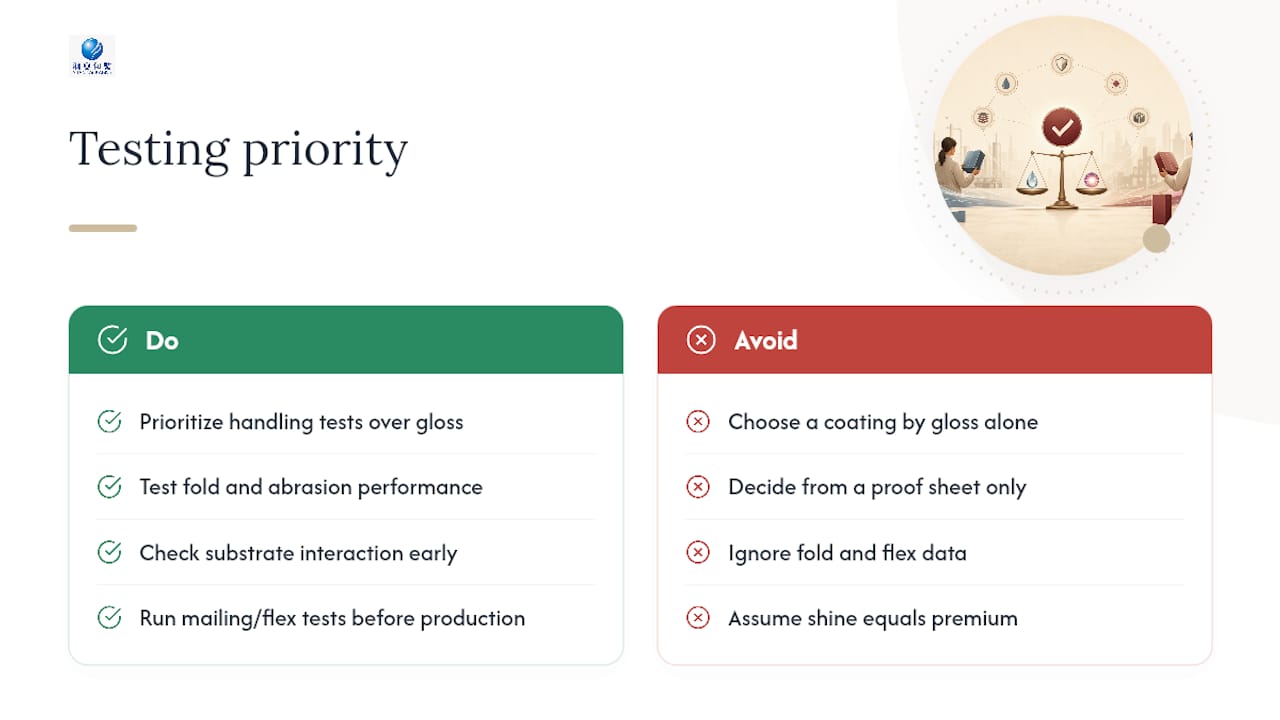
The bigger gap I see in practice: teams choose a coating based on a proof sheet, then discover the mismatch after a full production run, once the fold or the mailing test finally happens. Substrate interaction is the variable that gets skipped most often, and it’s the one most likely to cause a costly reprint.
If you take one thing from this comparison, prioritize the handling test over the gloss meter. Gloss is easy to evaluate and easy to get wrong on assumption; fold and abrasion performance only reveal themselves under the exact stress your packaging will face after it leaves the press.
_— Anthony_
Get a Finish Recommendation for Your Next Production Run
Guessing between aqueous and UV on a spec sheet costs far less than discovering the wrong choice after a full print run ships. Yuan Packaging runs finish decisions daily across custom labels, rigid gift boxes, folding cartons, and non-woven bags, and our teams test coating and substrate combinations before committing to production tooling.
Send us your substrate, artwork files, and expected handling conditions, mailing, retail shelf, cosmetic use, and we’ll flag adhesion or fold risks before they become reprint costs. For photographic spirits or beauty labels chasing maximum shelf gloss, or foldable cartons that need to survive shipping without cracking, request a sample set through the custom labels page and get a feasibility review started this week.
Sources
- Differences Between Aqueous and UV Coatings — Cork Industries
- Notable differences between Aqueous Coatings and UV Coatings • Cork Industries
- Aqueous Coating Versus UV Coating: Which Works Best? — Ironmark USA
- UV coating vs aqueous coating for digital printing — Printing News
FAQ
Is Aqueous Coating Waterproof?
Aqueous coating is water resistant, not fully waterproof. It adds a protective barrier against light moisture and handling, but standing water or prolonged exposure can still degrade the finish faster than a cured UV coating would.
What Are the Four Types of Coatings Used in Print?
The four common liquid and film finishes in commercial printing are aqueous coating, UV coating, varnish, and lamination. Each cures or applies differently, water evaporation for aqueous, photochemical cure for UV, oil-based drying for varnish, and film bonding for lamination.
What Is an Aqueous Coating?
An aqueous coating is a water-based liquid finish applied on press and dried through evaporation, often assisted by infrared or hot-air drying. It’s valued for its flexibility, low odor, and recyclability, making it a common choice for foldable cartons and writable surfaces.
Is Aqueous Coating Glossy or Matte?
Aqueous coating is available in gloss, satin, and matte finishes, though it generally reads softer than UV gloss. For maximum shine and visual depth, UV coating still produces the highest gloss levels of any liquid finish.
Does Yuan Packaging Offer Both Aqueous and UV Finishing?
Yuan Packaging works with both coating families and helps clients test finish options against their specific substrate and handling needs. Current finish capabilities and pricing are available through the labels product page or by requesting a consultation directly.