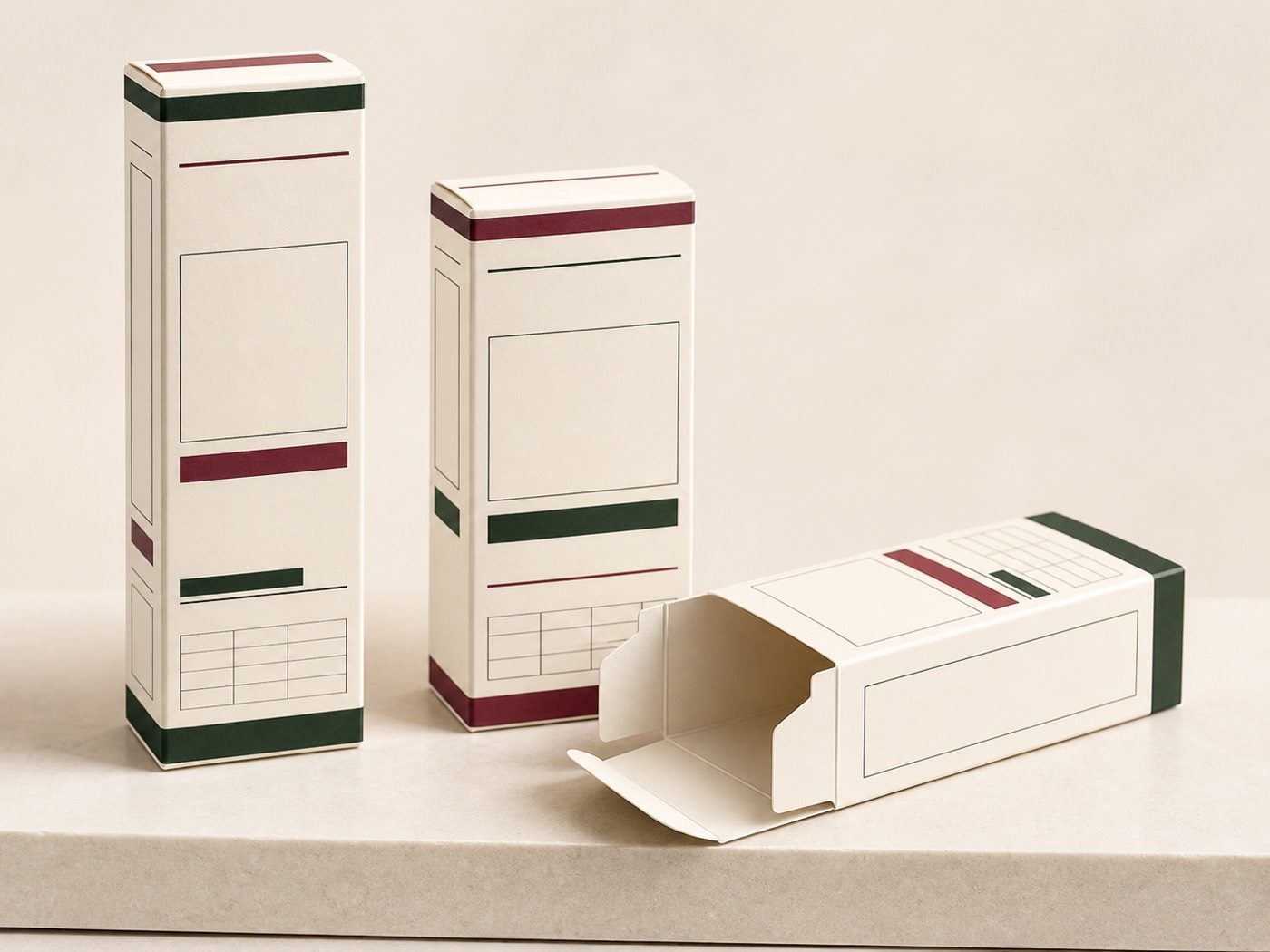
Specify five things before the dieline is drawn: the Braille text and position, the tamper-verification feature, the leaflet's folded size, the coding area for the Data Matrix, and the board and finish limits. Each one changes the carton's structure, and EU, UK and US rules differ on several of them.
Key takeaways: Fix Braille, the tamper feature and the coding area in the dieline before artwork starts. Your regulatory team supplies the approved text and code data. Approve a folded, filled sample on your cartoning line, and plan separate EU and UK packs, because UK packs must now say "UK Only".
Table of Contents
- Braille: EN ISO 17351 and Marburg Medium
- Tamper Verification and the EU Anti-Tampering Device
- Patient Information Leaflets and Outserts
- Serialisation and the Coding Area: EU, UK and US
- Board, Print and Production Pitfalls
- Artwork Control and Supplier Qualification
- What to Send for a Quote
- How Yuan Packaging Can Help
- FAQ
- Sources
Braille: EN ISO 17351 and Marburg Medium
Article 56a of Directive 2001/83/EC requires the medicine's name in Braille on the packaging. The European Commission's readability guideline reads this as the brand (invented) name and the dose strength, in every language of a multilingual pack. Single-strength products may show the name alone; products given only by healthcare professionals are excluded.
The guideline asks for uncontracted Braille and highly recommends the Marburg Medium cell size. For packs of 10 ml or less it accepts contracted Braille, defined abbreviations or a supplementary tab label. EN ISO 17351, which replaced EN 15823 without changing its content, sets legibility requirements, including dot height, and gives verification methods in a normative annex.
Fix the Braille position on the dieline, clear of creases, glue flaps and the coding area, and agree how dot height will be measured. Embossed dots add no material but their height depends on the board; screen-printed Braille uses a raised varnish. See how the tactile panel is planned for Braille-embossed cartons.
Tamper Verification and the EU Anti-Tampering Device
Delegated Regulation (EU) 2016/161 defines the anti-tampering device as the safety feature that shows whether a pack has been tampered with. The Commission's safety-features Q&A adds that removal or breakage should be visually evident throughout the shelf life, that the device should survive normal handling, and that manufacturers may consider EN ISO 21976:2020, which superseded EN 16679:2014. In the US, 21 CFR 211.132 requires tamper-evident packaging and a label statement for most over-the-counter retail products (dermatological, dentifrice, insulin and lozenge products are exempt).
The table compares the four carton-related categories in EN ISO 21976.
| Feature | Applied by | Line equipment | Watch for |
|---|---|---|---|
| Folding box closed with glue | Your cartoning line | Glue unit on the cartoner | The glue bond must leave visible damage when opened; keep Braille and code off the glued flap |
| Specially constructed folding box, such as a tear strip | The carton supplier, in the dieline | None beyond closing | Must survive transport yet tear cleanly |
| Sealing label or tape | Your packing line | Label applicator | Not over printed batch and expiry; over the Data Matrix only if it stays readable and holds no patient information (Q&A 1.23) |
| Film wrapper or sleeve | Your line | Wrapper or sleever | The code must scan through or around it |
Compare structures on the tamper-evident cartons and seals page.
Patient Information Leaflets and Outserts
The leaflet's folded size sets the carton's internal dimensions. Article 59(3) of Directive 2001/83/EC requires the leaflet to reflect consultation with target patient groups, and the readability guideline treats 9-point type with at least 3 mm between lines as the minimum, so long multilingual texts need larger pages, more folds or lighter paper.
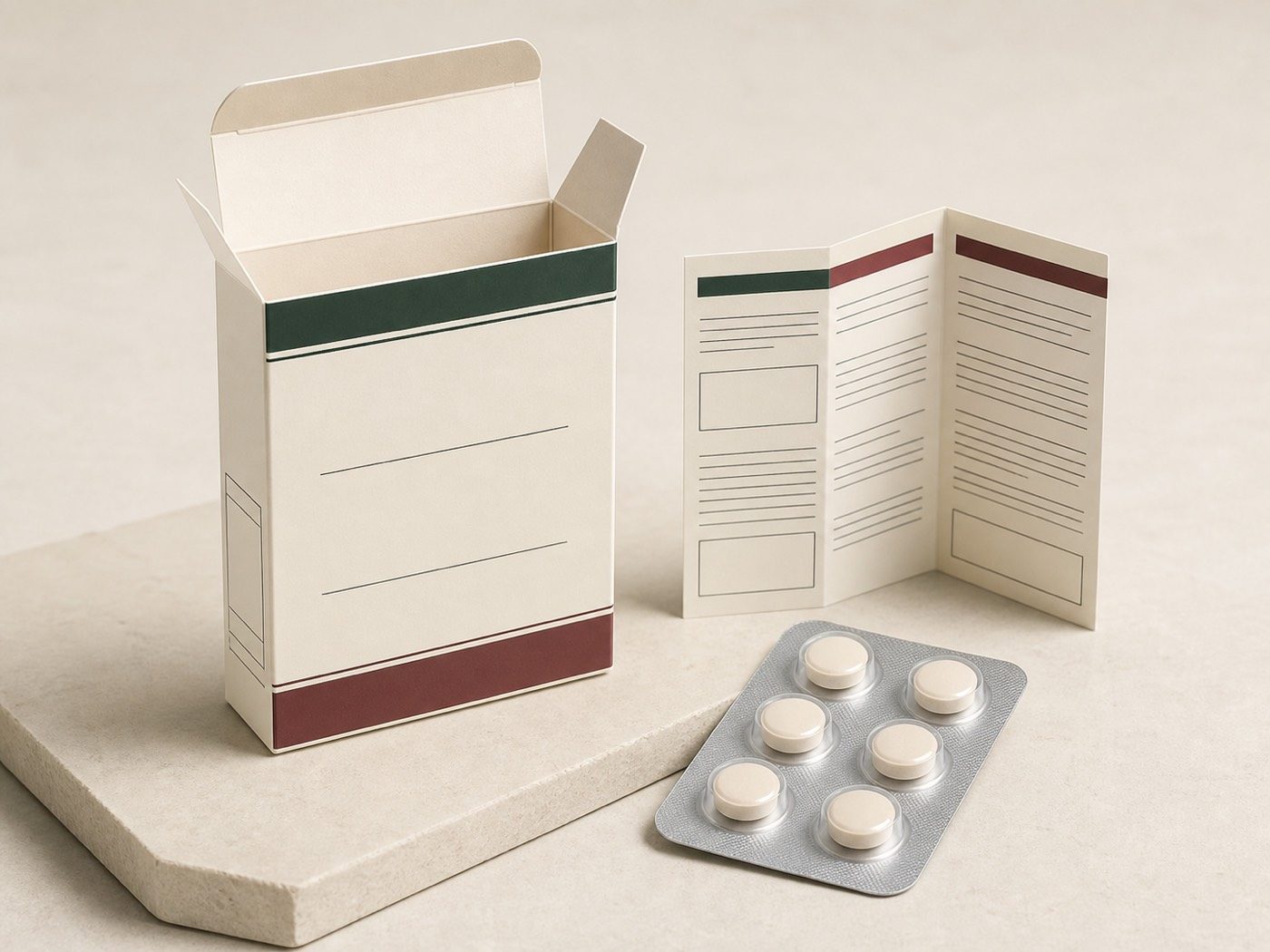
An outsert is a leaflet folded into a compact block and attached to the outside of a container or carton. It suits packs with no carton, or no room inside one, but adds a gluing or labelling step on your line.
Send the leaflet's flat size, fold pattern and folded size, ideally with a folded dummy, and choose paper opaque enough to stop the reverse showing through. Carton, leaflet and primary pack are sized together for unit medicine cartons.
Serialisation and the Coding Area: EU, UK and US
The EU Falsified Medicines Directive rules and the US Drug Supply Chain Security Act (DSCSA) both require a unique, machine-readable identifier on each pack. Neither makes GS1 mandatory, but the GS1 DataMatrix Guideline is the common reference, encoding (01) GTIN, (17) expiry, (10) batch and (21) serial number. Since 1 January 2025 the whole UK follows its own rules (MHRA guidance).
| Requirement | EU: Regulation 2016/161 | UK: since 2025 | US: DSCSA |
|---|---|---|---|
| Scope | Prescription medicines (minus Annex I exemptions) and the Annex II non-prescription medicines | EU safety features no longer apply; packs must carry "UK Only" | Prescription drugs, per package and per homogenous case (a sealed case of one product and lot) |
| Code | Data Matrix: product code, randomised serial number of up to 20 characters, batch, expiry, any national number | Optional 2D code, but none uploaded to the EU repository system | 2D data matrix: NDC, serial number of up to 20 characters, lot, expiry |
| Human-readable text | Product code and serial number beside the code, unless the two longest sides total 10 cm or less; batch and expiry on every pack | "UK Only" in 7-point type or larger; batch and expiry as before | NDC, serial number, lot and expiry required on every package, with no small-pack exemption (FDA recommends NDC, SERIAL, LOT, EXP labels) |
| Tamper evidence | Anti-tampering device required | Encouraged | Not in the DSCSA; most OTC retail products fall under 21 CFR 211.132 |
| Braille | Name, plus dose strength if several exist (Article 56a, Directive 2001/83/EC) | Name (Human Medicines Regulations 2012, regulation 259) | Not in the DSCSA |
US entries follow FDA's product identifier Q&A; a carton for both the EU and the US needs room for the US human-readable block even on small packs. In Switzerland both safety features are optional under Article 17a of the Therapeutic Products Act, and in September 2026 the Federal Council proposed keeping them voluntary. Confirm Swiss Braille and coding rules with your Swiss marketing authorisation holder.
Mark a coding area on the dieline, not just a space for the code. Regulation 2016/161 requires a smooth, uniform, low-reflecting surface, and the area should include the following.
- The Data Matrix and a quiet zone one module wide. GS1's table for regulated healthcare items sets the module size (X-dimension) at 0.254–0.495 mm, target 0.380 mm.
- The human-readable product code, serial number and any national number, beside the code and on the same face where space allows.
- The coder type and the surface it needs: inkjet usually needs an unvarnished patch, laser a printed colour patch. Ask the line owner.
- Its position against folds, glue flaps, the Braille and any tamper seal.
Decide early who prints the code. The Commission's Q&A lets an audited, qualified packaging supplier pre-print it under a written agreement (EU GMP Chapter 7). But the identifier includes batch and expiry, so pre-printed cartons are tied to one batch, serial data must be exchanged and reconciled, and the manufacturer still checks the codes on receipt and before release. For cartons made overseas, coding on the packing line of the marketing authorisation holder or its contract packager is usually more practical. For code sizing, see Data Matrix vs QR code.
Board, Print and Production Pitfalls
- Board: coated folding boxboard with a white surface gives small type and codes contrast. Specify grain direction so cartons open square on your cartoner.
- Type size: the readability guideline asks for at least 7-point text, or an x-height (height of a lower-case x) of 1.4 mm, with at least 3 mm between lines. On multilingual cartons this sets panel size.
- Coding area: keep lamination, foil and gloss varnish off it.
- Colour: give Pantone references for colour coding by dose strength, and keep an approved physical colour standard.
Where Pharma Cartons Go Wrong in Production
- Braille dots flattened by folder-gluer belts or tightly packed shipping cases.
- Braille placed too close to a crease or on the glue flap.
- The coding area moved in a dieline revision while the coder on the line stayed in place.
- A thicker-than-planned leaflet bowing the panels and jamming the cartoner.
- Board grain running the wrong way, so cartons will not open square.
- Near-identical SKUs or language versions mixed up after sharing a print sheet.
Each is cheaper to catch on a folded, filled sample run on your line. Construction options are on our folding cartons page.
Artwork Control and Supplier Qualification
An outdated text version is as serious as a print defect, so build these steps into proof control.
- Keep one master artwork per SKU and market, with a version code and a line-readable identification code on the glue flap or another hidden area.
- Check every proof word for word against the approved text, including the Braille text and code fields.
- Approve the dieline on a folded sample holding the leaflet and primary pack, before plates are made.
- Run approved samples on your cartoning line and verify printed codes to ISO/IEC 15415 before sign-off.
- Treat every text change as a new version with a new proof, and quarantine obsolete stock.
What to Ask Any Carton Supplier
Chapter 5 of the EU GMP Guidelines asks medicine manufacturers to qualify printed-packaging suppliers like starting-material suppliers, secure printed materials and destroy obsolete ones; Chapter 7 requires written agreements for outsourced work. Ask any carton supplier about these points.
- A quality agreement, with change control and artwork version control.
- Line clearance between SKUs, and controls when several SKUs share a print sheet.
- Print inspection, and how rejects are kept apart.
- Recorded destruction of obsolete plates, cutting dies and printed stock.
- Retained samples, and a certificate of conformance with each delivery.
Our guides to qualifying a packaging supplier in China and artwork preparation cover the general checks.
What to Send for a Quote
Send these items with your enquiry. The table also shows who usually supplies each one and when it must be fixed.
| What to send | Usually supplied by | Fix before | What it changes |
|---|---|---|---|
| Primary pack dimensions, or physical samples | Brand packaging team | Dieline | Internal size |
| Carton style (ECMA code or dieline), internal length × width × depth, tuck and closure type, cartoner make and model | Line owner | Dieline | Running on the cartoner |
| Leaflet or outsert size, fold pattern and paper weight | Regulatory team and leaflet printer | Dieline | Internal size |
| Braille text per language, position and method | Regulatory team (text), brand packaging team (position) | Dieline | Embossing tool, panel layout |
| Tamper-verification feature, and who applies it | Brand packaging team with the contract packager | Dieline | Flaps, glue pattern, seal label |
| Coding area: who prints, coder type, code size, human-readable fields | Contract packager or line owner | Dieline | Varnish-free area, layout |
| Approved text per SKU and market | Regulatory team | Artwork | Every printed panel |
| Board, Pantone references, finishes and varnish-free areas | Brand packaging team | Printing plates | Print and coding surface |
| Quantities per SKU and language, reorder frequency, markets, delivery address, Incoterm | Procurement | Quote | Price and delivery |
Send it through our contact page. The same list works for nutraceutical and health packaging, where the medicinal-product rules above do not apply.
How Yuan Packaging Can Help
Yuan Packaging has made printed packaging since 2000. Our pharmaceutical cartons page sets out the formats for medicine packs, with standard cartons from 1,000 units. Once your specification is agreed, a project runs as follows.
| Step | Timing |
|---|---|
| Folded carton sample | 5–7 working days |
| Artwork approval | Set by your review |
| Production | 15–20 working days after artwork approval |
| Samples to Europe | 1–2 weeks; DDP or DAP to the EU and the UK, DDP to Switzerland |
FAQ
Can Braille be embossed over printed text on a medicine carton?
Yes. The European Commission's readability guideline says Braille dots need no empty area, provided the printed text underneath stays easily legible. Check both on a folded sample.
Can a QR code go on the same carton as the Data Matrix?
Yes, if it is not used to identify or authenticate the medicine. The Commission's Q&A encourages using spare Data Matrix capacity instead, and placing any QR code away from the Data Matrix, preferably on another side.
Can the unique identifier be applied with a sticker?
Only in limited cases. Regulation 2016/161 requires the code to be printed on the packaging; the Commission's Q&A accepts a tamper-evident sticker for parallel trade, where no alternative exists, or where the competent authority allows it.
How long must the Data Matrix on a medicine carton stay readable?
Under Regulation 2016/161, until at least one year after expiry or five years after release for sale, whichever is longer. ISO/IEC 15415 grade 1.5 or higher is presumed to achieve this.
Sources
- Delegated Regulation (EU) 2016/161 (European Commission)
- Safety features Q&A, version 22 (European Commission)
- Readability guideline for labelling and package leaflets (European Commission)
- EU GMP Guidelines, Chapter 5 (European Commission)
- EU GMP Guidelines, Chapter 7 (European Commission)
- DIN EN ISO 17351, Braille on medicinal product packaging (DIN)
- DIN EN ISO 21976, tamper verification features (DIN)
- GS1 DataMatrix Guideline (GS1)
- Labelling and packaging under the Windsor Framework (MHRA)
- Human Medicines Regulations 2012, regulation 259 (legislation.gov.uk)
- Combating falsified medicines, in German (Swiss Federal Office of Public Health)
- Drug Supply Chain Security Act (US FDA)
- Product identifiers under the DSCSA: Q&A (US FDA)
- 21 CFR 211.132, tamper-evident packaging for OTC drugs (eCFR)
— Anthony
Can Braille be embossed over printed text on a medicine carton?
Yes. The European Commission's readability guideline says Braille dots need no empty area, provided the printed text underneath stays easily legible. Check both on a folded sample.
Can a QR code go on the same carton as the Data Matrix?
Yes, if it is not used to identify or authenticate the medicine. The Commission's Q&A encourages using spare Data Matrix capacity instead, and placing any QR code away from the Data Matrix, preferably on another side.
Can the unique identifier be applied with a sticker?
Only in limited cases. Regulation 2016/161 requires the code to be printed on the packaging; the Commission's Q&A accepts a tamper-evident sticker for parallel trade, where no alternative exists, or where the competent authority allows it.
How long must the Data Matrix on a medicine carton stay readable?
Under Regulation 2016/161, until at least one year after expiry or five years after release for sale, whichever is longer. ISO/IEC 15415 grade 1.5 or higher is presumed to achieve this.