Custom Printed Unit Medicine Cartons
A folding unit carton developed around the primary pack, the information hierarchy and the way the finished pack will be filled.
At a glance
- Minimum order quantity
- Standard cartons from 1,000 units
- Sampling
- Presentation-quality sample in 5–7 working days. The sample cost is credited against your first approved production order.
- Production lead time
- 15–20 working days after artwork approval
- Delivery to Europe
- DDP or DAP to the EU and the UK, DDP to Switzerland; your customs broker confirms duty and VAT rates
- Production
- Made to order (OEM/ODM)
- Country of origin
- Huai'an, Jiangsu, China
- Primary-Pack Fit
Overview
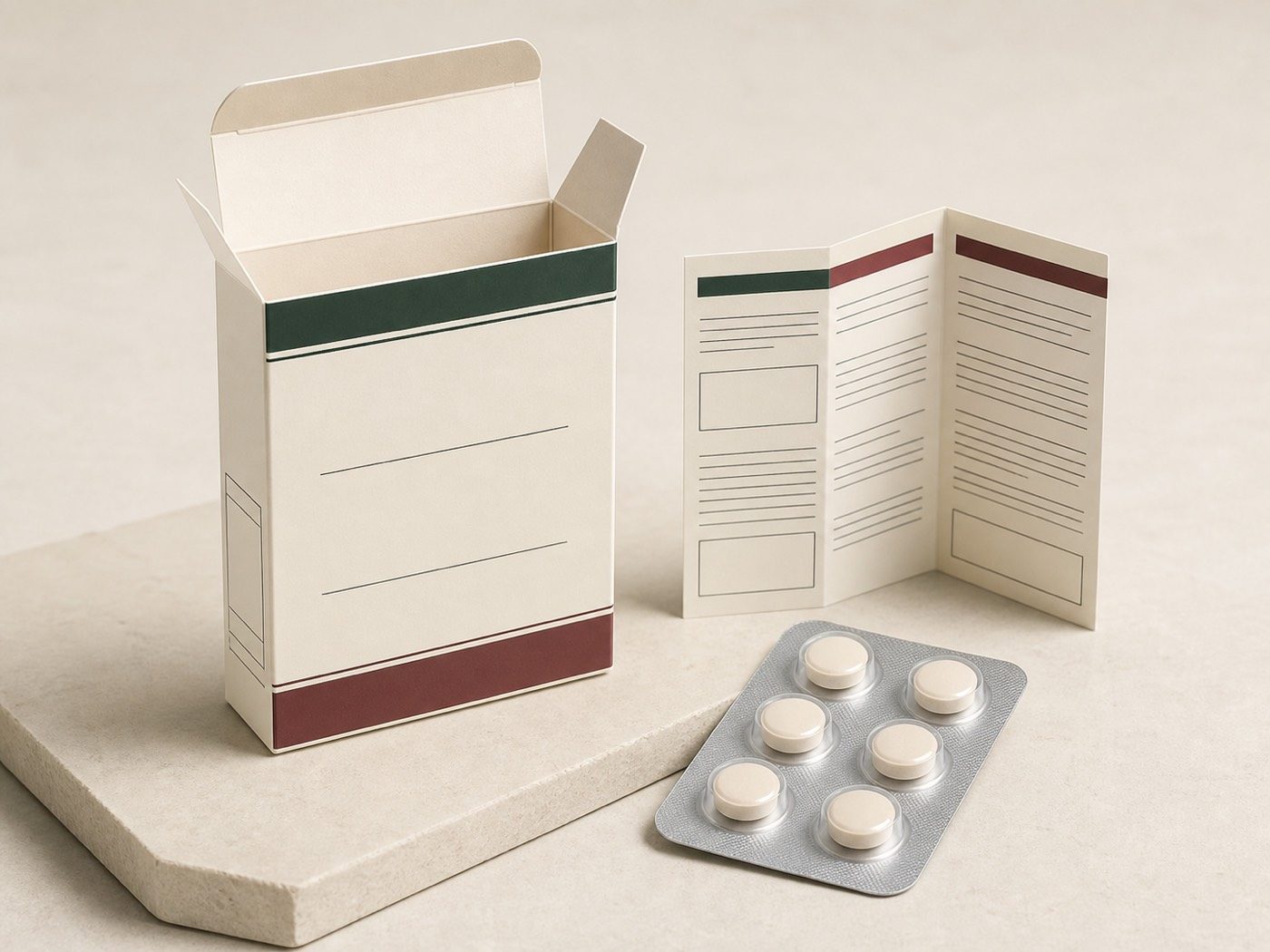
A unit medicine carton brings the primary container and its printed information into one handled pack. The structure is sized to the actual blister, bottle, tube or vial, with room for any folded leaflet and with panels allocated for the approved information, coding areas and identification system supplied for the destination market.
Fit and repeatability matter more than decorative complexity. The dieline and leaflet fold are reviewed together, then a cut, creased and folded sample is packed with the real components. That establishes whether the carton erects square, the leaflet fits without distorting the panels and the information remains where it is expected after folding.
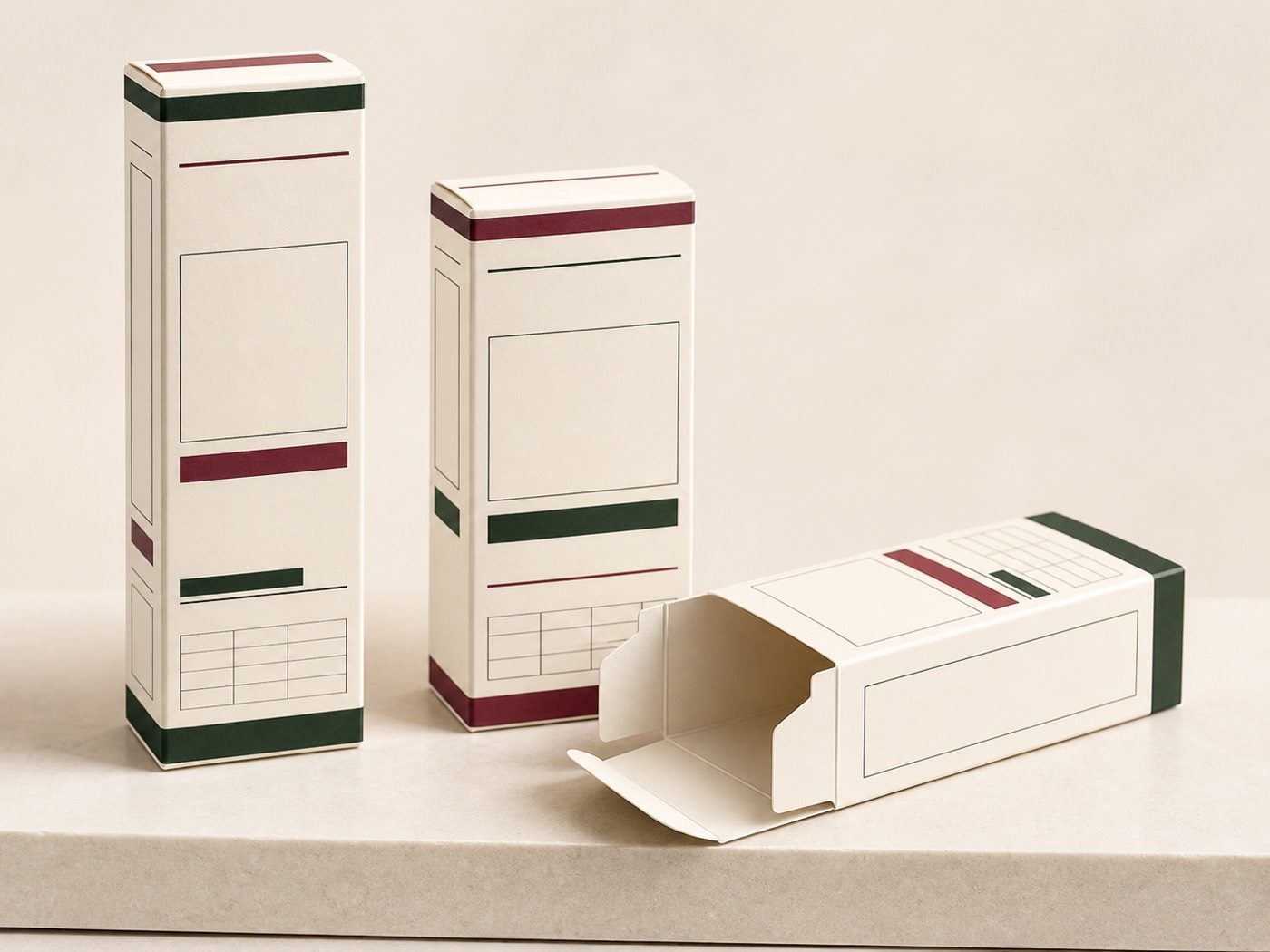
Most unit medicine cartons are tuck-end cartons: four body panels joined by one glued side seam and closed at both ends, the form a horizontal cartoning machine opens, loads from one end and closes. The tuck and dust flaps are proportioned for the cartoner's closing action, and the glue flap is placed behind a panel that carries neither the main information nor the coding area. Board caliper and grain direction are chosen for crease recovery, so the flat carton opens square when it is picked from the magazine.
What to decide for this format
Primary Pack & Leaflet Fit
Size the carton from the actual container and folded leaflet, including how both components are loaded.
Information & Coding Zones
Allocate approved copy, identification and variable-data areas before folds, glue seams and finishing are finalised.
Carton Alone or With a Tray Insert
Blisters, a bottle or a tube go straight into an end-load tuck carton. Vials or ampoules that must be kept apart sit in a tray or board insert, which is usually end-loaded with them on the same cartoner; top-load cartons suit sets packed by hand. The insert is a second component that sets the carton size, so choose it when the contents must not touch.
Selected work
Across the Pharmaceutical Cartons range
This page covers what is particular to this product. The full lists for the whole range are set out once, on the Pharmaceutical Cartons page:
What applies to this product
- Materials
- Coated Folding Boxboard; Leaflet Papers; Label Face Stocks; FSC-Certified & Recycled Board
- Printing & Finishes
- Offset Printing; Batch & Variable Data Coding; Matte & Gloss Lamination; Die Cutting, Creasing & Gluing
- Applications
- Prescription Medicines; OTC & Consumer Health; Injection & Hospital Products; Supplements & Nutraceuticals
- How it is made
- Component & compliance review; Structure, dieline & fold pattern; Artwork & legibility check; Sampling; Production & coding; Inspection & export packing
What you can customise
- Carton structure sized to the blister, bottle, tube or vial
- Information layout, minimum type size and language versions
- Leaflet size, fold pattern and paper weight
- Batch, expiry and serialisation coding
- Matching primary container label
- Export case pack, labelling and pallet configuration
Specifications
| Minimum order quantity | Standard cartons from 1,000 units |
|---|---|
| Production lead time | 15–20 working days after artwork approval |
| Printing | Koenig & Bauer Rapida 106 eight-colour offset — 0.1 mm register at 18,000 sheets per hour |
| Quality management | ISO 9001 quality management, ISO 14001:2015 environmental management, ISO 45001 |
| Colour consistency | Pantone spot colours with a physical reference retained between repeat orders |
| Components supplied | Unit carton, patient leaflet, primary container label and outer shipping case |
Terms for this specification
- Sampling
- Presentation-quality sample in 5–7 working days. The sample cost is credited against your first approved production order.
- Colour matching
- Pantone references and physical samples are used where the selected print process supports them. The approval method follows the substrate, artwork and process.
- Certifications
- ISO 9001, ISO 14001:2015, ISO 45001 and China Environmental Labelling (Ten-Ring). ISO 22000 applies to eligible food-contact work.
- Sustainable options
- FSC-certified or recycled-content paper and board, water-based inks and adhesives, and fibre-based fitments are available where the selected construction supports them.
Design & artwork
From an artwork check, through a dimensioned dieline and print-ready files, to a full concept package across a range — done by the factory that will make it.
Frequently asked questions
Can the carton and patient leaflet be developed together?
Yes. The leaflet fold pattern affects the space inside the carton, so both are reviewed against the primary pack and proven together in the physical sample rather than treated as unrelated components.
What do you need before drawing the unit-carton dieline?
Provide the actual blister, bottle, tube or vial dimensions, the leaflet requirement, packing method and the approved information requirements for the destination market. Those inputs establish the structure before artwork is placed.
Can one dieline serve several strengths or pack sizes?
Often, if the primary packs share the same dimensions. The variants are then told apart by print, such as colour bands, strength panels and codes, while the structure and cutting die stay the same. When the container or the count changes the carton size, a separate dieline is drawn and sampled with that pack.
Where should the coding area go?
On a flat panel away from creases, the glue seam and any laminated or heavily varnished area, so the code prints cleanly and the scanner on your line can read it. Tell us the coding method and the point on the line where it is applied; the area is then marked on the dieline before artwork begins.
From the Journal
Related products
Request a custom packaging quote
What to send for a quote
- The product it is for, and the format you have in mind
- Size as length × width × height, and whether those are inside or outside dimensions
- Quantity, or two or three quantities if you want to compare unit prices
- Material and finish preferences, or the look you are after
- Artwork status: print-ready files, a draft, or nothing yet
- The date you need the goods by
- The destination country
Missing some of these? Send what you have, and we will ask about the rest.