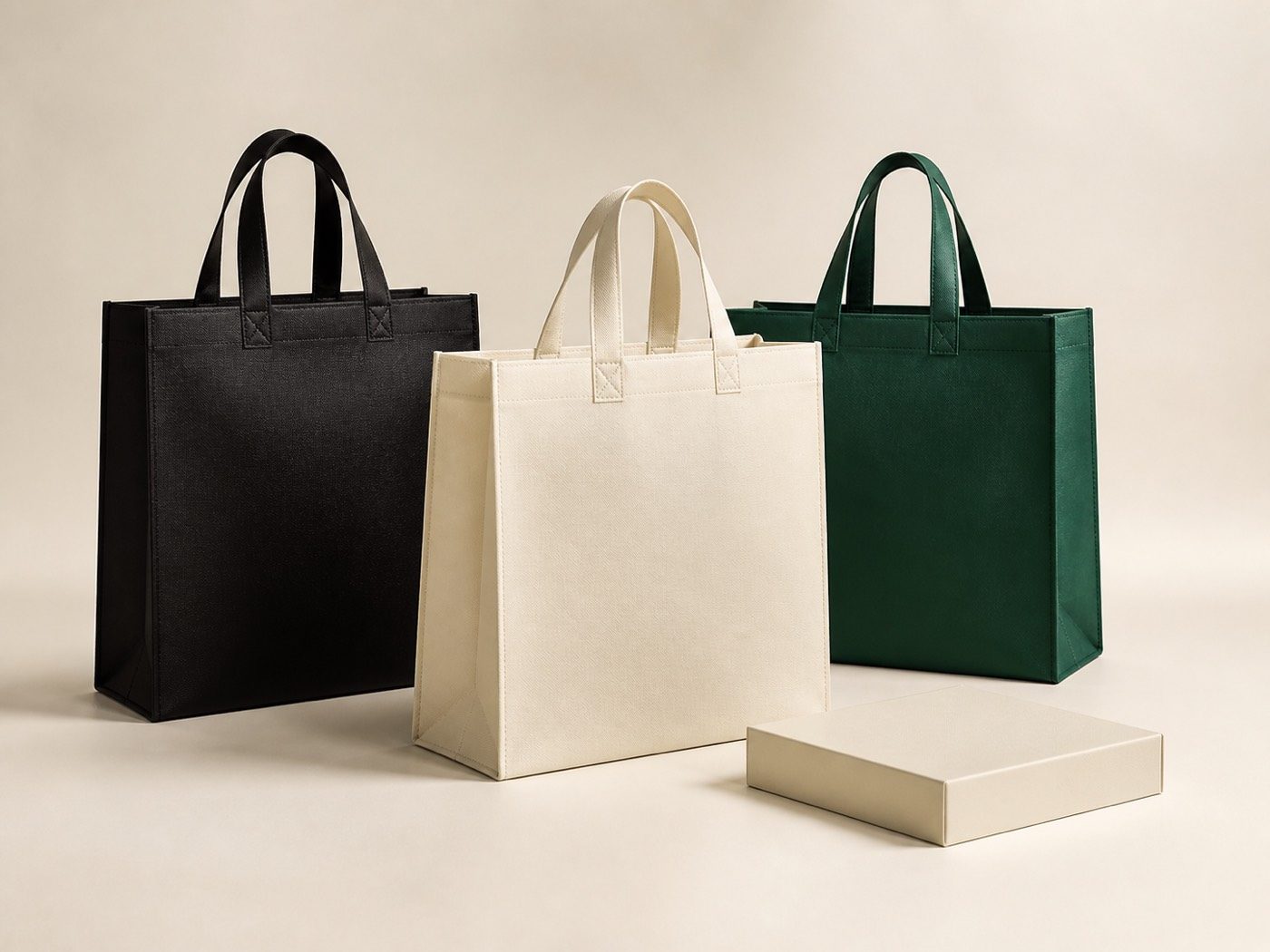
Custom Flat Non-Woven Tote Bags
A simple flat carrier for briefs that value an economical format, clear print area and easy storage between uses.
At a glance
- Minimum order quantity
- Typically 500–1,000 units for carrier bags with complex finishes; confirmed per specification
- Sampling
- Presentation-quality sample in 5–7 working days. The sample cost is credited against your first approved production order.
- Production lead time
- 15–20 working days after artwork approval
- Delivery to Europe
- DDP or DAP to the EU and the UK, DDP to Switzerland; your customs broker confirms duty and VAT rates
- Production
- Made to order (OEM/ODM)
- Country of origin
- Huai'an, Jiangsu, China
- Flat Format
Overview
The flat tote is the simplest non-woven carrier format: a straightforward bag without the added depth of side or base gussets. It suits lighter, flatter contents and programmes where a broad printed panel matters more than a bag that stands by itself.
The main decisions are the finished dimensions, handle length and print route. Laminated non-woven supports full-colour artwork across the panel, while unlaminated material suits simpler screen-printed spot-colour graphics; the artwork and intended lifespan should decide between them.
A flat tote has no gussets: the front and back are cut as two panels, or as one panel folded at the base, and joined along the edges. Handles are cut from the same fabric or from webbing and fixed to the inside of the top hem, where a folded or bound edge gives the attachment more material to grip. With laminated material, the printed film covers the face before the panels are cut, so artwork near the seams and the hem needs a safe margin.
What to decide for this format
Contents and proportions
Confirm the largest item and how it should sit in the bag before setting the panel width and height.
Print route
Choose laminated full-colour or direct spot-colour printing from the artwork rather than treating them as equivalent surfaces.
Handle length and fixing
Choose hand-carry or shoulder length, then where the handles join the hem, because both affect how the printed panel hangs when the bag is full.
Across the Non-Woven Bags range
This page covers what is particular to this product. The full lists for the whole range are set out once, on the Non-Woven Bags page:
What applies to this product
- Materials
- Non-Woven Polypropylene; Laminated Non-Woven; Handle Options
- Printing & Finishes
- Full-Colour Laminated Print; Screen Printing; Matte & Gloss Lamination
- Applications
- Retail Programmes; Promotional & Events; Corporate & Membership
What you can customise
- Finished panel width and height set around the intended contents
- Material colour and whether the surface is laminated
- Full-colour laminated or screen-printed spot-colour artwork
- Handle type, length and attachment
- Matching specification with a paper bag or gift-box programme
Specifications
| Minimum order quantity | Typically 500–1,000 units for carrier bags with complex finishes; confirmed per specification |
|---|---|
| Production lead time | 15–20 working days after artwork approval |
| Production line | Handbag production line — premium carriers in paper and composite materials, with automated forming and post-processing |
Terms for this specification
- Sampling
- Presentation-quality sample in 5–7 working days. The sample cost is credited against your first approved production order.
- Colour matching
- Pantone references and physical samples are used where the selected print process supports them. The approval method follows the substrate, artwork and process.
- Certifications
- ISO 9001, ISO 14001:2015, ISO 45001 and China Environmental Labelling (Ten-Ring). ISO 22000 applies to eligible food-contact work.
Design & artwork
From an artwork check, through a dimensioned dieline and print-ready files, to a full concept package across a range — done by the factory that will make it.
How it is made
Use & load review
The intended contents, frequency of use and carry method set the material weight, panel size and handles.
Flat proportions & print route
Panel width and height are set without gussets, then laminated full-colour or screen-printed spot colour is selected from the artwork.
Sampling
A made-up sample in 5–7 working days is used to judge hand-feel, colour, proportions and handle length.
Printing & lamination
Full-colour print is laminated to the face material, or spot colours are screen printed directly on unlaminated stock.
Cutting, panel joining & handles
Flat panels are cut and joined before the specified handles are attached and reinforced.
Inspection & export packing
Visual and handle checks are made against the approved sample before flat packing.
Frequently asked questions
When is a flat tote preferable to a gusseted bag?
Choose a flat tote for lighter, flatter contents and a simple profile. Choose a gusseted carrier when boxed goods need added depth or the bag benefits from standing more squarely when filled.
Can a flat tote carry full-colour artwork?
Yes, using laminated non-woven with a printed film applied to the face. Simpler solid-colour artwork can instead be screen printed on unlaminated material.
How long should the handles be on a flat tote?
Start from how it will be carried. A hand-carry handle only has to leave room for the hand above the contents, while a shoulder handle has to fit over a coat as well as the shoulder. Handle length is usually given as the drop above the top hem, so the simplest reference is a bag you already use, measured the same way and then confirmed on the made-up sample.
How do we brief a flat non-woven tote for pricing?
Give the finished width and height, the handle length (hand or shoulder) and whether the handles are self-fabric or webbing, the material colour, the quantity per order and the artwork. Say whether the design needs full-colour reproduction or can be printed in solid spot colours, because that decides between laminated and unlaminated material. Say which country the bags are delivered to and, for the EU or the UK, whether you want DDP or DAP.
From the Journal
Related products
Request a custom packaging quote
What to send for a quote
- The product it is for, and the format you have in mind
- Size as length × width × height, and whether those are inside or outside dimensions
- Quantity, or two or three quantities if you want to compare unit prices
- Material and finish preferences, or the look you are after
- Artwork status: print-ready files, a draft, or nothing yet
- The date you need the goods by
- The destination country
Missing some of these? Send what you have, and we will ask about the rest.