Custom Non-Woven Bottle & Gift Set Carriers
A reusable carrier developed around the dimensions and weight of a bottle or complete presentation set.
At a glance
- Minimum order quantity
- Typically 500–1,000 units for carrier bags with complex finishes; confirmed per specification
- Sampling
- Presentation-quality sample in 5–7 working days. The sample cost is credited against your first approved production order.
- Production lead time
- 15–20 working days after artwork approval
- Delivery to Europe
- DDP or DAP to the EU and the UK, DDP to Switzerland; your customs broker confirms duty and VAT rates
- Production
- Made to order (OEM/ODM)
- Country of origin
- Huai'an, Jiangsu, China
- Bottle & Gift Fit
Overview
Non-woven bottle and gift-set carriers are developed around a specific packed item, not treated as a general shopping tote. A narrow bottle and a wide presentation box place different demands on the bag proportions, handle clearance and base area.
The format is most useful when the carrier is expected to tolerate repeated use beyond the first journey. Full-colour laminated print or simpler screen-printed artwork can be selected after the structure, intended load and relationship to the primary gift pack are clear.
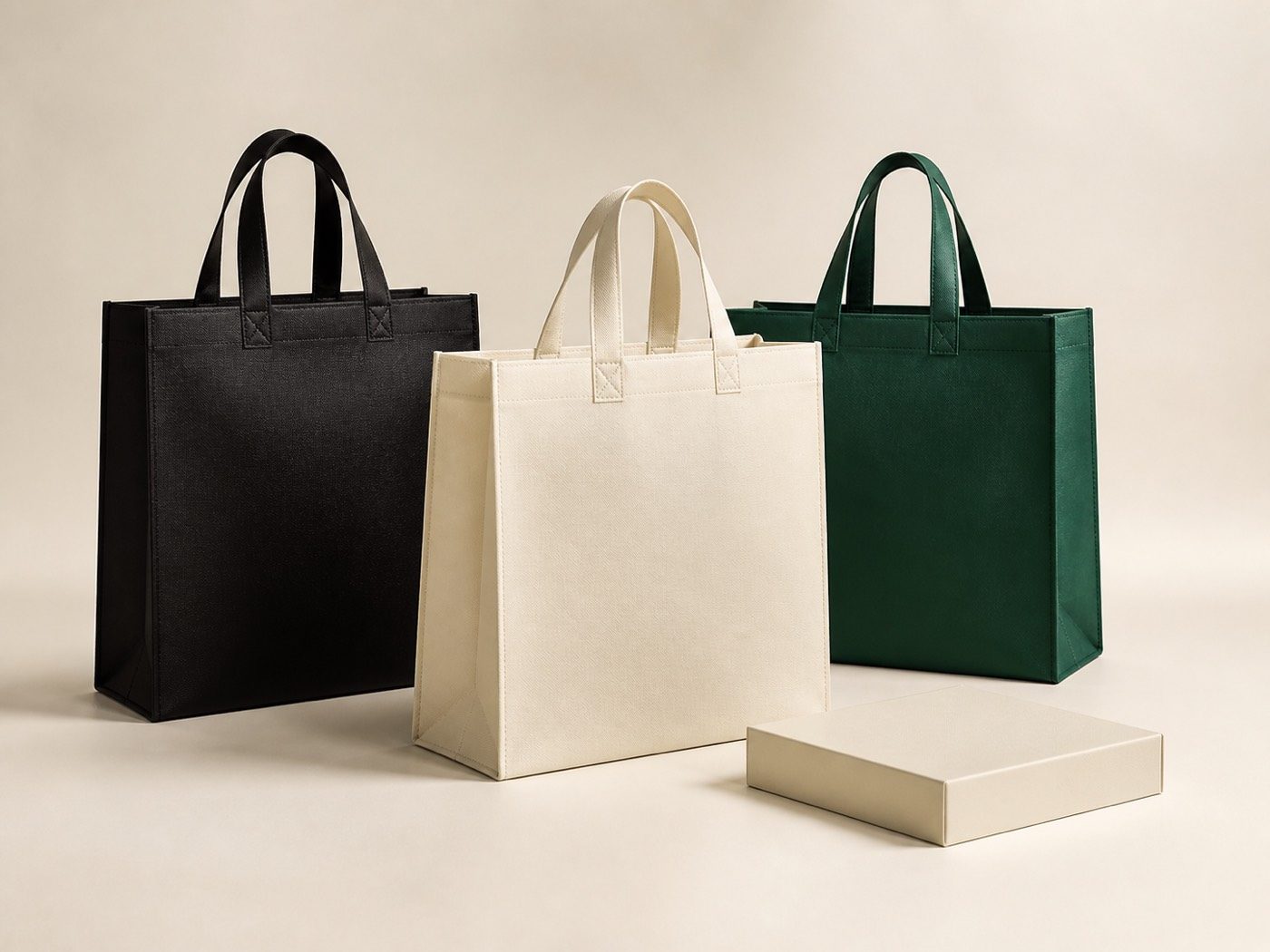
The non-woven bottle carrier is a gusseted bag sized to one item: a narrow front and back, side gussets set to the depth of the bottle or box, and a base panel matched to its footprint. A loose board in the base and webbing or self-fabric handles fixed into the top hem take the weight. Because the fabric is soft, the bag takes its shape from the pack and the base board rather than from its own walls, so it is sized closely to the bottle or box: too loose and the contents lean, too tight and they are hard to take out.
What to decide for this format
Bottle or set geometry
Confirm the complete packed dimensions and orientation so the carrier is proportioned to the real item.
Handle and base
Review the total weight and hard edges together before deciding the handle type and whether base support is needed.
Closure at the top
Decide whether the bag stays open or needs a closure such as a press stud, then check it on the loaded sample.
Across the Non-Woven Bags range
This page covers what is particular to this product. The full lists for the whole range are set out once, on the Non-Woven Bags page:
- Materials and finishes
- What you can customise
- Applications
- How it is made
- What drives the cost
- Why work with us
What applies to this product
- Materials
- Non-Woven Polypropylene; Laminated Non-Woven; Handle Options; Base Reinforcement
- Printing & Finishes
- Full-Colour Laminated Print; Screen Printing; Matte & Gloss Lamination
- Applications
- Retail Programmes; Gifting & Bottle Carriers; Corporate & Membership
- How it is made
- Use & load review; Format & print method; Sampling; Printing & lamination; Cutting, forming & handles; Inspection & export packing
Specifications
| Minimum order quantity | Typically 500–1,000 units for carrier bags with complex finishes; confirmed per specification |
|---|---|
| Production lead time | 15–20 working days after artwork approval |
| Production line | Handbag production line — premium carriers in paper and composite materials, with automated forming and post-processing |
Terms for this specification
- Sampling
- Presentation-quality sample in 5–7 working days. The sample cost is credited against your first approved production order.
- Colour matching
- Pantone references and physical samples are used where the selected print process supports them. The approval method follows the substrate, artwork and process.
- Certifications
- ISO 9001, ISO 14001:2015, ISO 45001 and China Environmental Labelling (Ten-Ring). ISO 22000 applies to eligible food-contact work.
Design & artwork
From an artwork check, through a dimensioned dieline and print-ready files, to a full concept package across a range — done by the factory that will make it.
Frequently asked questions
Can this format be made for a bottle as well as a boxed set?
Yes, but each needs its own dimensions and load review. A bottle carrier is typically narrow and deep, while a boxed set may require different proportions and base support.
Can the non-woven carrier match a paper gift box?
Yes. They can be developed as one programme, but colour should be judged on physical samples because non-woven and printed paper reproduce the same artwork differently.
Can a non-woven carrier hold two bottles?
It can be specified for two, if it is proportioned for both and you say whether the bottles may touch. Keeping them apart changes the base size and the gusset layout, so a twin carrier is quoted as its own specification, not as a wider single.
Which bottle or box details do you need to price a non-woven carrier?
The bottle height and diameter or the box dimensions, the filled weight and how many items each carrier holds. Add the quantity per order, the handle preference and the artwork. If the carrier should coordinate with a paper gift box, include the box's colour reference so both are sampled to it. Say which country the carriers are delivered to and, for the EU or the UK, whether you want DDP or DAP.
From the Journal
Related products
Request a custom packaging quote
What to send for a quote
- The product it is for, and the format you have in mind
- Size as length × width × height, and whether those are inside or outside dimensions
- Quantity, or two or three quantities if you want to compare unit prices
- Material and finish preferences, or the look you are after
- Artwork status: print-ready files, a draft, or nothing yet
- The date you need the goods by
- The destination country
Missing some of these? Send what you have, and we will ask about the rest.