Custom Printed Window Cartons
A folding carton that lets the product take part in the front-panel design through a die-cut opening, optionally backed by a clear patch.
At a glance
- Minimum order quantity
- Standard cartons from 1,000 units
- Sampling
- Presentation-quality sample in 5–7 working days. The sample cost is credited against your first approved production order.
- Production lead time
- 15–20 working days after artwork approval
- Delivery to Europe
- DDP or DAP to the EU and the UK, DDP to Switzerland; your customs broker confirms duty and VAT rates
- Production
- Made to order (OEM/ODM)
- Country of origin
- Huai'an, Jiangsu, China
- Die-Cut Product Window
Overview
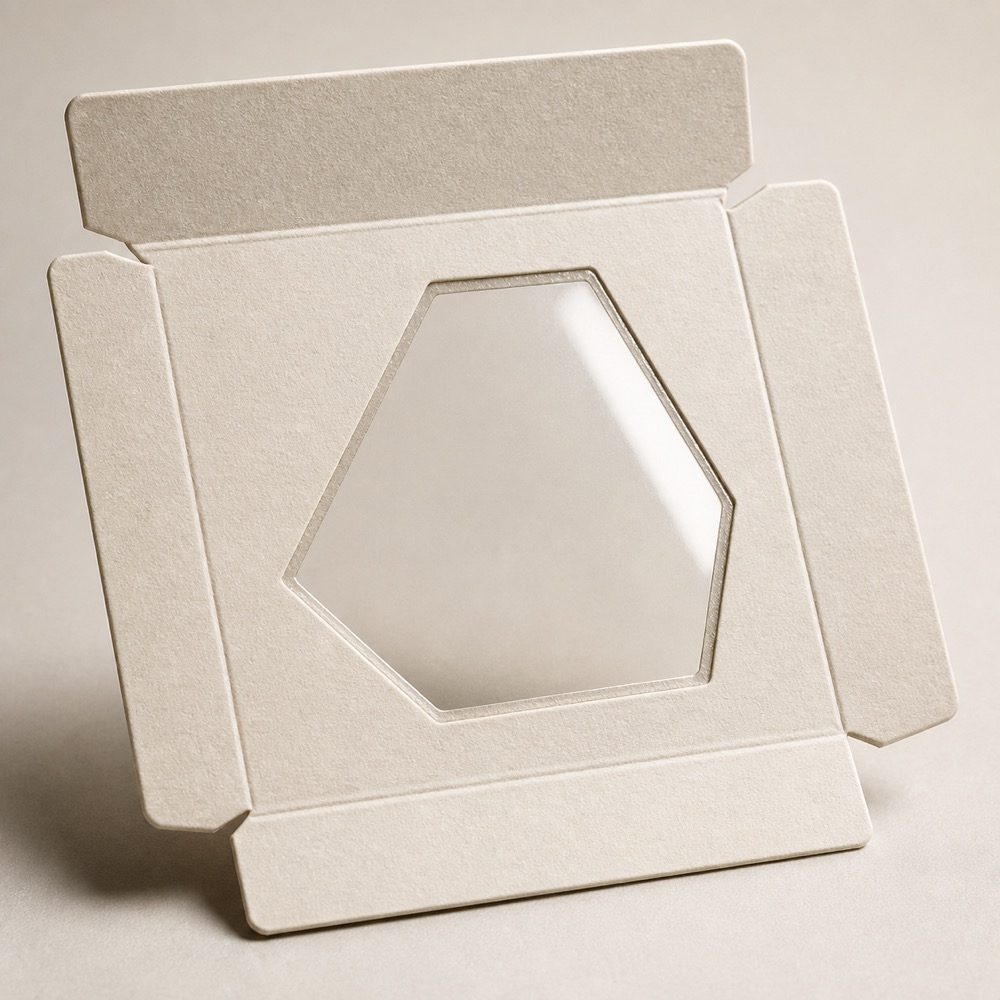
A window carton replaces part of the printed promise with a direct view of the product. The aperture can be a simple geometric opening or follow a deliberate shape in the artwork, but it has to leave enough board around folds, corners and glue areas for the carton to convert and erect cleanly.
The product position matters as much as the window shape. A sample is packed with the real item so the visible face, clearance and movement can be judged before the cutting tool and artwork are final. Where a clear patch is used, its edge and attachment area are planned into the same dieline rather than added after the design is complete.
The window is cut by the same die as the carton outline, so its position is fixed relative to every crease. Where a clear patch is used, it is applied to the inside of the blank over the opening before the side seam is folded and glued, with an adhesive margin around the aperture that has to stay clear of creases and the glue flap. Removing board makes that panel less rigid, so the opening is normally kept inside one panel with a border of board on every side. Large openings, or windows that wrap round a corner, call for a stiffer board or a different panel.
What to decide for this format
Window Position & Shape
Choose what must be visible while retaining sound board around creases, corners, glue areas and finishing details.
Open Aperture or Clear Patch
Decide whether the product can remain exposed through the opening or whether the presentation needs a clear barrier.
Window or Fully Printed Panel
A window shows the real product and can replace a printed image of it, but exposes the contents to light and handling and leaves less room for copy. Choose it when seeing the product decides the purchase; a fully printed panel protects better and carries more information.
Across the Folding Cartons range
This page covers what is particular to this product. The full lists for the whole range are set out once, on the Folding Cartons page:
What applies to this product
- Materials
- Coated Board; Kraft & Uncoated Board; FSC-Certified & Recycled Board; Specialty Papers
- Printing & Finishes
- Offset Printing; Matte, Gloss & Soft-Touch Lamination; Hot Foil Stamping; Embossing & Debossing; Spot UV; Die Cutting, Creasing & Gluing
- Applications
- Beauty & Skincare; Pharmaceutical; Food & Confectionery; Retail & E-Commerce
- How it is made
- Structure & dieline; Artwork on dieline; Sampling; Offset printing; Lamination & finishing; Die cutting, creasing & gluing; Inspection & export packing
What you can customise
- Structure and dieline developed for your product and packing method
- Board type, grade and thickness
- Print — CMYK plus Pantone spot colours
- Lamination, foil, emboss and spot UV combination
- Window apertures and clear patching
- FSC-certified or recycled board with water-based inks
- Export carton count, labelling and pallet configuration
Specifications
| Minimum order quantity | Standard cartons from 1,000 units |
|---|---|
| Production lead time | 15–20 working days after artwork approval |
| Printing | Koenig & Bauer Rapida 106 eight-colour offset — 0.1 mm register at 18,000 sheets per hour |
| Converting | Fully automated line integrating printing, laminating and gluing |
| Food-contact capability | ISO 22000 food-safety certified for food and beverage packaging work |
Terms for this specification
- Sampling
- Presentation-quality sample in 5–7 working days. The sample cost is credited against your first approved production order.
- Colour matching
- Pantone references and physical samples are used where the selected print process supports them. The approval method follows the substrate, artwork and process.
- Certifications
- ISO 9001, ISO 14001:2015, ISO 45001 and China Environmental Labelling (Ten-Ring). ISO 22000 applies to eligible food-contact work.
- Sustainable options
- FSC-certified or recycled-content paper and board, water-based inks and adhesives, and fibre-based fitments are available where the selected construction supports them.
Design & artwork
From an artwork check, through a dimensioned dieline and print-ready files, to a full concept package across a range — done by the factory that will make it.
Frequently asked questions
Can the window follow a custom shape?
Yes. The outline can follow the artwork or the product, provided the remaining board still supports clean die cutting, folding and gluing. The final shape is confirmed on a cut sample rather than judged only on screen.
Do all window cartons need a clear patch?
No. Window cartons can be made with an open aperture or with a clear patch. The choice follows how exposed the product may be, the desired shelf presentation and how the filled carton will be handled.
What should we send for a window carton quote?
The product or a sample of it, its dimensions, the part of it the customer should see, whether the opening needs a clear patch, the quantities you are considering, and the delivery country (for the EU or the UK, also whether you want DDP or DAP). A rough sketch of the window on the front panel is enough to start; the exact outline is drawn on the dieline and checked on a cut sample.
Does a window weaken the carton?
It removes board, so the panel with the opening becomes less rigid. Keeping a border of board around the aperture, placing it away from creases and the glue flap, and choosing the board with the window size in mind keep the carton square. The erected sample, loaded with the product, confirms it before production.
From the Journal
Related products
Request a custom packaging quote
What to send for a quote
- The product it is for, and the format you have in mind
- Size as length × width × height, and whether those are inside or outside dimensions
- Quantity, or two or three quantities if you want to compare unit prices
- Material and finish preferences, or the look you are after
- Artwork status: print-ready files, a draft, or nothing yet
- The date you need the goods by
- The destination country
Missing some of these? Send what you have, and we will ask about the rest.