Custom Push-Fit Cap Paper Tube Packaging
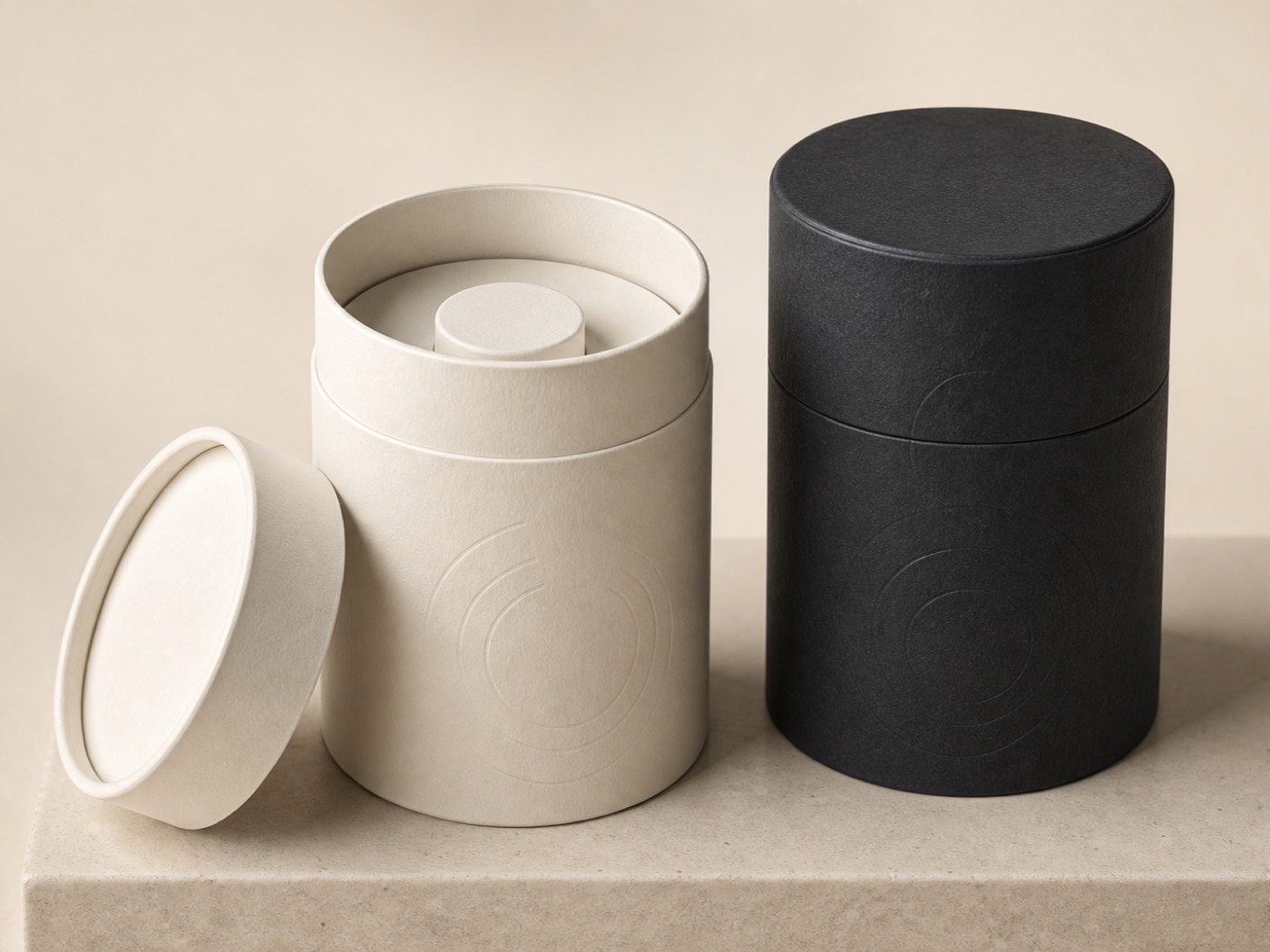
A short friction-fit cap that keeps access direct while retaining the wrapped surface and cylindrical form of a rigid paper tube.
At a glance
- Minimum order quantity
- Confirmed per specification — tube tooling is diameter-specific, so MOQ follows the diameter and finishing chosen
- Sampling
- Presentation-quality sample in 5–7 working days. The sample cost is credited against your first approved production order.
- Production lead time
- 15–20 working days after artwork approval; complex finishing 25–30 working days
- Delivery to Europe
- DDP or DAP to the EU and the UK, DDP to Switzerland; your customs broker confirms duty and VAT rates
- Production
- Made to order (OEM/ODM)
- Country of origin
- Huai'an, Jiangsu, China
- Repeat Access
Overview
A push-fit cap sits over the top of the tube with less overlap than a telescoping lid. It is the practical choice when the pack is expected to be opened, closed and returned to use rather than treated as a single presentation moment.
Cap depth, grip and the way artwork crosses from cap to body have to be considered together. A cap that works mechanically can still look unresolved if the seam or printed composition shifts at the join, so fit and artwork alignment are reviewed on the same sample.
A push-fit tube is a body tube closed at the base and a short cap that grips either the outside of the body or a neck collar fixed into its rim. The grip comes from how closely the cap's inner diameter matches the body or collar, and from the surfaces in contact, so the board, the body wrap and any lamination on it all affect how firmly the cap holds. Because the cap is short, the wrap on the body carries most of the artwork, and the line where the cap ends becomes a visible horizontal break in the design.
What to decide for this format
Cap depth and handling
Balance enough overlap for a confident close with the ease of removal expected during repeated use.
Artwork across the join
Decide whether cap and body read as separate colour fields or as one composition, with the wrap seams positioned accordingly.
Fit after repeated opening
Say how the pack will be used, a gift opened now and then or a caddy opened every day, because a cap that feels firm when new eases with use. The fit is set on the sample with that in mind, and a neck collar can help where the grip has to stay consistent.
Across the Paper Tubes & Cylinder Boxes range
This page covers what is particular to this product. The full lists for the whole range are set out once, on the Paper Tubes & Cylinder Boxes page:
- Materials and finishes
- What you can customise
- Applications
- How it is made
- What drives the cost
- Why work with us
What applies to this product
- Materials
- Wound Paper Body; Printed Art Paper Wrap; Specialty & Textured Papers; Kraft & Recycled Board; Paper & Board Ends; Inserts & Cradles
- Printing & Finishes
- Hot Foil Stamping; Embossing & Debossing; Soft-Touch & Matte Lamination; Spot UV; Seam Alignment
- Applications
- Tea & Gourmet Food; Candles & Home Fragrance; Beauty & Gift Sets
- How it is made
- Product & opening review; Body & end specification; Wrap artwork & seam placement; Sampling; Print & finish the wrap; Forming, wrapping & assembly
Specifications
| Minimum order quantity | Confirmed per specification — tube tooling is diameter-specific, so MOQ follows the diameter and finishing chosen |
|---|---|
| Production lead time | 15–20 working days after artwork approval; complex finishing 25–30 working days |
| Printing | Offset printing of the wrap on the Rapida 106 — CMYK and Pantone spot colours |
| Material basis | Paper-based construction; recycled-content and FSC-certified stocks available |
Terms for this specification
- Sampling
- Presentation-quality sample in 5–7 working days. The sample cost is credited against your first approved production order.
- Colour matching
- Pantone references and physical samples are used where the selected print process supports them. The approval method follows the substrate, artwork and process.
- Certifications
- ISO 9001, ISO 14001:2015, ISO 45001 and China Environmental Labelling (Ten-Ring). ISO 22000 applies to eligible food-contact work.
- Sustainable options
- FSC-certified or recycled-content paper and board, water-based inks and adhesives, and fibre-based fitments are available where the selected construction supports them.
Design & artwork
From an artwork check, through a dimensioned dieline and print-ready files, to a full concept package across a range — done by the factory that will make it.
Frequently asked questions
When should I choose a push-fit cap instead of a telescoping lid?
Choose it when direct, repeated access matters more than a long lid lift. The shorter cap makes the opening action quicker while the final fit is still established during sampling.
Can the cap and body carry one continuous design?
They can be designed as one visual system, but the physical join and both wrap seams must be allowed for in the artwork. The assembled sample is where that relationship is approved.
Does a neck collar change what fits through the opening?
Yes. The collar is fixed inside the rim of the body, so the opening is narrower than the body by the collar's wall on every side. Check the product's widest point against that opening or, for loose contents, whether a scoop or fingers can still reach in comfortably. Where the full opening matters more, the cap can fit straight over the body instead, which leaves a visible step where the cap ends.
Which product details do you need to price a push-fit tube?
Its size, how it is taken out and whether the pack will be opened now and then or every day, together with the order quantity, the artwork and the surface finish. Tell us whether the cap and body should read as one design or as separate colour areas, because that sets where the wrap seams and the cap line fall, and if the range already uses tubes, list their diameters in case one can be shared. Say which country the tubes are delivered to and, for the EU or the UK, whether you want DDP or DAP.
From the Journal
Related products
Request a custom packaging quote
What to send for a quote
- The product it is for, and the format you have in mind
- Size as length × width × height, and whether those are inside or outside dimensions
- Quantity, or two or three quantities if you want to compare unit prices
- Material and finish preferences, or the look you are after
- Artwork status: print-ready files, a draft, or nothing yet
- The date you need the goods by
- The destination country
Missing some of these? Send what you have, and we will ask about the rest.