Custom Lid & Base Paper Tube Packaging
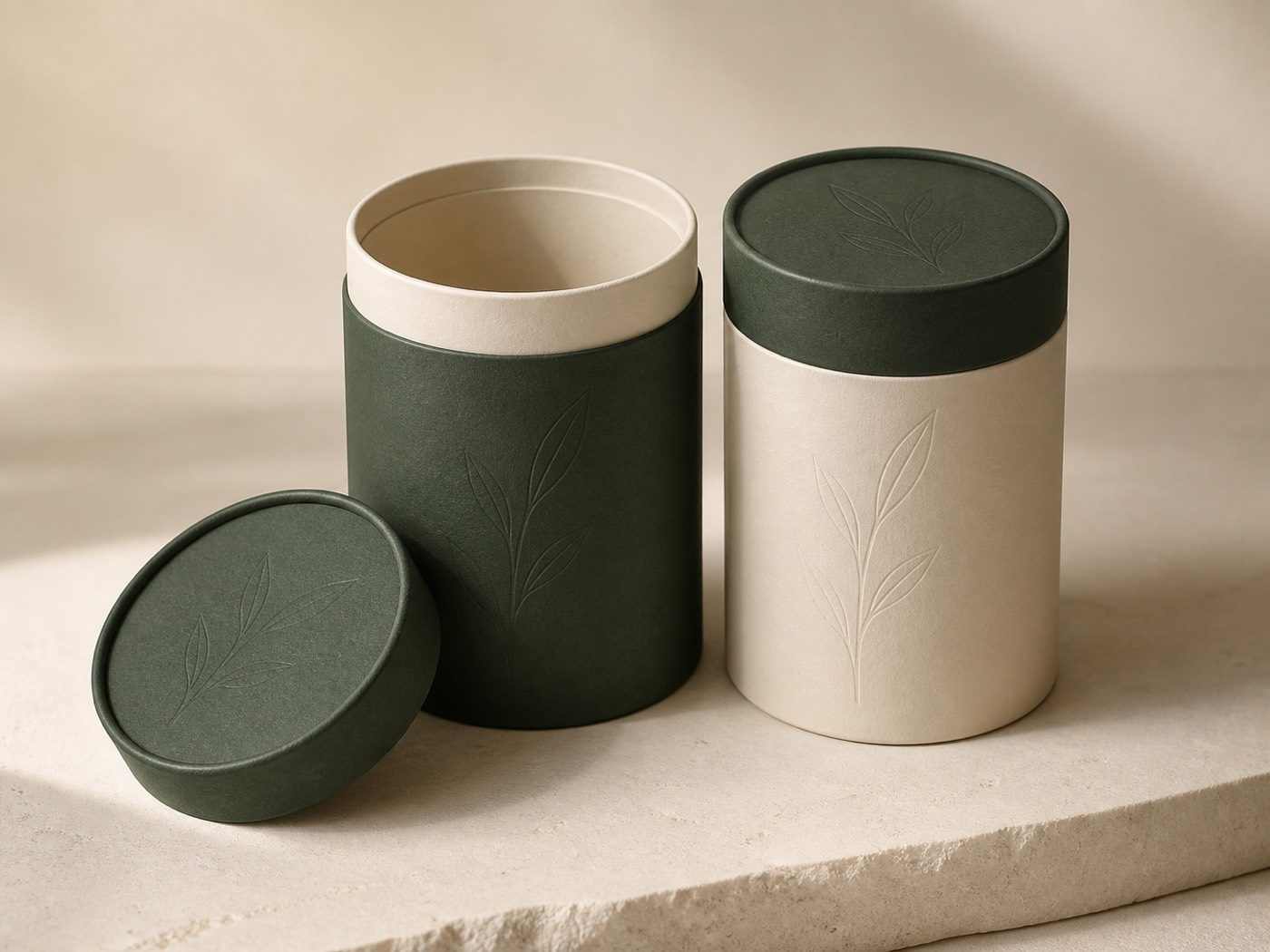
A telescoping paper tube whose lid overlap and opening feel are resolved around the product and checked on the physical sample.
At a glance
- Minimum order quantity
- Confirmed per specification — tube tooling is diameter-specific, so MOQ follows the diameter and finishing chosen
- Sampling
- Presentation-quality sample in 5–7 working days. The sample cost is credited against your first approved production order.
- Production lead time
- 15–20 working days after artwork approval; complex finishing 25–30 working days
- Delivery to Europe
- DDP or DAP to the EU and the UK, DDP to Switzerland; your customs broker confirms duty and VAT rates
- Production
- Made to order (OEM/ODM)
- Country of origin
- Huai'an, Jiangsu, China
- Telescoping Lid
Overview
A lid and base tube uses a telescoping upper section over the main body. The overlap gives the pack a clear two-part silhouette and a deliberate opening sequence, making it suitable when the first lift of the lid is part of the presentation.
The important choices are the proportion of the lid, the resistance as it lifts and what holds the product centrally once the tube is open. Those decisions are judged together on a made-up sample because the wrap, end construction and internal support all affect how the pack feels in the hand.
A lid and base tube is made from two wound paper tubes of slightly different diameters. The base tube holds the product and is closed at the bottom with a paper or board end; the lid tube fits over it and is closed at the top. Each tube carries its own printed wrap, turned in at the open edge so the paper finishes cleanly where the two parts meet.
What to decide for this format
Lid overlap and opening feel
Set how much of the body the lid covers and how the lift should feel, then confirm both on the assembled sample.
Product support and end construction
Choose the internal collar, cradle or spacer around the product, together with the paper-based end construction appropriate to the brief.
Stepped or flush profile
Choose whether the lid steps out over the body or closes flush over a neck collar glued inside the base. A flush lid still covers a deep section of the body, but the collar narrows the opening, so the product's widest point is checked against it on the structural sample.
Across the Paper Tubes & Cylinder Boxes range
This page covers what is particular to this product. The full lists for the whole range are set out once, on the Paper Tubes & Cylinder Boxes page:
- Materials and finishes
- What you can customise
- Applications
- How it is made
- What drives the cost
- Why work with us
What applies to this product
- Materials
- Wound Paper Body; Printed Art Paper Wrap; Specialty & Textured Papers; Kraft & Recycled Board; Paper & Board Ends; Inserts & Cradles
- Printing & Finishes
- Hot Foil Stamping; Embossing & Debossing; Soft-Touch & Matte Lamination; Spot UV; Seam Alignment
- Applications
- Spirits & Wine; Tea & Gourmet Food; Candles & Home Fragrance; Beauty & Gift Sets
- How it is made
- Product & opening review; Body & end specification; Wrap artwork & seam placement; Sampling; Print & finish the wrap; Forming, wrapping & assembly
Specifications
| Minimum order quantity | Confirmed per specification — tube tooling is diameter-specific, so MOQ follows the diameter and finishing chosen |
|---|---|
| Production lead time | 15–20 working days after artwork approval; complex finishing 25–30 working days |
| Printing | Offset printing of the wrap on the Rapida 106 — CMYK and Pantone spot colours |
| Material basis | Paper-based construction; recycled-content and FSC-certified stocks available |
Terms for this specification
- Sampling
- Presentation-quality sample in 5–7 working days. The sample cost is credited against your first approved production order.
- Colour matching
- Pantone references and physical samples are used where the selected print process supports them. The approval method follows the substrate, artwork and process.
- Certifications
- ISO 9001, ISO 14001:2015, ISO 45001 and China Environmental Labelling (Ten-Ring). ISO 22000 applies to eligible food-contact work.
- Sustainable options
- FSC-certified or recycled-content paper and board, water-based inks and adhesives, and fibre-based fitments are available where the selected construction supports them.
Design & artwork
From an artwork check, through a dimensioned dieline and print-ready files, to a full concept package across a range — done by the factory that will make it.
Frequently asked questions
How is a lid and base tube different from a push-fit cap tube?
A lid and base tube uses a longer telescoping lid, so the overlap is a visible part of the structure and the opening is more ceremonial. A push-fit cap is shorter and better suited when the product will be accessed repeatedly.
How is the opening resistance decided?
It is set during structural sampling rather than from a fixed catalogue value. The assembled tube is checked with its wrap and intended internal support so the lid can be judged as a complete pack.
Can the lid and base carry different colours or finishes?
Yes. Each part has its own wrap, so a contrasting lid, foil on the lid alone or a plain base under a printed lid can each be specified. The thing to plan for is rotation: the lid can go back on at any angle, so artwork that crosses the join only lines up when the lid is turned the right way. Designs that run across the join are usually kept to bands or patterns that read at any angle.
What do you need from us to draw and price a lid and base tube?
The product dimensions or the item itself, how it should sit in the tube, the quantity per order, the artwork and the finishes you have in mind. Say whether the product needs a support such as a collar, cradle or spacer and whether the outline is stepped or flush, so the tube diameters and the support are drawn from the start. If another tube in your range already has a diameter this one could share, say so too, because tube tooling follows the diameter. Add the delivery country and, for the EU or the UK, whether you want DDP or DAP.
From the Journal
Related products
Request a custom packaging quote
What to send for a quote
- The product it is for, and the format you have in mind
- Size as length × width × height, and whether those are inside or outside dimensions
- Quantity, or two or three quantities if you want to compare unit prices
- Material and finish preferences, or the look you are after
- Artwork status: print-ready files, a draft, or nothing yet
- The date you need the goods by
- The destination country
Missing some of these? Send what you have, and we will ask about the rest.