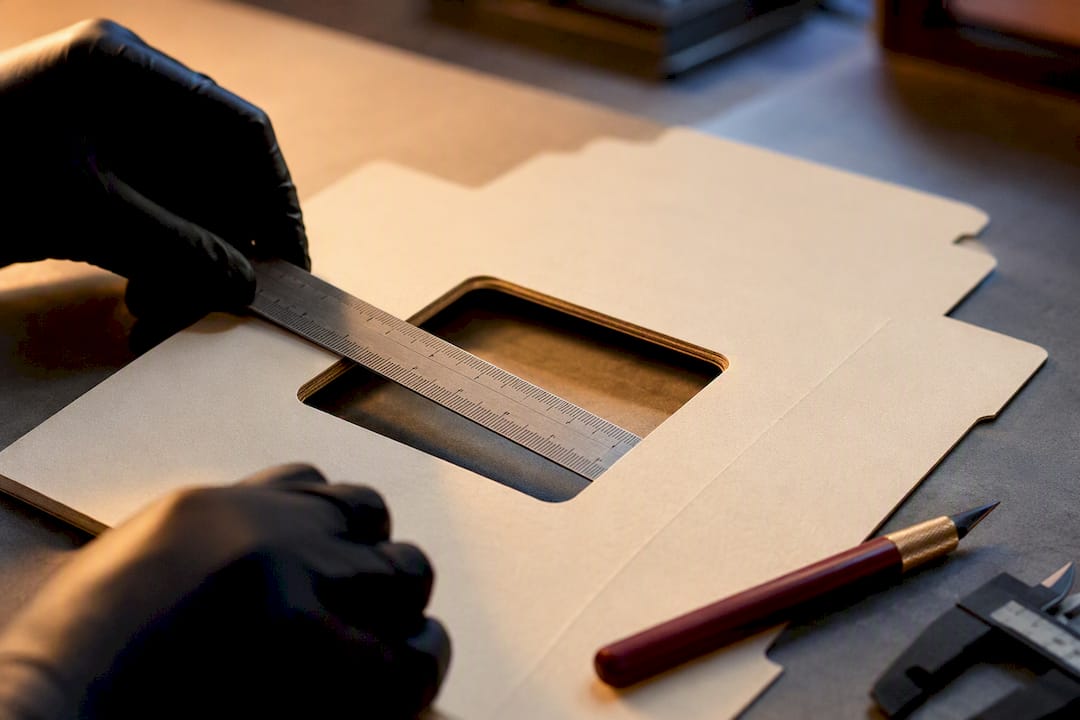
A die-cut window earns its place on any SKU where the product itself sells better than a photo of it does. That covers most beauty, spirits, and fresh food packaging. It works against you on light-sensitive formulas, inconsistent-looking batches, or brands whose print story carries the shelf impact. Either way, the next move is the same: request a white-dummy sample built around your actual product, and require a structural review before you commit to a production run. Some suppliers may include that review as part of their quoting process.
**TL;DR:** Windows are most effective when the product’s appearance is a key selling point, such as textured surfaces, gradients, or variable SKUs. They should be avoided with light-sensitive formulas, natural variation, or premium sealed products where the box design is the main aesthetic. Minimum window size is typically 20-35% of the panel, with at least 15 mm buffer from folds and critical zones, and custom shapes increase cost and lead time. PET film is ideal for high-visibility, durable windows, while BOPP is suitable for food and moisture resistance, and acetate or PLA are premium or eco-friendly options depending on needs. Structural testing like compression and transit tests are essential to prevent failure modes, and samples should include real product and shipping simulations for accuracy.
Yuanpackaging
Explore packaging solutions
Table of Contents
- When Do Die Cut Windows Actually Help?
- How Do You Specify Window Size and Placement?
- Which Film Should You Choose for a Window?
- What Structural Tests Should You Require?
- What Drives Cost and Lead Time on Windowed Cartons?
- What Should You Ask for in a Sample?
- How Yuanpackaging Approaches Window Carton Projects
- Get a Sample and Structural Review From Yuanpackaging
- Sources
- FAQ
When Do Die Cut Windows Actually Help?
Windows work when the product is the argument. A cut window lets a shopper verify the color of a serum, the marbling in a soap bar, or the fill level in a spirits bottle without unboxing it or reading a claim. That instant verification does something print alone cannot: it removes doubt at the exact moment someone is deciding whether to pick up the box.
Certain product traits make a window a near-obvious win:
- Visible texture, color gradient, or craftsmanship that photography struggles to reproduce accurately
- Variable-SKU lines where the box itself needs to stay generic while the product inside signals the flavor, scent, or shade
- Gift sets and fresh or bakery goods where “what you see is what you get” builds trust fast
Other traits argue against it:
- Formulas or ingredients sensitive to light, moisture, or oxygen, where an opening in the board compromises protection
- Products with natural batch-to-batch variation in appearance that could look like a defect through the window
- Premium spirits or fragrance lines built on a fully printed, sealed presentation where the box itself is the design statement
One real case makes the upside concrete: a botanical skincare brand recorded a 42% retail conversion lift after moving to window-patched cartons, though the switch demanded flute-direction changes and compression testing to keep pallets from crushing under the new structure. A window is not a free upgrade. It is a design change with structural consequences, which is exactly why the next section matters.
How Do You Specify Window Size and Placement?
Window area is a structural decision disguised as a design one. Retail windows commonly run 20% to 35% of the panel face, and once you push past a certain proportion, rigidity drops fast enough that you typically need heavier board or internal supports to compensate. Treat that range as your starting brief, not a hard ceiling.
Placement carries its own guardrails. Keep the window at least 15 mm from folds, glue flaps, and barcode zones, and avoid running it to the panel edge, where board strength is already thinnest. Custom silhouettes (a bottle outline, a logo shape) cost more in tooling and slow down die-cutting than a simple rectangle or oval, so reserve them for hero SKUs rather than an entire line extension.
Build your RFQ and dieline approval around these steps:
- Confirm target window area as a percentage of the panel, not just a dimension in millimeters.
- Mark a minimum 15 mm buffer from every fold line, glue flap, and code or barcode zone.
- Specify die registration tolerance, with ±0.5 mm as a practical target for crisp, premium-looking edges.
- Flag whether the shape is geometric (lower tooling cost) or custom silhouette (higher tooling cost, longer lead time).
- Note board flute direction if the carton will carry weight in transit or on a display pallet.
**Pro Tip:** _Ask your supplier for a flat dieline proof with the window outline overlaid on real product photography before you approve tooling. It catches misalignment between the cutout and the product’s actual profile faster than any spec sheet._
Which Film Should You Choose for a Window?
Film choice decides how the window looks in six months, not just on day one. PET film is the common default for large windows and demanding retail applications, thanks to strong tensile performance, optical clarity, and dimensional stability that holds up under handling. Thermosealable BOPP costs less and resists moisture well, and it’s the standard choice for fresh produce and bakery packaging, with seal initiation temperatures around 90 to 115°C and gauges commonly running 15 to 40 microns depending on the stiffness you need. Acetate delivers a glossier, more premium hand feel that suits fragrance and spirits gifting but comes at a higher cost. PLA offers a compostable option, but its performance and end-of-life claim only hold up where the adhesive system and local recovery infrastructure actually support composting.
- *PET / BOPET**: clarity and stiffness for larger windows and high-touch retail
- *BOPP (thermosealable)**: cost-efficient, moisture-resistant, strong fit for food categories
- *Acetate**: premium optical quality for gift and spirits packaging
- *PLA**: compostable, but only where recovery systems match the claim
**Film compliance checkpoint:** any film, adhesive, or ink that could touch or approach food needs a compliance check against FDA rules, EU Regulation (EC) No 10/2011, or Canada’s Division 23, depending on your market. Ask for that documentation before approving film, not after the run ships.
What Structural Tests Should You Require?
Cutting a window removes board material, and that material was doing structural work. Vertical load capacity drops, bridge strength across the panel weakens, and cartons stacked on a pallet or shelf riser can bow or crush at the cutout if nobody accounted for it during design. The most common failure modes: corner crush near an oversized window, patch delamination at the film-to-board seam, and visible print misregistration once the window frame shifts against the artwork underneath.
Before sign-off, run:
- *Compression testing** in an ISTA 3A-style protocol to confirm stacking strength under realistic pallet loads
- *Transit and drop testing** to catch damage that only shows up after real handling, not a lab bench
- *Flat-pack shipping scratch tests**, since folded cartons rub against each other in transit and film scratches faster than printed board
- *Assembly ergonomics checks**, confirming line workers can fold and glue the window patch at production speed without misalignment
Glue area, film stiffness, and patching speed all move your defect rate. A film that’s too rigid for your patching equipment will show peel or bubbling faster than one matched to the adhesive and application method your supplier already runs.
What Drives Cost and Lead Time on Windowed Cartons?
A window adds a distinct converting step called window patching, where film is cut, registered, and adhered to the board after the main die-cut pass. That step, plus tooling for the window die, film gauge selection, and tighter print-to-cut registration, is what moves your unit cost.
Budget around these drivers:
- Die tooling for the window shape (custom silhouettes cost more than geometric cuts)
- The added patching step itself, which affects both unit cost and line speed
- Film gauge and grade (heavier PET or acetate costs more than standard BOPP)
- Registration tolerance tightness, since ±0.5 mm precision takes more QA time than a looser spec
Expect tooling and sample approval to run several weeks before full production, and always plan a pilot run before committing to volume.
What Should You Ask for in a Sample?
Digital mockups do not catch what a physical sample does. Validate window designs with real prototypes run through actual shipping and stacking conditions, not renders alone.
Your sample request should include:
- A white-dummy mockup built around your actual SKU, not a placeholder object, with photos showing product orientation inside the carton and on a shelf mockup.
- Compression, stacking, and transit simulation results, with visible inspection for scratches, film delamination, or misalignment between the window and the artwork.
- Documented film, adhesive, and board specifications, plus any relevant certifications, food-contact or compostability, that apply to your category.
**Pro Tip:** _Ask for the sample photographed under retail-style lighting, not a studio softbox. Window glare and reflection behave differently under fluorescent shelf lighting than they do in a product photo._
How Yuanpackaging Approaches Window Carton Projects
Some packaging manufacturers have extensive experience delivering units to thousands of brands across beauty, spirits, pharma, and lifestyle categories; they may build their quoting processes around structural review, film selection matched to product and distribution conditions, and consideration of sustainability tradeoffs against recovery infrastructure, not just marketing claims. To get a fast, accurate quote, send your SKU dimensions, dieline or reference structure, preferred film type, target volumes, and timeline. That briefing lets the review start immediately instead of after a round of clarifying questions.
_— Anthony_
Get a Sample and Structural Review From Yuanpackaging
You’ve seen the tradeoffs: window area versus rigidity, film clarity versus food-contact compliance, tooling cost versus conversion upside. Rather than guessing where your SKU lands, send it in and get a structural answer instead of a rendered guess. A packaging supplier may review your dieline, recommend film based on your product and distribution path, and produce a white-dummy sample with your actual product before you commit to tooling.
Send your SKU details, target window dimensions, preferred film (PET, BOPP, acetate, or PLA), volume, and timeline, and Yuanpackaging will return structural notes, a recommended film spec, and an estimated unit cost and lead time. Beauty and spirits brands can start from the rigid gift box line or the window carton product page; food, pharma, and nutraceutical brands should route compliance questions through the pharmaceutical cartons page. Whatever your category, the fastest path to a real answer is the full product catalog, where you can request a quote and sample review in one step.
Sources
FAQ
What Percentage of a Carton Panel Should the Window Cover?
Most retail windows run 20% to 35% of the panel face.
What Is the Difference Between a Window Patch and a Cutout?
A cutout is just the die-cut hole in the board. A window patch is the finished assembly, the film applied and sealed over that hole, which is why patching is treated as its own converting step with its own cost and lead time.
Which Film Is Best for Food-Contact Packaging?
Thermosealable BOPP is a common choice for fresh produce and bakery goods thanks to its moisture resistance and heat-seal properties, but any film, adhesive, or ink near food needs a compliance check against FDA, EU Regulation (EC) No 10/2011, or Canada’s Division 23 rules depending on your market.
Can PLA Film Be Used for a Compostable Package Claim?
Only when the adhesive system and local recovery infrastructure actually support composting. A compostable film paired with a non-compostable adhesive or shipped to a region without industrial composting access undermines the claim.
How Long Does It Take to Produce a Die-Cut Window Carton?
Tooling and sample approval typically take several weeks before full production begins, which is why running a pilot batch and requesting a structural review from a supplier like Yuanpackaging early in development protects your launch timeline.