Packaging for Cosmetics & Beauty Brands
Durable high-end labels, shelf impact and colour control — for brands where the pack is photographed as often as the product.
At a glance
- Minimum order quantity
- Cartons and labels from 1,000 units; digital label runs support launch and shade-extension quantities
- Sampling
- Presentation-quality sample in 5–7 working days. The sample cost is credited against your first approved production order.
- Production lead time
- Typically 15–20 working days after artwork approval; confirmed on your quote
- Delivery to Europe
- DDP or DAP to the EU and the UK, DDP to Switzerland; your customs broker confirms duty and VAT rates
- Production
- Made to order (OEM/ODM)
- Country of origin
- Huai'an, Jiangsu, China
- Pantone Control
- Small-Format Precision
- Soft-Touch Finishes
- Coffrets & Sets
- Low MOQ Launches
Overview
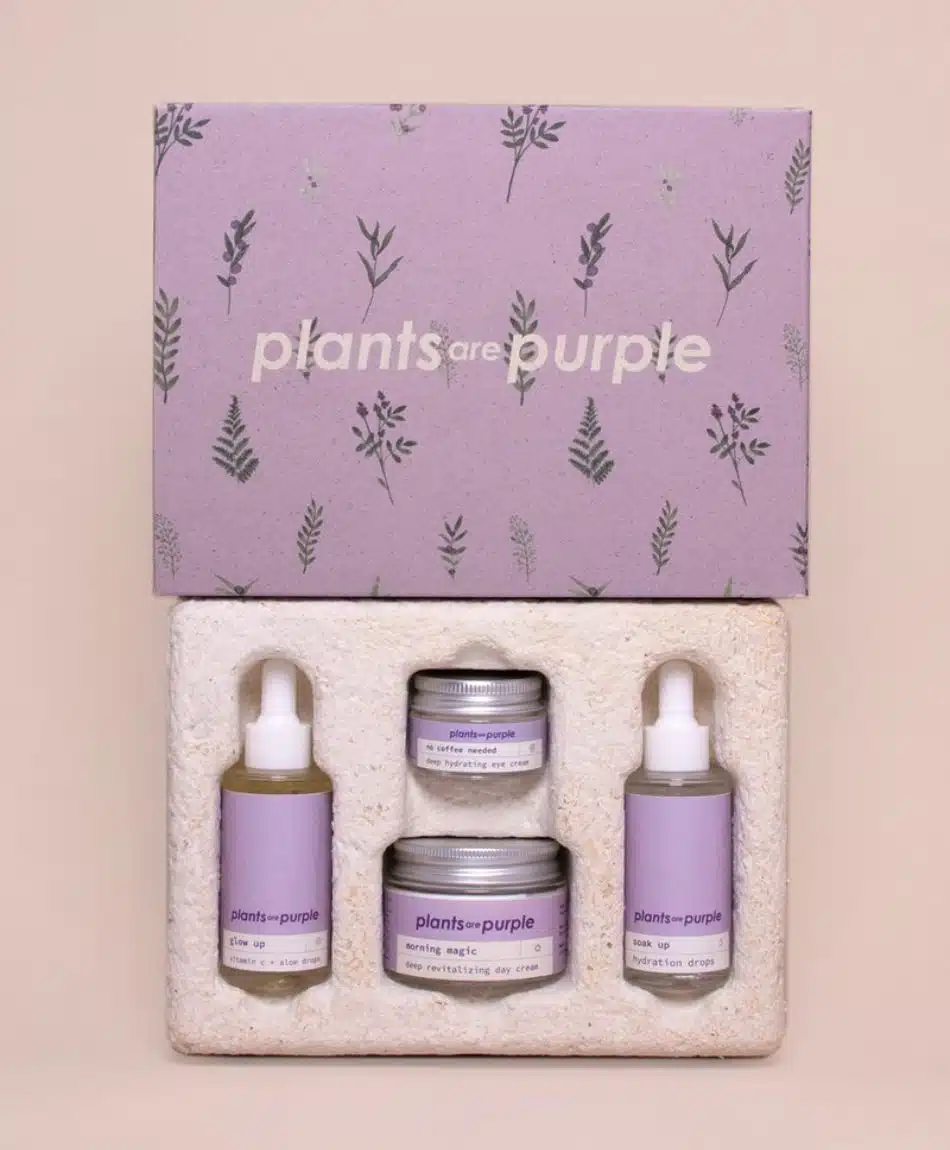
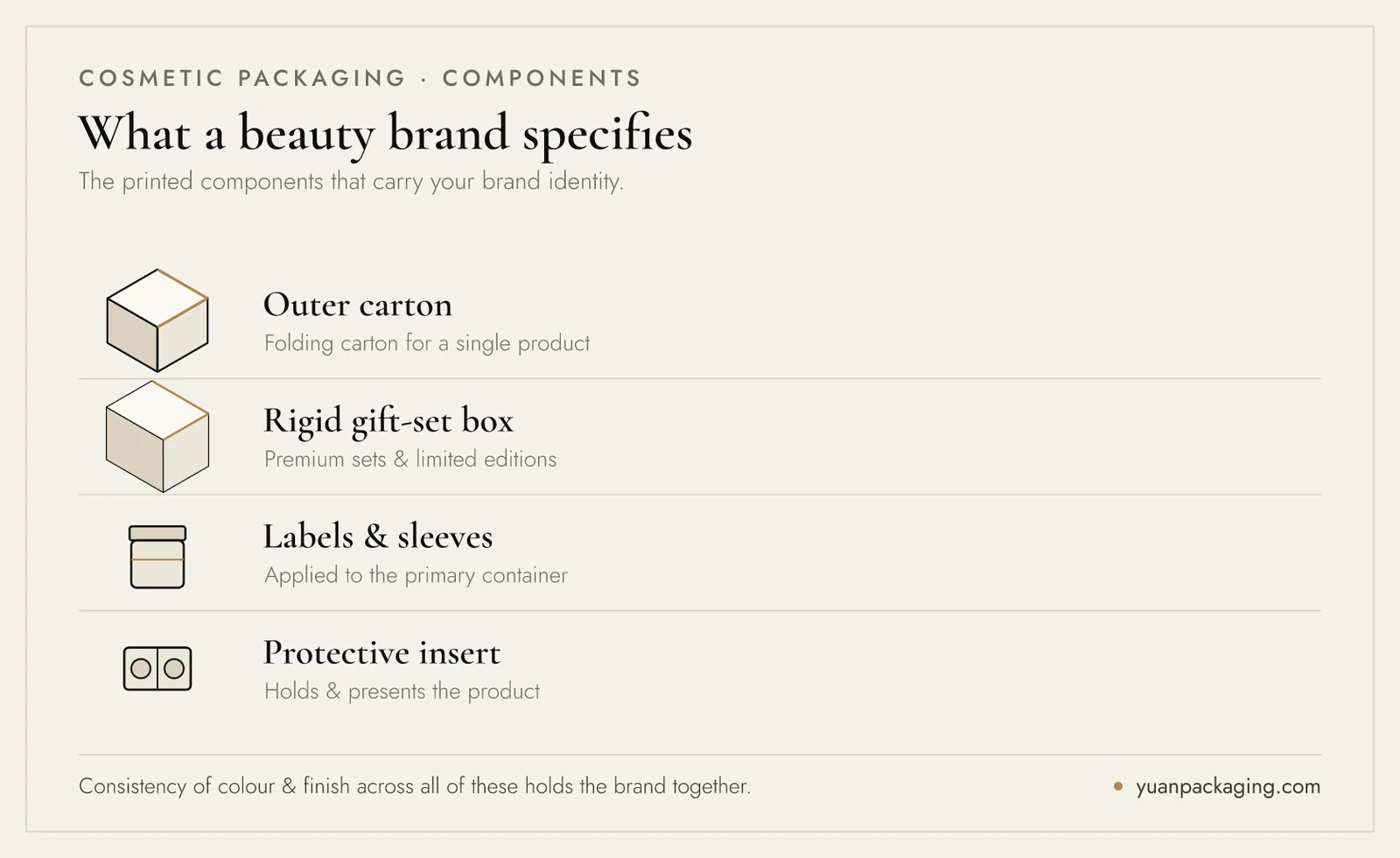
Beauty packaging is bought as a set of components, not as a product. A single SKU typically needs an outer carton, a label on the primary container, sometimes a sleeve, an insert that holds the bottle upright, and a coffret for the gift edition. Each is a different process; all of them have to be the same colour.
Colour is where this category is won or lost. A nude, a blush pink or a brand off-white will read differently on a coated carton, an uncoated tag and a clear film label, and a difference the factory calls acceptable is one a beauty buyer will reject at the shelf. We print components against one Pantone reference on the same press for exactly this reason — and we sample the set together rather than each piece in isolation.
The second constraint is the product itself. Serums, oils and creams get onto label surfaces, bathrooms are warm and humid, and compacts are handled daily. Face stock, laminate and adhesive are chosen against that exposure — which is why we ask what the formulation is before recommending a substrate.
What we make for this sector
- Folding Cartons — Unit cartons for serums, creams and colour cosmetics, with window and crash-lock options.
- Cosmetic Labels — Clear film, small-format precision die cutting and soft-touch finishes for bottles, jars and tubes.
- Coffrets & Gift Boxes — Rigid boxes with fitted trays for launch kits, seasonal sets and gift editions.
- Peptide Vial Gift Boxes — Rigid boxes with inserts cut to 2–10 ml vials, for peptide skincare and serum kits.
- Sleeves & Cards — Belly bands, sleeves and care cards that carry seasonal versions off one base pack.
- Carrier Bags — Counter and gift-with-purchase bags produced to the same colour standard as the cartons.
What a beauty SKU usually needs
Outer Unit Carton
The folding carton the product sells in, sized to the bottle or compact and creased to erect square on a packing line.
Primary Container Label
Bottle, jar and tube labels — small formats on tight curvature, specified against oils and daily handling.
Coffrets & Gift Sets
Rigid boxes with fitted trays for launch kits, seasonal sets and influencer seeding.
Sleeves & Belly Bands
Printed wraps that create a seasonal or market version from one base carton, without new tooling.
Inserts & Cradles
Paper-based fitments that hold a bottle upright and central, so the product presents square when the box opens.
Care Cards & Inserts
Printed cards carrying usage, ingredient or provenance copy — read after purchase, when the pack does its second job.
Selected work
What to get right in this sector
One colour standard across components
A brand colour behaves differently on coated board, uncoated card and clear film. Sample the set together or expect a mismatch at the shelf.
Formulation contact
Serums, oils and alcohol-based fragrance attack paper labels. Film face stocks with a laminate handle it; test against the actual product.
Small-format die accuracy
A beauty label is a few centimetres across with body copy that must stay legible and foil that must register inside a millimetre.
Launch quantities
Shade extensions and market tests do not justify a full offset run. Digital printing covers launch volumes without committing the range.
Sustainable specification
FSC-certified and recycled board, water-based inks and paper-based fitments in place of foam, where your materials policy requires it.
Specifications
| Typical minimums | Cartons and labels from 1,000 units; digital label runs support launch and shade-extension quantities |
|---|
Terms for this specification
- Sampling
- Presentation-quality sample in 5–7 working days. The sample cost is credited against your first approved production order.
- Colour matching
- Pantone references and physical samples are used where the selected print process supports them. The approval method follows the substrate, artwork and process.
- Certifications
- ISO 9001, ISO 14001:2015, ISO 45001 and China Environmental Labelling (Ten-Ring). ISO 22000 applies to eligible food-contact work.
What drives the cost
We do not publish a price list, because no two specifications are alike. The levers that decide a quote are consistent, though.
Quantity
Most of the cost of a print job is set-up — plates, dies, make-ready, the first good sheet. Doubling a run rarely doubles the price, which is why it is worth asking for two or three volumes on the same quote.
Structure
A rigid box is formed, wrapped and often assembled by hand; a folding carton is die-cut and glued in one pass. Structure is usually the single biggest difference between two otherwise identical packs.
Material
Board grade and wrap stock. Specialty and textured papers cost more per sheet, but can replace a finishing pass — sometimes the cheaper route to the same effect.
Finishing passes
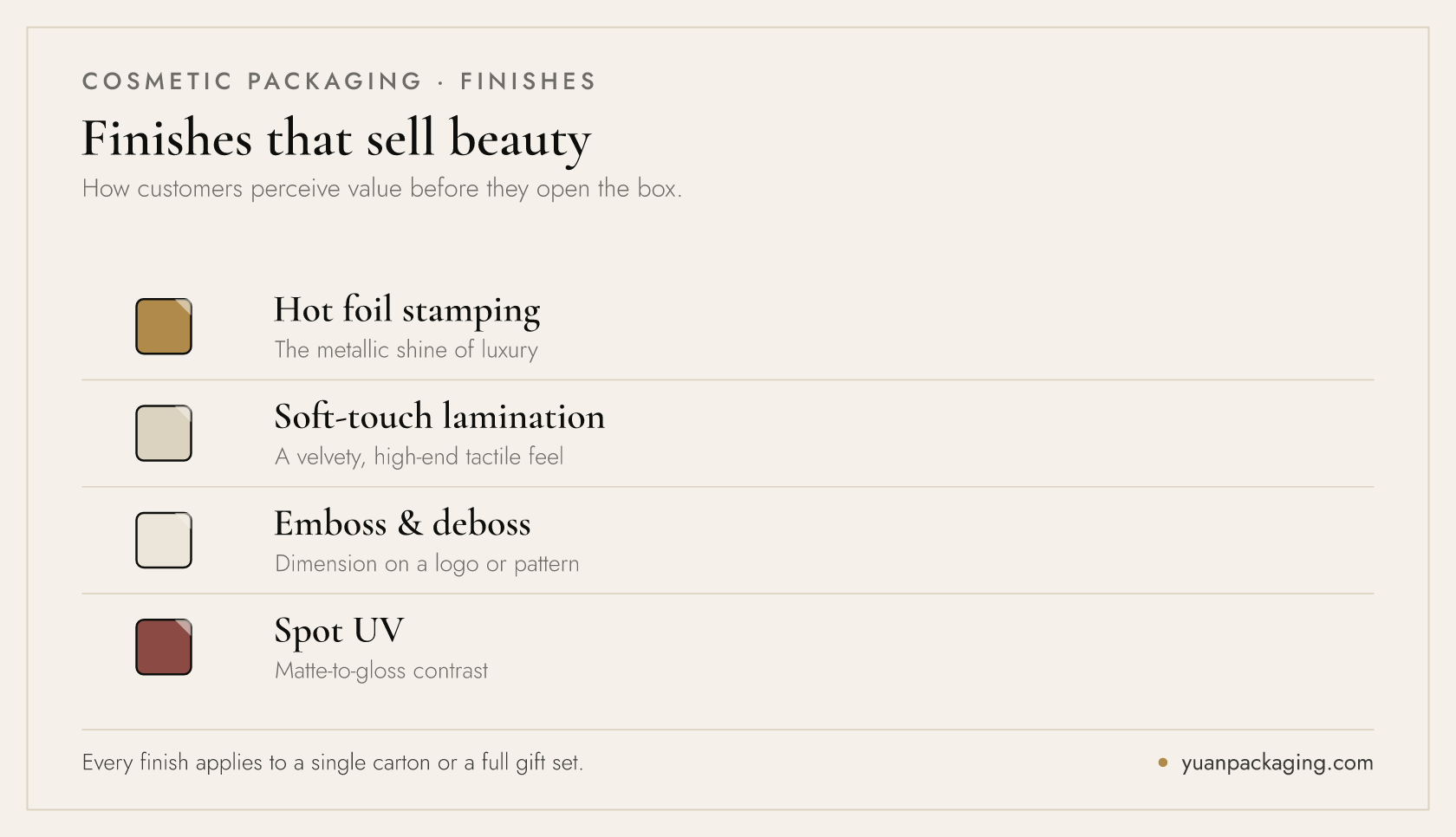
Each of foil, emboss, spot UV and lamination is a separate pass through a machine. Two effects cost roughly twice one, so the question is always which effect earns its place.
Tooling
Dies, emboss plates and foil blocks are one-off costs carried by the first order and reused on every repeat. Repeat runs of an approved specification are materially cheaper than the first.
Design & artwork
From an artwork check, through a dimensioned dieline and print-ready files, to a full concept package across a range — done by the factory that will make it.
Applications
Skincare
Serum, cream and treatment packs where the label meets oils and the carton carries the claims.
Fragrance
Coffrets, sleeves and bottle labels with foil and emboss on textured or metallised stocks.
Colour Cosmetics
Compact, palette and lip packaging — the smallest formats and the tightest die tolerances.
Personal & Daily Care
Bath, body and household personal care, a sector our label line has served for domestic brands for years.
Why Yuan Packaging
- Carton, label, coffret and printed components made on one site against a single Pantone reference
- Digital label press for launch quantities and shade extensions without committing to an offset run
- Small-format die accuracy held across the run, not just the first sheets
- FSC-certified and recycled board with water-based inks where a materials policy applies
Frequently asked questions
Can you match the carton, label and gift box to one colour?
They are printed against one Pantone reference on the same press, which removes the vendor-to-vendor variation. The remaining difference is the substrate itself — the same ink reads differently on coated board and clear film — so we sample the components together and adjust before signing off, rather than assuming one file guarantees one colour.
We are launching one SKU. Is the quantity too small?
Not for labels — the digital press installed in 2022 supports very short runs, which is the usual route for launches, shade extensions and market tests. Cartons start at 1,000 units, and because carton cost sits in set-up rather than material, it is worth asking for pricing at two or three volumes before deciding.
Do you make gift boxes for peptide serum and vial kits?
Yes. Magnetic, drawer and lid-and-base rigid boxes with inserts cut to your vials — 2 to 10 ml, kits of 1 to 12 — from 500 boxes, with a prototype in 7–10 days. We make the packaging only; the product's regulatory compliance and labelling stay with the brand.
Will the label survive contact with our formulation?
Film face stocks with a laminate or overvarnish handle oils, serums and alcohol far better than uncoated paper. We will recommend a combination for your formulation and container, then you should test the sample against the actual product before the specification is approved.
From the Journal
Request a custom packaging quote
What to send for a quote
- The product it is for, and the format you have in mind
- Size as length × width × height, and whether those are inside or outside dimensions
- Quantity, or two or three quantities if you want to compare unit prices
- Material and finish preferences, or the look you are after
- Artwork status: print-ready files, a draft, or nothing yet
- The date you need the goods by
- The destination country
Missing some of these? Send what you have, and we will ask about the rest.