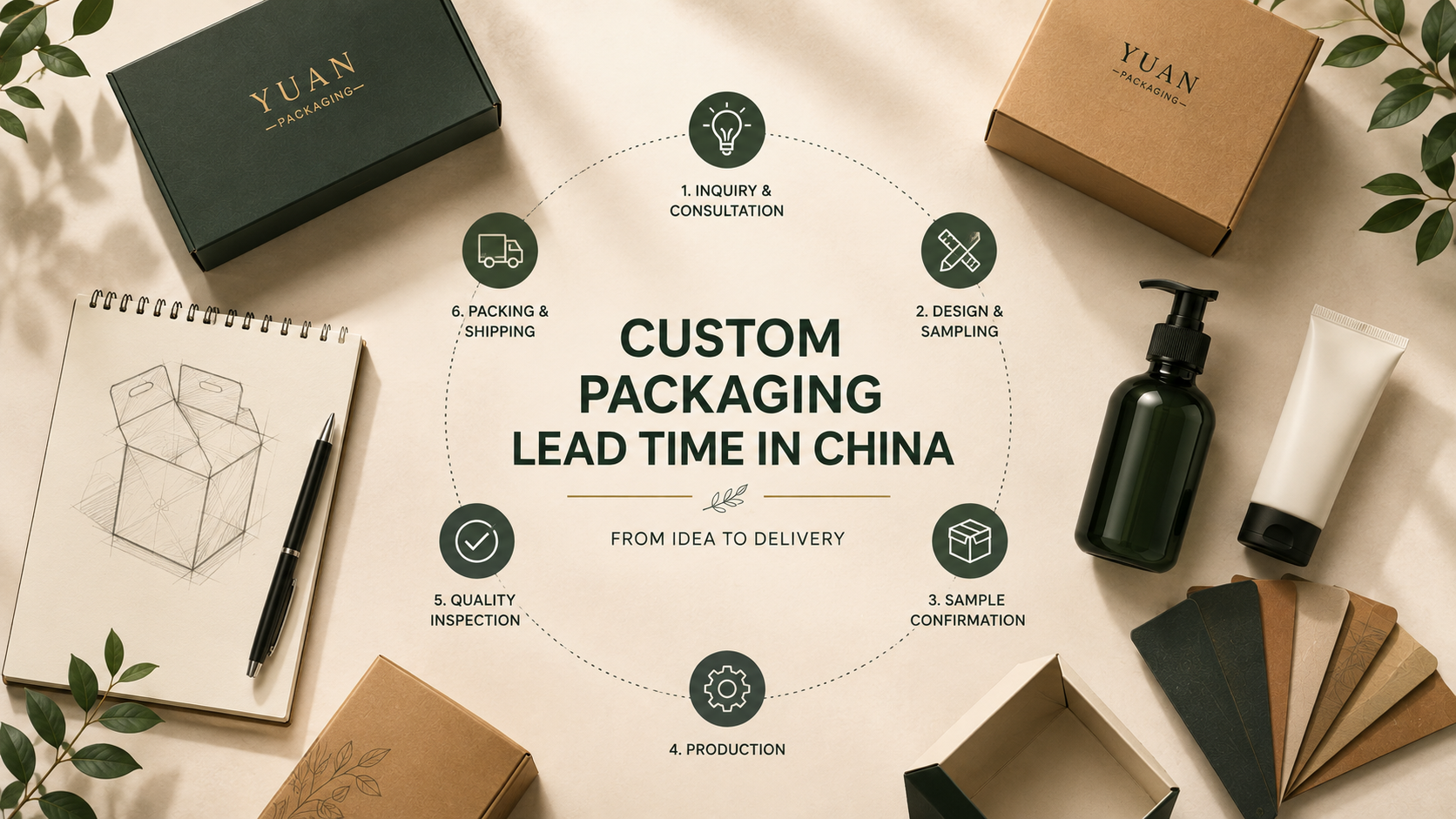
Lead time is one of the first questions buyers ask when sourcing custom packaging from China, and one of the most important to get right. A packaging delay can hold up a product launch, a seasonal range, or a retail listing. The total time from enquiry to delivered goods is the sum of several stages — sampling, artwork approval, production, quality control, and shipping — and each one can be planned for. This guide breaks down a realistic timeline for custom packaging from China, what drives each stage, and how to keep your project on schedule.
Table of contents
- How long does it take? The short answer
- Stage 1: Sampling (1–2 weeks)
- Stage 2: Artwork and proofing
- Stage 3: Production (4–8 weeks)
- Stage 4: Quality control and packing
- Stage 5: Shipping
- What adds time to a packaging order
- How to keep your project on schedule
- Annual programmes and reserved capacity
- Summary
- Frequently asked questions
How long does it take? The short answer
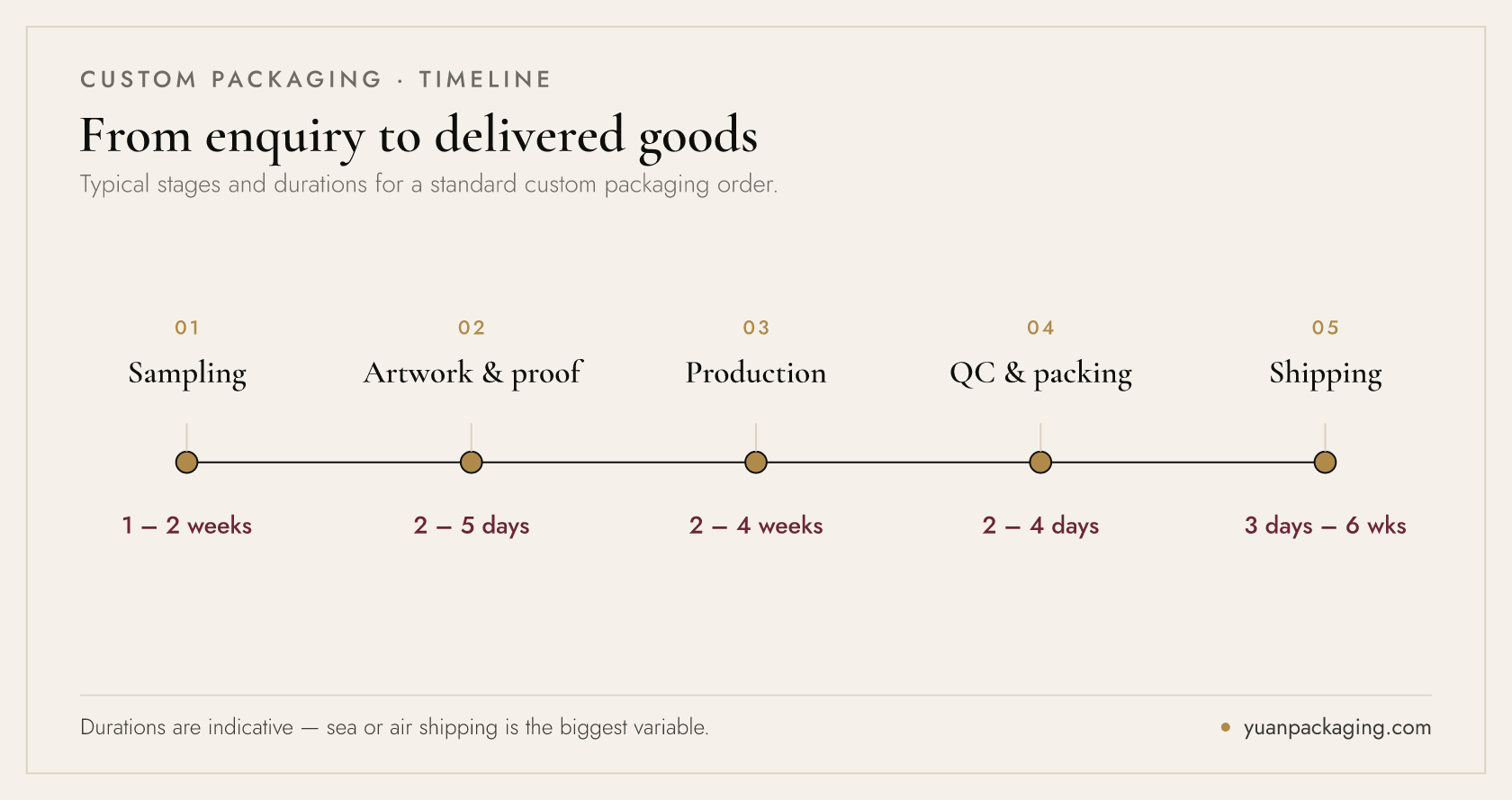
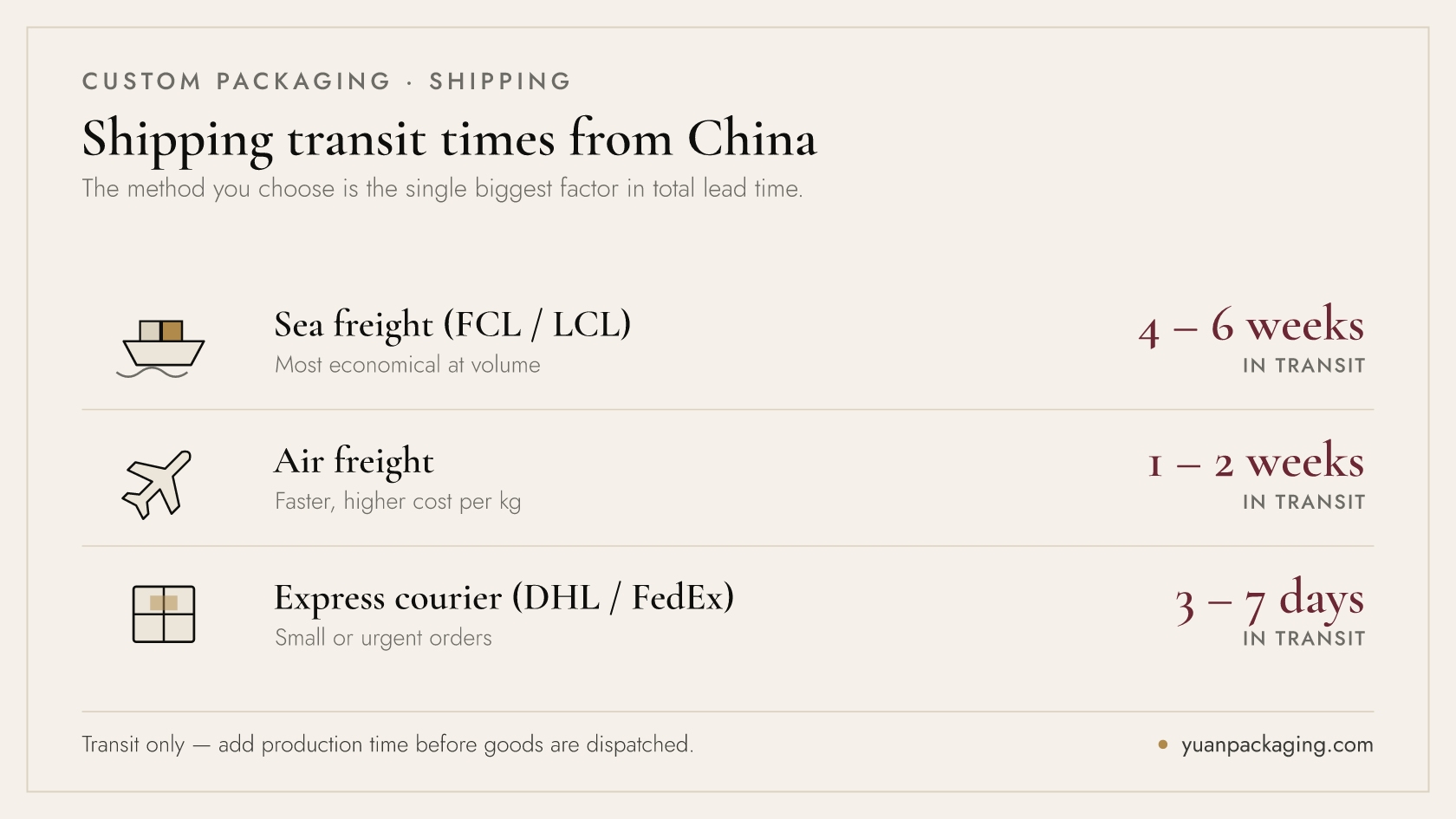
As a working guide, a standard custom packaging order takes roughly four to eight weeks in production once artwork and samples are approved, plus shipping. Sea freight adds about four to six weeks in transit; air freight one to two weeks; express courier three to seven days. So a typical door-to-door timeline runs from around two weeks (a small air-freighted order) to ten or twelve weeks (a large sea-freighted order). The exact figure depends on the product, the finishing, the order volume, and the shipping method — the stages below explain where the time goes.
| Stage | Typical duration | What drives it |
|---|---|---|
| Sampling | 1–2 weeks | Complexity and courier transit |
| Artwork and proofing | Days to 1 week | How print-ready your files are |
| Production | 4–8 weeks | Finishing processes and volume |
| Quality control and packing | Runs in line with production | Order size |
| Shipping — sea freight | 4–6 weeks | FCL or LCL |
| Shipping — air freight | 1–2 weeks | Higher cost per kilo |
| Shipping — express courier | 3–7 days | Small or urgent orders |
Stage 1: Sampling (1–2 weeks)
Stage one is sampling. Before production begins, most brands approve a physical sample or pre-production sample to confirm structure, colour, and finish. Producing and shipping a sample typically takes one to two weeks, depending on complexity and courier transit. This stage is worth the time: approving a physical sample removes the risk of a costly reprint later. For repeat orders of an already-approved specification, sampling can often be skipped, shortening the overall timeline.
Stage 2: Artwork and proofing
Stage two is artwork and proofing. Production cannot start until print-ready files are approved. Supplying correct, print-ready artwork from the outset is the single biggest thing a brand can do to protect the timeline — files that arrive with missing bleed, RGB colour, or unoutlined fonts force corrections and add days. Our artwork preparation guide covers exactly what to send. Once files are checked, a digital or physical proof is issued for sign-off before plates are made.
Discuss your packaging project
Stage 3: Production (4–8 weeks)
Stage three is production, where most of the time sits, and it varies with finishing and volume. A straightforward printed carton runs faster than a rigid gift box with foil stamping, embossing, and specialty lamination, because each finishing process adds a production step. Order volume matters too — but not linearly: our offset presses, including the Koenig & Bauer Rapida, run at high speed, so a 200,000-unit run does not take ten times longer than a 20,000-unit run. High-volume orders are where our four production lines are most efficient.
Stage 4: Quality control and packing
Stage four is quality control and packing. Finished packaging is inspected for colour accuracy, registration, finishing quality, and assembly, then packed for export. On larger orders we run inspection in line with production rather than only at the end, which keeps quality consistent across the run and avoids last-minute delays before shipping.
Stage 5: Shipping
Stage five is shipping, and the method you choose has the single biggest effect on total lead time. Sea freight (FCL or LCL) is the most economical for large orders but adds roughly four to six weeks in transit. Air freight cuts that to one to two weeks at a higher cost per kilo. Express courier such as DHL or FedEx delivers small or urgent orders in three to seven days. We quote FOB as standard and can coordinate freight or work with your nominated forwarder.
What adds time to a packaging order
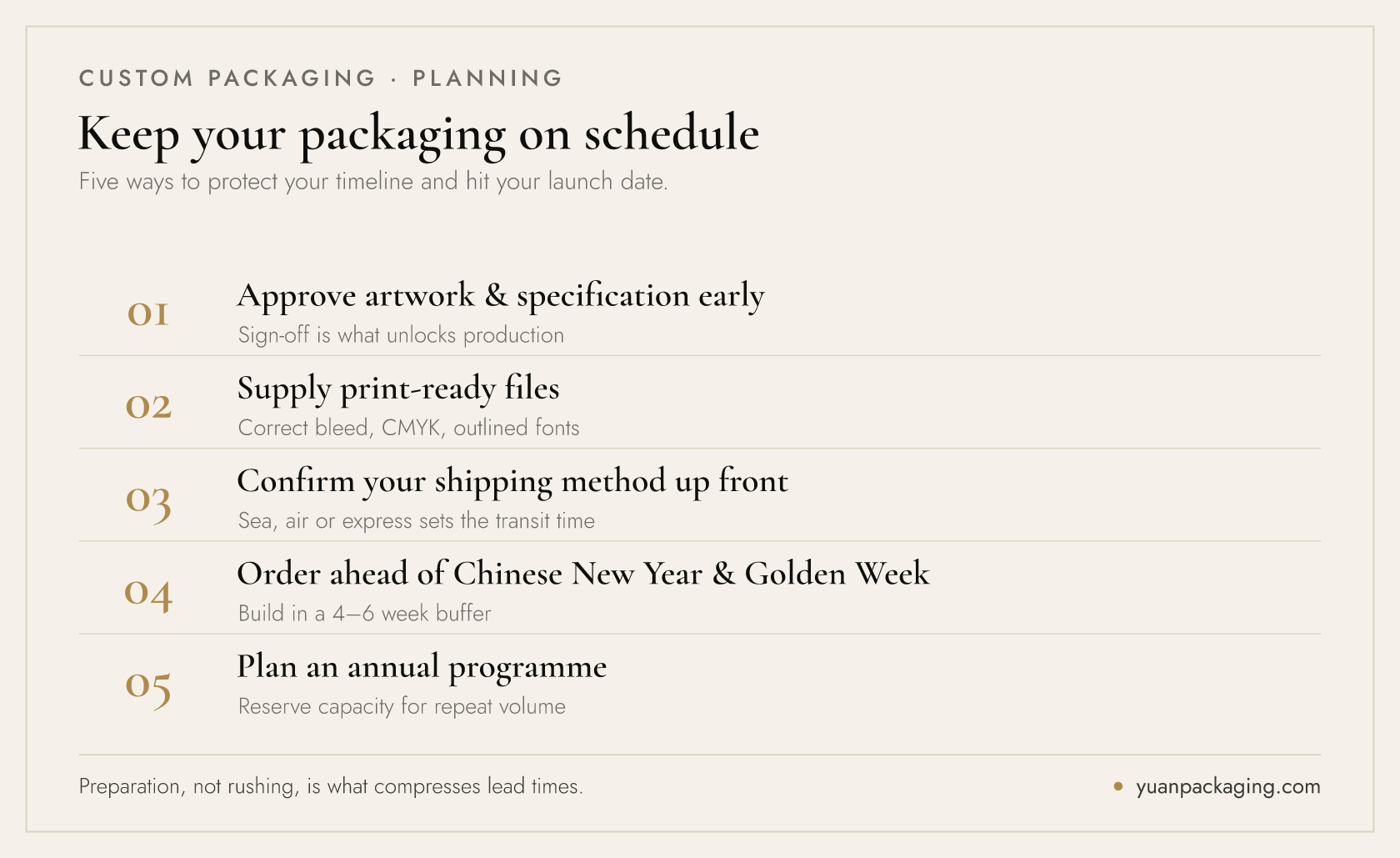
Several things add time to a packaging order: complex finishing combinations, multiple rounds of sampling, very large volumes, and changes to artwork mid-project all extend the schedule. The biggest external factor is seasonal — Chinese New Year (late January to February) and the National Day Golden Week (early October) pause most production in China. Orders that need to land before or during these periods should be placed well ahead; we advise building in a four-to-six-week buffer around Chinese New Year in particular.
How to keep your project on schedule
Keeping a packaging project on schedule comes down to preparation. Approve your specification and artwork early, supply print-ready files, and confirm your shipping method up front. For brands that order regularly, the most effective way to compress lead times is to plan ahead rather than rush each order — locking in your specification and forecasting volume lets production run smoothly without repeated set-up.
Annual programmes and reserved capacity
For repeat and high-volume buyers, an annual packaging programme is the strongest lever on lead time. Committing to a forecast volume across the year lets us reserve production capacity and hold material, so your orders are scheduled rather than queued. Our facility runs four dedicated production lines and is built for high-volume manufacturing — from 100,000-unit launches to multi-million-unit annual programmes — with a single point of contact coordinating timing from sampling to delivery. At scale, predictable lead times become part of the supply agreement.
Summary
The practical takeaway: plan your packaging timeline backwards from your launch date, allow time for sampling and shipping, and supply correct artwork to avoid the most common delays. If you would like a precise production and shipping timeline for your specific packaging — and to understand how an annual programme could shorten it — tell us about your project and we will map the schedule against your target delivery date.
Frequently Asked Questions
How long does custom packaging take from China?
As a guide, allow about four to eight weeks for production once artwork and samples are approved, plus shipping — roughly four to six weeks by sea, one to two weeks by air, or three to seven days by express courier. A typical door-to-door timeline is two to twelve weeks depending on product, finishing, volume and shipping mode.
What is the fastest way to get custom packaging?
Approve artwork and samples quickly, choose a simpler finish, and ship by air freight or express courier. Digital printing suits small rush runs with minimal set-up. For repeat specifications, skipping the sampling stage and pre-booking capacity through an annual programme is the fastest route.
How does Chinese New Year affect packaging lead times?
Most factories in China pause for Chinese New Year (late January to February) and the October Golden Week, and capacity is tight immediately before and after. Place orders that must land around these periods four to six weeks earlier than usual to allow a buffer.
Can production start before I approve a sample?
No — structure, colour and finish are confirmed on an approved sample and print-ready artwork before production begins, which protects you from a costly reprint. Sampling and artwork can run in parallel to save time, and repeat orders of an approved specification can skip sampling.