
A premium gift card box must protect the card, present the brand, and turn a flat piece of plastic into an object worth pausing over. The three levers that decide whether it succeeds are structure, material, and finish. Start now by sending your manufacturer a one-page brief and a physical card sample so tolerances get built in from the first mockup, not fixed after a failed sample run.
**TL;DR:** Proper die-line clearance of 0.5 to 1.0 mm is essential to prevent warping and fitting issues during large-scale production. Recyclable premium boxes should use mono-material rigid board with water-based finishes, avoiding plastic laminates that hinder recyclability. Finishes like soft-touch lamination, foil stamping, embossing, and Spot UV significantly enhance perceived luxury at relatively low additional cost. Structural formats should match the retail context, with drawer, magnetic closure, or tuck-top options aligning with customer interaction and speed requirements. Precise specifications, including dimensions, materials, and finishes, are necessary upfront to minimize costly revisions and ensure consistent quality.
Yuanpackaging
Explore Yuan Packaging
Table of Contents
- What Makes Gift Card Box Design Work for Retail
- Materials and Finishes That Signal Premium Quality
- Inserts That Protect the Card and Elevate the Reveal
- Choosing Recyclable Materials Without Losing the Premium Look
- Production Specs and Quality Checks Procurement Should Require
- What Drives Cost, MOQ, and Lead Time on Custom Boxes
- The RFQ Checklist That Cuts Revision Cycles
- What Twenty-Five Years of Box Runs Have Taught Us
- Request a Sample or Quote for Your Gift Card Box
- Sources
- FAQ
What Makes Gift Card Box Design Work for Retail
Every structural decision should trace back to how the box behaves on a shelf and in a customer’s hands. Nearly all brand owners in a recent L.E.K. Consulting survey said packaging is highly important to brand success, and beauty and personal care brands rated it especially critical. That’s not a marketing platitude. It means the format you choose for gift card packaging carries real commercial weight, not just aesthetic weight.
Match the format to the retail context:
- *Drawer boxes** suit slow, deliberate reveals at checkout counters or gift sets, where the customer has a moment to interact.
- *Magnetic closure boxes** work best when the card is a hero product on open shelving. The lid stays flush, and the reveal feels intentional.
- *Tuck-top or sleeve formats** fit high-volume retail where speed and footprint matter more than ceremony.
Order your priorities before you brief a designer: brand signifiers (logo, color, texture) come first, unboxing sequence second, and visual hierarchy on the outer face last. A box that opens well but reads as generic on the shelf wastes the structural investment.
**Pro Tip:** _Test your box footprint against actual shelf depth before finalizing dimensions. A drawer box that’s 3 mm too deep for a standard gondola shelf gets pushed to the back room, no matter how good it looks._
Materials and Finishes That Signal Premium Quality
Board weight is the first thing a customer’s hand registers, often before their eyes process the design. Rigid board in a substantial thickness range delivers the feel that separates premium gift card packaging from a folding carton trying to punch above its weight.
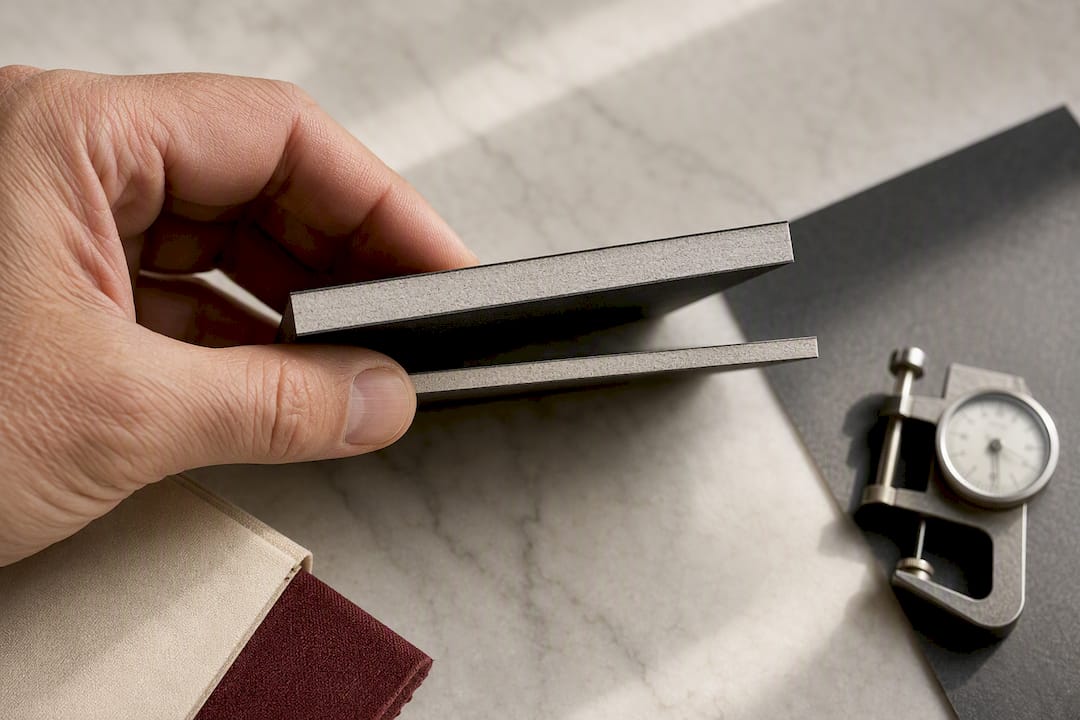
Consumers form quality judgments in under 50 milliseconds, and tactile finishes drive much of that snap decision, according to reporting on premium packaging trends. That statistic should reframe how you allocate a finishing budget: the difference between a forgettable box and a memorable one is often decided before anyone reads the copy.
Four finishes do most of the perceptual heavy lifting:
- *Soft-touch lamination** gives a velvet-like hand feel that reads as luxury on contact.
- *Foil stamping** adds metallic accents that catch light on shelf, ideal for logo treatment.
- *Embossing** creates dimensional texture without adding ink cost.
- *Spot UV** highlights specific elements against a matte base for contrast without full-surface expense.
Structural customization rarely returns as much perceived value per dollar as a well-chosen finish. If your budget is tight, spend it on the surface, not the shape.
Inserts That Protect the Card and Elevate the Reveal
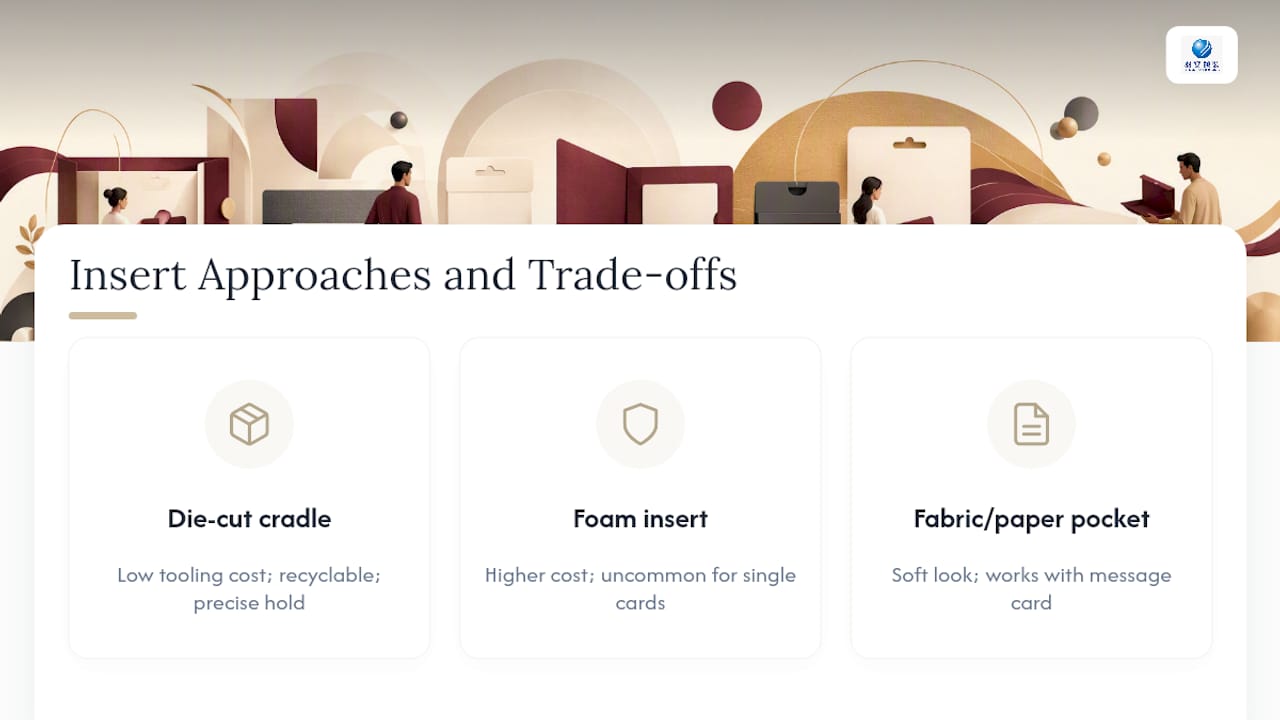
The card itself needs a home that holds it still without gripping so tightly that removal feels like a fight. Three insert approaches dominate gift card box design, and each carries different cost and durability trade-offs.
A **die-cut board cradle** is the most common choice for mid-volume runs. It’s inexpensive to tool, recyclable when paired with the right board, and precise enough to keep the card from rattling in transit. **Foam inserts** cost more and rarely make sense for something as thin and light as a gift card, though they show up occasionally in combination gift sets. A **bonded fabric or paper pocket** adds a softer visual layer and works well when you’re including a printed message card alongside the gift card itself.
Adding a brand message card is one of the easiest ways to extend the unboxing moment, and it rarely complicates production if you size it to the same die-line as the card cradle.
Tolerance is where most first samples fail. Specify **0.5 to 1.0 mm of clearance** on the cradle die-line to account for board swell during lamination and printing. Skip this step and you’ll get a sample that fits perfectly on day one, then warps just enough to jam during a full production run.
Choosing Recyclable Materials Without Losing the Premium Look
Sustainability and premium presentation aren’t opposing goals anymore. Mono-material rigid board constructions now hold up visually against mixed-laminate alternatives, and brands using them can claim genuine recyclability, per industry coverage of packaging trends.
If recyclability is a hard requirement, avoid PE or PP film laminates entirely. An aqueous, water-based varnish can mimic the soft-touch feel of lamination when applied correctly, without contaminating the recycling stream.
- Specify mono-material board and avoid mixed-plastic film laminates.
- Ask for FSC chain-of-custody documentation, not just a logo on the quote.
- Request a sample recyclability statement in writing before approving production.
**Pro Tip:** _Ask your supplier for the specific varnish or coating name on the quote, not just “eco-friendly finish.” Vague language on a purchase order is where sustainability claims quietly fall apart._
Production Specs and Quality Checks Procurement Should Require
A supplier can’t quote accurately, let alone manufacture accurately, without a complete spec sheet. Before you send an RFQ, lock down these details:
- *Die-line and final dimensions**, including any tolerance range for the card cradle.
- *Board GSM or ply thickness**, specified for both the outer shell and any insert.
- *Pantone color calls** for every printed element, not just the primary brand color.
- *Finish specifications**, naming the exact lamination, foil type, or coating.
Once specs are locked, the prototype sequence should move from a digital mockup to a physical sample to a pre-production approval round, each stage catching problems the previous one couldn’t. Require crush-resistance testing and finishing-uniformity checks before the sample is approved, and insist on a pre-shipment inspection report before the full order leaves the factory floor.
What Drives Cost, MOQ, and Lead Time on Custom Boxes
Unit cost climbs fastest with three variables: board thickness, the number of finishes stacked on one surface, and any custom insert beyond a basic cradle. A magnetic closure box with foil stamping and a bonded pocket insert costs meaningfully more per unit than a tuck-top box with a single spot UV hit, even at identical volumes.
Minimum order quantities for custom rigid boxes typically run from a few hundred to a few thousand units, depending on the manufacturer and the complexity of the tooling. Smaller sampling runs are usually negotiable outside the standard MOQ, which matters if you’re testing a design before committing to a full production order.
Premium finishes and consistent design execution measurably lift perceived brand value, based on analysis of packaging’s role in brand equity, which is worth remembering when a finish adds a few cents to unit cost.
Expect lead time in phases: quoting and spec finalization, tooling, sampling, full production, and shipping. Each phase can shift depending on finish complexity and factory backlog, so build buffer time into your retail launch calendar rather than working backward from a fixed date.
The RFQ Checklist That Cuts Revision Cycles
A tight brief eliminates most of the back and forth that stalls a project. Include these items on a single page before you send anything to a supplier:
- SKU use-case (retail shelf, gift set, direct-to-consumer mailer).
- Final dimensions and expected sell price band.
- Sustainability targets, stated specifically (mono-material, FSC-certified, recyclable coating).
- Sample policy: how many rounds are included before charges apply.
Ask suppliers directly who owns the tooling once it’s built, how long a physical sample takes to produce, what certifications they can document rather than just claim, and what their inspection procedure looks like before shipment. A supplier who can’t answer the tooling-ownership question clearly is a red flag worth taking seriously.
**Pro Tip:** _Send the physical card sample with your brief, not just its dimensions on paper. Pairing a concise brief with an actual sample measurably shortens sampling iterations because the factory isn’t guessing at tolerances._
What Twenty-Five Years of Box Runs Have Taught Us
Most design failures we see at Yuan Packaging aren’t creative failures. They’re tolerance failures that surface only after a client has already committed to a print run. Across more than 100 million units delivered to brands worldwide, the pattern repeats: a cradle that fit the first sample perfectly but warped under production lamination, or a finish that looked flawless on a flat proof and cracked along a fold line at scale.
The fix is almost always the same. Build clearance into the die-line before tooling, not after the first bad sample. We’ve also watched sustainability requests shift fast in the past two years, from a nice-to-have line item to a non-negotiable spec on the brief itself, especially among beauty and spirits clients where mono-material recyclable rigid boxes now compete directly with laminated designs on shelf appeal.
_— Anthony_
Request a Sample or Quote for Your Gift Card Box
If you’re comparing structural formats, finish combinations, and MOQ ranges from the sections above, the fastest way to know what actually works for your SKU is to get a physical sample in hand rather than guess from a spec sheet. Yuan Packaging manufactures bespoke rigid gift boxes with magnetic closure, drawer, and tuck formats, backed by prototyping support, sustainable and FSC-certified material options, and global logistics for brands shipping into retail.
Send a one-page brief with your target dimensions, sell price band, and sustainability requirements, along with a physical card sample if you have one, and a production team can turn that into a real prototype rather than a rendering. Explore the full rigid box product range or request a quote directly to start the sampling process on your next gift card program.
Sources
- The Power of Packaging: Brand Owners Point to the Crucial Role Packaging Plays in Brand Success | L.E.K. Consulting
- Confetti
- Premium packaging becomes a growth strategy for retailers - AOL
FAQ
How Long Does a Custom Gift Card Box Take to Produce?
Lead time runs through quoting, tooling, sampling, production, and shipping, and each phase varies with finish complexity and factory backlog, so build buffer time into your launch calendar.
What Is the Minimum Order Quantity for Rigid Gift Card Boxes?
MOQs for custom rigid boxes typically range from a few hundred to a few thousand units, though some manufacturers offer smaller sampling runs outside that standard range.
Which Finish Gives the Best Return for the Cost?
Soft-touch lamination and foil stamping generally deliver the most visible premium impact per dollar spent, outperforming costly structural changes to the box shape.
Can a Gift Card Box Be Both Premium and Recyclable?
Yes. Mono-material rigid board with an aqueous varnish coating can achieve a soft-touch feel while remaining fully recyclable, as long as PE or PP film laminates are avoided.
What Tolerance Should I Specify for a Card Cradle Insert?
Add 0.5 to 1.0 mm of clearance on the die-line to account for board swell during lamination and printing, which prevents tight-fit issues once production scales up.