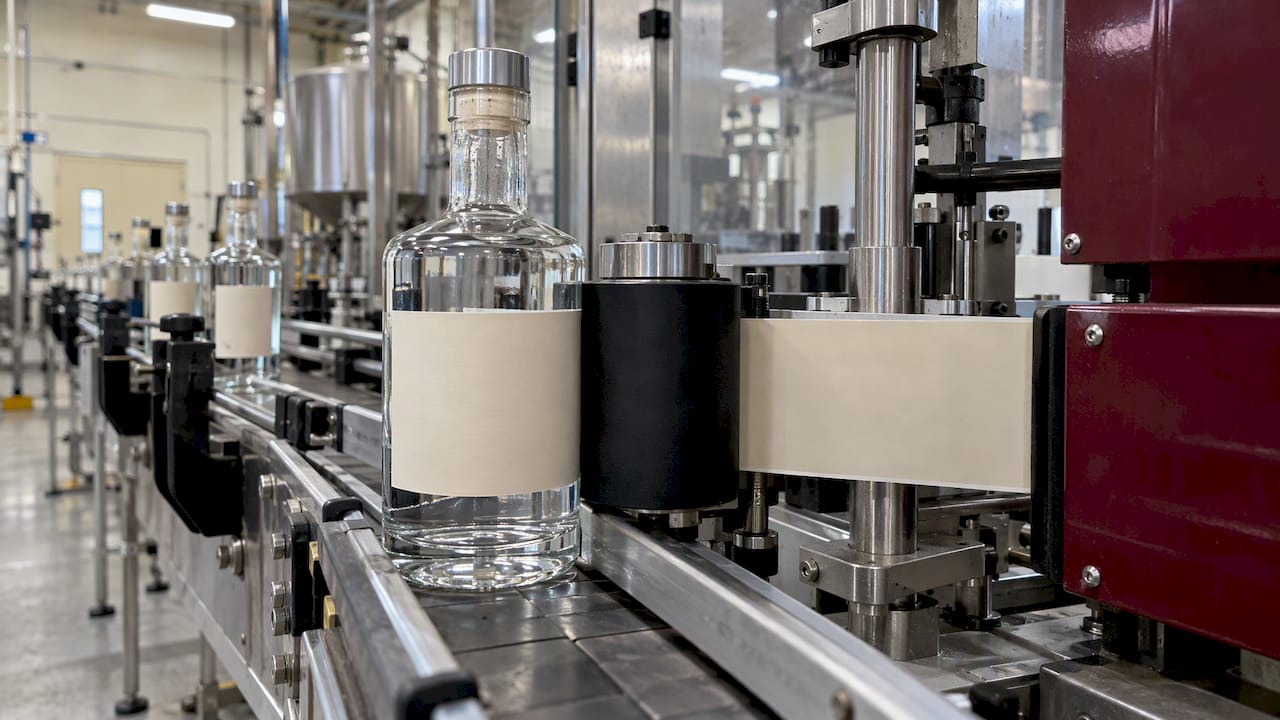
Spirits label regulations vary by country, but they share a core. A label must name the brand, state what the product legally is, declare its alcohol content, identify the bottler or importer, and show the net contents. In the United States, the Alcohol and Tobacco Tax and Trade Bureau (TTB) adds a mandatory health warning and, for most products, a label approval before bottling. This guide walks through those rules, then shows where the EU, the UK, Canada, and Australia and New Zealand diverge, and what it means for the people who design and print the label.
TL;DR
- In the US, 27 CFR Part 5 requires brand name, class/type and alcohol content in the same field of vision. Bottler or importer name and address and net contents may sit elsewhere on the container.
- A bottler generally needs a TTB Certificate of Label Approval (COLA) before bottling, with an exemption only for spirits that will not enter interstate or foreign commerce. Get it before you print a production run.
- The US "GOVERNMENT WARNING" is mandatory on beverages at 0.5% ABV or more, and TTB has a policy of not approving other countries' warning statements on the label, even alongside the US one.
- The EU, the UK, Canada, and Australia and New Zealand each have their own legal names, language, allergen and ingredient rules. One global label rarely passes everywhere.
- Treat the regulation as a design brief. Type size, placement, finishes and substrate all affect whether mandatory text stays legible.
Table of Contents
- What a US spirits label must show
- The US health warning statement
- Label approval: do you need it before bottling?
- What you cannot say: health and therapeutic claims
- How the rules differ outside the US
- Comparing the main markets
- Perspective: regulation is a design constraint, not an afterthought
- Turning compliance into a label that performs
- Working with Yuan Packaging
- A pre-print compliance checklist
- FAQ
- Sources
What a US spirits label must show
For distilled spirits sold in the US, the governing text is 27 CFR Part 5. Under current §5.63, the brand name, the class/type designation and the alcohol content must appear in the same field of vision. The name and address of the bottler, distiller or importer, and the net contents, may appear elsewhere on the container (eCFR, 27 CFR Part 5).
TTB's own overview of distilled spirits labeling lists the full set of items: brand name, class and type, alcohol content, an age statement where applicable, color-ingredient disclosures where applicable, a commodity statement where applicable, the health warning, name and address, net contents, and country of origin for imports (TTB, Distilled Spirits Labeling).
Mandatory items at a glance
| Item | What it means in practice |
|---|---|
| Brand name | The name the product is actually marketed under |
| Class/type | The legal designation, such as whisky, gin, vodka or tequila |
| Alcohol content | Declared on the label, in the same field of vision as brand and class/type |
| Name and address | Bottler, distiller or importer |
| Net contents | Volume of the container, which may sit away from the brand panel |
| Health warning | The statement required by the Alcoholic Beverage Labeling Act |
| Country of origin | Imported products |
| Conditional statements | Age, commodity, coloring and other disclosures, depending on the recipe |
Conditional disclosures
The second group is where labels most often go wrong, because the requirement depends on what is in the bottle. The current rule calls for statements covering:
- neutral-spirit percentage and commodity;
- coloring or wood treatment;
- age;
- state of distillation for specified whiskies;
- FD&C Yellow No. 5;
- cochineal or carmine;
- sulfites at 10 ppm or more;
- aspartame.
The source is again §5.63(c) of Part 5. If your liquid uses a natural colorant, a flavoring or a sweetener, check this list against the formula before the artwork is final, not after.
Where the statements can go
TTB states that the mandatory brand, alcohol-content and class/type information may appear on the front, back or side label. It does not have to be the panel facing the consumer on the shelf (TTB, Mandatory Label Information). That flexibility gives designers room: a clean front label with the legal block on the back is entirely workable, provided the grouping rule is respected.
The US health warning statement
The warning is mandated by the Alcoholic Beverage Labeling Act of 1988 and must appear on all alcohol beverages sold or distributed in the US containing not less than 0.5% alcohol by volume. It may sit on the front, back or side label (TTB, Health Warning Statement).
The formatting is strict:
- The statement must appear separate and apart from all other information.
- The words "GOVERNMENT WARNING" must be in capital letters and bold type.
- The rest of the statement must not be bold.
- It must run as a continuous paragraph.
TTB also notes that warning statements required by other countries may be confusing or misleading where they communicate different information, and says it is TTB's policy not to approve such statements on alcohol beverage labels, even in addition to the US warning. In practice, a product that ships to several markets needs a US-specific label version that carries only the US warning, rather than both warnings printed together.
Label approval: do you need it before bottling?
Generally, yes. A bottler must obtain a TTB Certificate of Label Approval before bottling distilled spirits, and an importer needs a certificate covering the spirits, either its own or one it is authorized to use, before removing bottled spirits from customs custody for consumption (27 CFR §§5.21–5.25). The bottler exemption in §5.23 covers only spirits that will not be sold or shipped in interstate or foreign commerce. TTB publishes a mandatory-information checklist and an interactive label anatomy tool, which are the most useful pre-checks before you submit.
The practical sequence looks like this:
- Confirm the class/type and any conditional disclosures from the formula.
- Build the artwork with the legal block, the warning and the alcohol statement positioned correctly.
- Submit for approval and wait for the certificate.
- Only then release the approved artwork to print and bottling.
Pro tip: Hold the premium finishing decisions (foil, embossing, a textured stock) until the approved artwork is locked. If the reviewer asks for a change, you do not want to rework a die or a foil plate.
What you cannot say: health and therapeutic claims
The other half of compliance is the copy. Under 27 CFR §5.129, a spirits label may not carry any health-related statement that is untrue or tends to create a misleading impression about the health effects of drinking. Health-related statements include curative or therapeutic claims, general references to health benefits and claims of nutritional value. TTB approves a specific health claim only if it is truthful, adequately substantiated by scientific or medical evidence and qualified as to whom it applies, discloses the health risks of both moderate and heavier drinking, and identifies the people for whom any drinking may be a health risk. Wellness language that is common on food and supplement packaging, such as "detox," "immune support" or "good for you," is therefore a risk on a spirits label. Run any such wording past a regulatory attorney or submit it through the approval process before it goes on a production run.
How the rules differ outside the US
If you export, the label is not portable. These are the main differences.
European Union
Spirit drinks on the EU market must follow the general food-information rules unless Regulation (EU) 2019/787 provides otherwise, and they must use the applicable legal name in their description, presentation and labelling. The general mandatory list for prepacked food includes the food name, allergens, net quantity, operator name and address, origin where applicable, and actual alcohol strength for beverages above 1.2% (European Commission, mandatory food information).
The EU also regulates presentation. Mandatory information must be conspicuous, easily visible, clearly legible and, where appropriate, indelible. The minimum x-height is generally 1.2 mm, reduced to 0.9 mm for packaging whose largest surface is below 80 cm². The name, net quantity and alcohol strength must sit in the same field of vision, and allergen names must be typographically emphasized when an ingredient list is given (European Commission, language and presentation). For a small bottle or a miniature, that 0.9 mm threshold shapes the whole layout.
United Kingdom
GOV.UK defines a spirit drink as an agricultural-ingredient beverage for human consumption with a minimum strength of 15% ABV, with egg liqueur at 14%. Great Britain and Northern Ireland differ: Great Britain uses sales denominations and retained category rules, while Northern Ireland uses legal names under the EU regulation. GOV.UK counts 47 categories in Great Britain and 44 in Northern Ireland (GOV.UK, Labelling spirit drinks).
Geographical indications such as Scotch Whisky or Irish Cream are protected, and additional requirements apply to Scotch Whisky. The same guidance says single-malt Scotch moved from Scotland to another country must be retail-ready labelled before it leaves Scotland.
Canada
Canadian alcoholic beverages fall under the Safe Food for Canadians Act and Regulations, the Food and Drugs Act and Regulations, and potentially the Spirit Drinks Trade Act, plus provincial rules (CFIA guidance). Common names must appear in English and French, and the CFIA lists many established spirit names, including bourbon, dry gin, Scotch whisky, tequila and mezcal, as bilingual common names (CFIA, language requirements).
Ingredient lists work differently from what many US producers expect. Standardized beverages, and specified unstandardized products such as Scotch whisky, Irish whisky, Cognac, bourbon, Tennessee whisky, tequila and mezcal, are exempt from an ingredient list, while other unstandardized products generally need a complete one (CFIA, list of ingredients). Allergens, gluten sources and added sulphites at 10 ppm or more must still be declared, even on exempt products (CFIA, allergens and added sulphites).
On accuracy, Health Canada's guidance on flavoured purified alcohol applies a ±0.5% tolerance between labelled and measured alcohol content for those products, and notes that a tolerance is also allowed for other alcoholic beverages such as spirits. For flavoured purified alcohol, a larger gap could be considered false, misleading or deceptive under the Food and Drugs Act (Health Canada guidance). For every alcoholic beverage at 1.1% or more alcohol by volume, the CFIA requires the alcohol content on the principal display panel, in English and French (CFIA, alcohol by volume declaration).
Australia and New Zealand
The Food Standards Code has a separate Standard 2.7.1 for labelling alcoholic beverages and food containing alcohol, and Standard 2.7.5 for spirits (FSANZ Food Standards Code compilation, May 2025). Under Standard 2.7.1, a spirits label must state the alcohol content (in mL/100 mL or as a percentage of alcohol by volume, accurate to within 0.5% alcohol by volume) and the approximate number of standard drinks, where one standard drink is 10 grams of ethanol. Beverages above 1.15% alcohol by volume for retail sale must also carry the pregnancy warning label, mandatory for beverages produced and labelled since the transition period ended on 31 July 2023 (FSANZ, pregnancy warning labels). Read both standards when you plan a label for these markets.
The international reference point
The OIV's 2022 international standard, written for spirituous beverages of vitivinicultural origin, lists sales denomination, alcoholic strength as a percentage at 20°C, nominal volume, batch, the responsible person and address, and whatever the selling country requires, especially allergens (OIV standard). It is a useful baseline, but the law of the selling country always governs.
Health warnings are not harmonized
A 2026 peer-reviewed study of the labelling rules of all 194 WHO Member States, based on a document review carried out in February 2023, found that 32.5% mandated alcohol health warnings (International Journal of Drug Policy, 2026). Expect the warning to be a market-by-market item, not a global constant.
Comparing the main markets
| Topic | US | EU | UK | Canada |
|---|---|---|---|---|
| Core rule | 27 CFR Part 5 | Regulation (EU) 2019/787 plus food-information rules | GOV.UK spirit-drink guidance, GB and NI differ | Several federal acts plus provincial rules |
| Pre-approval | COLA generally required before bottling | Not covered in this guide | Not covered in this guide | Not covered in this guide |
| Language | English | A language easily understood by consumers; member states may specify | English | English and French for mandatory information, such as common name and alcohol content |
| Allergens | Conditional disclosures such as sulfites at 10 ppm or more | Declared, emphasized when ingredients listed | Must be declared under general food-labelling rules | Declared, plus sulphites at 10 ppm or more |
| Health warning | Mandatory, at 0.5% ABV or more | No EU-wide warning; member states may add national rules | GOV.UK advises showing the low-risk drinking guidelines | Not federally required; CFIA accepts the US statement |
Use the table as a first screen only. Always confirm the current text with the regulator before sign-off.
Perspective: regulation is a design constraint, not an afterthought
We print spirits labels for brands that sell across several markets, and the same pattern repeats. The legal block is treated as something to squeeze in once the artwork is approved internally, and that is when the trouble starts. A warning statement set too small, a back label with no clear space, or a metallic foil laid over a mandatory line can all create a problem that costs more to fix than it would have to design around.

Our approach is to put the compliance text into the dieline from the first draft. We reserve a panel for the legal block, choose substrates and finishes that keep small type crisp, and test samples on the actual glass before a full run. Foil and embossing belong on the brand mark and the decorative elements, while the required statements stay on a clean, high-contrast area. We combine hand-finishing craft with automated production under one roof, so a change after label approval does not mean coordinating three suppliers.
If you are planning several market versions of one label, ask for the variants to be built from a single master file, with only the market-specific panel changing. It keeps the brand consistent and makes each regulatory review simpler.
— Anthony
Turning compliance into a label that performs
Once the required content is fixed, production choices decide whether it stays readable and attractive.
- Substrate and texture. A heavily textured stock can soften fine legal type. Our guide to textured paper labels explains how to choose premium stocks that still print sharply.
- Moisture. Bottles spend time in ice buckets and bar wells. See our notes on waterproof label printing for why sampling first matters.
- Neck and secondary labels. Additional panels can take brand storytelling and free space on the main label. Our neck label design guide covers production-ready layouts.
- Anti-counterfeit and traceability. Serialization and security features help protect premium spirits. Our anti-counterfeit labels and variable data labels pages describe the options, and our article on track and trace labels that survive lamination covers keeping codes scannable.
- The wider pack. Labels, boxes and carriers work as one system, which our wine and spirits packaging guide lays out. For a deeper look at the print process itself, read our label printing guide for premium spirits.
Working with Yuan Packaging
We manufacture custom wine and spirits labels with foil stamping, embossing and soft-touch finishes, along with rigid gift boxes, folding cartons and bottle carrier bags to match. Send us your approved or draft artwork, the target markets and the bottle size, and we will review where the mandatory text sits against the dieline and recommend a finish that protects legibility. You can see the full range on our products page. We do not give legal advice, so we work from the content your compliance team or regulatory advisor has confirmed.
A pre-print compliance checklist
- Confirm the legal class/type or sales denomination for each market.
- Check the formula against conditional disclosures: colorings, sulfites, sweeteners, age and commodity.
- Place brand, class/type and alcohol content in the same field of vision for the US.
- Set the health warning as a separate continuous paragraph, with "GOVERNMENT WARNING" in bold capitals.
- Check minimum type sizes for EU packs, particularly on small bottles.
- Review every phrase for implied health or therapeutic benefit.
- Secure label approval before releasing artwork to print.
- Approve a physical sample on the real bottle.
FAQ
Does every spirits label in the US need TTB approval?
Generally, a bottler must obtain a TTB Certificate of Label Approval before bottling distilled spirits, and an importer needs a certificate covering the spirits, either its own or one it is authorized to use, before the spirits are released from customs custody for consumption. The bottler exemption in 27 CFR §5.23 applies only to spirits that will not be sold or shipped in interstate or foreign commerce. Check 27 CFR §§5.21–5.25 or ask TTB if you think the exemption applies. Do not print a production run until the certificate is in hand.
Can the alcohol content go on the back label?
Yes, but not on its own. TTB allows the brand, alcohol-content and class/type information on the front, back or side label, and they must appear in the same field of vision. If the brand is on the front, the alcohol content and class/type should be there too, or all three should move together to another panel.
Can I use a UK or EU health warning on a bottle for the US?
No. The US requires the "GOVERNMENT WARNING" statement, and TTB's stated policy is not to approve other countries' warning statements on alcohol beverage labels, even in addition to the US warning, since they may communicate different information. Produce a US-specific label version.
Are the label rules the same for wine, beer and spirits?
No. In the US, spirits fall under 27 CFR Part 5, while wine is covered by Part 4 and malt beverages by Part 7. Each part has its own requirements, so a rule that applies to one category cannot be assumed for another.
Sources
- eCFR: 27 CFR Part 5, Labeling and Advertising of Distilled Spirits
- TTB: Distilled Spirits Labeling
- TTB: Mandatory Label Information
- TTB: Health Warning Statement
- TTB: Checklist of Mandatory Label Information
- TTB: Anatomy of a Distilled Spirits Label Tool
- eCFR: 27 CFR 5.129, Health-related statements
- EUR-Lex: Regulation (EU) 2019/787
- EUR-Lex: Regulation (EU) No 1169/2011 on food information to consumers
- European Commission: Mandatory food information
- European Commission: Language and presentation of food information
- GOV.UK: Labelling spirit drinks
- GOV.UK: Food labelling, giving food information to consumers
- CFIA: Labelling requirements for alcoholic beverages
- Health Canada: Guidance on flavoured purified alcohol
- Parliament of Canada, LEGISinfo: Bill S-202 (warning label on alcoholic beverages)
- FSANZ: Food Standards Code compilation, May 2025
- FSANZ: Pregnancy warning labels on alcoholic beverages
- OIV: International standard for the labelling of spirituous beverages
- International Journal of Drug Policy (2026): A comparison of labelling requirements for alcohol, tobacco, and cannabis across WHO regions and implications for alcohol labelling policy in Canada
Recommended
- Production Ready Neck Label Design for Spirits, Beauty & Lifestyle
- Wine & Spirits Packaging: Labels, Boxes & Carriers Guide
- Label Printing for Premium Spirits
- Custom Wine & Spirits Labels | Bottle Label Manufacturer
Does every spirits label in the US need TTB approval?
Generally, a bottler must obtain a TTB Certificate of Label Approval before bottling distilled spirits, and an importer needs a certificate covering the spirits, either its own or one it is authorized to use, before the spirits are released from customs custody for consumption. The bottler exemption in 27 CFR §5.23 applies only to spirits that will not be sold or shipped in interstate or foreign commerce. Check 27 CFR §§5.21–5.25 or ask TTB if you think the exemption applies. Do not print a production run until the certificate is in hand.
Can the alcohol content go on the back label?
Yes, but not on its own. TTB allows the brand, alcohol-content and class/type information on the front, back or side label, and they must appear in the same field of vision. If the brand is on the front, the alcohol content and class/type should be there too, or all three should move together to another panel.
Can I use a UK or EU health warning on a bottle for the US?
No. The US requires the "GOVERNMENT WARNING" statement, and TTB's stated policy is not to approve other countries' warning statements on alcohol beverage labels, even in addition to the US warning, since they may communicate different information. Produce a US-specific label version.
Are the label rules the same for wine, beer and spirits?
No. In the US, spirits fall under 27 CFR Part 5, while wine is covered by Part 4 and malt beverages by Part 7. Each part has its own requirements, so a rule that applies to one category cannot be assumed for another.