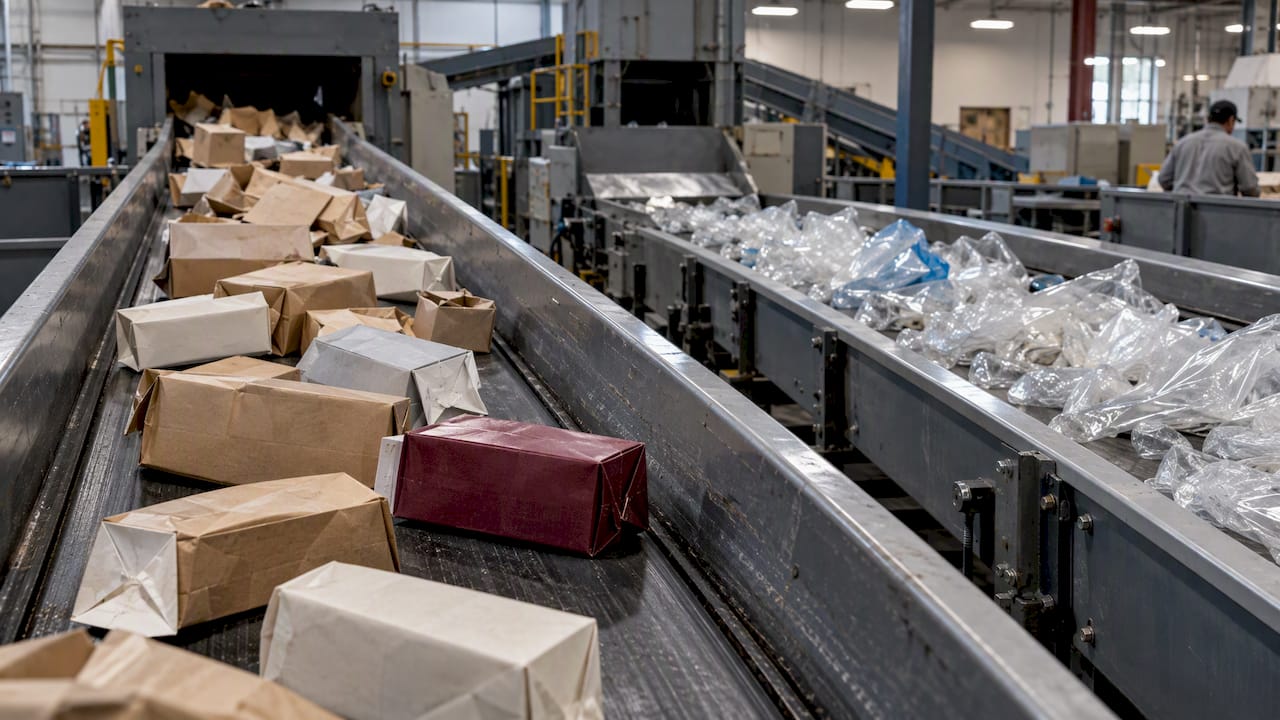
Mono material packaging is a pack built from a single material family, such as polyethylene (PE), polypropylene (PP) or paper fiber, so that a recycler can process it as one stream instead of separating bonded layers. In practice the term is looser than it sounds. Most so-called mono-material packs contain small amounts of other substances, and the real test is whether the main material dominates enough for the pack to be recycled well. This guide explains where that line sits, how it affects design choices and regulation, and what it means for premium beauty, spirits, food and pharmaceutical brands.
TL;DR
- Mono material means one dominant material family, not a single thin layer. Industry guidance puts the base polymer at roughly 90% or more of pack weight.
- Recycling is decided by the whole system: inks, labels, adhesives, coatings, closures and colors all count, not just the main substrate.
- The EU Packaging and Packaging Waste Regulation makes recyclability a market-access condition, with Grade C required by 2030 and Grade B by 2038.
- The hard part is performance: barrier, strength and shelf life. Premium brands also need to protect tactile finishes and print quality.
- Start with the pack's job and its end-of-life route, then choose the material and finishes that serve both.
Table of Contents
- What mono material packaging actually means
- Why the interest is growing
- The technical challenge: performance without laminates
- Recycling is a system, not a material choice
- Mono material design for premium brands
- How to know if your pack qualifies
- Perspective: where we see mono-material thinking pay off
- Choosing between mono-material routes
- Work with us on a mono-material brief
- FAQ
- Sources
What mono material packaging actually means
The plain definition is packaging made from one type of material. For plastics that means one resin family, for example all PE or all PP. For fiber-based packs it means paper or board with minimal non-fiber components.
The common misconception is that mono-material equals a single-layer structure. According to the Plastics Pact guidance on mono-material flexible packaging, these structures are often multi-layered to reach the barrier performance a product needs. What matters is that the base polymer (PE or PP) makes up at least 90% of total packaging weight, and that secondary materials such as EVOH, adhesives or metallization stay in low, strictly defined percentages, typically below 5%.
So a pack can have several layers and still be mono-material, provided every layer belongs to the same polymer family and the minor components stay within limits.
Mono material versus multi-material
| Feature | Multi-material laminate | Mono-material structure |
|---|---|---|
| Composition | Different polymers, foil or paper bonded together | One polymer family (or fiber) with minor additions |
| Recycling | Layers are difficult to separate, so often sent to disposal | Can enter a single recycling stream where collection exists |
| Barrier performance | Established, each layer solves one problem | Improving, but needs engineering |
| Design freedom | Wide | Narrower, with rules on colors, coatings and attachments |
| Regulatory outlook | Increasingly exposed | Better aligned with recyclability requirements |
The table simplifies. A multi-material pack is not automatically unrecyclable, and a mono-material pack is not automatically recycled. Collection, sorting and processing infrastructure in the pack's selling region decides the outcome.
Why the interest is growing
Two forces push brands toward mono-material design: regulation and recycler economics.
On regulation, the EU's Packaging and Packaging Waste Regulation (PPWR), which applies from 12 August 2026, requires packaging to be designed for recycling from 2030 and recycled at scale from 2035 (both dates move later if the Commission's detailed rules are delayed). From 2030, packaging below Grade C recyclability is treated as technically non-recyclable and may not be placed on the EU market; from 2038, the minimum is Grade B. That turns mono-material design from a voluntary sustainability project into a compliance question for any brand shipping to Europe. We cover the printer's side of this in what packaging printers need to know about the EU PPWR.
On economics, recyclers want clean, predictable bales. Mixed-material packs add sorting cost and lower the quality of recycled output, which is why design guidance from recyclability bodies keeps returning to the same principle: maximize the share of the main polymer and minimize components made of other polymers. The RecyClass Design Book lists exactly that among its key principles, right after choosing plastics with an EU recycling stream.
If you sell in the United States, the picture is different in detail. There is no federal equivalent of PPWR, and plastics design guidance there is led by industry bodies. Treat the EU rules as applying to EU sales, and check the requirements of each state and market you ship to.

The technical challenge: performance without laminates
Laminates exist because they work. A foil layer blocks oxygen and light, a polyester layer adds stiffness and print quality, and a sealant layer closes the pack. Removing them means asking one polymer family to do all three jobs.
A review in Nature Reviews Materials identifies barrier properties and structural integrity as the long-standing hurdle for mono-materials, and points to progress in orientation, blending and molecular engineering that lets these materials meet demanding food and pharmaceutical needs while staying compatible with mechanical recycling.
For a brand manager, this translates into a few practical questions to put to any supplier:
- What oxygen and moisture barrier does my product need over its shelf life?
- Does the proposed structure keep the base polymer above the recommended share of total weight?
- Have the components been checked against a recognized design guide for the target market?
- How does the structure behave on my filling and sealing line?
That last question is easy to forget. A mono-material film or board can seal at different temperatures than the laminate it replaces, so the pack and the filling line need to be developed together. Machinery makers that serve cosmetics design capping, labeling and filling equipment around container type, so involve line engineers before artwork is locked.
Recycling is a system, not a material choice
Choosing PE or PP is the first step, not the last. The same design principles apply even when the main material is a single polymer: keep labels small or remove them, favor clear unpigmented plastics, and avoid additives that contaminate the stream. The goal is recycled material good enough for high-value reuse, not just a pack that technically enters a recycling bin.
The components that quietly break a mono-material claim are usually these:
- Labels and sleeves. A full-coverage label in a dissimilar material adds contamination. Match the label face material to the pack where possible, or use a label sized and adhered so it separates cleanly.
- Inks and coatings. Heavy coverage, metallic inks and some barrier coatings can affect the recycled output.
- Adhesives. Permanent adhesives that do not release in wash processes can leave residue.
- Colors. Dark or heavily pigmented plastics can be hard for sorting equipment to identify, and they limit what the recycled resin can become.
- Closures, pumps and springs. Metal springs and mixed-polymer pumps often sit outside the mono-material claim.
For paper-based packaging the same logic applies to different elements. The American Forest & Paper Association's design guidance for recyclability notes that paper-based packaging is recyclable, though some non-fiber elements, such as barrier coatings or adhesives, can affect recyclability in paper mills. It also reports a US corrugated recycling rate of 91.4% in 2021 and a paper recycling rate of 66.2% in 2019. Fiber has an established collection stream in the US, which is a real advantage for any pack that can be made predominantly from paper.
Mono material design for premium brands
Premium beauty and spirits packaging lives on touch, weight and finish. Those cues are exactly what mono-material rules put under pressure. Here is how to think about each one.
Substrate
If your product does not need a high gas barrier, such as many dry cosmetics, gift sets, tea, confectionery sleeves and candles, a fiber-based pack may be the most straightforward route to a single-material structure. Rigid boxes, folding cartons and paper tubes are all built from board and wrapping paper. Our materials and board types page lists the board options we work with, and the rigid box design guide walks through dielines and production rules.
Finishes
Finishes are where a premium pack either keeps or loses its recyclability story. Blind embossing and debossing add tactile depth without adding another material, so they sit comfortably in a mono-material brief. Foil stamping, plastic lamination and thick coatings deserve a second look. Our finishes overview shows the effects available, and our comparison of matte versus gloss lamination addresses glare, color and recyclability together.
Pro tip: Ask for the finish to be specified on the dieline from the first round. A late decision to add foil or a laminate can undo a recyclability claim you already printed in your sustainability report.
Labels
Labels are the smallest part of most packs and often the biggest recycling problem. A label that covers a whole bottle changes the composition of that bottle. For beauty brands, our cosmetic label printing range covers pressure-sensitive options, and a short conversation about face material and adhesive at the design stage costs far less than a redesign later.
Print and color
Keep ink coverage proportionate, avoid unnecessary metallic effects on the largest panels, and test the artwork on the actual substrate rather than a proof. Premium does not require maximum decoration. A single well-judged finish on a restrained pack often reads as more luxurious than five effects competing.
How to know if your pack qualifies
There is no single global certificate for the word mono-material. Instead, brands combine several checks:
- Composition audit. List every component (substrate, layers, inks, coatings, adhesives, labels, closures) with its weight.
- Compare to the threshold. Check that the main material meets the share recommended by your chosen guidance, commonly around 90% for polymer structures.
- Assess against a design guide. Use the RecyClass Design Book for EU-bound packs, and the Association of Plastic Recyclers design guide for North America.
- Verify collection. A pack is only as recyclable as the infrastructure where it is sold. Check whether the target market actually collects and sorts it.
- Test on the line. Run trials for sealing, scuffing, drop and shelf life before committing to volume.
- Word the claim carefully. Say what is true in the market it is true in, and avoid blanket recyclable claims.
Perspective: where we see mono-material thinking pay off
We make rigid boxes, folding cartons, labels, paper bags, tubes and hang tags for beauty, spirits, lifestyle, food and pharmaceutical brands. Our view is shaped by that work: for most of the premium packs that come through our facility, the biggest recyclability gains come from simplifying, not from adding a new material.
Brands often arrive asking for a sustainable version of a pack they already have. The useful first question is what each element contributes. A window patch, a plastic insert, a full lamination and a foil panel each have a reason, and each has a lighter alternative that is worth discussing. Because we handle structure, material, finishing and compliance under one roof, we can test those trade-offs on a sample before they become a production commitment.
We would also advise against treating mono-material as a badge. It is a design discipline: fewer materials, clearer separation, honest claims. A pack that does that well tends to look more confident too. For more on how this thinking is changing brand decisions, see why leading brands are rethinking packaging sustainability.
— Anthony
Choosing between mono-material routes
| If your product is... | Route to consider | Watch for |
|---|---|---|
| Dry or low-barrier (cosmetic sets, candles, accessories) | Fiber-based rigid box, folding carton or tube with minimal plastic | Laminates, foil, plastic windows and magnets |
| Liquid or oxygen-sensitive (food, some pharma) | Mono-polymer film or container engineered for barrier | Barrier layers above threshold, line compatibility |
| Retail carry (bags and totes) | Paper bag with fiber handles, or single-polymer non-woven | Mixed handle materials, heavy coatings |
| Bottle with label (spirits, beauty) | Label matched to the container material | Full-coverage dissimilar labels, metallic inks |
These are starting points rather than approvals. Always confirm against the guidance for the market where the pack will be sold.
Work with us on a mono-material brief
If you are redesigning a gift box, carton, label set or carrier bag around fewer materials, our team can review your current structure and suggest where to simplify without losing the premium feel. Browse the full product range, or look at our rigid gift box manufacturing and folding carton pages to see what we can produce.
FAQ
What is mono material in packaging?
It is packaging made predominantly from one material family, such as PE, PP or paper fiber. The pack may have several layers, as long as they belong to the same family and secondary materials stay within low limits. The purpose is to let recyclers process it as a single stream.
Is mono-material packaging always recyclable?
No. Recyclability depends on the full pack, including labels, inks, adhesives, colors and closures, and on whether the local collection and sorting system accepts it. A mono-material pack that is not collected where it is sold will not be recycled in practice.
Does mono-material packaging perform as well as laminates?
It can, but it takes engineering. Barrier and strength were the historic weak points, and recent research points to advances in orientation, blending and molecular design that narrow the gap. Test any structure against your product's shelf-life needs and your filling line.
Does mono-material design matter for packaging sold in the US?
Yes, but the drivers differ. The EU regulation sets legal recyclability grades for the EU market, while US design guidance mostly comes from industry organizations. Brands selling in both regions often design to the stricter standard to avoid maintaining two versions.
Sources
- Pathways to Mono-Material Flexible Plastic Packaging: Guidance Document
- Regulation (EU) 2025/40 on packaging and packaging waste
- Advances and technical challenges in mono-material plastics design for sustainability, Nature Reviews Materials
- AF&PA Design Guidance for Recyclability
- RecyClass Design Book: A Step-by-Step Guide to Plastic Packaging Recyclability
- APR Design Guide for Plastics Recyclability
Recommended
- Cosmetic Paper Tubes: Design, Closures and Recyclability
- Why Leading Brands Are Rethinking Packaging Sustainability
- 30/60/90 Day Compliance Plan for U.S. Packaging EPR Rules
What is mono material in packaging?
It is packaging made predominantly from one material family, such as PE, PP or paper fiber. The pack may have several layers, as long as they belong to the same family and secondary materials stay within low limits. The purpose is to let recyclers process it as a single stream.
Is mono-material packaging always recyclable?
No. Recyclability depends on the full pack, including labels, inks, adhesives, colors and closures, and on whether the local collection and sorting system accepts it. A mono-material pack that is not collected where it is sold will not be recycled in practice.
Does mono-material packaging perform as well as laminates?
It can, but it takes engineering. Barrier and strength were the historic weak points, and recent research points to advances in orientation, blending and molecular design that narrow the gap. Test any structure against your product's shelf-life needs and your filling line.
Does mono-material design matter for packaging sold in the US?
Yes, but the drivers differ. The EU regulation sets legal recyclability grades for the EU market, while US design guidance mostly comes from industry organizations. Brands selling in both regions often design to the stricter standard to avoid maintaining two versions.