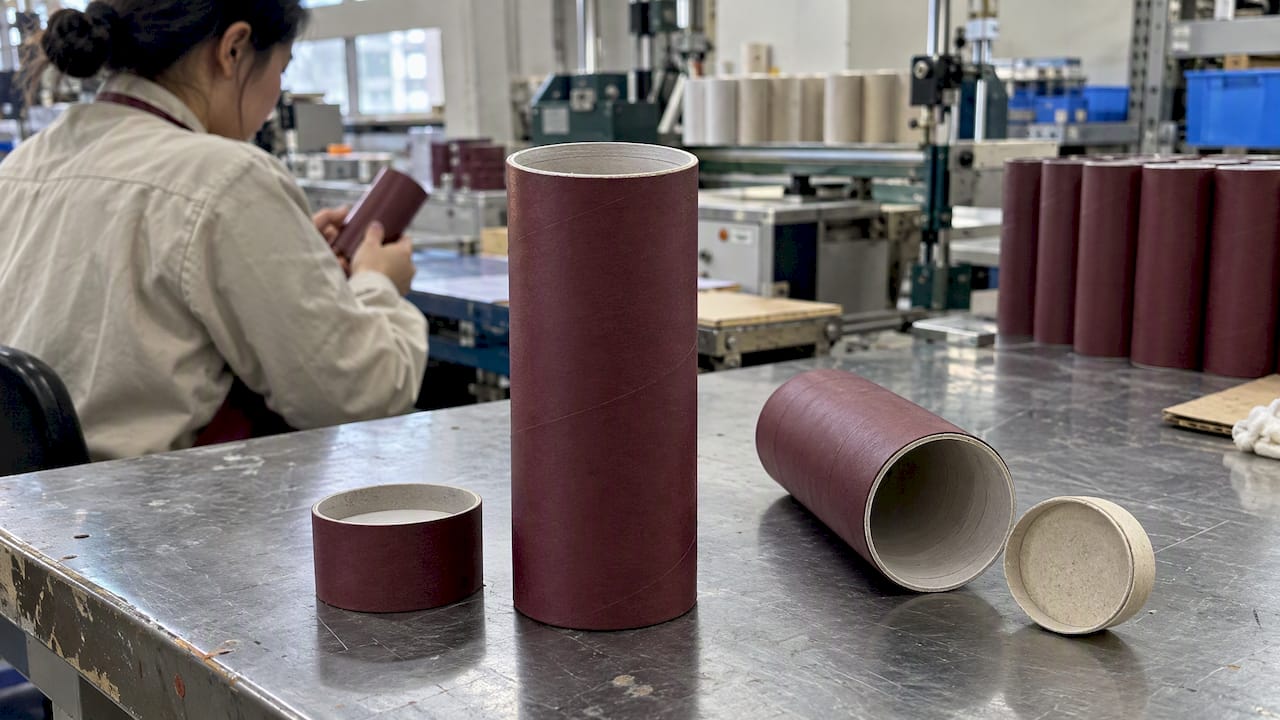
Cosmetic paper tubes are rigid cylindrical containers made from wound or rolled paperboard, used for everything from lip balm and deodorant to serum bottles, candles and gift sets. The material is easy to like, but the details decide whether a tube performs: the structure, the closure, what sits between the formula and the board, and whether the finished package can really be recycled. This guide walks through each decision in the order a brand team usually meets them.
TL;DR
- Choose the structure first (lid and base, push-fit cap, bottle tube or push-up), because it determines the closure, the fill method and the shipping weight.
- Paperboard is not a barrier to oils, waxes or fragrance. If the formula touches the board, you need a liner or coating, and that choice affects recyclability.
- "Paper" does not mean "recyclable." Metallized foils, heavy colorants, plastic linings and non-fiber caps can get the whole package rejected.
- Refillable formats work best when the refill is the same size as the original and drops into a durable outer tube.
- Order a physical sample and a dieline check before any production run; paper tubes are unforgiving about tolerances.
Table of Contents
- What a cosmetic paper tube actually is
- Closures and end caps: where the tube succeeds or fails
- Designing the tube: a practical sequence
- Barriers, migration and formula compatibility
- Recyclability: what you can honestly claim
- Refillable cosmetic packaging in paper
- Our perspective
- Specifying a tube with Yuan Packaging
- Choosing between a tube, a carton and a rigid box
- FAQ
- Sources
What a cosmetic paper tube actually is
The term covers several constructions that behave very differently. A spiral-wound or convolute-wound body gives the tube its wall strength, a printed wrap covers the outside, and a base, shoulder or cap completes the pack. Some tubes are purely secondary packaging: a paper cylinder that holds a glass bottle, a jar or a candle. Others are primary packaging that holds the product itself, such as lip balm, solid perfume or a deodorant stick.
That difference matters more than any other. A secondary tube is an exercise in appearance, protection and unboxing. A primary tube is also a formula-compatibility problem, which is where most of the technical risk sits.
Common structures for beauty brands include:
| Structure | Typical use | What to watch |
|---|---|---|
| Lid and base tube | Gift sets, candles, jars, multi-item kits | Lid fit and ease of opening; a tight fit can scuff printed surfaces |
| Push-fit cap tube | Single items, samples, small bottles | Cap tolerance and friction; the cap should seat cleanly without bulging the body |
| Bottle paper tube | Serums, oils, toners, fragrance | Internal fit and inserts that stop the bottle rattling |
| Candle and cosmetic tube | Candles, balms, solid products | Heat, oils and residue contacting the board |
Closures and end caps: where the tube succeeds or fails
People searching for paper tube end caps and closures are usually trying to solve one of three problems: the tube will not stay shut, it will not open smoothly, or the closure undermines the sustainability story. Each has a different fix.
Matching the closure to the product
A friction-fit cap suits dry or low-risk products and is the simplest option. A lid-and-base construction gives a more ceremonial opening, which is why it dominates gift sets and fragrance. Where the contents can leak, a tube is rarely the primary container on its own: a bottle or jar sits inside, and the tube provides the presentation and protection.

For primary tubes holding balms or sticks, the closure needs a liner or inner seal that matches the formula, and the cap must be sized to the real wall thickness after printing and lamination, not the nominal one. Coatings and laminates add thickness, and a cap that fit on a bare sample can bind once soft-touch lamination is applied.
Fiber-based caps and shoulders
Historically, a paper tube that needed to hold product often depended on a plastic shoulder or cap for structural integrity. That is changing. As of February 2026, fiber-based tube designs such as the PaperX FiberTop use fiber shoulders and caps, reach over 85% paper content and are designed to meet the CEPI/4evergreen 2025 recyclability guidelines. The developers report up to 87% less plastic and up to 65% lower carbon emissions than traditional Polyfoil or COEX tubes, so treat those figures as the supplier's own claims for that specific design, not an industry average.
The broader picture is more cautious. Pact Collective notes that truly circular solutions need fiber-based closures and mono-material constructions, yet these remain early in broad commercial scalability compared with traditional rigid tubes. If your brief says "fully recyclable," ask for the closure construction in writing before you commit to the claim.
Designing the tube: a practical sequence
Paper tube packaging design goes wrong most often when artwork is created before the physical specification is settled. This order avoids rework.
- Define the contents and their chemistry. Is the formula water-based, oil-based, waxy, fragranced or powder? This decides whether any barrier is needed.
- Fix the interior dimensions. Measure the product or inner container with its cap, label and any tolerance, then add room for inserts.
- Select the structure and closure. Use the table above; confirm how the pack is filled, whether by hand or on a line.
- Choose the board, wrap and finish. Wall thickness, paper stock and finish such as soft-touch lamination, foil stamping or blind embossing each change the feel and the cost.
- Build the dieline. The printed wrap must account for overlap, seam position and the curve of the cylinder. Keep key artwork away from the seam.
- Approve a physical sample. Check fit, closure feel, color on the actual stock and how the pack looks on a shelf and in a shipper carton.
- Plan the outer pack. A cylinder ships differently from a box, and damaged rims are a common transit failure. Corrugated shippers or inserts should be part of the spec from the start.
Pro tip: Put the seam where the consumer will not see it on the shelf, and align it with the back of the pack. It is a small decision that makes a tube look considered rather than assembled.
Finishes that work on curved surfaces
A cylinder invites tactile finishes. Soft-touch lamination gives a velvety hand that suits skincare. Foil stamping and embossing add luxury cues, but they have recyclability consequences discussed below. Matte uncoated stocks with a single spot color are the lowest-impact way to look premium, and they photograph well for e-commerce.
Barriers, migration and formula compatibility
This is the part many paper tube listings skip. Standard paperboard does not act as a functional barrier. Guidance on printing inks for paper and board packaging notes the need for compliant materials and good manufacturing practice, and in practice that means low-migration inks and verified barriers where the board contacts the formulation. Oils, waxes and volatile fragrance compounds can interact with the board, and mineral oils can also transfer from recycled pulp or external printed surfaces.
In practical terms:
- Dry or solid products in a closed inner pack: the paper tube is secondary packaging and needs no barrier.
- Oils, balms and fragranced products in direct contact: specify a compatible liner, film or coating and ask the supplier to confirm it is suitable for your formula.
- Products that need a regulatory file: involve your safety and regulatory team before choosing inks and coatings, not after.
The trade-off is real: the barrier that protects your formula is often the thing that complicates recycling. Decide which risk you are prepared to carry, and make marketing claims match the construction.
Recyclability: what you can honestly claim
The most common sustainability mistake with cosmetic paper tubes is over-promising. Pact Collective's guidelines point out that many cosmetic paper tubes fail recycling criteria because of product residue or mixed materials such as moisture-barrier coatings, metallized foils or plastic linings. Its advice is to prefer clean, single-material designs and give consumers clear end-of-life instructions.
The ELIPSO/FEBEA guide makes a related point: recyclability is judged on the whole package system, not the body material alone. A paper body with a plastic cap or a metallized finish can still be rejected by sorting and recycling streams.
Researchers at Technikum Wien, writing about the DACH cosmetics market, link recyclability problems to incompatible material combinations, including excessive colorants and metallization on paper substrates, under growing pressure from rules such as the EU PPWR.
A claims checklist
Before a tube goes to print with a recyclability statement:
- Is the body, liner, cap and adhesive system compatible with paper recycling, or only the body?
- Are foils, metallic inks or heavy flood colors used? If so, what share of the surface do they cover?
- Will residue from oily products affect recovery, and does the pack carry end-of-life instructions?
- Are you making the claim for the market where the pack is sold? Collection rules differ between the US, the EU and other regions.
If you sell in Europe, our note on what the EU PPWR means for packaging printers covers the regulatory background. In the US, check the current guidance of the recycling programs where your customers live, since acceptance varies by municipality.
Refillable cosmetic packaging in paper
Refill is one of the fastest-moving ideas in beauty, and paper tubes fit it naturally: a durable, well-finished outer tube is kept, and a lighter refill replaces the consumable part. Beauty Packaging reports that Smithers sees cosmetics and personal care as one of the most promising segments for refillable packaging. It also notes that in-store refill stations have limited reach in e-commerce, and that the most promising growth is refills the same size as the original that fit into the same base unit.
That last point is the design brief for paper. A few principles help:
- Make the outer tube worth keeping. A refillable pack only reduces waste if people keep using the shell. Tactile finishes, a satisfying closure and a shape that sits well on a vanity all help.
- Standardize the interior. The refill cartridge, jar or stick should seat in a defined cavity with a snug insert, so there is no wobble and no mismatch across product generations.
- Keep the refill simple. A refill built from one material is easier to recycle than one stacked with foil and plastic.
- Say how it works on the pack. A small diagram of the swap does more for adoption than a paragraph of claims.
Broader industry activity points the same way. The Pulp in Action consortium, reported in February 2026, brings together 50 players to develop alternatives to plastic cosmetics packaging. Whether pulp, molded fiber or wound paper wins in each category will depend on formula demands and recovery systems, so keep specifications flexible.
Our perspective
We have spent more than 25 years making labels, rigid gift boxes and paper packaging for beauty, spirits and lifestyle brands, and our view on paper tubes is shaped by what goes wrong on the production floor rather than on a mood board.
First, a tube is a precision object disguised as a simple one. The gap between a cap that glides and a cap that sticks is a fraction of a millimeter, and it moves with every layer you add: paper wrap, lamination, foil. We recommend finalizing the finish before locking the closure tolerance, and approving a sample that has been through the full finishing process, not a plain white mock-up.

Second, we would rather help a brand make a smaller, accurate claim than a larger one that does not survive scrutiny. If a design includes a foil band, a plastic liner or a non-fiber cap, the honest description is "paper-based," not "fully recyclable." Brands that choose the accurate wording tend to save themselves a difficult conversation later with retailers and regulators.
Third, because we combine hand-finishing craft with automated production in one facility, we can usually advise on a tube, its matching carton or rigid box, and its label as a single system. That matters for cosmetic launches, where a tube, a gift set and a carrier bag need to share color, texture and a recycling story.
— Anthony
Specifying a tube with Yuan Packaging
If you are comparing structures, our custom paper tubes and cylinder boxes range covers lid-and-base, push-fit, bottle and candle formats, and our team can pair them with cosmetic label printing or a rigid gift box for set launches. Pricing is quoted per project and is not published, so bring your product dimensions, formula type, target quantities and market, and we will work through structure, finish and claims with you. You can also see everything we make on our products page, or read how we approach the category in our industry overview for cosmetics and beauty packaging.
Choosing between a tube, a carton and a rigid box
A tube is not always the right answer. Use this as a quick filter:
- Tube: best for cylindrical or bottle-shaped items, solid sticks, candles and products where a distinctive silhouette helps shelf recognition.
- Folding carton: best for high-volume retail where efficient storage and shipping matter; see custom folding cartons.
- Rigid box: best for gift sets and prestige products where the box itself is part of the experience. Our comparison of rigid boxes and folding cartons sets out the trade-offs.
For a wider view of the whole packaging system, the complete guide to cosmetic packaging for beauty brands is a good next read.
FAQ
Are cosmetic paper tubes recyclable?
Sometimes. A tube made of a single fiber material with no foil, plastic liner or plastic cap has the best chance, but recyclability depends on the entire package and on local collection. Pact Collective notes that many cosmetic paper tubes fail criteria because of residue or mixed materials. Ask your supplier for the full construction before making a claim.
Can a paper tube hold lip balm or other oil-based products directly?
Only with the right protection. Paperboard is not a functional barrier to oils, waxes or fragrance compounds, so direct-contact formulas generally need a compatible liner or coating and low-migration inks, as industry ink guidance indicates. Test your formula with the exact construction before launch.
What closure is best for a cosmetic paper tube?
It depends on the product. A push-fit cap suits single items and samples, a lid-and-base format suits gift sets and jars, and a fiber-based cap or shoulder is the route for brands that want to reduce plastic. Always size the closure against the finished, laminated tube, not a bare sample.
Can paper tubes work for refillable beauty products?
Yes, particularly when the outer tube is a durable, well-finished shell and the refill is the same size as the original so it drops straight in. Beauty Packaging describes this as the most promising area of refill growth. Keep the refill to a single material where you can.
Sources
- Pact Collective: guidelines
- Pact Collective: sourcing smart packaging and materials
- Guidance for the use of printing inks for paper and board food-contact packaging
- ELIPSO/FEBEA guide on recyclability of cosmetic packaging
- Assessment of sustainability indicators for cosmetic product packaging in the DACH region
- Beauty Packaging: Beauty shifts into Refill 2.0
- Industries Cosmétiques: Pulp in Action
Recommended
Are cosmetic paper tubes recyclable?
Sometimes. A tube made of a single fiber material with no foil, plastic liner or plastic cap has the best chance, but recyclability depends on the entire package and on local collection. Pact Collective notes that many cosmetic paper tubes fail criteria because of residue or mixed materials. Ask your supplier for the full construction before making a claim.
Can a paper tube hold lip balm or other oil-based products directly?
Only with the right protection. Paperboard is not a functional barrier to oils, waxes or fragrance compounds, so direct-contact formulas generally need a compatible liner or coating and low-migration inks, as industry ink guidance indicates. Test your formula with the exact construction before launch.
What closure is best for a cosmetic paper tube?
It depends on the product. A push-fit cap suits single items and samples, a lid-and-base format suits gift sets and jars, and a fiber-based cap or shoulder is the route for brands that want to reduce plastic. Always size the closure against the finished, laminated tube, not a bare sample.
Can paper tubes work for refillable beauty products?
Yes, particularly when the outer tube is a durable, well-finished shell and the refill is the same size as the original so it drops straight in. Beauty Packaging describes this as the most promising area of refill growth. Keep the refill to a single material where you can.